We love villains and scapegoats.
What we have here is a systemic cultural illness symbolized by “The Orange Plague,” we must look beyond our clownish dark tetrad POTUS scapegoat—beyond assigning responsibility to individual political figures or popular sensationalism—and instead examine the basic mechanisms of “Uncle Sam Inc.” American culture constantly celebrates the Dark Tetrad traits, raising hyper-militarized technology, financialized extraction, and violent spectacle to the status of worshiped ideals. To break the cycle of automated cultural reproduction, in which people passively repeat these damaging patterns on social media and in interactions with AI chatbots, we must use three separate but deeply interconnected cognitive abilities: recursion, critical thinking, and moral self-examination. I know, it sounds like a lot of work with little swipping and fingering of screens. But nonetheless, we need to do the work.
Uncle Sam Inc. thinks it runs the world.

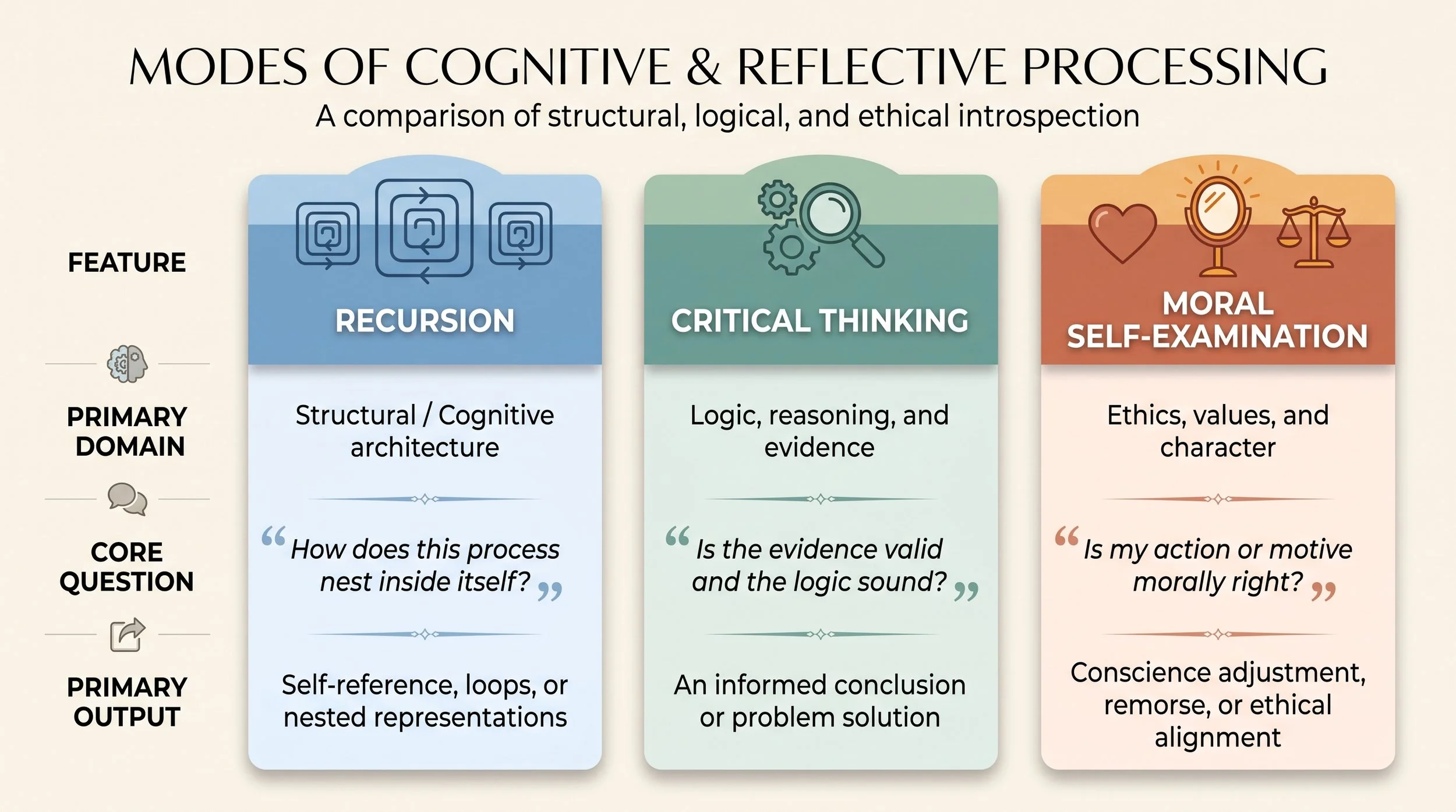
At the most fundamental level, recursion acts as the mind’s system of procedures. It is a formal process in which a rule, thought, or operation is applied to its own output or incorporated into itself, forming the mental framework necessary for complex syntax, the sense of self, and the capacity to imagine oneself over time. Recursion is inherently value-neutral because it makes no moral judgments or attempts to establish objective truth; instead, it offers the basic ability to “think about thinking” or “use a tool to make a tool.” Without this ability to loop their thoughts back on themselves, humans would remain confined to immediate external stimuli and unable to step back and observe the cognitive machinery that produces their reactions.
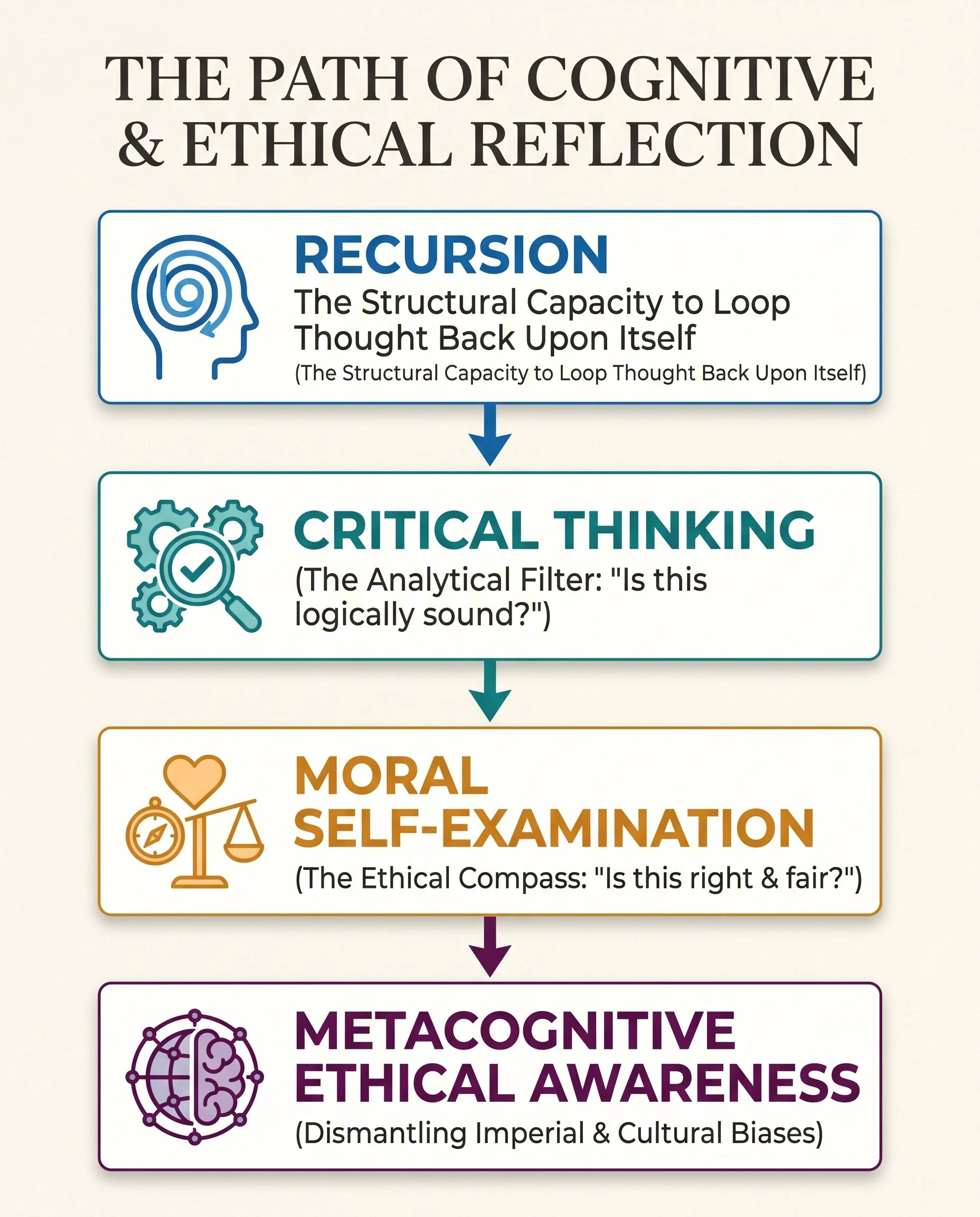
While recursion provides the structural loop, critical thinking provides the analytical discipline needed to assess what passes through it. Critical thinking is a goal-directed, self-regulating process based on objective analysis, evidence-supported reasoning, and logical evaluation. It systematically examines claims against empirical reality, spotting logical fallacies, cognitive biases, and unexamined assumptions. While recursion examines how one thought is contained within another, critical thinking asks: “Is this claim logically sound, backed by verifiable evidence, and free from error?” It acts as an intellectual filter by breaking down cultural myths, state-approved narratives, and the attractive justifications offered by corporate power.
Beyond mere logic and procedural mechanics, moral self-examination involves reflecting on normative principles and one’s own conscience. It is an inward, value-based inquiry that assesses one’s motives, actions, character, and degree of conformity with ethical duties, fairness, and the need to avoid causing harm. While critical thinking can judge whether a financial system or military technology functions efficiently and logically, moral self-examination poses the essential human question: “Is what I am thinking about, building, or taking part in ethically right, fair, and responsible?” It separates technical performance standards from moral responsibility and holds the individual accountable to human dignity and the community’s well-being.
The powerful convergence of these three processes occurs at the point of ethical metacognition—that is, when a person directs their own cognitive abilities inward to examine their moral biases. Here, recursion provides the layered structure needed, enabling the mind to watch its own judgment process in real time. Critical thinking then uses its analytical tools to examine that internal process, revealing how cultural conditioning, imperial chauvinism, or self-serving justifications have undermined logical reasoning. Lastly, moral self-examination serves as a normative guide by assessing those biases against a commitment to justice, empathy, and harm prevention. Without this full metacognitive cycle, citizens remain bound by the cultural programming of Uncle Sam Inc., confusing corporate propaganda with personal virtue and continuing to support the very systems that endanger their collective survival.
To reduce the systemic crisis in North America to a single political figure, a viral election campaign, or to a lone “Orange” event is to confuse the latest symptom with a long-existing illness. The “Orange Plague” did not appear out of nowhere; it is simply the most recent and highly noticeable shade in the wide range of cultural, economic, and imperial maladies that have characterized Uncle Sam Inc. since it began. The history of the United States has been marked by a plague of various colours—a continuous, multi-generational effort of parasitic growthism that has systematically destroyed both biological and social capital in order to power the machinery of empire.
The original spectrum consisted of the Crimson associated with settler-colonial expansion and the Black connected with chattel slavery and the extraction of fossil fuels. The Crimson stood for the violent, initial clearing of the continent, hiding the act of territorial conquest behind the theological idea of Manifest Destiny while at the same time suppressing Indigenous concepts of reality and relationship. The Black referred to the harsh commodification of human bodies within racial capitalism, a process which established the financial foundation for Wall Street and was soon followed by the mining of black crude and coal. By burning up millions of years’ worth of stored geological sunlight, the young republic created a temporary “phantom carrying capacity,” confusing a single, finite energy inheritance with inherent cultural brilliance and eternal exceptionalism.
During the second half of the twentieth century the spectrum moved in the direction of the Green associated with neoliberal financialization and the Cold Blue linked to the military-industrial complex and the surveillance state. The Green aspect turned the natural environments, social connections, and human relationships into abstract financial products and established a global economic religion which considers unlimited expansion of GDP on a planet of finite resources as a moral duty. The Cold Blue aspect appeared in the Pentagon’s ongoing war economy and in Silicon Valley’s technological network — a system based on state-subsidized military Keynesianism that developed from radar and guidance systems into a huge machine of surveillance and cloud capitalism. This version of Cold Blue extends its influence into the mind by means of algorithmic feedback cycles to manipulate the brain’s “Critic-Selector” structure, collecting the surplus of human behaviour, and inducing the population into a state of automated, consumerist submission.
In the final stage of this empire the hyper-stimulating Orange and Gold of the present-day spectacle and end-times fascism emerges. Orange is the colour of the hyper-polarised infotainment economy. This flashy, outrage-based spectacle turns public discussion into a gladiator-style arena, celebrating Dark Tetrad traits while at the same time protecting the ruling oligarchy from having to answer for its actions. Gold stands for the toxic, apocalyptic theology common to Christian Zionists, Silicon Valley transhumanists, and ethno-nationalist survivalists. This version of the end-times narrative acts as the ultimate psychological remedy in that it excuses the parasitic ruling class from any responsibility towards the environment, portraying the hoarding of resources and neglect of the ecosphere as the necessary and divinely ordained step leading up to a great catastrophe which will save the ‘elect’.
To face the harsh, cold truth of this multi-coloured plague means that we must firmly reject imperial amnesia. It is not possible to remedy Uncle Sam Inc. by simply replacing one management group with another without at the same time keeping the high-energy, omnicidal, extractive system in place. If we are to survive in a world that is coming apart, citizens must carry out a radical moral self-examination and engage in critical thinking—that is, exposing the “Single-Self” myth of consumer identity, giving up the harmful craving for national dominance, and starting a real Convivial Descent. We can begin the process of healing from the plague and developing a livable, post-industrial future by stepping down from the imperial position, destroying the myth of endless progress, and basing ourselves on relational stewardship, local knowledge, and deep human solidarity. We could chose to invest in peace, and health.