
Decades of Throwing Fuel on the Fire in a Place Called Palestine, or Israel
This is how the Great Game is played. Civilized, all too civilized.
Hi Sam,
Regarding “Just Say, Jews. They Do”
Well, we’ve been exchanging emails about ‘the troubles’ in the Middle East for a long time now. The piece is more insightful than you might think at first glance, whether it prompts reflection on well-examined historical events or piques your interest in armchair revolutionary polemics.
It’s better if I write down my thoughts and we can talk about it later.
Emotionally, the piece struck some notes, struck, hit, yes, but the overall thesis was the same old disastrous ideological shibboleths that keep us in this horrific predicament.
I’ve read about this subject for decades and am still perplexed and horrified. Armchair revolutionaires annoy me, but I still understand their frustration and anger. The current round of killing (mowing the grass) has put immense pressure on my friendships with Jewish friends, and that hurts.
Below is how I contextualize it. I don’t think the killing will ever stop as long as we are civilized, all too civilized. Perhaps, in the future, different values will define cultures.
Samarajiva’s polemic centers on the deliberate, total erasure of categories. The entire thrust of it is that you have to abandon the very idea of a distinction between the State of Israel, Zionism as a political ideology, and the Jewish people as a whole. He claims Israel is acting on behalf of the Jewish people and therefore all Jews must be collectively guilty of its military operations. That’s the basis of the argument. It’s a complete abandonment of any institutional, legal, or anti-imperialist critique and a total embrace of ethnoreligious essentialism. What it does is, in fact, simply reintroduce one of the oldest mechanisms of persecution of a minority, namely that the whole diaspora is to be held collectively responsible for the actions of the ruling elite. The piece goes on to resurrect the old tropes (the pogroms in Europe being the classic example, reinterpreted as peasant revolts against the moneylenders) and ends with an unambiguous curse upon the whole of the Jewish people. It ceases to be a critique of state violence and becomes, in effect, a justification of collective punishment. What is the destruction of Gaza other than collective punishment? Tit for Tat.
This is absolutely the view within the wider Palestinian liberation movement and the anti-colonial intellectual tradition. From Edward Said right through to the present day, it’s been the position of the various theorists and activists that Zionism is a modern political and colonial project and not an inescapable aspect of Judaism. To collapse the two is to accept precisely the ideological premise which the Israeli state itself puts forward (that its actions are those of all Jews). The international solidarity movement is also built on the principles of international law, human rights, and the ability to build coalitions across communities, including many Jewish anti-Zionists, Jewish dissidents, and human rights monitors. To say that an entire identity group is irredeemable is to alienate the very people you need to build solidarity with and to turn a struggle for justice, for civil rights, for land and for decolonization into a zero-sum ethnic and religious war. So how long has the world been talking about that? What rewards the powers that be: war or peace? Is diplomacy and peacemaking dead?
On the other hand, hardline Israeli nationalists and pro-government lobby groups will find all sorts of uses for this kind of polemic. The fundamental tenet of classical political Zionism is the notion that the non-Jewish world is inherently and permanently hostile to the Jewish people and that the only way to ensure survival is through the possession of state power and military might (what else is new and where did that idea come from?). When a commentator calls for people to “just say Jews,” will dismiss any internal Jewish dissent as illegitimate, and will go on to call for collective curses, the hardline state apologists will take up the cudgels and use such statements to argue that any criticism of Israeli policy is in fact rooted in antisemitism, and round and round we go. “Thank you very much!” This in turn feeds the siege mentality of the Israeli public and the diaspora and drives them ever further into the arms of militarism, providing a convenient political cover for the documented human rights abuses, abuses that have been going on for decades. This all started long ago and seems never-ending. I can’t tell you how many times I have had these conversations with people over the past 40 years.
This directly affects the fight over civil liberties and the criminalization of state criticism in the West. In a ‘free’ society, the right to criticize, protest, and demand accountability from any state or political ideology (be it the US, France, China, or Israel, etc.) is a fundamental aspect of political freedom. To see Western governments go to the lengths of criminalizing boycotts, criminalizing pro-Palestinian activism, or equating the detailed documentation of war crimes with racism is a massive overreach and a clear assault on free speech. Why even mention moral sentiments, ethics, international law, or any number of failed ideas and institutions? The fundamental legal and moral protection of that right has always been the line drawn between criticizing a state and attacking an ethnic group. Samarajiva’s argument effectively removes that line and thereby provides the very justification that authoritarian-leaning leaders and state censors use to silence legitimate political discourse. This attitude is common among armchair revolutionaries.
To understand why these tensions are so combustible, you have to go back to the 19th-century European roots of political Zionism. It wasn’t a movement born of an ancient religious impulse. It was very much a secular nationalist movement which was a direct reaction to the utter failure of European liberalism to protect its Jewish citizens. Herzl and Pinsker were thoroughly assimilated Europeans who had seen the Russian Empire firsthand, with its pogroms, and France in the throes of the Dreyfus Affair. They were convinced that the mere fact of legal emancipation and cultural assimilation did not in any way guarantee safety from the violence of the mob or the state’s propensity to scapegoat. It was in that context that the early Zionists adopted the very model of ethno-nationalism which was so prevalent in Europe at the time and came to the conclusion that Jewish survival was only possible through the creation of a Jewish state.
That nationalist project remained a marginal current in world Jewry until it aligned with European empires’ geopolitical aspirations during the First World War. British imperial strategy in the Middle East was among the most contradictory and cynical. They promised Arab leaders self-determination in the McMahon-Hussein Correspondence to encourage them to rise against the Ottomans. They then divided the Levant with France in the Sykes-Picot Agreement and, at the same time, issued the Balfour Declaration in 1917. The British primarily sought to secure the overland route to India and the approaches to the Suez Canal, so they treated Palestine as an imperial asset. They simply did not provide the indigenous Palestinian Arab majority with any form of representative democratic institutions, and their policy of divide and rule was the very foundation of the enduring communal conflict. This strategy is hundreds of years old, and European empires have applied it all over the world.
The Holocaust was the death of the Jewish people in Europe, and that in itself was the deathblow to Zionism as a concept. It turned Zionism from a rather dubious ideological experiment into a very real, very urgent struggle for survival. With six million dead and the Western powers (US, Britain and Canada) all refusing to open their doors to hundreds of thousands of survivors of the Holocaust who were rotting in the camps, Palestine was the only place to go. “Get rid of them, send them to Palestine.” The fact that they called it Palestine means there is and was a Palestine, not to mention the broader identifiers local groups in the region used.
The UN Partition Plan of 1947 and the 1948 war were the result. For the Israelis, it was the birth of the nation out of the ashes of genocide. For the Palestinians, it was the Nakba, the complete and utter destruction of their society and the mass expulsion of over 700,000 people. In effect, the crisis of European antisemitism was resolved by simply transferring the consequences to a native population who had in no way been involved in the European atrocities.
The enormous geopolitical weight of American Christian Zionism further complicates this history. This ideological force routinely eclipses Jewish political organizations in its total and uncompromising support for state expansion. Rooted in 19th-century dispensationalist theology (the theology of the Scofield Reference Bible), tens of millions of American evangelicals see the modern State of Israel as the essential theological prerequisite for the End Times. In their millenarian worldview, the return of the Jews to the land, the rebuilding of the Temple, and the complete territorial realization of Jerusalem are all necessary preconditions to the Second Coming and the apocalyptic battle of Armageddon. The alliance with the Israeli hardliners is not based on any concern for the well-being of the Jews or the Palestinians per se; it is based on an eschatological script in which the whole of the region is just collateral damage.
When you’ve got the slaughter going on, the destruction of civilian life and the total moral impotence of our international institutions, it’s legitimate to be furious. However, channeling that fury into a collective ethnic indictment achieves neither justice nor liberation. What is required is the dismantling of state violence, the end of apartheid and the full realization of legal and political rights for the Palestinians. That is the path of universalism, based on international law and the equality of all human beings. That is the path to justice. To go down the route of tribal hatred is to re-enact the very horrors that have been the history of civilization.
How did indigenous people of the region identify themselves?
Before the collapse of the Ottoman Empire, identity among Palestine’s Arabic-speaking inhabitants did not follow the modern nation-state model with clearly defined borders. It operated in concentric, overlapping circles. For centuries, people identified themselves first and foremost in terms of religious confessionalism (Sunni Muslim, various Christian denominations, the indigenous Sephardic and Musta’arabi Jews) and in terms of localism (one’s village, one’s clan (hamula), one’s urban center, e.g., Jerusalem, Nablus, Jaffa). Politically, they were subjects of the Ottoman Sultan within an administrative system structured around regional districts (sanjaks), such as the Mutasarrifate of Jerusalem and the Sanjaks of Nablus and Acre. Within the wider political and intellectual imagination of the Arab Renaissance (al-Nahda) of the late 19th century, the educated elite also felt a strong sense of belonging to Greater Syria (Bilad al-Sham) and the broader Arab cultural and linguistic sphere. They envisioned governance as an Arab commonwealth, or a Muslim one, within the Ottoman Empire, rather than a distinct form of provincial nationalism.
Alongside these broader political allegiances, a distinct territorial and cultural identity as Filastini (Palestinian) began to emerge in the final decades of the Ottoman period. The spread of print capitalism, the expansion of the public school system, and the political upheaval of the 1908 Young Turk Revolution all contributed to this emerging regional identity. Key publications explicitly addressed their readership as Palestinians. The most important of these was the newspaper Falastin, based in Jaffa and founded in 1911 by the Christian cousins Isa and Yousef al-Isa and Najib Nassar (of Haifa). (One of my friends when I was in high school is from Haifa.) Falastin and its counterpart, Al-Karmil (from Haifa), were deeply concerned with the peasantry and local agrarian life. They were particularly incensed by the early waves of Zionist immigration and the massive land purchases by European organizations. Land has always been a strategic asset. They were deeply concerned that European land agencies and absentee Ottoman landlords were evicting peasant tenant farmers through transactions, and they sought to publicize it. We’ve seen this before in other places and times. In this way, the intellectual circles of the day established a clear, urgent link between Palestine’s specific geography, the vulnerability of its peasantry, and the need for a distinct political defense for Palestine itself, rather than the concerns of Beirut, Damascus, or Cairo.
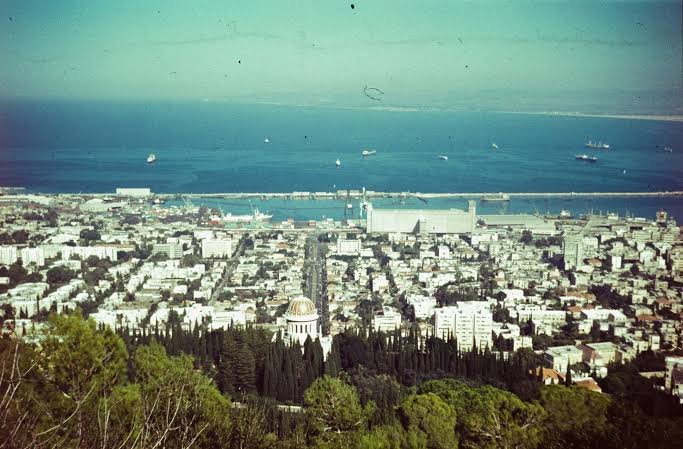
Haifa 1977
Imperial decisions in the post-WW1 period led to the formal establishment of the entity as a recognized political entity. The Arab Kingdom of Syria under King Faisal was effectively destroyed by the French at the Battle of Maysalun in 1920, and the dream of a united Syrian state incorporating Palestine was thus utterly extinguished. With that prospect gone, the Arab leaders met at national congresses within the new boundaries of the British Mandate for Palestine. The British authorities then enshrined this in law with the Palestinian Citizenship Order of 1925, which created a nationality in the form of citizenship under the authority of the League of Nations. This applied to all permanent inhabitants of the territory (Arab and Jewish) and was legislation designed to serve colonial administration. It legally defined the territory as the arena in which competing claims to political legitimacy and national existence would be fought out.
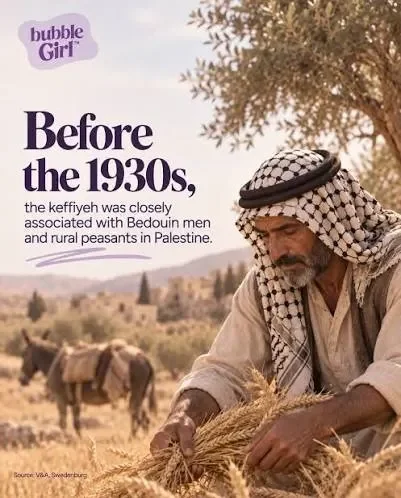
Political mobilization within the mandated territory reached a revolutionary turning point during the Great Arab Revolt of 1936-1939. Before the revolt, the traditional a’yan (urban notables) ruled Palestinian politics, and their entrenched family feuds (most famously the feud between the Husseini and Nashashibi factions) had effectively stymied any real mass mobilization. The revolt began with a historic six-month general strike in 1936 calling for a complete stop to Jewish immigration, a ban on land sales and the creation of a sovereign national government. When the British refused to accede to these demands, the movement quickly became a general rural peasant insurrection. This completely transformed the movement’s social makeup: rural rebel commanders replaced the a’yan, and all classes adopted the peasant keffiyeh as the uniform of Palestinian national identity (discarding the Ottoman tarbush/fez in the process).
The political consequences were decisive, the military ones utterly disastrous. To put down the revolt, the British used over 20,000 troops, dropped bombs, carried out massive acts of collective punishment and dissolved the Arab Higher Committee, exiling and imprisoning its top leadership. By the time the revolt was finally put down in 1939, some 10% of the adult male Arab population had been killed, wounded, imprisoned or exiled, and the British had systematically taken back tens of thousands of guns. The revolt had forced Britain to issue the 1939 White Paper, which committed to a very substantial restriction on Jewish immigration and land purchases. The effect of the revolt was to leave Palestinian society politically splintered, economically devastated and militarily defenseless at precisely the moment when the world was moving rapidly towards the crisis of 1947 and 1948.
The 1948 war and the Nakba (the catastrophe) destroyed this nascent society in every sense of the word. Some 700,000 Palestinians were uprooted from their homes. The population was thus scattered across several different legal jurisdictions: a destitute refugee diaspora in Lebanon, Syria and Jordan; a population annexed in the Jordanian West Bank; a population administered in the Egyptian Gaza Strip; and a small, marginalized minority under military rule in the new State of Israel until 1966. In the immediate aftermath of the war, Palestinian political agency was effectively swallowed up by the broader pan-Arab ideologies of the day (Nasserism, Ba’athism, etc.). Ordinary refugees looked to the conventional armies of neighboring Arab states to restore their situation. Early regional political formations such as George Habash’s Arab Nationalist Movement held that Palestinian liberation could only be a by-product of the complete political unification of the Arab world.
The era of external dependence ended with the 1967 Six-Day War. The swift defeat of the Egyptian, Syrian, and Jordanian armies and the complete Israeli occupation of the West Bank and Gaza were the definitive end of that era. The Arab defeat catalyzed a complete reversal toward Palestinian self-reliance (al-qarar al-watani al-mustaqill). The fedayeen, in particular Fatah under Yasser Arafat, argued that liberation could only be achieved through a struggle waged by Palestinians themselves rather than through reliance on Arab capitals. The 1968 Battle of Karameh, in which the PLO fedayeen put up a very determined resistance to an Israeli military incursion, was the moment that the armed factions took off. They took over the PLO in 1969. The modern Palestinian national movement was thus reborn as a national movement in its own right, rather than as a movement of people whose identity was based on their ancestral villages or their relationship to Arab state patronage. In 1974, the UN and the Arab League recognized the PLO as the sole legitimate representative of the Palestinian people.
I guess few U.S. citizens know much about Middle East history. People don’t seem to care and therefore have a shallow understanding of current events, shaped by the usual ideologues.
Civilized, All Too Civilized
The point of Civilized, All Too Civilized is that the very processes that enable human scale (sedentism, grain agriculture, state administration, codified hierarchy) also produce organized mass violence. Around 10-12k years ago, and over the next 5-8k years as societies became established states, the Neolithic transition completely transformed the human social world. The mobile hunter-gatherer bands certainly did commit acts of lethal raiding, but they simply didn’t have the capacity, the surplus, or the structural incentive for systematic, industrial-scale slaughter. The moment humans became sedentary, tied themselves to a piece of land, and began to accumulate stored surplus, property became something to defend and steal, land became territory, and people became subjects. Civilization didn’t so much suppress the human capacity for violence as it institutionalized, professionalized, and legitimized it through the state’s monopoly of force. Truisms, platitudes by now to those who pay attention to such things.
This is why culture can’t be treated as a software package that pure reason and good intentions can wipe clean and reprogram. Culture is an emergent, stochastic, and profoundly conservative evolutionary adaptation. It is the sediment of thousands of years of survival, of technological change, of institutional inertia. Any attempt to go in and completely dismantle that accumulated cultural substrate in a single swoop and re-engineer a ‘New Man’ from theory alone (be it the Jacobin Terror in the French Revolution, the Bolsheviks’ collectivization or Pol Pot’s Year Zero) is going to end in total and utter slaughter. The ideological projects all fail because they run head-on into both human behavioral biology and the coordination traps of large-scale societies. You simply don’t have the tools to enforce social order once you’ve obliterated the organic, inherited norms. Your only tool left is total terror.
Under the rhetoric of national destiny and ideological struggle, a very real game-theoretic trap exists that Nick Bostrom and several systems thinkers have called a multipolar trap (or, as the ancient world would have it, Moloch). In an anarchic international system, any society that unilaterally disarms, chooses pure ecological balance, or abandons the pursuit of economic expansion is very quickly conquered, absorbed, or otherwise marginalized by a rival that chooses extraction, militarisation, and scale. Over time, this selection pressure will ruthlessly eliminate any non-coercive system. The Roman Empire, the British Empire, Napoleonic France, and the modern military-industrial complexes of the superpowers all exist because their political systems were designed to mobilize resources, build weapons, and project lethal force against their neighbors as efficiently as possible. The oligarchs and the defense contractors who are reaping the benefits while the average citizen is being blown to bits are not some aberration of the system; they are the beneficiaries and curators of the system, and they sit at the apex of institutions which have been fine-tuned over centuries to externalize the suffering of the periphery while concentrating the wealth at the center.
When you’re up against this monolithic, self-reinforcing civilization machine, the question of what the average person caught in the machine can actually do becomes profoundly existential. Historically, the most realistic answer has never been some grand top-down savior. Individuals don’t have the lever to change the momentum of a civilization that’s been going for 8000 years. The first and most fundamental act of agency is epistemic: refusing to be ideologically conscripted. The state, the oligarchs, and the corporate media machine all need the ordinary person to provide the emotional fuel for their wars. They need us to buy into the idea of collective guilt, to be able to cheer on the extermination of the enemy, to surrender our own moral compass to the flag or the party. Simply withdrawing our psychological consent, seeing the geopolitical game for what it is (a cynical, resource-driven meat grinder) rather than what it is sold to us as (a romanticized, noble pursuit), is the first step in depriving the machine of its most malleable army. Boycott, divest, and use your imagination and critical thinking skills.
Beyond the epistemic resistance, there’s the matter of historical precedent. During the collapse of the Roman administrative state, or during the rampant feudal violence of medieval Europe, meaningful human agency operated entirely at the local, relational level. (Explore relational ontology.) The human species survived, and a degree of decency was maintained, not through the actions of emperors or generals but through the resilience of a host of local counter-institutions: monastic networks, mutual aid societies, self-governing communes, and the like. The real leverage is in the local. It’s in building up regional food security; it’s in supporting the local institutions that exist in the face of the state; it’s in building up a cross-community solidarity that actively and directly resists the state’s institutionalized hatreds, and it’s in the protection of the vulnerable from both state and market violence. That won’t stop a ballistic missile. It won’t stop the macro machine from grinding down. But it will preserve the thread of human decency beneath that machine’s weight.
Accepting that you can’t personally reverse the structural trajectory of global empires isn’t fatalism at all. It’s simply the shedding of hubris. Civilization may very well be an ecocidal, destructive vehicle which is locked into its own destructive logic. But in the small space of everyday life, we still have the capacity to choose solidarity over cruelty, local resilience over total dependency, and truth over propaganda.