
Do we chose what we want to know? Knowing what’s what is not enough.
Before we get into this, let’s indulge in some entertainment from Mr. Newberger’s AI Funnies, because it’s nicer to giggle and laugh than to think about the structural, systemic, ideological, economic, and religious narratives that got the world into this thing we all ignore, AKA the Polycrisis. Entertainment and stories will help us break on through to the other side.
The New Tragedy of the ‘This Thing of Ours’ (Commons? What commons?)
The classical notion of tragedy starts with Aristotle’s observation that catastrophe doesn’t just strike like a bolt of lightning from a wrathful sky. It’s the inevitable outcome of hamartia (a term from archery meaning a miss of the mark, a perceptual error, a fundamental misapprehension of reality). Oedipus kills his father at the crossroads, believing he is running from his fate; his undoing is the very product of the intelligence, pride, and agency he brings to bear in an attempt to escape it. In this original sense, tragedy is neither melodrama nor misfortune. It is the inevitable mechanics of a system which operates according to its own internal logic, in which the protagonist’s virtues, his blind spots and his very strategies for survival are precisely the tools of his destruction.
Centuries later, the language of tragedy underwent a rather cynical political mutation. As the modern state became more and more the state of mechanized violence, the very notion of tragedy ceased to be about the hero confronting the limits of existence and instead became a device of administrative exculpation, so to speak, the “tragedy trap.” If the state is going to deliberately induce a famine, genocide, or allow an industrial ecological sacrifice zone to be created, or simply unleash a set of algorithmic targeting protocols which will slaughter entire civilian corridors, the rhetoric is always the same. The spin doctors will be the first to appear on camera and declare it an “unspeakable tragedy.” By dressing up the predictable outputs of a system designed to extract profit and maintain military supremacy as a tragic inevitability, the state can wash its hands of any responsibility whatsoever. The system’s predictable outcome is recast as an unfortunate, entirely uncontrollable twist of the cosmos.
This is where the technological and administrative evasion becomes truly profound when systems attain second-order autonomy. In algorithmic warfare and automated high-frequency capital markets, the human ceases to be a conscious moral agent and becomes a biological peripheral to an ever-accelerating computational system. The very systems that are designed to achieve maximum efficiency and precision will invariably produce catastrophic first-order reversals, leading to accelerated slaughter and fragility in the name of risk management. The irony is complete: the victories of modern imperial and economic contests are so utterly hollow, so ecologically devastated and socially atomized that the spoils of victory are in fact indistinguishable from a complete and total defeat. The machine keeps going not because anyone believes in where it’s going, but because the game structure itself won’t let anyone get off the game.
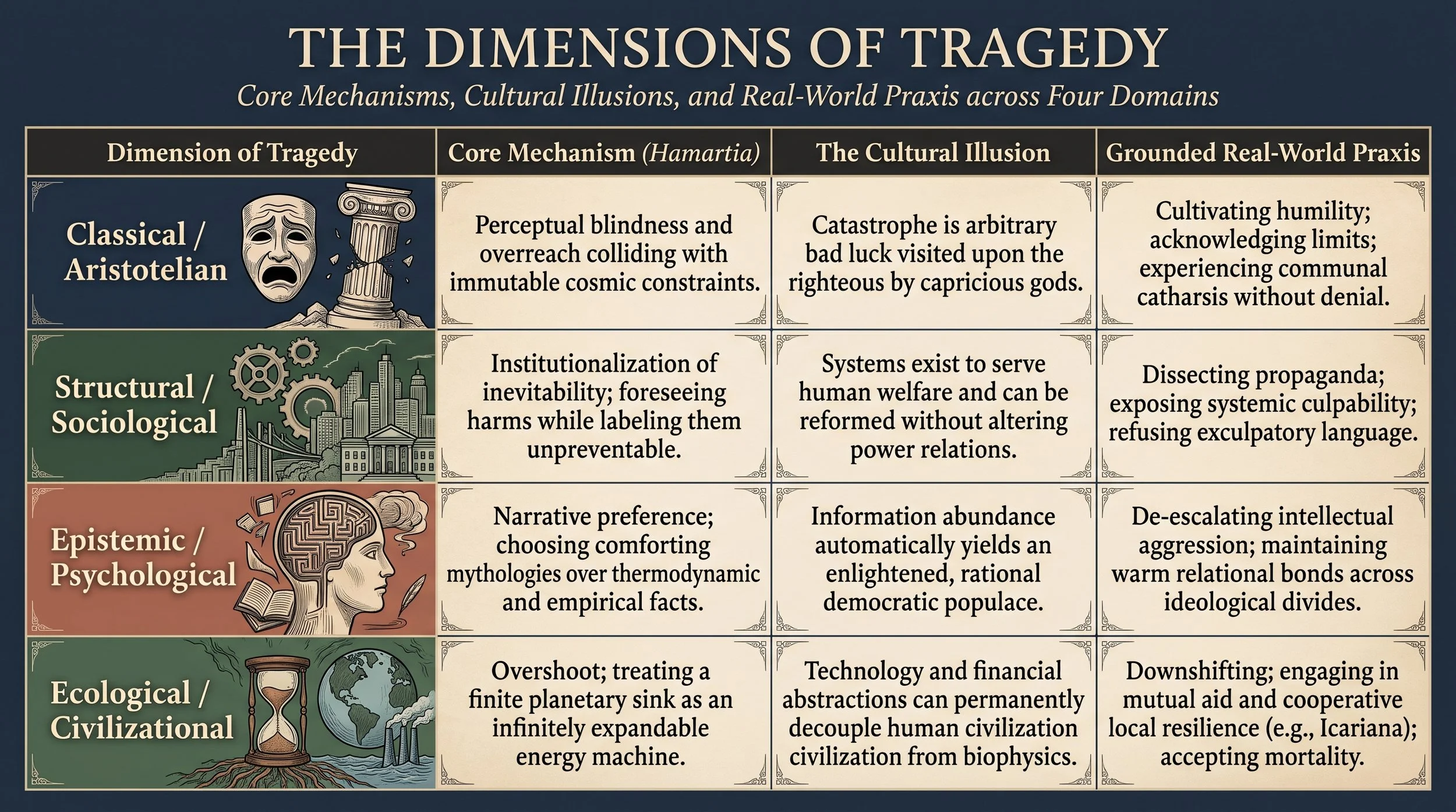
The root of this systemic runaway is, in the first instance, our species’ epistemic vulnerability: the absolute primacy of the campfire story. We didn’t evolve to perceive thermodynamic reality, ecological carrying capacity, or complex non-linear systems. We evolved in small Pleistocene bands where social cohesion, shared myth, and belonging were what separated life from death. As sociologist Peter Berger observed, society is fundamentally an enterprise in world-building: a collective world we all create to shield ourselves from the terror of an indifferent universe. When my friend justifies spending thousands of dollars to align their metaphysical energy conduits, or when another friend finds meaning and stability in the Unification Church’s authoritarian embrace, they are not failing an exam. They are behaving exactly as Homo Narrans has always behaved: trading empirical truth for psychological safety, social predictability, and emotional comfort.
But to them the ‘phenomena’ is objectively real.
That gap between the reality of the empirical world and the mythic comfort of belief explains the Sisyphean nature of the science-oriented creator’s work (Dave Farina of Professor Dave Explains). Professor Dave is an absolutely fantastic example of pedagogical clarity, taking the complex subjects of organic chemistry, biochemistry, and physics and systematically breaking them down for millions of students. His wider cultural profile has been built in the arena of public debunking, where he’s a regular and very effective sledgehammer to the creationists (James Tour and Kent Hovind), the flat-earthers, the anti-vaxxers, and the various other pseudoscientific charlatans. He’s the archetypal Enlightenment rationalist in all his glory, going in with receipts, quoting papers, pointing to the thermodynamics of the situation, and being utterly contemptuous of the intellectual dishonesty of the people he’s arguing with.
“He’s not nice!”
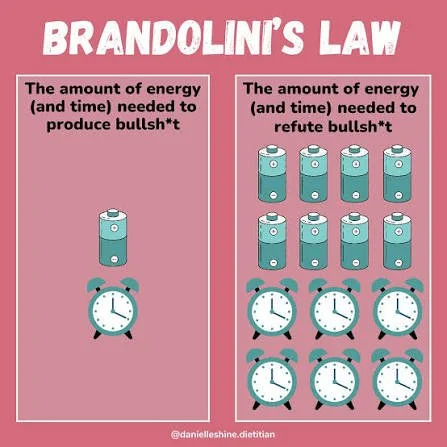
Yet through the lens of tragic theory, it’s a textbook example of Brandolini’s Law (the Bullshit Asymmetry Principle) in action: the energy required to refute bullshit is orders of magnitude greater than the energy required to produce it. Farina is a lone craftsman with a lathe trying to stop a volcanic eruption of narrative sludge. For every person who’s watched Dave dismantle a creationist’s biochemical nonsense, the algorithms feed millions of users emotionally seductive stories of ancient aliens, miraculous herbal cures, divine destiny, and all manner of techno-messianic fantasies where Silicon Valley oligarchs upload human consciousness into servers in the sky. Dave’s approach is to treat superstition as a cognitive error to be corrected by better data. (Who is Karl Popper?) History suggests superstition is an existential coping mechanism. His work is immensely useful to those who are converted and those who are genuinely curious. Against the sheer structural force of human irrationality, it’s a stark reminder of the tragic limits of rationalism itself.
The great tragedy of our age, the one that encompasses all the others, is ecological overshoot. As William Catton put it so eloquently in his book Overshoot, modern industrial society has made a Faustian deal: it has used up fossil energy to go beyond the planet’s carrying capacity temporarily. We are living on “phantom carrying capacity,” in effect, consuming millions of years of stored geological sunlight in a multi-century binge. In The Collapse of Complex Societies, Joseph Tainter, the anthropologist, observed that societies tend to deal with the problems that arise as they grow by adding layers of socio-political and technological complexity. Eventually, every society hits a point of diminishing returns on that complexity, and the energy required to maintain the society’s administrative structure bankrupts the whole civilization.
I mention Catton and Tainter all the time, hoping that my readers and friends will read them. The dark, gritty framework of Catton (with his work on ecological overshoot and the concept of ‘phantom carrying capacity’) and Tainter (on the principle of diminishing returns of complexity) is by no means an isolated position. It’s part of a very substantial body of work from a range of different disciplines (from thermodynamics through to anthropology) all coming to broadly similar and often identical conclusions about how civilizations end up trapping themselves through their own achievements. Today we live in a failing Global Civilization.
But it pisses off capital so ofcourse it’s not mainstream. We don’t bite the hand that delivers stuff to our door.
If Catton gave us the biological and ecological limits and Tainter gave us the organizational maths of collapse, Ronald Wright provides the historical psychology. His notion of the ‘progress trap’ is that human history is full of civilizations (Sumer to Easter Island) that have all worked out a particular survival strategy, have grown exponentially as a result of that strategy, and then become utterly incapable of changing course when that very same strategy starts to destroy the very basis of their environment. The same applies to the transition to intensive agriculture. Once you’ve built a highly complex, high-energy system to feed your population, you can’t ‘downshift’ to a simpler way of life without massive die-offs.
William Ophuls takes that dynamism into the political sphere and argues that as resources get scarcer, democratic consensus can’t resolve the ‘predicament.’ As the ecological margin of error shrinks, natural limits will eventually assert themselves, and society will have to choose between authoritarian control over resources and total disintegration. That’s a very chilling political counterpart to Tainter’s complexity. The more a society tries to ‘manage’ its way out of the decline, the heavier the administrative, bureaucratic state becomes and the more fragile it is in the end.
I can’t emphasize this enough, and I tell my friends over and over: The biophysical constraints and complexity problems running through our global systems are reinforced by a wide and rigorous range of modern interdisciplinary thinkers. They build on these original theories to show that the path of systemic overreach and organizational decay is highly predictable for high-energy societies.
Biophysical Overshoot and Resource Exhaustion
William Catton’s argument that industrial society is built on the concept of ‘phantom carrying capacity’ is strongly supported by the system dynamics work of Donella Meadows, Dennis Meadows and Jørgen Randers. They were the first people to do computer modeling of resource use and pollution, and in The Limits to Growth they stated quite clearly that “the earth’s interlocking resources—the global system of nature in which we all live—most probably cannot support present rates of economic and population growth much beyond the year 2100.” They showed that overshoot results from decision delay, observing that “to overshoot means to go too far, to grow so large so quickly that limits are exceeded” and that “the challenge of overshoot from decision delay is real, but easily solvable if human society decided to act.” The overshoot and collapse they modeled is in fact an epistemic phenomenon, with one of the key drivers being “the delay or mistake in the perceptions and the responses that try to keep the system within its limits”—this could be due to inattention, bad data, or “deliberate efforts to mislead.”
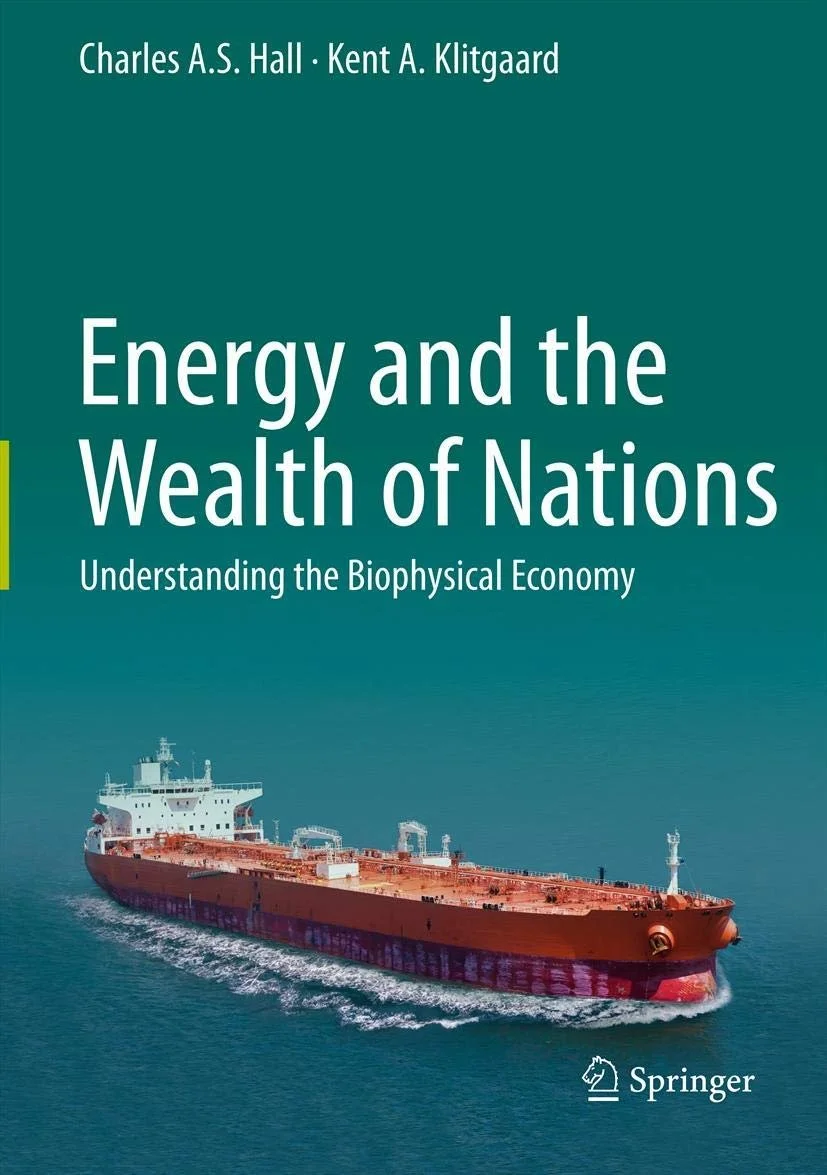
Evolutionary biologists Paul R. Ehrlich and Anne Ehrlich examine these ecological constraints from an evolutionary biology perspective, focusing on the biological and agricultural constraints that make exponential human growth untenable. They point out that our huge population depends entirely on depleting finite natural capital, which is precisely the ecological trap Catton described. A species whose population has grown beyond the carrying capacity of its habitat is bound to suffer a collapse. Biophysical economists Charles A. S. Hall and Kent Klitgaard take the biological overshoot a stage further by linking it directly to the laws of thermodynamics in their work on Energy Return on Investment (EROI). They show that a society cannot sustain its level of complexity if it is using too much energy to extract new energy. In Energy and the Wealth of Nations, they show that our dependence on increasingly poor-quality fossil fuels is a metabolic dead end. The modern economy is trying to get around this physical reality by printing money (or, Modern Monetary Theory), which postpones and intensifies the biophysical debt.
Diminishing Returns and Social Fragility
Joseph Tainter’s theory that societies add complexity to solve problems and that this complexity eventually becomes the system’s undoing is a theory that is picked up and developed by several historical, ecological, and psychological researchers looking at the phenomenon of social decline. Historical anthropologist Ronald Wright explores this in A Short History of Progress, where he introduces the notion of ‘progress traps.’ He says that “civilizations get trapped in progress traps” because human societies solve today’s problems with new technology, which then creates many systemic vulnerabilities. He notes that “a small village on good land by a river is a good idea, but when the village grows into a city, and you pave over the good land it’s a bad idea.” This is the ‘experiment of the settled life,’ and it’s the fact that once you depend completely on a complex system, you can no longer return to a simpler state without a crisis. Each time history repeats itself, the price goes up.
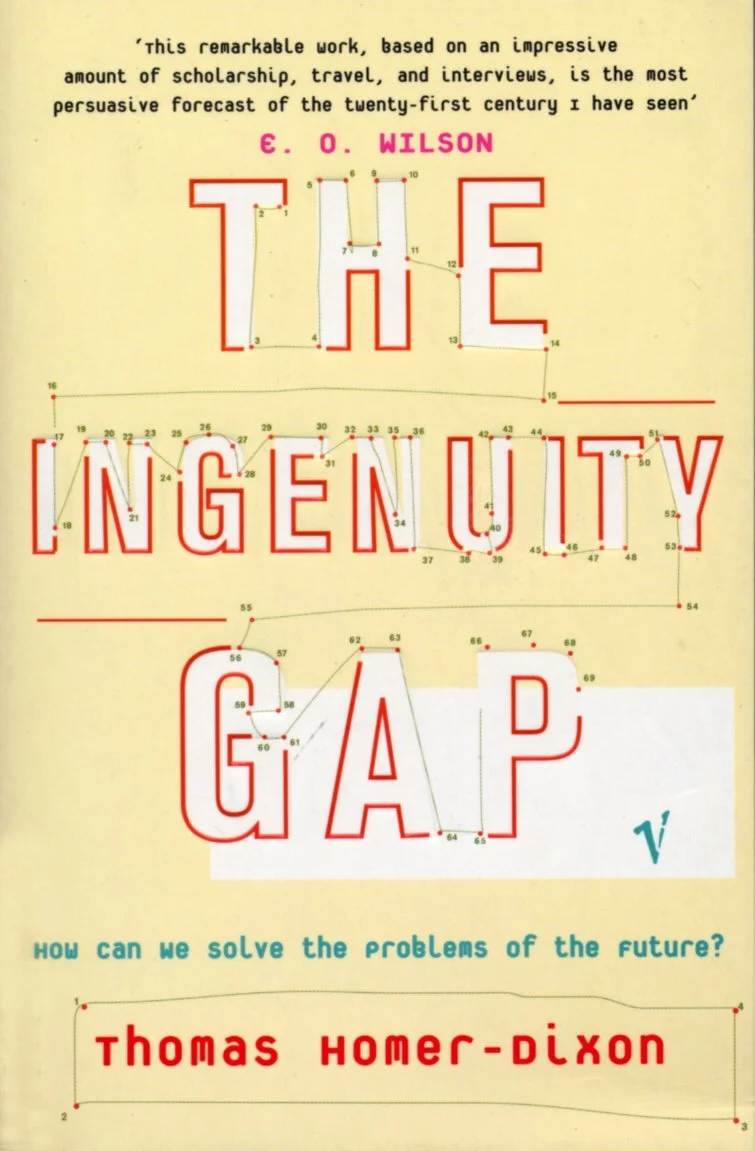
Political scientist Thomas Homer-Dixon calls this ever-increasing demand for complexity ‘the ingenuity gap.’ He claims that as the problems we face grow in both scale and speed, the gap between the practical, creative ideas we need and the ones we actually have is widening. In The Ingenuity Gap, he states that “the complexity of our problems would accelerate faster than our collective ingenuity to solve them and that failure to close this ‘gap’ would leave societies fragile and exposed.” As societies are “stretched beyond their capacity to adapt”, failing to resolve the problems that created this complexity can lead to political collapse and civil unrest, simply because we don’t see that the problems are interlinked.
Ecologist C.S. Holling formalizes this systemic vulnerability in the concept of ‘the adaptive cycle,’ which describes how complex systems go through phases of growth, conservation, release, and reorganization. As a system matures and becomes highly specialized, it ‘becomes increasingly specialized and rigid.’ At this stage, it is highly connected and ‘has low fluctuations and low resilience’ and is therefore very fragile. This is what Holling and Lance Gunderson call a ‘rigidity trap’: the system is so optimized around one objective that it ‘has little room for further innovation.’ It lacks the flexibility to survive a shock. This leads to the ‘release’ phase, which is a collapse that ‘radically and rapidly reduces its structural complexity.’
These people take the debate beyond the political and beyond the personal, reframing the human condition as a structural and evolutionary process.
“But it’s ok, we are experiencing a spiritual reset.”
Meadows and Homer-Dixon’s systems dynamics show that the instinct to ‘fix’ civilizational collapse with more technology is what speeds it up (the essence of Aristotelian hamartia on a global scale). Just as Tainter argues that societies consume themselves to maintain existing layers of administrative complexity, the TESCREAL oligarchs and their geoengineering schemes are attempts to use even more complexity to escape metabolic reality.
Ronald Wright’s ‘progress traps’ explain why my friends switch off and stop listening when I get into overshoot and limits. Scurrying back to familiar stories is not a sign of personal failure. It’s the evolutionary inheritance of a species which has always preferred the short-term social cohesion of the group to the thermodynamic reality of our broader reality-based circumstances.
Without any workable top-down solution, Holling’s cycle of “release and reorganization” is perfectly exemplified by practical, grounded approaches such as the Icariana co-op or collaborative theatre, performance art, filmmaking, and music. They are not “solutions” to the planet’s machine; they are precisely the kind of “low complexity, resilient reorganization” that we need if we’re going to make it through the inevitable simplification of an overextended civilization. They show that you can’t stop an empire from falling apart, but you can build relational, humble systems that make the fall more humane, less violent, painful, and horrific.
Do we have to continue extincting species and waging wars?
In a world fundamentally at odds with the idea that progress is possible in the face of hard biophysical limits, these scholars offer different perspectives on the same sad truth. Our most significant achievements are precisely the mechanisms through which we will ultimately be simplified. Meadows through system dynamics, Wright through historical anthropology, and Holling through systemic ecology.
This turns our polycrisis from a ‘problem’ into a ‘predicament.’ A problem is an engineering question with an optimal technical solution: replace the bridge, clear the valve, make the vaccine. A predicament is an existential condition with no solution at all, only a set of consequences which you have to live with, manage, or suffer. The tragedy of modern statecraft and modern corporate discourse is the sheer, unyielding persistence of the idea that a biophysical predicament can be engineered away by some further layer of the very complexity which gave rise to it. Whether it’s modern monetary theory, geoengineering, carbon capture dreams, or the mad dash to achieve artificial general intelligence. It’s the very classic Aristotelian reversal played out on a planetary civilizational scale. Every technological fix you apply to get round the limits to growth tightens the noose of ecological exhaustion.
Can tragedy be averted in the real world? At the planetary or civilizational level, the empirical answer seems to be no if by ‘mitigated’ one means maintaining industrial supremacy whilst avoiding the biophysical bill. Civilizations, like individuals, are dissipative structures subject to the laws of thermodynamics. They rise, consume available energy gradients, complexify, overshoot their base, and simplify. To grieve that is entirely natural. To expect a global political system constructed explicitly to extract resources competitively to turn off its own engines voluntarily is to misunderstand empire’s evolutionary logic.
True mitigation can only exist if we get rid of the rather grandiose, techno-managerial notion of the term and bring it back down to earth. In The Myth of Sisyphus, Camus says that one must imagine Sisyphus happy. Not because the boulder will stay at the top of the hill (it won’t), but because the very act of pushing it asserts human dignity in the face of an indifferent universe. Dr Rieux in The Plague continues treating the sick to the very end, knowing full well that he can’t possibly eradicate the bacillus and that the plague will come back and bite the city in its ignorance. His efforts are not undermined by their ultimate futility. They are justified by the very fact that he will not be an accomplice to despair or cruelty.
Mitigation in the real world therefore moves from an obsession with saving the empire to an embrace of relational ontology (the idea that our very humanity is defined by our relationships with each other, with the soil and with the immediate ecosystem in which we live). It won’t look like an international summit on climate targets at all. It’s going to look like pruning stone fruit at the Icariana co-op in the Portuguese afternoon. It’s going to look like spending weeks in a drafty hall rehearsing scenes for an indie film with local actors and finding some fleeting sense of transcendence in the shared rhythm and the shared craft. It’s going to look like drinking coffee with a friend who does Reiki or a high school friend who went down the Unification Church route, choosing the warmth of affection and the humor of shared experience over the cold victory of an evidence-based cross-examination.
If we’re going to be the species that trundles through the closing stages of this high-energy age, propelled by the campfire tales that soothe us, the moral imperative isn’t either a cynical pull back or some form of self-righteous proselytizing. It’s the creation of small, tough little enclaves of sanity, art, and soil where we can go down the slope with as much grace, humor, and compassion as we can manage.
Given that human connection so fundamentally relies on meeting people where they are rather than where we’d like them to be, how does one personally balance respecting one’s own hard-won realism with staying genuinely open to the myth-making lives of the friends one loves?