
Undoing a thing of this magnitude is practically impossible. The State watches until it can’t anymore.
I am reading Prophecy: Prediction, Power, and the Fight for the Future, from Ancient Oracles to AI, and I highly recommend it. It is a must-read book for everyone who still reads and thinks recursively and critically.
Having spent years doing business in China, I had to look into one section of the book that discusses the Chinese Surveillance State. I have done this periodically over the years because I am always skeptical of mainstream reports on China that lack nuance and carry Great Game agendas.

Privacy? What Privacy?
The politics of privacy is the view that personal data is, in fact, a currency of power rather than an asset of individual preference. Carissa Véliz (Oxford), in Privacy Is Power, goes further to say that mass data collection creates a situation of systematic power imbalance: “If we give our data to the companies, then the rich will rule. If we give our data to the state, then we will end up with some form of authoritarianism. Only if the people keep their data will society be free.” She sees the bulk data in question as a toxic substance: “The surveillance economy is not only bad because it creates and reinforces undesirable power imbalances. It is also dangerous because it trades in a toxic substance.”
This is precisely the point Shoshana Zuboff makes in her analysis of ‘surveillance capitalism,’ where modern big tech is not simply an advertising business but a regime of ‘instrumentarian power’ that treats human experience as raw material for behavioral modification and prediction. When public institutions start using algorithmic profiling, as Pasquale has shown, human agency is subordinated to probability scoring. Predictive policing doesn’t stop crime; it simply pre-assigns suspicion. It replaces constitutional protections with probability proxies, effectively codifying the system’s existing inequalities under the banner of computational objectivity.
The Black Box Society: The Secret Algorithms that Control Money and Information, by Frank Pasquale. Cambridge: Harvard University Press, 2015. 320 pp. ISBN 978–0674368279
The Black Box Society: The Secret Algorithms that Control Money and Information, by Frank Pasquale. Cambridge: Harvard University Press, 2015. 320 pp. ISBN 978–0674368279
Empirical Documentation of Xinjiang’s Internment System
The argument that the mass detention camps in Xinjiang are without evidence or are in any way in dispute with the consensus of investigators is directly contradicted by a massive amount of verifiable evidence in the form of Chinese Communist Party (CCP) internal records, satellite imagery, and official reports. As in the United States, institutions are not shy about telling us their intentions and bragging about their initiatives and accomplishments. The documentary basis of the detention system was laid bare in 2019 by The New York Times through the so-called ‘Xinjiang Papers,’ a leak of over 400 pages of internal CCP documents. In those documents, Xi Jinping is seen instructing party cadres in 2014 to ‘go forth and use the organs of dictatorship’ and show ‘zero mercy’ in the fight against what the CCP deemed ideological extremism and secessionism. Local officials were told to inform the parents of children who had disappeared that their relatives had been ‘infected with unhealthy ideas’ and would be receiving ‘isolated, enclosed treatment’ in government facilities.
What happens to people in the United States and the Anglosphere who have something to say about Palastinians?
The very physical reality of the facilities as high security prisons rather than as voluntary ‘vocational education centers’ was confirmed by the China Cables (published by the ICIJ). The cables included an operations manual signed by Xinjiang’s then head of security, Zhu Hailun, which instructed camp staff to ‘never allow escapes’ and to achieve this through ‘guard towers, double locked doors, alarms, blanket video surveillance and front gate security’. These operational instructions were subsequently matched to human faces and to the actual physical facilities in the 2022 Xinjiang Police Files (an internal police file which contained thousands of photographs of detainees along with operational instructions which included orders to ‘shoot to kill’ any prisoner who attempted to escape and to maintain armed perimeter security).
Complementing the internal records, open-source researchers at ASPI reviewed over 380 new or expanded detention facilities built between 2017 and 2020 by combining multi-temporal satellite imagery with government construction tenders and procurement records. In August 2022, the Office of the UN High Commissioner for Human Rights (OHCHR) issued a formal assessment which found that the scale of extrajudicial deprivation of liberty, arbitrary detention and the associated abuses in Xinjiang “may amount to international crimes, in particular crimes against humanity.”
Divergent Architectures: Direct State Dragnets vs. Corporate Monetization
While predictive tracking and biometric surveillance are global phenomena, the technical architectures and institutional objectives of such systems differ sharply between the Chinese and Western worlds. In China, corporate technology platforms effectively extend state security. The clearest example of this is the Integrated Joint Operations Platform (IJOP) in Xinjiang. As Human Rights Watch has documented through reverse engineering of the police software, the IJOP is an automated triage system:
“The Xinjiang policing programme collects data on people and flags those it deems potentially threatening. The Chinese authorities are tracking people’s everyday behaviour – how much electricity they use, whether they use the back door rather than the front – and using algorithms of repression to trigger police investigations and arbitrary detention.” —Maya Wang, Human Rights Watch.
In the Chinese system, a single algorithmic flag (arising from cross-referencing mobile app usage, border crossings, or utility use) can lead to immediate physical detention with no possibility of any independent judicial review.
Does this sound familiar? Look in your own backyard.
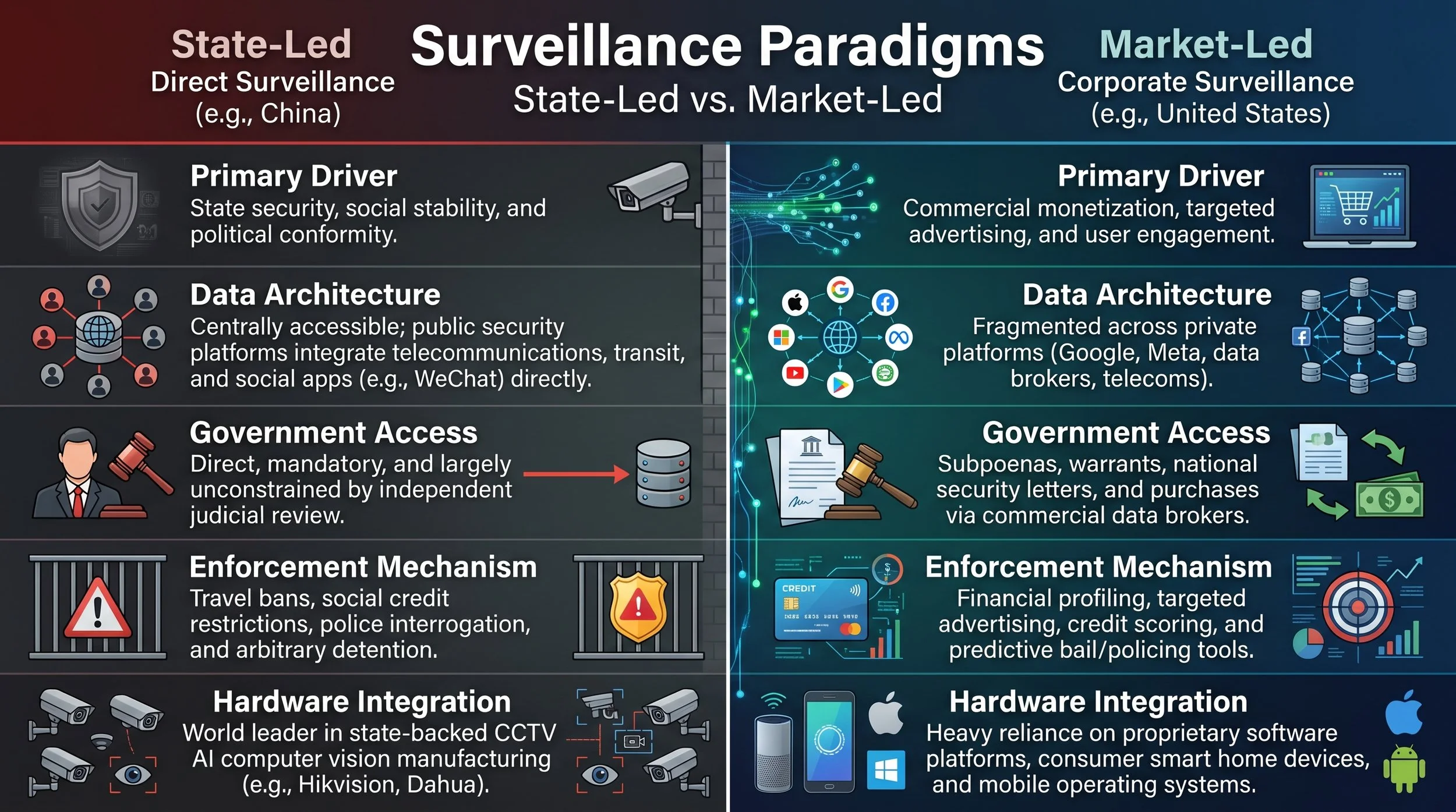
In the US, the surveillance state is driven by the financial logic of corporate extraction rather than any centralized national security imperative. The data infrastructure is essentially a network of private companies (telecoms, ad networks, mobile OS providers, etc.) and data brokers (LexisNexis, Venntel, etc.). US law enforcement doesn’t have the statutory power to conduct all-round surveillance of the population via a centralized state platform, but it can buy the data it wants from commercial brokers on the open market. The harms of this in the West are all economic profiling, aggressive commercial targeting, predatory credit and insurance gating, and targeted predictive policing at the municipal level. The two models differ in motivation, but they end with the same outcome: the total, non-consensual logging of the civilian population.
Hardware Hegemony and the Proliferation of Control
The commercial market for surveillance tech is overwhelmingly Chinese in its manufacturing base. State-backed companies Hikvision and Dahua, in particular, account for a huge share of the world’s network cameras, license plate readers, and computer vision hardware. These physical infrastructures have been deployed globally via Beijing’s “Safe City” exports and the Digital Silk Road.
The US is preparing to go to war over this.
This global spread is precisely Véliz’s point: surveillance capabilities developed in one place don’t stay there. Once you have the hardware for high-density tracking, facial recognition, and algorithmic threat assessment as a standard public good, it’s available to any municipality, border agency, or authoritarian state that wants to buy it.
The Ratchet Effect of Techno-Industrial Society
Once surveillance systems are embedded in the administrative machinery of society, they exhibit complete path dependency in the sense of totalisation, making their removal through normal legal or political means practically impossible. This is the so-called ‘ratchet effect’ in technological philosophy. In a crisis of some kind (a wave of terror, a pandemic, a spike in crime), you can gradually surrender civil liberties. The surveillance infrastructure that you create to deal with that crisis, however, never goes away. The bureaucracies, the intelligence agencies and the vendor partners all have a vested interest in the apparatus they have created and will naturally want to maintain and expand it.
As modern techno-industrial (MTI) civilization becomes more complex, its dependence on cybernetic coordination becomes total. Modern states cannot distribute goods, run public health services, manage traffic, verify identity, or facilitate the flow of capital without constant algorithmic monitoring. The very nature of participation in modern life requires a digital footprint (a smartphone, a biometric ID, an active payment account, and a constant stream of geolocation pings), so refusing to be part of the system means effective economic and social exile.
Technologist Jacques Ellul termed this the ‘technological imperative’: technique will always demand its own continuous expansion, regardless of ethical considerations. Given that algorithmic surveillance is the answer to the fundamental problem of the modern state (how to govern and stabilize the billions of hyper-specialized individuals who make up the modern industrial world), no society that wishes to remain an advanced technological power can afford to get rid of its own sensory apparatus. There will be no going back from the state’s sensory organs in the sense of removing them. Short of total systemic breakdown or the ultimate collapse of modern techno-industrial civilization itself, the apparatuses designed to measure, predict, and control human behavior will be an ever-present and ever-expanding feature of our lives.