Says who? Tell me about it.
I told a friend I had been rereading the Nag Hammadi scriptures and King Arthur books. I love stories about the origin of these books, their discovery, how they were published, controversies inspired by their stories and publication, cultural background, and various interpretations of the texts. He replied that he had just read Heaven and Hell by Bart D. Ehrman.
I don’t think my friend would mind my sharing his messages with me:
I like Bart’s interpretation of the Gnostic gospels and agree that the first 2 centuries of the Christian “church” created an orthodoxy and dogmatic foundation that wasn’t necessarily “true,” but rather a created consensus that “worked” for the budding Christian empire.
Bart lost his faith along the way, but I merely adjusted mine, and I can still believe in (a) God.
My most recent read of Bart’s was about Heaven and Hell, which Paul mostly invented/promoted. Bart claims that the historical Jesus - and all jews of his time - did not believe in an “eternal soul” that would journey on after death. Bart claims that was a Greek idea, not a Jewish one. —End quote.
I have read some of Bart’s books. I think all stories have antecedents, or that stories are derived from many stories and sources and, if not codified, morph constantly over time and space and across changing contexts, cultures, and circumstances.
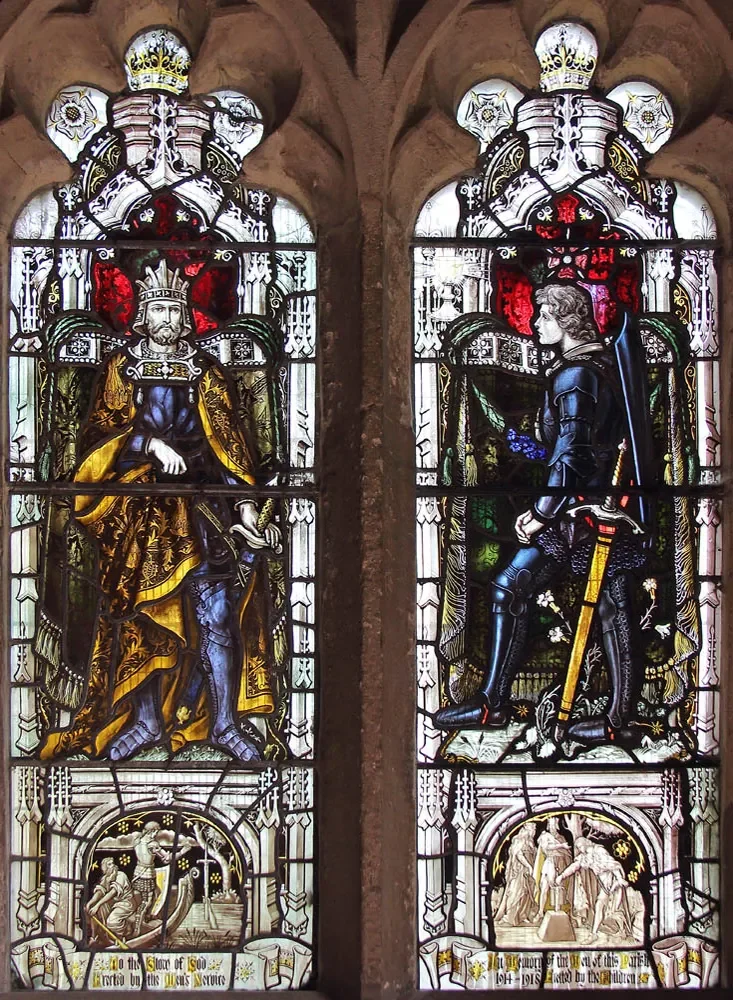
One might wonder: did King Arthur exist? Did the Jesus of the Gospels exist? Christians have long believed that Jesus was morally flawless, sinless, and completely righteous while living in the flesh. The character in the Arthurian stories was far from flawless and sinless, but he was the best of the best in the Chivalric traditions of late medieval Britain and Europe.
What makes a flawless character in a story relatable? Anyone?
What makes a flawed character relatable to me is that they struggle to be ‘good’ despite their flaws.
All value judgments are embedded in relational ontology and bound by culture, philosophy, epistemic rigor, and humility. That is, deciding what is good, right, or valuable cannot be done in isolation; it depends entirely on our relationships with others, and it requires deep honesty about the limits of what we can truly know.
A value judgment is an assessment of the rightness, wrongness, merit, or usefulness of something based on personal opinions, beliefs, or a specific set of standards rather than verifiable objective facts. [1, 2, 3]
One can search for lines of evidence for the existence of a thing, person, or event and may or may not find them. In the end, most serious, sincere investigators may wind up agnostic.
“Do I believe it? Maybe. Maybe not.”
People have mystical experiences. What are they? I don’t know.
“Tell me a story, help me believe it.”
How shall I interpret stories? From where do my interpretations arise? What do I know about the story’s broader context, its elements, locations, time period, etc.?
Reading ignites my intuition and gives me a deeper understanding of my ‘mystical’ experiences, revealing facets, deep-dark crevasses, shedding light, producing energy in the form of movement, heat, thought, and vitality, inspiring ideas, and making me feel there is more to my lived experiences and consciousness than my four senses can reveal. But honestly, my ‘spiritual’ experiences are ineffable.
And scientific investigations of consciousness, intelligence, physics, cosmology, etc., are far from settled. Debates rage over data interpretation, scientific modeling, and experiments.
Let’s take a multiperspectival view, as I do.
The Cosmological Crisis: The Hubble Tension and Dark Matter
The H0 tension has shifted from a statistical quirk to a genuine crisis for modern astrophysics. The early universe value of H0 (from the Planck CMB observation within the standard ΛCDM model) is 67.4 ± 0.5 km/s/Mpc. The local value from the late universe (the SH0ES value based on Cepheids and Type Ia SNe) is 73.04 ± 1.04 km/s/Mpc, a discrepancy which is now clearly in excess of the 5σ level. As Adam Riess (Nobel laureate and SH0ES team leader) put it: “The Hubble tension between the early and late universe may be the most exciting development in cosmology in decades; this tension has been growing, and it’s now at a point where you simply can’t ignore it as a fluke.” There have been various attempts to pin down the calibration uncertainties in the local measurements (e.g., Wendy Freedman has looked at the impact of using the TRGB as a standard candle), but the tension persists, and this forces the theorists to consider radical extensions to the standard model of cosmology, such as decaying dark matter or early dark energy prior to recombination.
The math, the physics, empiricism, is a completely different kind of magic.
Parallel to the expansion debate is the unresolved issue of the mechanical nature of galactic rotation curves. The orthodox view post-Vera Rubin is that the flat (non-Keplerian) rotation curves of the outer discs of galaxies are due to huge halos of invisible, non-baryonic Cold Dark Matter. An active alternative camp, however, would argue that this is simply an ad hoc epicycle introduced to save a broken theory of gravity. Mordehai Milgrom’s Modified Newtonian Dynamics (MOND) proposes that Newton’s law of gravity ceases to be an inverse-square law below a certain acceleration threshold of a0 ~ 1.2 x 10⁻¹⁰ m/s2. Stacy McGaugh, an astrophysicist who went from being a dark matter modeler to being a dark matter tester, has been quite outspoken in her critique of the cosmological dogma of the day: “Most of us are simply not prepared to consider something as radical-seeming as MOND until dark matter has been falsified. But dark matter can’t be falsified. So we patch our hypotheses accordingly... It’s a bit painful to think that we could be so wrong, but Milgrom predicted that all along with MOND. No other theory has ever anticipated the observed behavior.” They’re looking at the same data (the same spectra); one side says there’s a hitherto undetected fundamental particle out there, and the other says general relativity fundamentally breaks down.
These are different catagories of questions from questions like what is heaven and what is hell.
Neuroscience: The Structural Contest Over Consciousness
The search for the neural correlates of subjective experience has split into two very entrenched camps: cognitive function versus intrinsic physical architecture. Dehaene and Baars’ Global Neuronal Workspace Theory (GNWT) defines consciousness in terms of functional access and the distribution of information over the brain. Dehaene’s own summary in Consciousness and the Brain (2014) is that “consciousness is brain-wide information sharing... an evolved architecture for extracting the relevant information and dispatching it.” Under the GNWT, a sensory signal enters subjective awareness only when it achieves ‘ignition’ and recruits the global neuronal workspace (a large-scale, frontoparietal computational workspace), making the state available to executive memory, evaluation, and speech. Subjective experience is thus a state of computational accessibility.
Integrated Information Theory (IIT), developed by Giulio Tononi and pursued by Christof Koch, is the flip side of the functionalist view in that it posits consciousness as an ontological property of physical stuff with irreducible causal power over itself. Koch’s The Feeling of Life Itself (2019) lays out IIT’s core axiom as an identity relationship: “It is an identity relationship - every aspect of any experience is in one-to-one correspondence with the associated maximally irreducible cause-effect structure with nothing left over on either side.” IIT quantifies this irreducibility in terms of the measure Phi and makes the rather startling claim that the physical substrate of consciousness is not in the executive prefrontal cortex as we might expect, but rather in a posterior ‘hot zone’ of the brain comprising the temporo-parieto-occipital regions.
To break this empirical impasse, the international COGITATE consortium launched an adversarial collaboration in which proponents of both models pre-registered opposing empirical criteria across fMRI, MEG, and invasive ECoG. As project co-lead Lucia Melloni pointed out in reference to the nature of the exercise, “adversarial collaboration is a fantastic way of focusing the mind... You have to be absolutely honest about what the other says. You can’t just stay in your own little bubble. You have to listen very, very carefully.” The initial trial results were consistent with sustained posterior activation, as IIT predicted, but failed to show the structural grid-like synchrony IIT requires. The prefrontal activations were also transient, which of course runs counter to GNWT’s claim that sustained awareness requires continuous frontal ignition. Rather than give up, both sides defended their models by qualifying their auxiliary hypotheses in light of the data.
Demarcating Narratives: The Boundaries in Practice
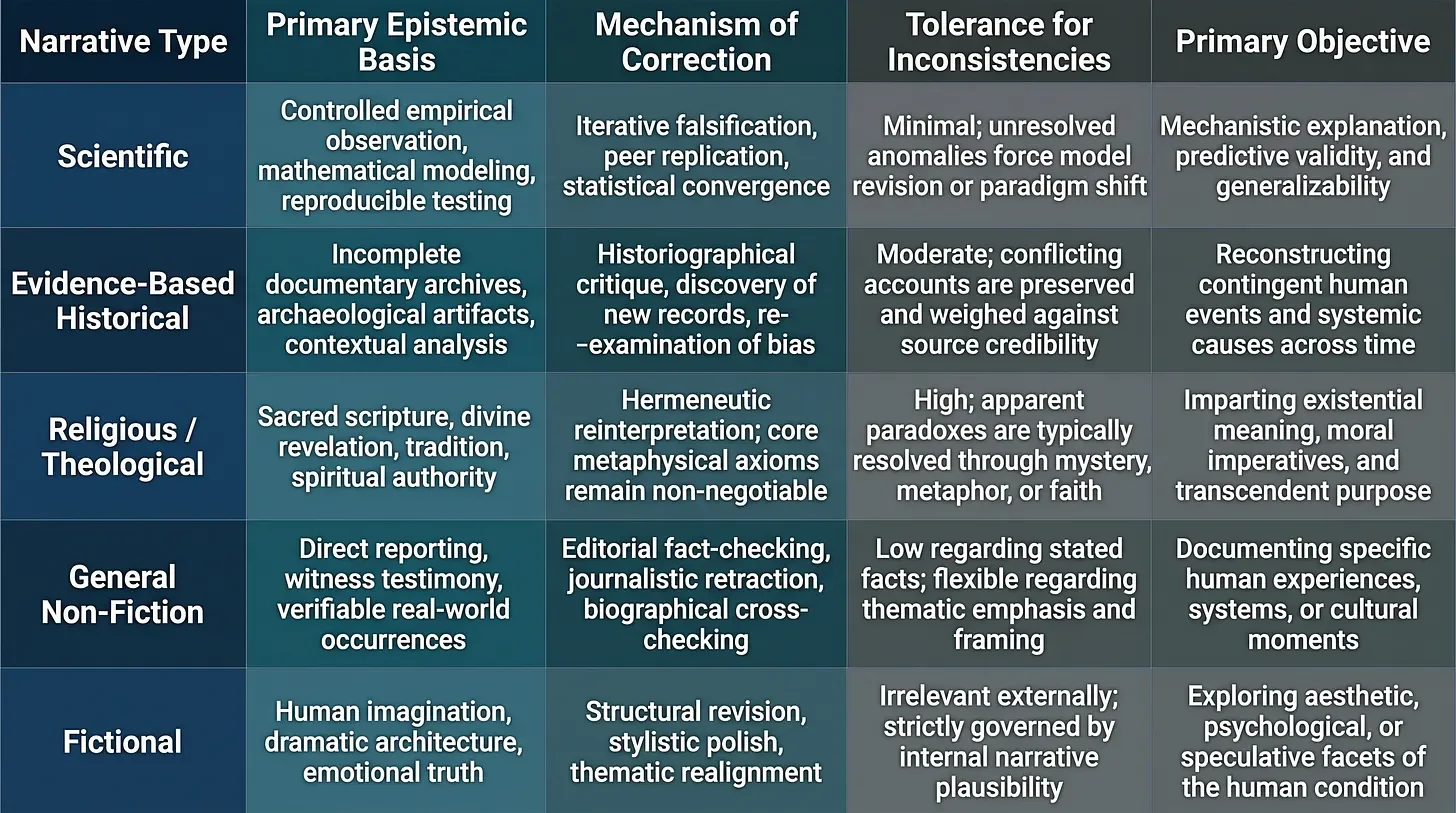
The line between a scientific model and an evidence-based historical narrative is the old Windelband distinction between nomothetic (universal, invariant laws) and idiographic (unique, unrepeatable) approaches. The standard of historical scholarship is the one set out by Leopold von Ranke in the 19th century, who held that history should be the study of “how it actually happened” (wie es eigentlich gewesen) and that it should be free of any grand philosophical teleologies. E.H. Carr, in What is History? (1961) makes the point that historical data is not like laboratory data: “The facts speak only when the historian calls on them: it is he who decides which facts to bring forward and in what sequence and context.” Of course you can’t just re-run the collapse of the Western Roman Empire or the outbreak of the First World War in a vacuum with different variables. History is therefore an interpretation of a necessarily incomplete record of facts, rather than a set of predictive, repeatable laws.
The divide between science and religion is, of course, the principle of falsifiability as articulated by Karl Popper in Conjectures and Refutations (1963). A theory only becomes scientific in Popper’s sense if it specifies what it rules out. A theory which accounts for every observation rules out nothing and therefore says nothing. A scientific theory must specify the conditions under which it would be shown to be wrong. Theological systems, by contrast, operate in what Stephen Jay Gould called the non-overlapping magisterium (NOMA): the domain of questions of ultimate meaning, purpose, and value. In Rocks of Ages (1999), Gould writes: “The net of science covers the empirical universe: what it is made of (fact) and why it is as it is (theory). The net of religion extends over questions of moral meaning and value.” When the empirical world conflicts with scripture or theology, people usually do not abandon the basic metaphysical axioms; instead, they resolve the conflict through allegorization or hermeneutic reinterpretation.
The line between scientific narrative and non-fiction/fiction lies in its authority and constraints. Narrative non-fiction is subject to the rules of dramatic tension, character, and narrative structure, but is ultimately constrained by the requirement of factual truth and public accountability. A biographer cannot simply make up a conversation. Fiction, by contrast, is free of such external verification and seeks a different kind of truth. Aristotle made this distinction in the Poetics (Book IX): “The function of poetry is to represent not what actually has happened, but what might happen... Therefore poetry is of a more philosophical and more serious character than history, for the statements of poetry are of the nature of universals whereas those of history are of the nature of singulars.” A scientific narrative is judged on its correspondence to the external world in terms of reproducible physical data. A fictional narrative is judged on its internal consistency, its power and its resonance.
Stories and descriptions of experience and phenomenon are, in a sense, magical.
The move from Old Stories to New Stories doesn’t kill the magic; it actually makes it more magical and more accessible. Rather than basing magic on supernatural whimsy, it reveals the magic of the real world. The real world is far more complex and fascinating than anything we could have invented.
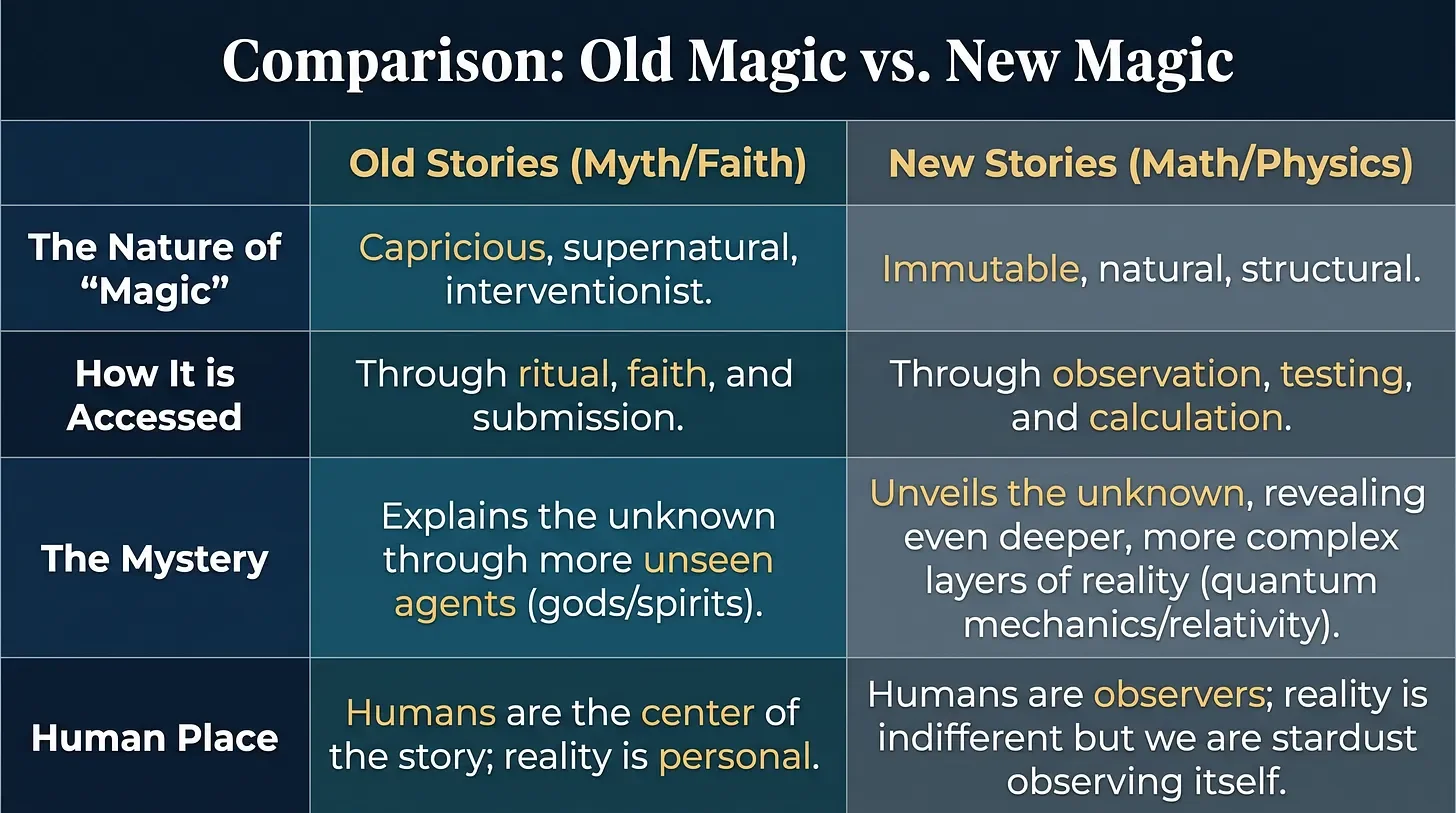
For most of human history, the “Old Stories” were our principal way of making sense of the world, an epistemic system based on revelation, authority, and emotional resonance. In that paradigm, magic was an active, interventionist force. The universe was a living, dramatic theatre with gods, spirits and moral forces at play. For many, it is today. As the poet and theologian Al-Ghazali put it, “the natural order is not a necessary connection but a habitual one, entirely contingent upon the will of God”. In those stories, rain fell because God was in a good mood, and the stars were actual beings who responded to the “power of the word” through the human voice, through ritual, and through belief. The ultimate proof of power was the miracle as an exception to the rule, the miracle being the very essence of the phenomenon and the very definition of mystery. The more you knew, the more you risked hubris. Magic in that worldview was intimate; it was poetic, very much human in its orientation, and very much the stuff of the human heart. It was also capricious, unpredictable, and entirely dependent on the whims of the unseen.
The ‘New Stories’ of the Scientific Revolution and our modern techno-industrial world (the stories based in maths, physics, and observation) removed the human from the universe. To some, this was the ‘disenchantment of the world’ (Max Weber’s term): we were taken off our pedestal and shown to be just a tiny organism on a speck of dust in an utterly indifferent and unimaginably vast universe. That story itself is a form of magic, though (I’d argue it’s more magical), as it doesn’t require belief to be true, yet its wonders are completely verifiable. I would not, however, dismiss mysticism and its insights.
This modern-day wonder starts with mathematics (maths), which is the real magic. In old stories, the wizard used a spell to achieve something in the physical world. Maths is the ultimate spell. As Wigner so famously observed, there is an “unreasonable effectiveness of mathematics in the natural sciences” which is absolutely miraculous. You can write a few abstract symbols on a blackboard and that will allow you to predict the existence of things that we’ve never actually seen, things like black holes, gravitational waves, subatomic particles, etc. You can go back to the very beginning of the universe and work out a planet’s future orbit with incredible accuracy. It’s a language that lets you do that.
Under the maths is the physics, and that reveals a whole other world which is infinitely stranger than any myth. Physics has discovered a real, invisible world that is utterly at odds with our everyday experience. We can’t see quantum entanglement, but particles can influence each other instantaneously across enormous distances (Einstein’s “spooky action at a distance” was his way of describing it). We can’t see spacetime curvature, but massive objects do curve spacetime, and that slows down time. We can’t see wave/particle duality, but at the most fundamental level, matter is in fact a cloud of probabilities until you look. Feynman put it perfectly when he said, “If you think you understand quantum mechanics, you don’t understand quantum mechanics,” which is a very good way of describing the sheer weirdness and speculation of it all, yet it is utterly, demonstrably real.
The real magic of empiricism is the power of ‘how’ rather than ‘why’. It’s all about humility, and it’s self-correcting. The old stories were full of absolute, unchanging truth. The new story is iterative. The magic of empiricism is that it forces you to test your assumptions against the universe. It demands that the universe itself show you where you’re wrong. Carl Sagan put it perfectly: “It is far better to grasp the Universe as it really is than to persist in delusion, however satisfying and reassuring.” The power of empiricism is that you can now tell the universe what you want to do and it will do it for you. Until you can’t anymore, but that’s another story. You can get rid of disease; you can transmit your voice across the planet at the speed of light; you can fly through the air in giant metal tubes. That’s not the magic of changing the laws of nature. That’s the magic of having learned the laws of nature so well that you can use them to transcend your own biology.
Today the Genies are out of the bottle and only circumstances can put them back in. Can wisdom help us live with the magic of modernity?
Ultimately, the move from Old Stories to New Stories doesn’t kill the ‘magic’ at all; it just makes it more democratic and more profound. The Old Stories told us we were created out of dust by a divine breath. The New Story tells us we are made of the detritus of dead stars, forged in stellar furnaces billions of years ago and then assembled into incredibly complex biological machines that can think, can love, and can, in fact, try to understand the universe that made them. As Carl Sagan so beautifully put it, “We are a way for the cosmos to know itself.” That quote always makes me emotional. When I was a child, I remember our church priest asking me what I thought God was, and I said something like, “God needed a creator, and that’s us.” I remember because he reminded me that I had said that a few times over the years. The math, the physics, the empiricism is a different kind of magic entirely in that it doesn’t ask you to believe in a fantasy. It simply reveals that the reality we experience every day is the fantasy and the reality underneath is far more beautiful, far more terrifying and far more wonderful than anything we could have ever invented.
But I still prefer to believe King Arthur existed. I chose to believe fantasies sometimes.
What can the word spiritual even mean in the context of biophysical existence, other than a feeling, a vague sense, or an allusion to an unknowable realm? Here, I mean a philosophical critique of spirituality from a strictly scientific or materialist perspective, interrogating the validity of “spirituality” in a world governed purely by biology and physics.
“But sir, I believe there is much, much more!”
Belief is real, in a sense. (That’s a long conversation.)
Tell me about it.
I have rarely talked with anyone about my transcendental experiences and have not sought the stories of people who claim to have had them, although I have met a few whose stories I felt were profound and sincere.
My supernatural experiences are deeply personal and indescribably universal. Universal? In what sense? I feel muted and expansively liberated, rested, and unlimited—in the moment, at peace, but not always; dilated; living is movement within constraints.
While the experience happens to me alone, the core truths, feelings, and realizations it unlocks connect me to a shared, collective human reality that transcends individual identity.
There is paradox: The small, loud, everyday ego—with all its specific anxieties, names, and labels—is silenced. By turning down the volume on the individual “self,” I feel connected to a vast, boundless existence. It is universal because I am tapping into a state of pure being that belongs to everyone, not just their specific ego.
Why explain it at all?
What puzzles me most about these stories, clouded by time and our lust for power, recognition, status, attention, control, and titillation, is why people tell them and what true contexts, traditions, and desires within the culture inspired and required them. Why did someone tell the story? I say story because they are not chronicles told by historians relying on hard evidence, and because they are full of mysteries subject to interpretation by readers who, for centuries, have argued over the true meaning of the various themes, characters, and events in the texts.
When one is puzzled this way, there is always more to discover and reveal, and plenty of room to grow. This quality makes stories classics that people across cultures cling to and value.
People have given their lives to great stories.
The longevity of both the Arthurian romance and the Nag Hammadi codices rests upon a common ground: they are both living mythologies. They are not fixed monuments of the past. They are constantly engaged with, reinterpreted, reworked, and repurposed over the centuries as societies respond to changing political regimes, scientific understandings, and existential fears. This explains their endurance. When we ask why these stories have survived and why our understanding of them necessarily changes over time, we are in fact asking why they are mythologies. The line between history and narrative myth is not a wall; it’s porous. Human consciousness doesn’t just record what happens; it requires meaning, and meaning requires a story.
The Nag Hammadi Library: Heresy, Power, and the Anatomy of Gnosis
When Muhammad Ali al-Samman came across the thirteen leather-bound papyri near Jabal al-Tarif in Upper Egypt in December 1945, he discovered far more than ancient manuscripts. He discovered an alternative theological world which fourth-century orthodoxy had spent centuries trying to bury.
Before this discovery, all our Western knowledge of ‘Gnosticism’ had been almost entirely filtered through the polemics of the early church fathers, most notably Irenaeus of Lyons in his late second-century work Against Heresies. Irenaeus operated within the imperial model of the Church, in which unity was predicated on uniformity (one God, one Christ, one Church, one bishop).
The Nag Hammadi texts (The Gospel of Thomas, The Gospel of Philip, The Gospel of Truth, The Apocryphon of John, etc.) prove that the early Christian movement was incredibly diverse rather than a single monolithic entity. As Pagels notes in her seminal work on the library, the early debates were essentially debates about the nature of the Church and its social/political structure. An institutional church requires an episcopal structure which controls the distribution of grace and doctrine. The Gospel of Thomas and the other texts take a very different view of salvation. Salvation isn’t about accepting a set of external doctrines or about depending upon a sacerdotal hierarchy. It’s about gnosis, the direct, personal experience of the divine spark which is already present within us.
This is precisely the argument that Bart Ehrman makes in Lost Christianities and Heaven and Hell. Ehrman shows that the very idea of the soul being immortal and going straight to heaven or hell at the moment of death (i.e., an immediate eternal afterlife of reward or punishment) was not part of the apocalyptic Judaism of the historical Jesus (Yahshua). Jesus himself expected a bodily resurrection within a radically transformed earthly Kingdom of God. Only as Christianity moved into the Hellenistic world did it pick up the idea of Platonic dualism (the separation of the pure spirit from the corruptible body).
Over the last century, modern developments in philosophy, psychology, and science have changed the whole game of reading these texts. From a purely psychological point of view (which was really brought home to us when the Jung Codex was shown to Jung in the 1950s), the Gnostic cosmologies of the Demiurge, Sophia and the Archons were no longer read as some mad metaphysics but as very sophisticated phenomenological allegories of individuation and the self in its struggle against the social conditioning of the unconscious. At the same time, the post-colonial and secular histories have completely demolished the notion that the fourth-century conciliar victors were in any way closer to the truth. They were, in fact, the theological wing of an administrative faction that used the Church’s authority to secure its own survival as an entity within the Roman imperial system under Constantine. Recovering the voices of those who were actually there and experiencing these things requires immense epistemic humility. What the empire calls heresy is often simply personal, mystical intuition that threatens the establishment’s institutional control.
The Matter of Britain: The Evolution of the Tragic, Flawed Sovereign
Parallel to the suppression and rediscovery of the spiritual texts is King Arthur’s evolution from a vague post-Roman Celtic warlord into the archetypal chivalric king.
Did Arthur exist? Modern archaeology and historical scholarship (from Leslie Alcock’s work at South Cadbury to present-day surveys of fifth-and sixth-century Sub-Roman Britain) have found no positive evidence for a single Arthurian high king. All we have from history are a few very brief and rather dubious references: Nennius in his 9th-century Historia Brittonum, who tells us of a warrior who fought twelve battles against the Saxons, and the earlier (and rather more reliable) Gildas, who speaks of the Battle of Badon but makes absolutely no mention of Arthur.
It wouldn’t stay a dark age guerrilla tale. Geoffrey of Monmouth took it up in the 12th century with his Historia Regum Britanniae and turned Arthur into an imperial British conqueror to suit Norman political purposes. Chrétien de Troyes came along a few decades later and added the romance of the feudal court to the tale, introducing Lancelot and the Grail quest. By the time Sir Thomas Malory compiled Le Morte d’Arthur in the 15th century, amid the terrible, bloody dynastic wrangling of the Wars of the Roses, Arthur’s court had become a tragic vision of a civilization breaking up from within.
One might wonder what myths and legends will emerge centuries after the catastrophic fall of global modern civilization?
Arthur’s lasting power is entirely dependent on his moral failings rather than any theological virtue. Camelot attempts to impose order, justice, and nobility on a savage world, and the very structure of chivalry brings it down through a series of inescapable, intractable conflicts of loyalty between king, romantic love, clan, and moral law. His tragic blind spots make him utterly human, whether it’s the blind spot that leads him to father Mordred in an incestuous relationship with Morgause or the blind spot that lets him ignore the affair between his queen and his most trusted knight until it becomes a public scandal—putting babies out to be swallowed up by the sea? Oh, dear. In the end, his famous epitaph sums up the human condition in the face of defeat: Rex Quondam, Rexque Futurus, the Once and Future King. We return to Arthur not because he was perfect, but because his noble experiment, however flawed, is one we are still prepared to continue.
One of my favorite King Arthur movies.
Biophysical Materialism and the Ineffable Encounter
So what is a transcendental experience from a purely biophysical point of view? A modern neuroscientist or evolutionary biologist might point to downregulation of the brain’s default mode network (the DMN). The DMN underpins self-referential thought, the sense of ego, and the sense of being a separate entity from the world around us. When the DMN is quieted (whether through deep contemplative prayer, trauma, drugs, or some other form of altered state), the neural boundary between the ‘self’ and the ‘world’ dissolves. The brain experiences unity because the neural mechanism that produces the sense of separation has effectively switched off. From that perspective, a materialist argument would be that ‘spirituality’ is just a case of misattribution. It’s an ancient neurochemical defense mechanism or a sensory quirk which we have mistakenly interpreted as a form of metaphysical revelation.
Some say LSD and mushrooms are a shortcut to such experiences.
Yet that very explanation is a classic category mistake. You can’t explain away the reality of an experience by describing its neurological mechanism. You can’t explain away the power of the experience by describing its neurological mechanism. You can’t explain away the experience of a Bach partita by explaining how a violin makes a sound via friction and tension on a string.

Andrés Curruchich Cúmez (Guatemala), Plaza de Comalapa (Comalapa Square), n.d.
This is where a relational ontology provides the crucial philosophical link. If reality is not in fact a collection of discrete, isolated objects (as we so often assume) but a web of relationships (as contemporary physics and philosophy would have us believe), then human consciousness is itself fundamentally relational. Meaning and value do not exist as inert physical things to be discovered in isolation; they arise only in the encounter between the observer and the observed. In that light, the transcendental paradox of silencing the noisy, defensive ego to reveal a universal ground of being fits perfectly with the notion of gnosis. The Gospel of Thomas is explicit that the kingdom is entered by making the inner like the outer and the high like the low. The kingdom is not some distant, otherworldly heaven to be accessed by fleeing the ego. It is the very transformation of perception that takes place in the here and now. The agnosticism of the genuine seeker is not a sign of failure but an act of epistemic hygiene, a rejection of the facile comfort of fundamentalism and an equally firm rejection of the dead dogma of reductive materialism.
Why the Stories Endure
We tell stories because unvarnished reality doesn’t come with a plot. Raw historical data is just a series of physical events, survival strategies, and political conquests.
When human beings come up against the mysterious, the suffering, and the fleeting glimpse of the transcendent, we need containers in which to hold the paradox. Dogma is dead because it is so rigid in its literalism and its insistence on obedience. It wants the story to be historicized and used as a tool of social cohesion and imperial control. The great myths—the search for the Holy Grail, the secret sayings of the enigmatic sage in the Egyptian jar, the rise and fall of the king who is not quite a king—survive because they don’t have a definitive end.
They ask each generation to bring its own wounds, its own scientific discoveries, its own spiritual longings to the text and see that underneath the armor of Camelot and the obscure allegories of the desert hermits is the same old human question: how do we live honorably, how do we seek the truth honestly, and how do we make peace with our own limitations in a world that is ultimately indifferent?