
Do we have the will to make choices with conviction? Shall we watch it burn with pride in thinking we know what’s what?
I started working on this a couple of years ago. After listening to a BBC In Our Time Episode a week ago and having a recent friendly yet animated chat with a friend, I remembered this effort and revisited it. Over the last few days, I have finally finished it with an updated eye. Please comment, even if your comment is about why you won’t comment. I am interested in what you think. Thanks.
Five hundred and ten years ago, in 1516, a Tudor lawyer named Thomas More published a slim, mischievously ambiguous book called Utopia—and five years earlier, his closest intellectual sparring partner, Desiderius Erasmus of Rotterdam, drafted In Praise of Folly while confined by ill health in More’s London house. Between them, those two Renaissance humanists diagnosed nearly every pathology currently eating our civilization alive: the enclosure of the commons, the capture of the state by a “conspiracy of the rich,” the manufacture of senseless wars by vainglorious rulers, the hijacking of religion by money-mad careerists, and the tragic ease with which ordinary people are pacified by flattery, spectacle, and tribal fables. Yet here we sit in late November 2026, armed with five centuries of printing presses, Enlightenment philosophy, and instantaneous planetary data—and our civilization is sleepwalking straight into a synchronized polycrisis.
Sir Thomas More coined the word utopia in 1516 to mean "no place" (from the Greek ou-topos), while intentionally playing on the sound of "good place" (eu-topos).
Look at the ledger of human attention right now. As of September 30, 2026, Sony Interactive Entertainment estimated a record 127 million monthly active users on PlayStation Network, with cumulative PlayStation 5 hardware sales to retailers surpassing 100 million units in November—just ahead of the November 19 launch of Grand Theft Auto VI. Meanwhile, on YouTube, a world-class BBC Radio 4 In Our Time seminar unpacking Thomas More’s Utopia with three leading Renaissance scholars sat at roughly 5,000 views, and fewer than 40 likes a month after posting. Over a single November weekend, Joe Rogan’s episode #2584 with former CIA covert operations officer Mike Baker raced past 1 million views—a 200-to-1 attention ratio achieved in seventy-two hours. That asymmetry is not an accident of bad marketing. It is the exact signature of a culture trained to stare at the walls of its own zoo enclosure while the Players of the Great Game keep the Wealth Pump running at record throttle.
Let us be brutally clear about the thesis here, because sentimentality will not save us. Our world does not suffer from a shortage of solutions, engineering brilliance, or moral insight. As Idries Shah warned—a line we keep pinned to the masthead at COSPOLON—“This is a civilization that is going down, not because it hasn’t got the knowledge that would save it, but because nobody will use the knowledge.” What we lack is a culture of human beings educated to see reality from a multiperspectival vantage point, disciplined enough to own their Will, and courageous enough to evolve continuously toward their ideals. Instead, Christians no longer understand Christianity; Humanists no longer understand Humanism; voters chase emotionally weaponized culture wars. At the same time, their representatives trade stocks in sectors they regulate, and the planet's biophysical foundation buckles beneath our civilizational hubris. If we want any chance of navigating what is coming—or at least preserving our sanity and dignity inside the Solon if the imperial Polis cannot be saved—we need to step outside the enclosure and audit our entire epistemic architecture from Athens to Rotterdam to Washington.
The Digital Zoo Enclosure and the Architecture of Diversion
Watch how most modern people inhabit the world. They see only what is placed directly in front of their eyes, as if pacing a well-tended zoo enclosure—fed on schedule, stimulated by curated cages of outrage and entertainment, while the wider realities of local community (the Solon), institutional power (the Polis), and planetary limits (the Cosmos) are scarcely considered. Circumstances dictate what they feel, what they buy, whom they hate, and how they vote. A genuinely multiperspectival awareness—zooming out from personal impulse to the structural mechanics of the Polis and the hard thermodynamic boundaries of the Cosmos—is rarely taught and actively discouraged.
Plato sketched the blueprint of this enclosure twenty-four centuries ago in Book VII of The Republic. Socrates asks Glaucon to picture prisoners chained by the legs and neck since childhood inside an underground cavern, unable to turn their heads, staring forever at shadows cast on a wall by puppeteers walking behind a fire. Because they have never seen anything else, “the truth would be literally nothing but the shadows of the images.” Worse still, Socrates warns that if someone breaks free, climbs painfully into the sunlight, and returns to liberate his companions, the prisoners will mock his blinking eyes and—if they can get their hands on him—kill him rather than surrender the cozy certainty of their cave. More than four centuries later, writing around 100 AD, the Roman satirist Juvenal watched a once-sovereign citizenry trade away its political agency to an imperial oligarchy and nailed the epitaph in Satire X: the Roman public, “which formerly gave military power, high offices, legions, all, now contains itself, and eagerly desires two things only—bread and circus games” (panem et circenses).
Today’s enclosure does not need iron shackles because we pay a monthly subscription to stay locked inside. Media theorist Neil Postman saw this coming in Amusing Ourselves to Death (1985), arguing that Aldous Huxley’s Brave New World, not George Orwell’s 1984, accurately prophesied our fate. “What Orwell feared were those who would ban books,” Postman wrote; Huxley feared a world where no one would need to ban a book because nobody would want to read one. Orwell worried that power would control us by inflicting pain; Huxley understood that power would control us by inflicting pleasure, rendering us “insensible to contradiction and narcotised by technological diversions.” Guy Debord called this total environment The Society of the Spectacle (1967), where lived civic agency is displaced by passive consumption of mediated images. Philosopher C. Thi Nguyen adds a sharper contemporary diagnostic: modern algorithmic ecosystems seal us inside epistemic bubbles—information structures that quietly omit outside voices—so that our narrow feed feels like the entire universe.
Watch what happens when you mix Huxleyan distraction with tribal engineering. Go to a major mixed martial arts or sporting event in the United States and listen to the crowd erupt into deafening chants of “USA! USA!”—even during bouts where neither fighter in the cage is from the United States. Sociologists studying American Institutionalized Sports Nationalism (AISN) document how modern sporting spectacles harness what they term “collective effervescence”—the intoxicating rush of communal, impassioned ritual—to sacralize flags, anthems, hyper-competition, and militaristic might. Nor is this merely organic folk patriotism: sports researchers note that the Department of Defense paid U.S. sports leagues to stage military tributes during pregame anthems. Scholars examining the UFC describe how the promotion functions as a powerhouse of cultural hegemony and American exceptionalism, funneling crowd energy vertically upward toward political power and rigid social hierarchy. When you are drunk on collective effervescence, cheering a flag in a fight between two foreigners, you are not thinking about ecological overshoot, corporate lobbying, or the dismantling of the commons. You are doing exactly what the Players of the Great Game need you to do: burning your emotional vitality on theater.
Two Friends in 1516: Thomas More, Erasmus, and the Mirror of Folly
This is where we have to pull Sir Thomas More and Desiderius Erasmus back off the dusty shelf—not as quaint museum relics, but as two of the sharpest whistleblowers in Western history. In the BBC Radio 4 In Our Time episode on Utopia (broadcast in September 2026), host Misha Glenny gathered three distinguished scholars—Joanne Paul (University of Sussex), Cathy Shrank (University of Sheffield), and Laura Ashe (University of Oxford)—to unpack why More’s tiny 1516 book still unsettles us five centuries later.
More was playing an extraordinarily sophisticated literary game with the fictional island he invented and placed in the mouth of the traveling stranger Raphael Hythloday. As Cathy Shrank explained on the panel, More deliberately structured Book I as an echo of Plato’s Republic—meeting outside a church after mass before retiring to a house for philosophical debate—while fusing Platonic seriousness with the biting satirical irony of the classical dialogist Lucian. This was never meant to be a naive blueprint handed down from a mountaintop. Misha Glenny captured the scholarly consensus neatly: More’s notoriously ambiguous text has been read simultaneously as “a blueprint for an ideal society, a scathing satire and a timeless warning.”
Strip away the irony, though, and look at the structural X-ray More performed on early capitalist England in Book I. Through Hythloday, More indicted the violent enclosure of common lands by wealthy landowners, who converted peasant farmland into lucrative wool pastures. In Gilbert Burnet’s classic 1684 translation—drawn, as its editor noted, “by the same sense of unreason in high places that caused More to write the book”—Hythloday delivers a line that still draws blood: “Your sheep, which are naturally mild, and easily kept in order, may be said now to devour men and unpeople, not only villages, but towns.” Peasants thrown off the commons were forced into vagrancy and theft, and then punished by the state for stealing to survive—leading More to ask the devastating question that indicts every carceral racket from Tudor London to America’s private-prison war on drugs: “What else is to be concluded from this but that you first make thieves and then punish them?” As Joanne Paul noted on In Our Time, Karl Marx read that exact passage in Book I and underlined it in his own copy while writing Das Kapital.
More did not stop at agrarian displacement. By the close of Book II, Hythloday delivers a verdict on statecraft that echoes my 2026 GlobeHackers dispatches: “I can have no other notion of all the other governments that I see or know, than that they are a conspiracy of the rich,” advancing their own private interests under the pretense of managing the commonwealth. Look at what More’s Utopians abolish and despise in Burnet’s translation: they abolish private property and regard the hoarding of gold as a “false shadow of joy,” marveling that human beings allow themselves to be valued less than a useless yellow metal. They ban lawyers entirely—dismissing them as “a sort of people whose profession it is to disguise matters and to wrest the laws”—and keep laws few and plain enough for every citizen to read. They refuse diplomatic treaties because “kindness and good nature unite men more effectually and with greater strength than any agreements whatsoever.” And they “detest war as a very brutal thing, and which, to the reproach of human nature, is more practiced by men than by any sort of beasts,” insisting that “there is nothing more inglorious than that glory that is gained by war.”
Yet the In Our Time scholars refused to let us romanticize Utopia, and their caveat is crucial for our own moment. Joanne Paul emphasizes in her scholarship that for More, Pride—the vice that “measures her prosperity not by her own goods but by others’ wants”—“ is a vice which necessarily cuts across the bonds which should unite people . . . [and] is the ultimate social, religious, and political problem.” To suppress pride, however, Utopia relies on monastic rigidity and relentless mutual oversight—raising the unsettling question modern editors pose: “Can we really stand a society in which everybody watches everybody?” Misha Glenny observed that while Utopia anticipates Karl Marx and Friedrich Engels’s vision in The German Ideology of versatile citizens moving freely between daily labor and intellectual criticism, More’s island carries a chilling austerity—“an absence of fun for fun’s sake.” Even a generation later, as Cathy Shrank pointed out, the Elizabethan humanist statesman Sir Thomas Smith (De Republica Anglorum, 1564) was already dismissing both Utopia and Plato’s Republic as “a vain fantasy of philosophers.”
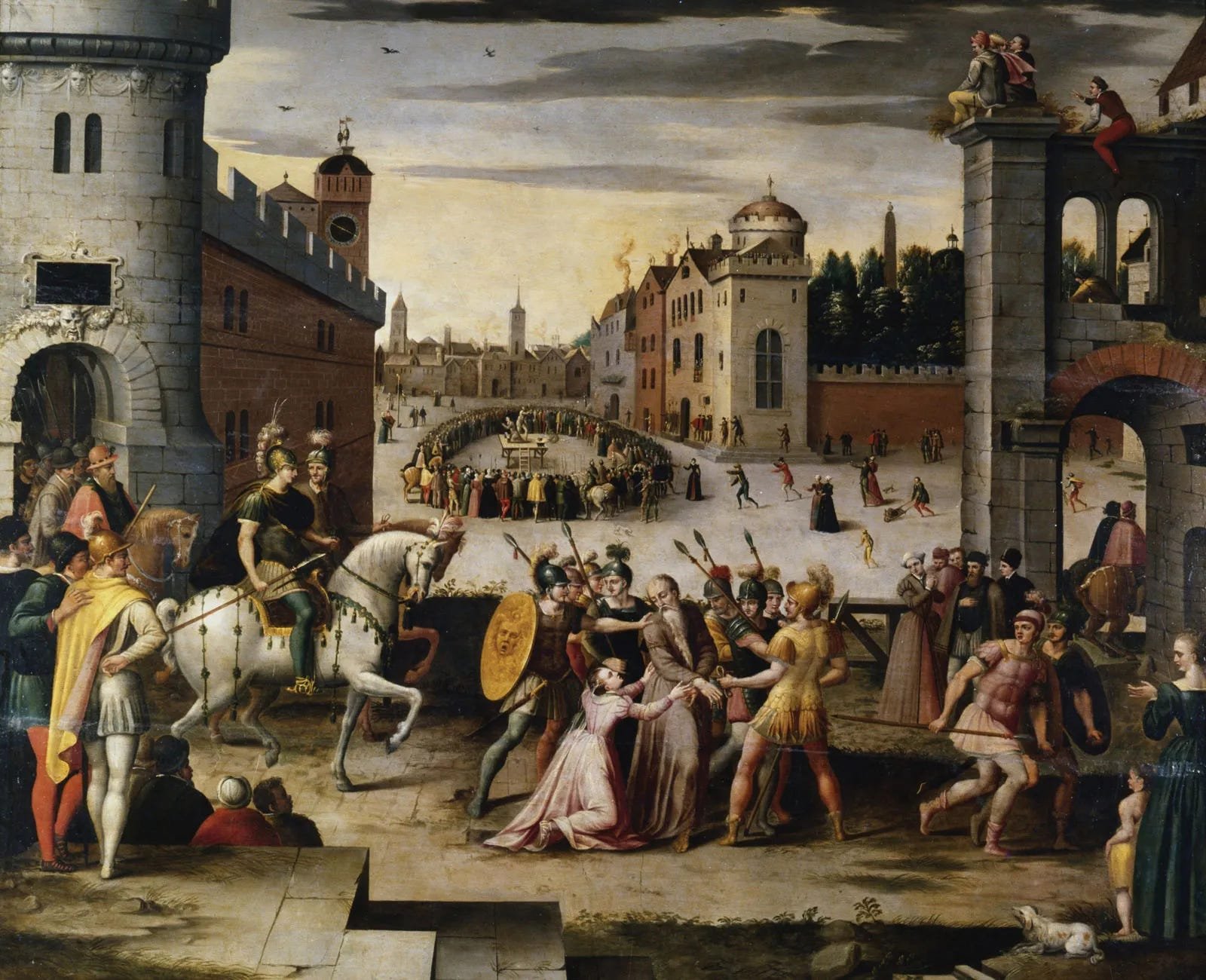
And here is the tragic hinge that Laura Ashe highlighted on the In Our Time panel. In Book I of Utopia, Hythloday warns that entering a king’s council is a fool’s errand: “rather than being able to do any good, you find yourself among colleagues who are easily able to corrupt even the best of men.” Watching crowds swarm in the streets soaking wet and refusing to come indoors, wise people stay inside, “seeing they cannot remedy the folly of the people.” More himself eventually rose to Tudor political power, refused the king’s oath, and ended up imprisoned in the Tower of London, facing execution. There, as he explained, More wrote his final work, A Dialogue of Comfort Against Tribulation (1535)—no longer an urbane humanist dialogue where you playfully weigh both sides and then adjourn to dinner, but a dialogue forced to end in unshakeable moral conviction: “Yes, I can die for my faith.” More had to step out of irony and own his Will at the cost of his life.
Now set More’s friend Erasmus beside him. As Christian History Issue 145 (“Erasmus: Christ’s humanist”) and historian Paul Michelson remind us, Erasmus was the first true bestselling author of the print age: by the 1530s, roughly 20 percent of all published books in Europe bore his byline, with In Praise of Folly appearing in over 600 editions and his Colloquies in over 300. Even the Greek title of In Praise of Folly—Morias Enkomion—was an affectionate pun on More’s own surname (moria meaning folly). As Anthony Grafton recounts in his foreword to The Praise of Folly, when the two first sparred anonymously at dinner, Erasmus exclaimed, “Either you are More, or no one,” and More fired back, “You are either Erasmus, or the devil.”
What makes In Praise of Folly so devastating in 2026 is that Erasmus lets Dame Folly take the podium and boast about how she—not reason, not wisdom—actually runs human civilization. “Man’s mind is so formed that it is far more susceptible to falsehood than to truth,” Folly observes. How did ancient Roman elites pacify mutinous commoners? Not with philosophical argument, Folly laughs, “but a ridiculous and childish fable.” Folly explains that social compliance rests on mutual self-delusion and flattery—the exact psychological grease that enables “the deification of the most wicked tyrants with public ceremonies.” Then Erasmus drops the comedic mask and turns Folly’s blade on the Players of the Great Game of sixteenth-century Christendom: monarchs who wage predatory wars, scholastic theologians spinning absurdities, and church hierarchs who turned salvation into a cash-extraction machine. “Nor are princes by themselves in their manner of life,” Folly sneers, “since popes, cardinals, and bishops have so diligently followed their steps that they’ve almost got the start of them.” If even a single grain of Christian wisdom entered the papacy, Folly mocks, it would ruin their entire “marketplace” of wealth, honors, revenues, and indulgences—a world where “to teach the people is troublesome,” “to pray is idle,” and “to shed tears is miserable and womanish.”
Erasmus saw war with the same unsentimental clarity as More. In his massively popular Adages (expanded to over 4,100 entries by 1536), he gave Europe the immortal warning: “War is a treat for those who have not tried it.” And war has always been THE racket. Citing Cicero, he insisted that “a disadvantageous peace is better than a just war,” warning that “the good Christian prince must be suspicious of all wars, however just.” And when the Reformation erupted into doctrinal warfare, Erasmus refused to join either faction’s fanaticism. Rejecting the popular gibe that “Erasmus laid the egg that Luther hatched,” he retorted in 1523 that he had laid “a hen’s egg: Luther hatched a bird of quite different breed.” He wanted reform through education, philology, inner piety, and sober accommodation—never sectarian slaughter.
The Great Amnesia: Why Christians Don’t Understand Christianity and Humanists Don’t Understand Humanism
Reading Erasmus and More side by side exposes one of the ugliest blind spots of our era: our two foundational Western moral traditions have been hollowed out into unrecognizable caricatures of themselves. Christians largely do not understand Christianity, and modern Humanists largely do not understand Humanism.
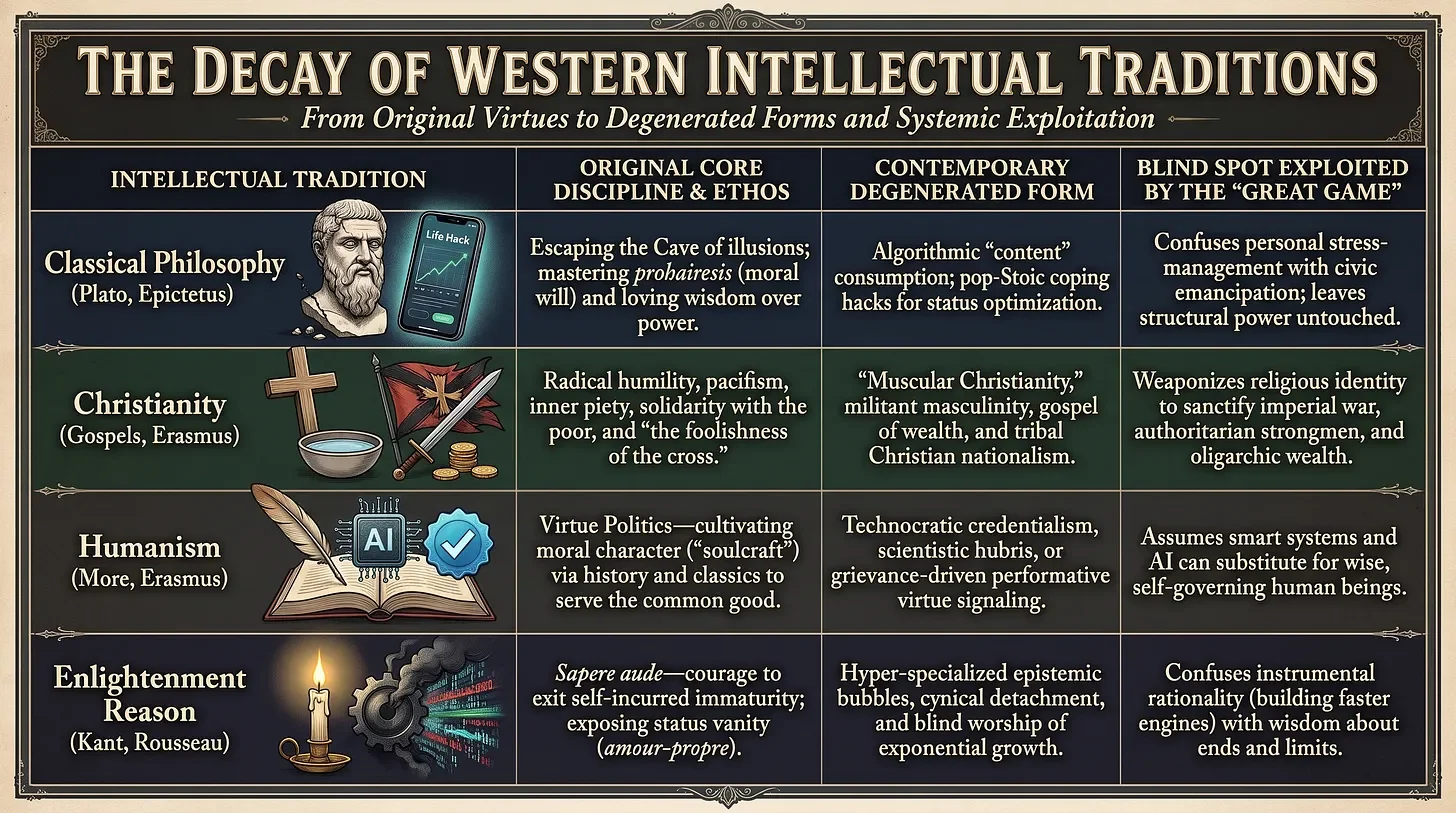
Start with Christianity. What did Erasmus actually mean by his “philosophy of Christ” (philosophia Christi), articulated in his Handbook of the Christian Soldier (1501) and his groundbreaking 1516 Greek New Testament? He meant stripping away outward tribal ritual, clerical power-grabs, and mercenary greed to recover radical inner transformation, humility, mercy, and universal peace—so accessible that “the plowman would sing a text of the Scripture at his plow and that the weaver would hum them to the tune of his shuttle.” In the electrifying climax of In Praise of Folly, Erasmus turns the entire satire upside down: true Christianity is itself the supreme “folly” in the eyes of worldly power, because it yields “none of the things that ordinary, prudent men and women seek: not wealth, not power, not fame.” Instead, “Christ himself, that he might the better relieve this folly, being the wisdom of the Father, yet in some manner became a fool when taking upon him the nature of man... Nor did he work this cure any other way than by the foolishness of the cross.”
Now walk into an American megachurch or scroll through Christian Nationalist media in the Anglosphere today. Where is the humble Galilean peasant who repudiated imperial violence, lived among the dispossessed, and died under Roman crucifixion—the same imperial terror machine that, decades later in 70 CE, saw Titus crucifying as many as 500 Jewish fugitives a day outside Jerusalem until the hillsides ran out of wood for crosses? He has been airbrushed out and replaced by an action hero. Historian Kristin Kobes Du Mez documents this ideological mutation with surgical precision in Jesus and John Wayne (2020). In the nineteenth century, ideals of Christian manhood still emphasized gentlemanly self-restraint. That gave way in the late nineteenth and early twentieth centuries to “muscular Christianity”—a conflation of imperial nationalism, competitive sport, and the gospel of wealth—which hardened in the 1940s and 1950s into militant patriarchal masculinity. As The Christian Century observed in reviewing Du Mez’s history: “This fused evangelicalism was born into a newly ascendant empire. To win, it had to make room for militarism and nationalism. The empire needed Christian boys for cannon fodder, so aggression itself was redefined as Christian.”
Du Mez nails the mechanism: “The products Christians consume shape the faith they inhabit.” Rather than drawing from deep biblical exegesis, evangelical culture absorbed Hollywood swagger, crowning John Wayne’s Sergeant Stryker as “the touchstone for authentic Christian manhood”—celebrating rugged, ruthless heroes “unencumbered by traditional Christian virtues.” Fear was actively stoked from the pulpit to consolidate pastoral power, and Jesus himself was remade into a tattooed warrior wielding a bloody sword, charging into battle. The excruciating Mevangelical needs a heroic, conquering Jesus because an imperial culture addicted to dominance cannot stomach a humble one. Erasmus would have wept—or written a second volume of Folly scorching enough to melt the printing press.
Yet secular Humanists have zero grounds for smugness, because they have committed an equally catastrophic act of historical amnesia. Ask a modern secular humanist what Humanism means, and you will likely hear a polite catechism of atheism, scientific rationalism, and technocratic progress—a nineteenth-century project invented, as Harvard intellectual historian James Hankins observes, “about providing a substitute for religion” when faith began waning in Europe.
That is not what Renaissance Humanism was. In his landmark study Virtue Politics: Soulcraft and Statecraft in Renaissance Italy (2019), Hankins—echoed by Oxford historian Noel Malcolm—recovers the real tradition. Renaissance thinkers did not generally call themselves “humanists”; they called their educational program the studia humanitatis—the deep study of ancient literature, history, biography (Plutarch and Livy), rhetoric, and moral philosophy. Most were devout Christians who followed St. Basil of Caesarea in believing humane studies sharpened Christian virtue. More importantly, their entire political project rested on a premise that modern institutional technocracy has completely abandoned: “Soulcraft, they believed, was a precondition of successful statecraft.” Echoing Thucydides’s maxim—“Men, not walls, make a city”—they recognized that no constitutional blueprint, market algorithm, or legal code can rescue a society whose leaders and citizens are morally rotten. You have to reform the materia prima of politics: human character itself.
Modern secular humanism kept the cleverness and threw out the soulcraft. It inherited Niccolò Machiavelli’s rupture from virtue politics—trading character formation for institutional mechanics, procedural bureaucracy, and technological leverage—or devolved into what Noel Malcolm critiques as performative “virtue signaling” animated by partisan grievance and Nietzschean ressentiment. As Hankins warns, wisdom is never transmitted by credentials or software updates alone: “Example is more important than precept... In the end, cor ad cor loquitur, humanity is transmitted by humanity.”
The Tooth-to-Tail Illusion: Why an Empire of Clerks Needs Warrior Myths
There is a telling structural reason why the Anglosphere is so obsessively hungry for mythic heroes—whether in UFC cages, Hollywood westerns, or weaponized pulpits. It is psychological compensation for how modern empires actually operate.
Look at the anatomy of a modern Western standing army. In the public imagination, military power is a cinematic brotherhood of rugged front-line warriors kicking down doors. In empirical military logistics, it is overwhelmingly an industrial bureaucracy. In his U.S. Army Combat Studies Institute monograph The Other End of the Spear: The Tooth-to-Tail Ratio (T3R) in Modern Military Operations (2007), military historian John J. McGrath tracked how technological modernization inexorably inflates the non-combat support “tail” relative to the combat “tooth.” Every shiny upgrade demands exponentially more fuel, maintenance, software, contractors, and supply chains: McGrath noted that upgrading from the M60 Patton tank to the M1 Abrams tripled fuel consumption—giving the army more lethal teeth, yes, but a vastly heavier logistical tail. A 2014 defense study by Jacques S. Gansler and William Lucyshyn confirmed that across the entire U.S. Department of Defense, only 17 percent of personnel were classified as performing combat roles.
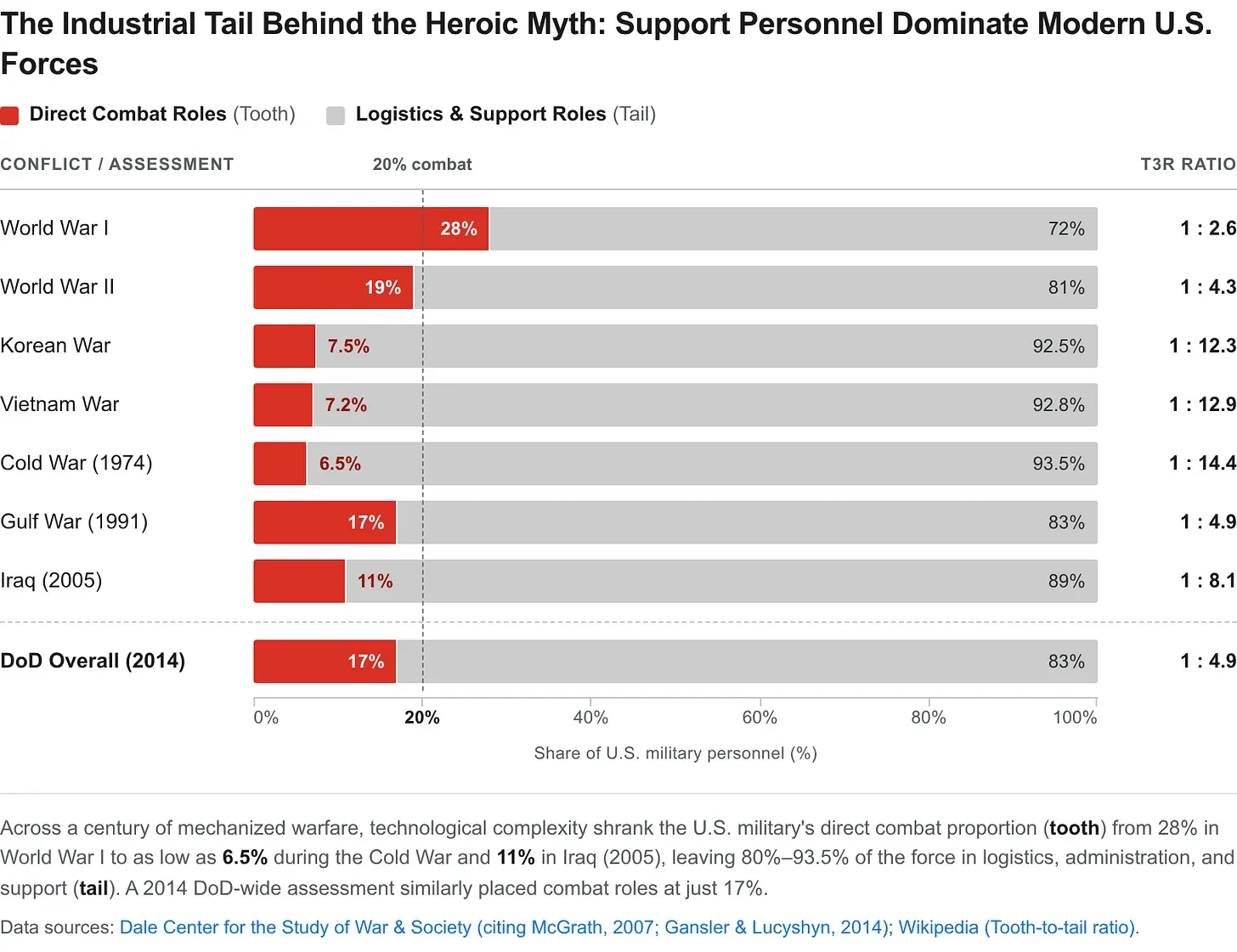
Look at what those figures actually reveal. The Western Military-Industrial Complex is not a band of Spartan heroes; as I have argued on the GlobeHackers blog, it is the “Iron Lung of Empire” and the “primary omnicidal heat engine” of financialized capitalism—an immense energy-burning, subsidy-laundering logistical apparatus where anywhere from roughly five to more than fourteen support personnel stand behind every combat soldier across modern U.S. deployments, including over eight to one in Iraq (2005).
Will military jobs be the only jobs left as accelerationist ideologues, incentivized by the wealth pump of our global market economy, race to burn down modern civilization?
Contrast that briefly with an irregular, decentralized resistance force like Yemen’s Ansar Allah (the Houthis)—not to romanticize them, since their parallel supervisory apparatus is deeply authoritarian and analysts note their willingness to treat Yemeni civilians as expendable in pursuit of regional ambitions, but to see the structural contrast clearly. No publicly verified tooth-to-tail dataset exists for Ansar Allah comparable to McGrath’s U.S. Army audits. Yet, military and regional analyses describe a fundamentally different force architecture: rooted in northern Yemeni tribal councils mobilizing tens of thousands of local fighters, decentralized guerrilla roots built around small teams of 20 to 30 fighters, local resource recycling, and low-cost asymmetric drones and missiles contesting major naval powers across the Red Sea without a globalized multi-trillion-dollar corporate supply tail.
In a Western society where the overwhelming majority of people sit behind desks, dashboards, or glowing consoles inside a hyper-complex logistical machine, everyday life feels abstract, precarious, and stripped of tangible agency. So the culture craves vicarious heroism like a starving organism craves salt. We cheer bloodsports, fetishize military aesthetics, and rewrite a crucified Jewish peasant into a gun-toting action hero. Meanwhile, the real machine quietly converts buried sunshine and public tax dollars into shareholder equity.
The Wealth Pump, Rigged Politics, and the Theater of Accountability
While ordinary citizens are busy fighting culture-war ghosts inside the enclosure, what is actually happening to the commonwealth? Complexity scientist Peter Turchin (End Times) gave us the exact mechanical term for it: the “wealth pump”—a structural engine that systematically siphons surplus from workers and the middle strata up to a tiny elite while simultaneously driving “elite overproduction,” flooding the system with frustrated credentialed aspirants fighting a zero-sum prestige tournament.
How many monopolies can there be?
We do not have to guess whether the Wealth Pump is running in late 2026. The Board of Governors of the Federal Reserve System handed us the receipt on September 18, 2026, in its Distributional Financial Accounts covering Q2 2026. Look at the distribution and trajectory below before we unpack what they mean for our politics.
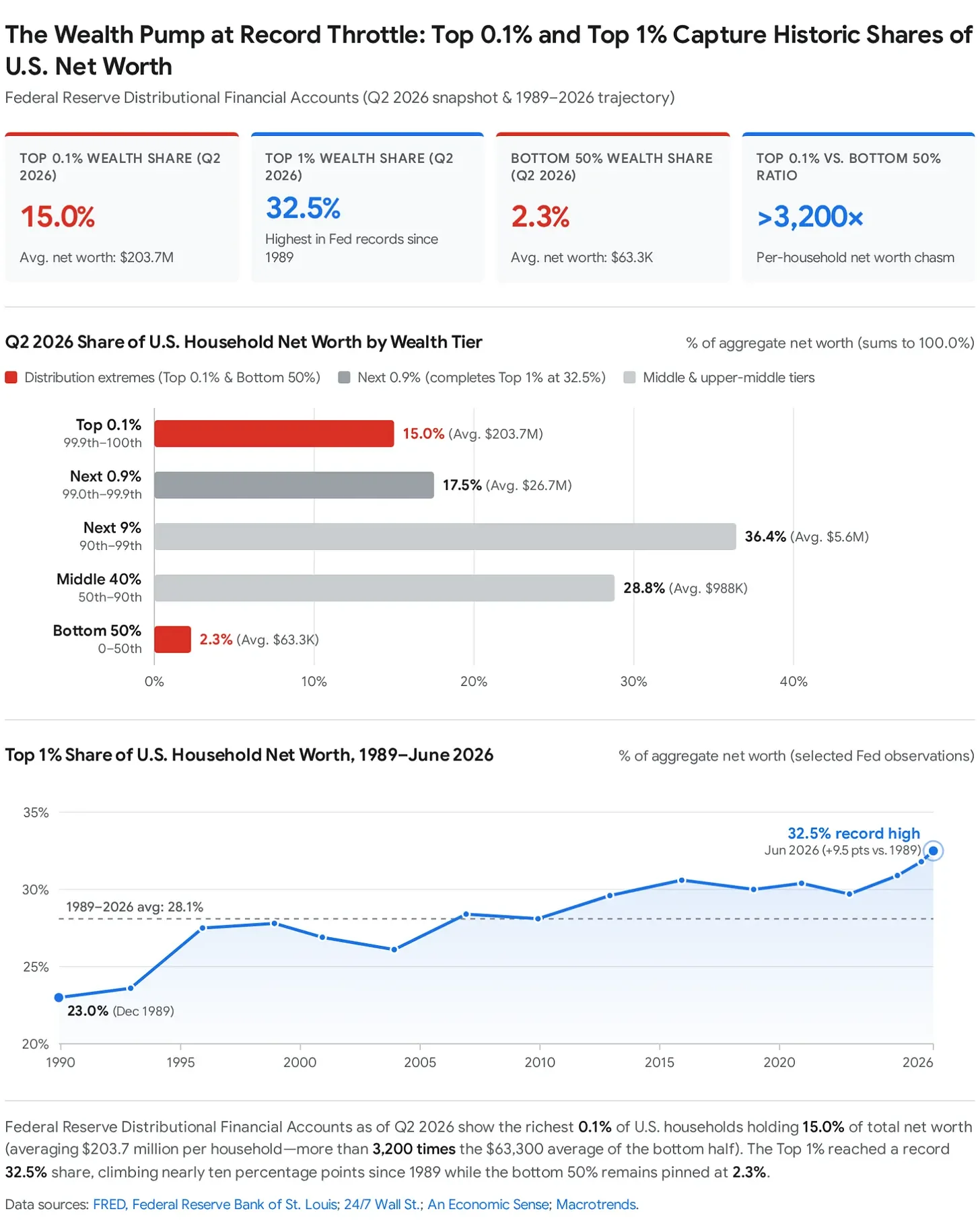
Pause and absorb the sheer structural imbalance encoded in those Federal Reserve figures. One-tenth of one percent of American households now commands 15.0 percent of all household net worth, averaging $203.7 million apiece and sitting atop $16.15 trillion in corporate equities and mutual fund shares alone. The top 1 percent holds a record 32.5 percent of total wealth and 50.9 percent of non-retirement corporate equities—surpassing the entire bottom 90 percent combined (31.1 percent)—while the bottom half of the nation, roughly 67 million households, divides a microscopic 2.3 percent. Secondary analyses applying Turchin’s framework cite a cumulative transfer of roughly $50 trillion from the bottom 90 percent to the top 1 percent since 1975. Meanwhile, private-sector union density has fallen to a record-low 5.9 percent (as of 2025), and in fiscal year 2025 the federal government paid $970 billion in net interest—18.5 percent of all federal revenue, the highest share since 1940. Commentators modeling Turchin’s structural-demographic data warn that societies locked into this phase of popular immiseration, elite overproduction, and state fiscal distress face an estimated 75 to 85 percent historical probability of severe political rupture or disintegration unless a reformist coalition turns off the Wealth Pump.
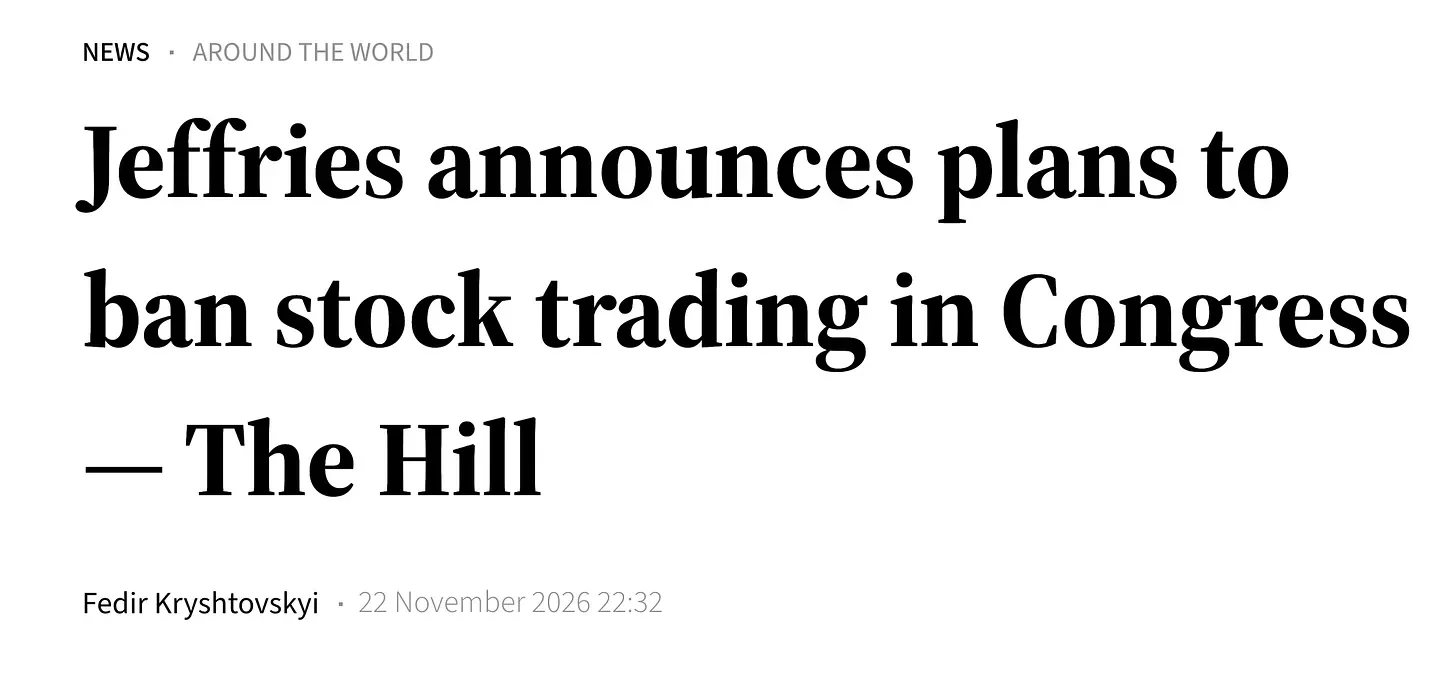
Now look at how our political theater responds to this systemic crisis. On November 22, 2026—just two days ago—incoming House Speaker-designate Hakeem Jeffries went on CBS’s Face the Nation to announce that House Democrats will move early in the new Congress to ban members of Congress from trading individual stocks, backed by a November letter from 51 incoming House Democrats calling for a Day-1 ban. Forgive anyone who refuses to hold their breath. According to financial-disclosure tracker Unusual Whales, between 2021 and 2024 alone at least ten congressional stock-trading ban bills—including bipartisan proposals from Jon Ossoff, Josh Hawley, Abigail Spanberger, Chip Roy, Alexandria Ocasio-Cortez, and Matt Gaetz—were introduced with fanfare. Not a single one reached the floor for a vote under either Republican or Democratic control. A watered-down House bill passed in September 2026 would have banned new individual stock purchases without requiring lawmakers to sell the stocks they already hold, and even that failed to clear the Senate. Meanwhile, at the executive apex, commentators at The New Republic highlight President Donald Trump’s personal enrichment through stock trading—including shares of Nvidia alongside loosened export restrictions—making congressional self-policing look even more theatrical.
As GlobeHackers residing in the great COSPOLON, we insist on intellectual rigor rather than lazy outrage, so let us look honestly at what the empirical literature actually shows about congressional stock trading. The evidence is more nuanced—and ultimately more damning—than a viral social media clip suggests.
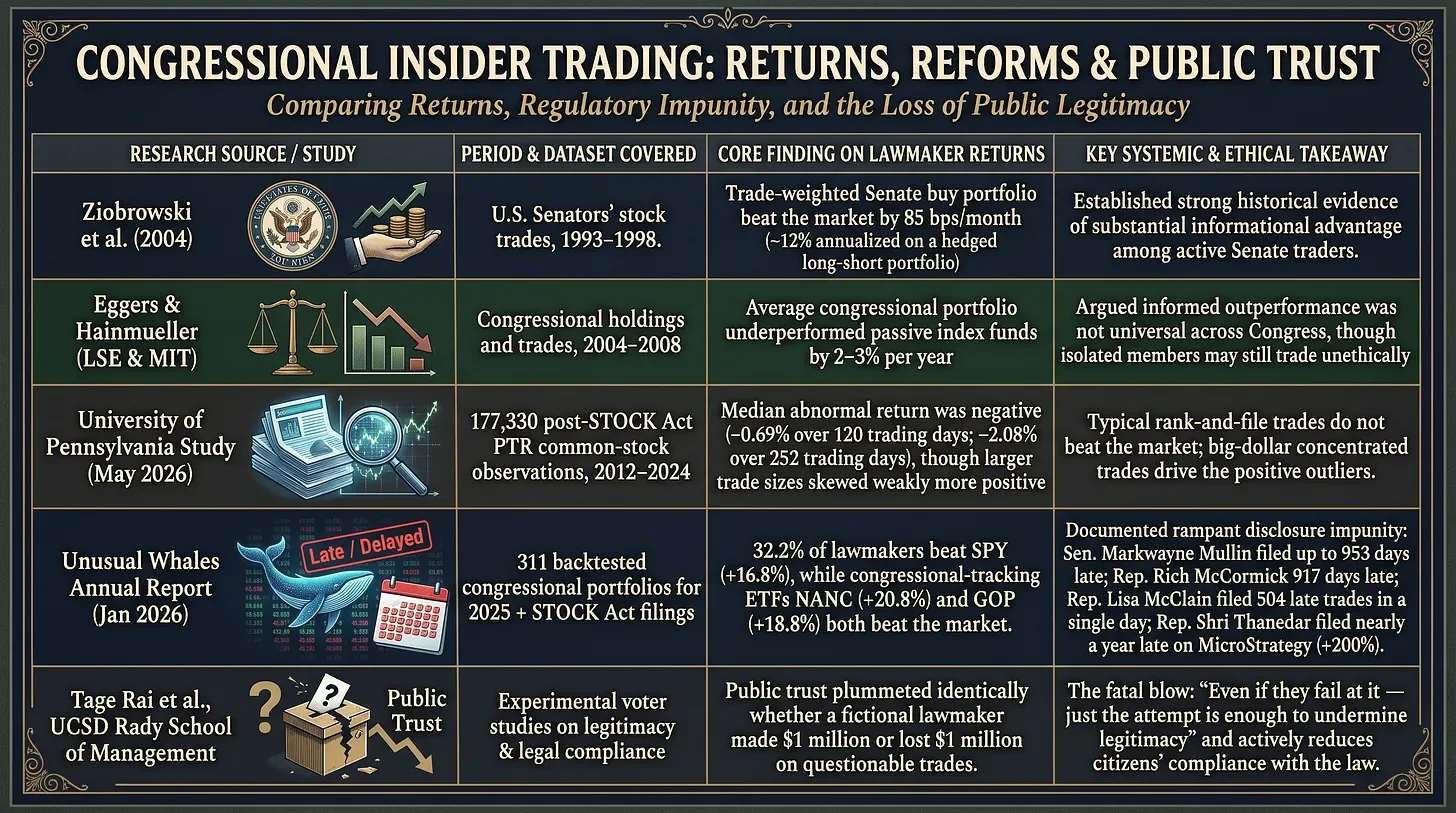
That last finding from UCSD’s Rady School of Management is the smoking gun of our democratic decay. Whether an individual lawmaker is a brilliant insider trader or a clumsy amateur riding megacap tech waves while sitting on regulatory committees, the mere existence of legalized self-dealing corrodes the moral contract of the Polis. When Rep. Ro Khanna’s wife’s third-party-managed portfolio executes over 3,000 transactions in a single year while he co-sponsors the Restore Trust in Congress Act, or when the House Ethics Committee unanimously dismisses STOCK Act violations for lack of “clear evidence of intentional failure to disclose,” voters absorb one cynical lesson: the rules are for suckers. Thomas More’s “conspiracy of the rich” is no longer hidden behind Tudor velvet; it files periodic transaction reports 900 days late and dares the public to do anything about it.
And why can’t the public stop it? Because voters are kept fractured along myopic, emotionally charged fault lines—voting out of tribal fear or cultural resentment for venal candidates who keep the Wealth Pump intact. As long as the Polis is divided into rival fanbases screaming inside their respective enclosures, the Players of the Great Game never have to address the core conditions of human survival unless people force them to.
And all the individual “journos” compete for pennies on platforms while the Players play and people pay.
Circumstances Dictate—Until We Own Our Will
Second, Erasmus’s defense of human agency at the height of the Reformation. When Martin Luther insisted in The Bondage of the Will (De servo arbitrio, 1525) that human beings are powerless in matters of salvation apart from divine grace, Erasmus—who despised sectarian combat—finally broke his silence in On Free Will (De libero arbitrio, 1524), declaring, “At least I cannot be accused of abandoning the Gospel to the passions of men.” Erasmus understood a profound psychological truth: strip human beings of moral agency, convince them that circumstances or fate dictate everything, and every ethical teaching collapses into passivity or fanatical obedience. In times when speaking endangers the body, Erasmus warned, “to remain silent endangers the soul.”
Third, the Enlightenment’s double diagnosis by Jean-Jacques Rousseau and Immanuel Kant. Rousseau showed how social environments hijack the Will: outside corrupt social hierarchies, human needs are modest, but inside stratified civilization, amour-propre—comparative vanity and restless status rivalry—turns human beings into anxious competitors who measure their worth only by outranking neighbors, echoing More’s diagnosis of Pride. Then Immanuel Kant, in his 1784 essay What is Enlightenment?, laid down the immortal challenge: Enlightenment is “man’s emergence from his self-incurred immaturity,” where immaturity is “the inability to use one’s own understanding without the guidance of another.” His motto was sapere aude—dare to be wise, dare to think and act for yourself.
Yet Kant also quietly named the terrifying trap that explains why five centuries of brilliant books have not saved us. “It is noticeable,” Kant observed, “that man is only educated by man—that is, by men who have themselves been educated.” Read that again. If a civilization is already trapped in immaturity, greed, and ecological blindness, its schools, churches, media, and families transmit those exact unexamined assumptions to the next generation. So let’s not expect LLMs to save us. Circumstances dictate because the zookeepers were raised in the zoo, too. I keep returning to a hard truth on the GlobeHackers blog: for the vast majority of human beings, circumstances dictate what they do. That is not an insult; it is an honest diagnosis of how badly our culture hobbles human development. Most people are systematically prevented—by degraded education, economic precarity, algorithmic addiction, and curated outrage—from ever becoming wise and owning their Will, their sovereign capacity to choose with clarity and conviction.
The classical, Renaissance, and Enlightenment thinkers who built the very best of our intellectual heritage spent two millennia trying to hand us the tools to break this conditioning. Look at the unbroken golden thread they left us:
First, Epictetus, the Stoic teacher who understood freedom more deeply than any emperor. In the Enchiridion and Discourses, Epictetus drew a razor-sharp boundary between everything outside our control (bodies, wealth, reputation, public office, the roar of the crowd) and the single domain that is eph’ hêmin—in our power: our prohairesis, our faculty of moral choice, judgment, and Will. “For you yourself are neither flesh nor hair, but choice (prohairesis),” he taught (Discourses 3.1.40). “No one is master of another’s prohairesis, and in this alone lies good and evil” (Discourses 4.12.7–8). And his warning to anyone tempted to trade their integrity for social comfort or tribal belonging should be carved above every schoolhouse door: “Only consider at what price you sell your own will and choice, man: if for nothing else, that you may not sell it cheap” (Discourses 1.2.33).
Civilizational Scale, the Polycrisis, and the COSPOLON Reckoning
Which brings us to the darkest, most honest question of all—the question that separates serious Positive Doomerism from cheap techno-optimism. Look at the mess we have built despite Plato, Epictetus, More, Erasmus, Rousseau, and Kant. We are no longer dealing with isolated policy glitches; we are trapped inside a global polycrisis.
French complexity philosopher Edgar Morin and journalist Anne-Brigitte Kern coined the term polycrise back in 1993 (Terre-Patrie / Homeland Earth) to describe the “complex intersolidarity of problems, antagonisms, crises, uncontrollable processes, and the general crisis of the planet.” Economic historian Adam Tooze brought the word into contemporary consciousness (“Here is your fear. This is what it might be called”), and Thomas Homer-Dixon and his colleagues at the Cascade Institute gave it rigorous causal teeth: a global polycrisis is not a coincidental “perfect storm” of bad luck, but “the causal entanglement of crises in multiple global systems in ways that significantly degrade humanity’s prospects,” triggering nonlinear feedbacks, synchronization, and tipping points whose combined harm exceeds the sum of individual shocks. Ecological overshoot, climate destabilization, energy depletion, AI-accelerated growth addiction, fiscal insolvency, elite overproduction, and epistemic and ontological collapse are all feeding one another simultaneously.
Let us face the cold mechanics of scale without flinching. As I explored in “The Architecture of Callousness” on the GlobeHackers blog, civilizational collapse is not merely a story of individual moral failure; it is a scaling problem. Every human population carries a biological baseline of clinical psychopathy and zero-empathy predation—roughly 1 to 4 percent. In a small, face-to-face community, reputational accountability and social friction keep predatory behavior in check. Scale human biomass up to hundreds of millions in anonymous megacities and digital networks, and community social friction collapses toward zero. Now hand those zero-empathy agents the techno-industrial force multipliers of global finance, algorithmic media, and AI, and a tiny cohort of callous players can burn and rebrand at planetary scale, turning the biosphere into fuel for an omnicidal heat engine.
That is why a centralized, planetary Utopia is almost certainly an impossibility—and why Karl Popper warned against sweeping top-down “utopian engineering” that almost always imposes massive social coercion. Even Thomas More understood that tension in his bones. Remember: five hundred years later, scholars on In Our Time still ask why the dream of Utopia can look “so much like a dystopia.” The Uruguayan writer Eduardo Galeano put the true purpose of utopian thought into the only frame that makes sense:
“Utopia lies at the horizon. When I draw nearer by two steps, it retreats two steps. If I proceed ten steps forward, it swiftly slips ten steps ahead. No matter how far I go, I can never reach it. What, then, is the purpose of utopia? It is to cause us to advance.”
This quote was popularized by Uruguayan writer Eduardo Galeano, who attributed it to his friend, Argentine filmmaker Fernando Birri. Galeano shared the reflection in his 1994 book Las palabras andantes after a student asked Birri what purpose utopia serves.
Utopia is not a blueprint you pave over the Earth to build. It is a compass bearing—a moral horizon that exposes the ugliness of the present and pulls us forward out of complacency.
So where does that leave us, here at the edge of the polycrisis? It leaves us with the three scales of COSPOLON.
At the scale of the Cosmos, the universe runs according to thermodynamics and biophysical reality regardless of our illusions, stock markets, or tribal chants. Overshoot will humble capital; biophysical limits always bat last. At the scale of the Polis, our captured empires and financialized states are staggering under the weight of the Wealth Pump and elite overproduction—and as cliodynamicists applying Turchin’s work warn, we should neither place naive faith in politicians to voluntarily dismantle their own privileges nor become passive “boats tossed in a rough ocean.” Pushing for real systemic guardrails—ending legalized self-dealing, dismantling counterproductive monopolies, demanding post-growth sanity—remains worth fighting for, with eyes wide open and zero illusions.
But the decisive battleground where we still hold immediate, unassailable sovereignty is the Solon—the scale of our own Will, our families, our intimate friends, and our local communities of mutual reliance. In the Solon, social friction is real again; reputation matters; humanity is still transmitted face-to-face. We can choose, right now, to walk out of the digital zoo enclosure. We can turn off the rage-merchants, stop letting algorithms and sports-nationalist spectacles harvest our nervous systems, and resurrect the real studia humanitatis—raising ourselves and the people we love to read deeply, think across perspectives, practice genuine humility, and refuse to sell our prohairesis cheap.
Maybe this overextended industrial civilization will burn itself down to the stones before it checks into rehabilitation. Maybe it won’t. Either way, our assignment is identical to the one Socrates, Epictetus, More, Erasmus, and Kant handed down across the centuries: refuse the comfortable anesthesia of the cave, laugh at the folly of tyrants without succumbing to the impotent comfort of misanthropy, own your Will with quiet courage, and build pockets of life-affirming, convivial culture sturdy enough to survive the storm and worth passing on to whoever walks out of the rubble. Buck up, step out of the enclosure, and let us finally use the knowledge we already possess.
https://www.fivebooksforcatholics.com/erasmus-of-rotterdam/
https://christianhistoryinstitute.org/st/magazine_pdfs/ch145s.pdf
https://basilica.ca/documents/2016/10/Thomas%20More-Utopia.pdf