
Oil is connected to the miracle of life. Whatever life is, its chemistry is amazing and perhaps extremely rare. Titan lives?
Petroleum is not some infinite subterranean lifeblood created by a living planet, nor is it an accidental accumulation of primordial cosmic chemistry. It is concentrated ancient solar energy in the form of fossil fuel, produced by marine micro-organisms over geological time. Yet every time you’ve got a long-form science documentary like Dozeology’s “Oil: The Strangest Liquid Earth Ever Made” getting out to a wide audience, you get the comment sections full of the most comforting of myths about Oil: that peak Oil is all a hoax, that oil wells keep refilling from down deep in the Earth, that the vegetable oils we buy in the supermarket are just crude Oil from modern-day plants, or that the hydrocarbon lakes on Titan disprove the biological origin of Oil. Those myths are so prevalent because the industrial civilization we live in is absolutely dependent on cheap hydrocarbons, and the fact that we have a finite, depleting energy source is very uncomfortable to face.
Multiple lines of geochemical, geological, and thermodynamic evidence have now settled the scientific question of petroleum’s origin and, at the same time, made it incontrovertible that conserving the remaining reserves is an absolute necessity. The crude Oil and natural gas we extract today are intact molecular fossils and light carbon isotope signatures of ancient photosynthetic organisms that were cooked within a very narrow temperature window in the crust. Ecologist Jeffrey S. Dukes has estimated that a single U.S. gallon (3.8 L) of gasoline would have required some 90 metric tons of ancient organic precursor material. The 2025 world energy data (published in 2026) confirms that fossil fuels still provide 86% of the World’s total energy despite the very rapid growth of solar and batteries, and this underpins the material basis of food, steel, cement, and plastics. We must slow the rate at which we burn hydrocarbons if we are to arrest global heating, avoid a sudden civilizational contraction, and preserve a living biosphere capable of sustaining complex life over deep time.
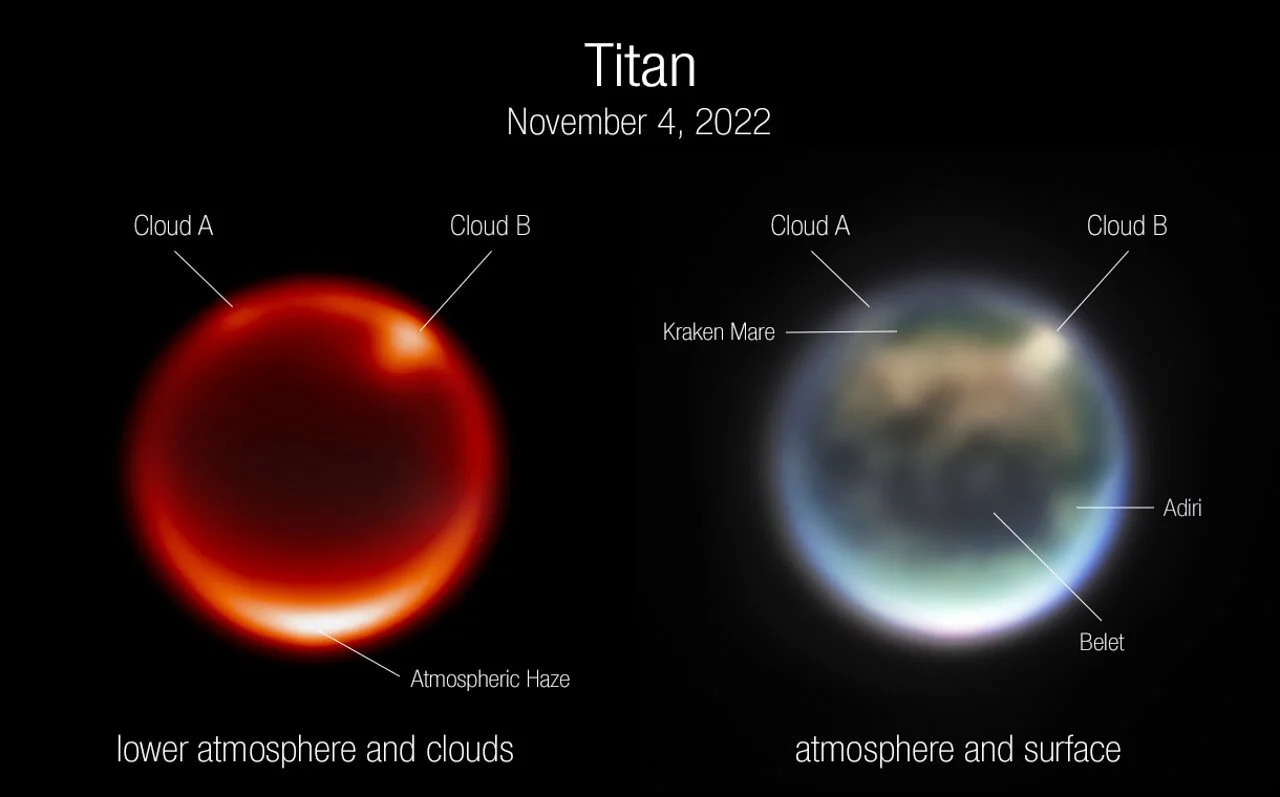

Life exists on what we call Planet Earth.
A few nights ago I watched the bedtime video mentioned above.
Oil: The Strangest Liquid Earth Ever Made
Perhaps a better title would be:
Oil: The Strangest Liquid Life, Solar Energy, Heat, Pressure, Geology, and Chemistry Ever Made
I am, as you know, very fond of living systems and find life incredibly fascinating and even miraculous. What are the odds of having life on our planet?
I asked Gemini, and here are the results. I verified the answers using Google and the references provided. I delved into the ‘what is life’ question many times. Emphasis mine:
Because we are here to ask the question, the conditional probability of life emerging on Earth is 100%, but the a priori odds—the baseline likelihood that a rocky planet like early Earth will spontaneously generate biology—remain unknown because science still has a confirmed sample size of one.
To estimate what those initial odds actually were, scientists break the problem into two parts: the odds of getting a planet like Earth, and the odds of chemistry turning into biology.
1. The Planetary Odds: How Rare Is a World Like Earth?
The case that Earth-like worlds are common: Exoplanet surveys from missions like Kepler indicate that roughly 10% to 20% of Sun-like stars host rocky planets in their habitable zones, where temperatures allow liquid water. In the Milky Way alone, that translates to billions of potentially habitable worlds.
The case that Earth is a cosmic outlier: According to the “Rare Earth” hypothesis, liquid water is only the starting line. Earth benefited from a stack of stabilizing conditions: a large Moon that prevents chaotic wobbles in our axial tilt, active plate tectonics that recycle carbon and regulate climate, a molten core generating a radiation-shielding magnetic field, and gas giants like Jupiter deflecting catastrophic asteroid impacts. Even if each of those traits had a generous 10% chance of occurring, multiplying five or six independent filters together drops the odds of an exact Earth twin to less than 0.001.
2. The Biological Odds: How Hard Is the Spark of Life?
Once a habitable planet exists, non-living chemicals still have to assemble into self-replicating cells (abiogenesis)—the biggest uncertainty in the equation.
Evidence that simple life is probable: Geological and isotopic records show life appeared on Earth remarkably fast—within a few hundred million years of the planet cooling enough to hold liquid oceans, roughly 3.8 to 4.1 billion years ago. In Bayesian probability models (including a 2025 Astrobiology analysis by astronomer David Kipping), a near-instant start yields betting odds greater than 3:1 that abiogenesis is a rapid, likely outcome on Earth analogs, even if the subsequent jump to intelligent life is rare. Reinforcing this, a 2026 Science Advances study led by evolutionary biologist William Martin found biochemical evidence that bacteria and archaea may have transitioned from hydrothermal vent chemistry into free-living cells independently twice, suggesting that under the right conditions, cellular life isn’t a one-in-a-trillion fluke.
Evidence that abiogenesis faces steep odds: From an information-theory and thermodynamics perspective (modeled in 2025–2026 research by Imperial College London’s Robert Endres), purely random chemical reactions struggle to accumulate and preserve biological information faster than heat and radiation break it down. For abiogenesis to succeed within Earth’s early geological window, prebiotic chemistry almost certainly relied on natural physical shortcuts—such as mineral surfaces, lipid compartments, or self-sustaining autocatalytic networks—rather than pure luck.
Ultimately, narrowing down the true odds requires breaking our N=1 limitation. Discovering even a single independent origin of microbial life elsewhere—whether beneath the ice of Europa or Enceladus, in ancient Martian rocks, or in the atmosphere of an exoplanet—would confirm that the universe is primed for biology.
Debunking the Myths Beneath the Video Comments
If you don’t have time to watch the whole video above, you might want to skip forward to the last quarter. Also, take a look at the comments section, where you will notice that few people watched the video all the way through. People believe what they want to believe and rarely do disciplined research concerning complex topics. Folks hear what they want to hear. We parrot what sounds about right to us based on a soundbite. Swipe, swipe, swipe…
Disinformation about petroleum works when bits of actual Earth science (subsurface microbes, hydrothermal methane vents, exposed rock strata, extraterrestrial organics, etc.) are taken out of context in terms of chemistry, scale, and geological time. Every piece of disinformation that goes viral under the guise of a documentary, podcast, or AI slop breaks down when you apply petroleum geochemistry and field geology.
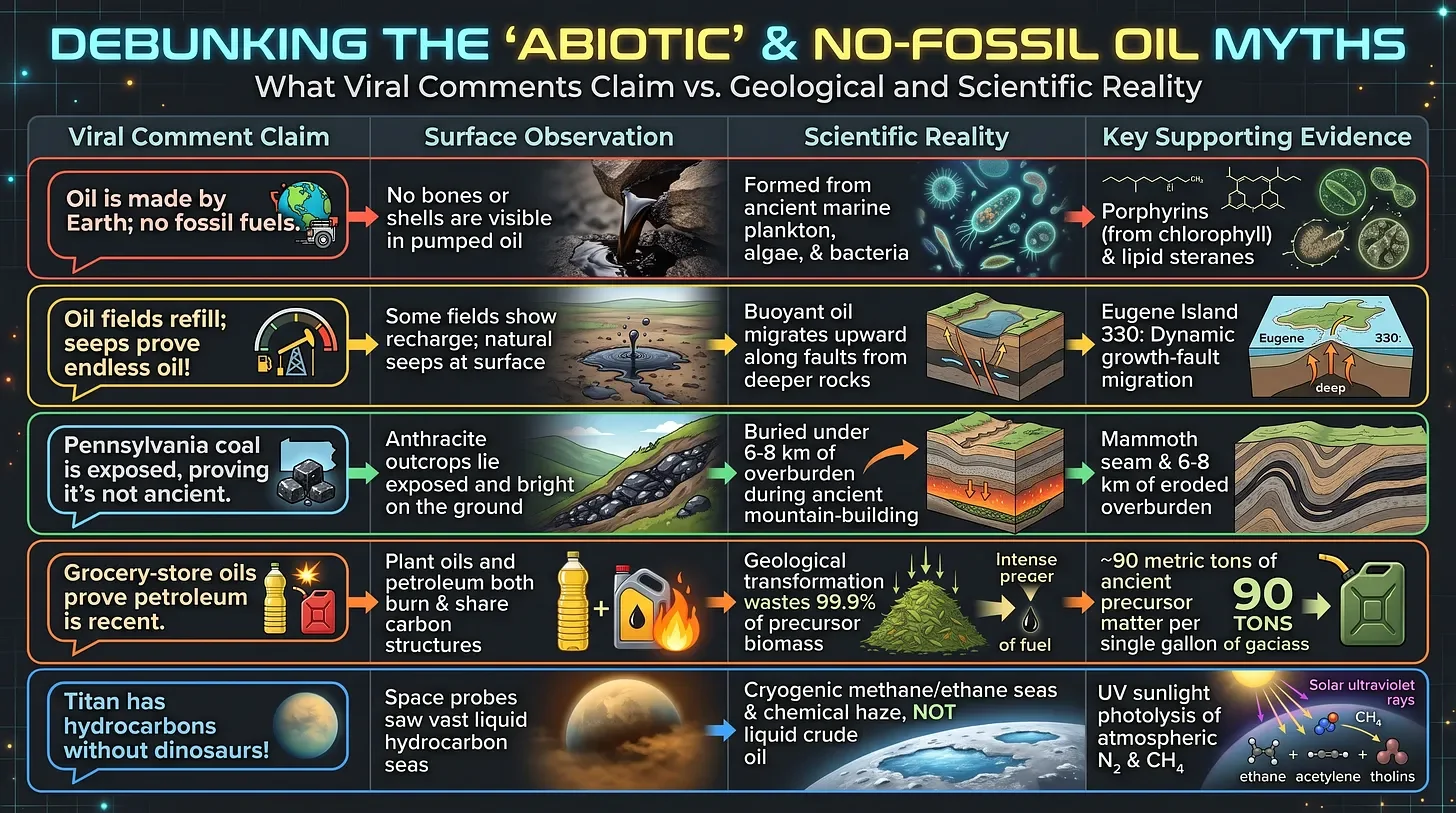
The two statements that “the earth makes oil, there is no such thing as fossil fuels” and that “oil is the blood of the earth” are both attacks on a complete and utter cartoonish misconception rather than anything to do with real geology. Scientists have never claimed that crude Oil is made from melted T. rex skeletons. As a 2019 PlasticsToday trade article (citing Wikipedia) pointed out, the term fossil fuel was coined by the German chemist Caspar Neumann in 1759 (well before dinosaur paleontology was even a thing) to describe combustible, carbon-rich substances you could dig up from the ground. The commercial crude Oil and natural gas we have today were overwhelmingly the product of accumulated microscopic aquatic phytoplankton, zooplankton, algae, and bacteria that settled in anoxic marine and lake basins. The same PlasticsToday article that makes the above point (by Clare Goldsberry, citing plastics expert Salvatore Monte) correctly dismisses the dinosaur myth and goes on to state that Oil and gas “contain no fossils” and “are not fossil fuels” to stress that plastics are bio-derived. While it is true that crude Oil contains no bones or shells, calling it non-fossil obscures the reality that it is full of molecular fossils (i.e., the intact organic ring skeletons of the original cells that made it).
Equally misleading is the notion that “oil fields refill naturally over time” and that natural seeps prove infinite underground replenishment. The seeps don’t happen because the mantle is constantly churning out liquid Oil. Oil seeps to the surface because hydrocarbons are less dense than the salty pore water in the ground, so they migrate upward until they hit an impermeable geological seal. Where that seal is breached by tectonic faulting, or where there is no intact trap to hold the fluid, buoyant Oil will slowly work its way to the surface over a very long period of time. The most oft-cited example of “refilling” is the Eugene Island 330 field (80 miles off the Louisiana coast in the Gulf of Mexico). This was a prime example of what proponents of non-biological Oil would have loved to point to. Subsequent geological work, including structural analysis of the Pathfinder core, demonstrated that Eugene Island 330 is a classic case of dynamic hydrocarbon migration. The Oil and gas migrated up into the shallower producing sands along a major active growth fault that linked the field to the deeper sedimentary formations, rather than simply welling up from the mantle.
Another poster points to the fact that in Pennsylvania you can find clean, shiny, unmined coal lying directly on the ground as proof that the million-year burial claims are all nonsense. The reality is that the exposed anthracite fields in Pennsylvania are a perfect example of tectonic uplift and erosion. The coal-bearing strata in question were laid down in the Appalachian foreland basin at the very beginning of the Alleghanian orogeny (the mountain-building event) during the Carboniferous period. As the continent collided, the strata were tightly folded and thrust upward, and were buried under 6 to 8 km of overburden as a result of the orogeny. Burial temperatures were high enough to metamorphose the organic matter into hard anthracite over vast areas, with the Mammoth coal bed being a good example at 10 to 12m thick and more than 60 coal seams in total across the state. In the region’s subsequent geological history, there has been considerable uplift, multiple glaciations in the anthracite valley, rivers cutting deep water gaps through the mountain ridges, and erosion stripping away 6 to 8 km of overburden. The result is that you now have the hard, shiny anthracite seams exposed at the surface. The fact that the coal is so clean and shiny is a direct result of the intense ancient metamorphic compression it has undergone, not any recent formation.
Equating crude Oil with the cooking oils you’d find in your local grocery store (“Oil comes from plants and animals that were recently living”) is a complete non sequitur. The cooking oils are biological triglycerides produced by the current-day process of photosynthesis. Crude Oil is the other way around. It’s oxygen-stripped alkanes, cycloalkanes, and aromatics from ancient organic matter that have been buried and thermally matured over millions of years. The Earth is an amazing cook. *WINK* In his 2003 paper “Burning Buried Sunshine: Human Consumption of Ancient Solar Energy” (Climatic Change), ecologist Jeffrey S. Dukes does the maths and comes up with a truly staggering figure for the geological inefficiency of our modern fuel: “The average U.S. Gallon (3.8 L) of gasoline today requires approximately 90 metric tons of ancient plant matter as a precursor.” That’s 90 metric tons of ancient plant matter per gallon. So a 10-gallon fill-up would be 900 metric tons of ancient plant matter (10 gallons x 90 metric tons/gallon), almost entirely marine phytoplankton, according to historical syntheses that cite his work. The point is that you could never possibly have enough fresh oils from contemporary agriculture to supply the scale of petroleum we consume today.
Finally, “Titan has hydrocarbons and no Dinosaurs!”— that’s the argument. It’s completely and utterly wrong to treat Titan’s hydrocarbons as the same as terrestrial crude Oil. The Cassini-Huygens mission (NASA and ESA) has observed hundreds of lakes and seas on Titan’s surface, with several dozen estimated to contain more hydrocarbon liquid than Earth’s total known oil and gas reserves. The equatorial dunes are also thought to contain organics several hundred times the volume of Earth’s coal reserves. Titan has no biological crude oil. Its surface seas are methane and ethane — both of which are gases at Earth temperatures and only liquefy at Titan’s very cold surface. Titan’s nitrogen-methane atmosphere drives all of this. Solar Lyman-alpha UV radiation (121.6 nm) and energetic ions in the upper atmosphere break up the methane (accounting for as much as 75% of the photolysis above 700 km), forming methyl radicals and carbenes which recombine to form ethane, acetylene, polyynes, and nitrogen-rich organic haze particles known as tholins. It’s non-biological planetary photochemistry, not petroleum geology.
Geochemical Fingerprints, Abiogenic Traces, and the Oil Window
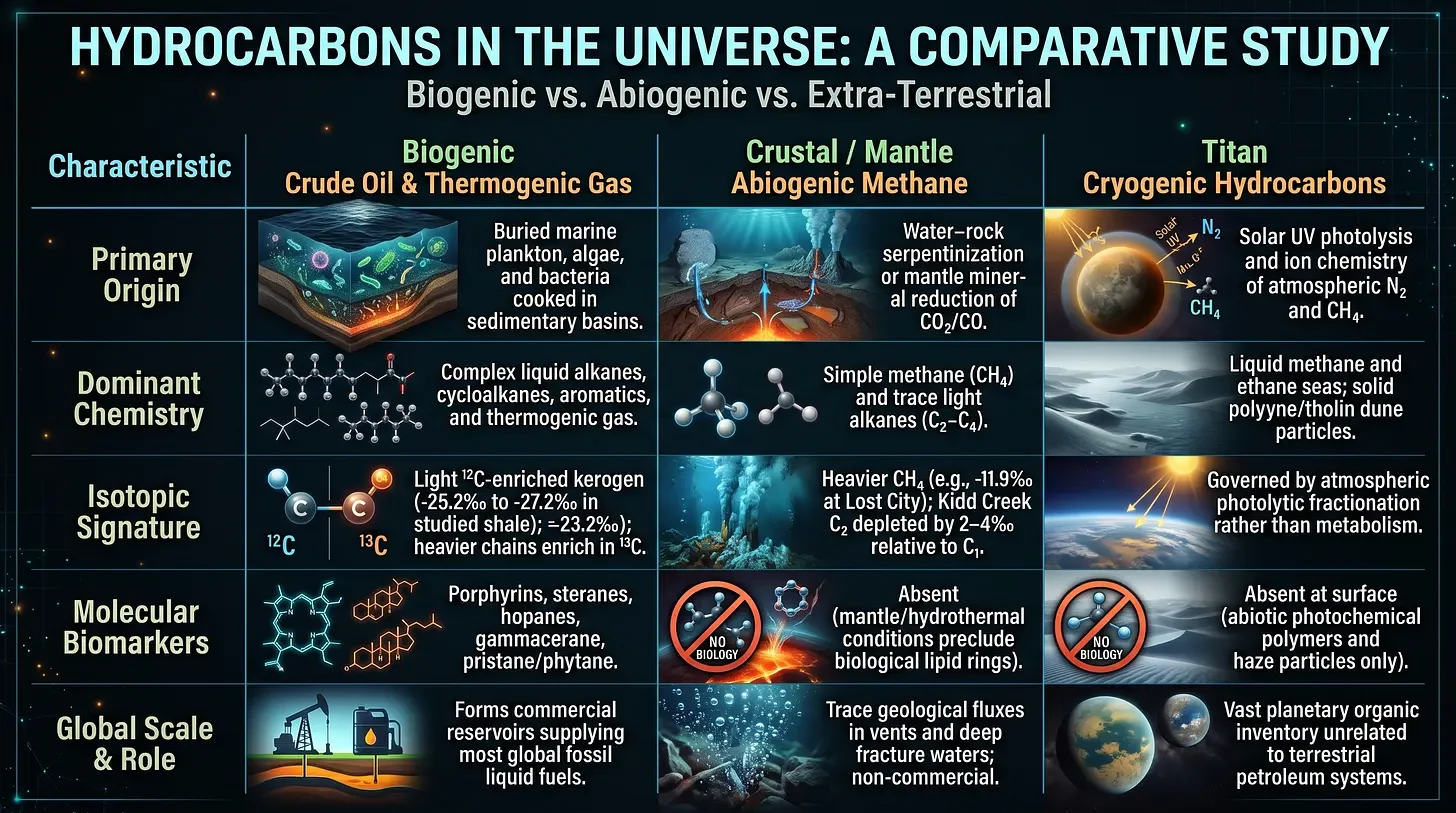
Petroleum geologists don’t “speculate” about the origin of Oil. Three completely independent lines of evidence (molecular fossils, stable isotope fingerprints, and crustal thermodynamics) allow you to unambiguously separate commercial crude Oil from non-biological hydrocarbons.
First, commercial petroleum contains sophisticated biomolecules that would be destroyed at the temperatures encountered in the basin. Treibs’ seminal discovery of porphyrins in crude Oil established the classic chemical link between petroleum and photosynthetic life. GC-MS is now routinely used to track hundreds of geochemical fossils (biomarkers) in oil and source rock. The Oil will contain a range of polycyclic lipid biomarkers, including steranes and hopanes, gammacerane (predominantly a product of photosynthetic cyanobacteria and a diagnostic of stratified ancient water columns), and low pristane-to-phytane ratios (e.g., 0.41 to 0.61 in the Sargelu Formation), which indicate an anoxic depositional environment. At shallow burial depths, the biomarkers remain in the form they have in the living cell; as depth and temperature increase, they progressively isomerize into more stable geological isomers, providing the driller with a precise molecular thermometer of the basin history.
Secondly, stable carbon and hydrogen isotopes act as chemical fingerprints. During photosynthesis, living cells prefer the lighter isotope of carbon (¹²C) over the heavier isotope (¹³C) because bonds involving ¹²C require less energy to form. As a result, the organic-rich source rock kerogen will have a distinctly light carbon isotope composition (e.g., from -25.2‰ to -27.2‰ across the various shale sections studied). Even when deep reservoir microbes attack crude alkanes, they will preferentially attack the weaker ¹²C–¹²C bonds rather than the ¹²C–¹³C bonds. When the kerogen is then thermally cracked down in the deep reservoir to form commercial natural gas, the heavier hydrocarbon chains (ethane, propane, butane) become progressively enriched in both ¹³C and deuterium (²H) relative to methane.
Third, geochemists know exactly what non-biological hydrocarbons look like because they’ve made them in the lab and found them in minute quantities in the Earth’s crust. High-pressure diamond anvil cell experiments (including work by Henry Scott and co-workers) produce methane and small amounts of ethane by subjecting inorganic minerals (e.g., iron oxide, calcite, water) to the high-pressure and high-temperature conditions of the upper mantle. In the crust, water-rock reactions (serpentinization) reduce dissolved CO2 with H2 over catalytic Ni-Fe alloys via Sabatier and Fischer-Tropsch-type reactions.

Real-world abiogenic methane has been observed at the Lost City hydrothermal field on the Mid-Atlantic Ridge (δ13C methane of -11.9‰, with adjacent ultramafic vents ranging from -6.1‰ to -17.8‰)41, at the eternal gas flames of the Chimaera ophiolite seeps in Turkey, and in ancient saline fracture waters 2,100 m down at Kidd Creek Mine in the ~2.7 billion-year-old Abitibi greenstone belt of Ontario. At Kidd Creek, 13 of the 17 boreholes showed a clear carbon isotope reversal (ethane depleted by 2-4‰ in 13C relative to methane and with an inverse deuterium enrichment), which is the signature of abiotic polymerization as seen in the Murchison meteorite rather than the commercial thermogenic gas. It is worth noting that Barbara Sherwood Lollar and Giuseppe Etiope stress that carbon isotope reversals by themselves are not sufficient to prove mantle origin; the 3He/4He ratios in the crust at Kidd Creek are indicative of local crustal water–rock synthesis rather than mantle gas (microbial methane being 10–25% of the gas in one borehole over 19 months). Modern labs go further, using intermolecular trends in conjunction with the intramolecular “clumped” isotopes (Δ13CH3D and Δ12CH2D2) to separate the abiotic from the biotic fraction. Abiogenic alkanes in the crust as a whole are at most a minor trace source and are by no means the reservoirs of liquid crude that we have in the industrial world.
Petroleum geology also completely contradicts the notion that Oil will become ever more abundant as you go deeper and deeper into the ground. Oil forms only within a bounded thermal zone in the crust known as the oil window (generally between 760 and 4880 m depth, or 2500 and 16000 ft, and at temperatures of 65–150 °C or 150-300°F), with peak oil generation occurring between 2,000 and 2,900 m. Local geothermal gradients (average of ~25 °C/km) and kerogen kinetics will shift those depth limits, and one geochemical study suggested that oil generation could begin above 130 °C and continue up to 215 °C under certain circumstances. Thermodynamics, however, puts a hard ceiling on this. Below the oil window, the kerogen is simply immature. Below about 4,800 m, the heat is so intense that it completely destroys liquid Oil, cracking the complex hydrocarbon chains down into dry thermal methane and residual carbon.
Even within the oil window, a recoverable field requires all four of the following geological elements: an organic-rich shale source rock which has been cooked into Oil; upward migration via buoyancy (as Oil and gas are less dense than the subterranean brine); a porous and permeable reservoir rock (sandstone or limestone) in which the fluid can be held in the microscopic pores; and an impermeable cap rock (dense shale or salt) which has been deformed into a sealing trap (e.g., an anticline, a fault trap or a salt dome). If any one of those four elements is missing, the hydrocarbons don’t make it upwards over the millions of years, and they biodegrade. Modern unconventional tight oil extraction (i.e., hydraulic fracturing or ‘fracking’) targets Oil that has never migrated out of the low-permeability source shale. Horizontal tight Oil and shale gas engineering has taken well architecture to a completely different level from the half-mile laterals which were the norm twenty years ago. The shale is now being fractured directly, and thermal cracking is being used to upgrade the lower-maturity shale oils. Even with all that, the U.S. shale industry’s continued ability to produce at current levels raises more questions about whether that output can be sustained without a constant stream of capital reinvestment.
Evaluating the Sources: From Dozeology and Thomas Gold to Industry Literature
Responsible public education means checking out the primary research underpinning both the mainstream documentaries and the more contrarian theories. With respect to Dozeology’s 2 hr 5 min documentary “Oil: The Strangest Liquid Earth Ever Made”, the full video description, the full reference bibliography, the chapter timestamps, and the full transcript are all missing from the public page records that I’ve looked at here. The only anchors that I can verify from the metadata that’s visible in the video are three: an IFLScience article (“Where Did The Myth That Oil Is Made Of Dinosaurs Come From? Because Scientists Never Said It Was”), Wikipedia’s coverage of Alfred E. Treibs and petroleum porphyrins, and Wikimedia Commons images. Those three anchors do confirm that the filmmakers have a basis in Treibs’ discovery of the biomarker and are addressing the dinosaur myth. If one is incurious and not prone to exploring primary sources of multiple lines of evidence across domains of science, one can’t possibly understand the nuances and complexities involved in the narrative.
One simply has to read books on verious subjects to even know where to start understanding complex domains.
To understand the intellectual foundations of modern abiogenic arguments, you have to go back to astrophysicist Thomas Gold, his seminal 1992 paper, and his 1999 book, The Deep Hot Biosphere. In a 25-year retrospective published in PNAS in 2017, geobiologists Daniel R. Colman, Saroj Poudel, Blake W. Stamps, Eric S. Boyd, and John R. Spear clearly drew the line between Gold’s lasting biological contribution and his fundamentally flawed oil hypothesis. Gold made the controversial claim that hydrocarbons were primordial ingredients present during Earth's accretion 4.5 billion years ago and had migrated up through the deep crust to feed microbes there (his famous phrase was that hydrocarbons were ‘geology reworked by biology’). To test that claim, he advocated deep drilling in 1986 into the Siljan Ring in Sweden (a 370-million-year-old meteorite impact structure). Geochemists including Harmon Craig and John Hunt opposed that. The Siljan field test was a failure: USGS Professional Paper 1570 (1993) found the prospects for commercial abiogenic gas at Siljan to be very poor, and a 2019 Nature Communications paper on the gases in the crater and the secondary carbonates concluded that the accumulations were the result of long-term (at least 80 million years) microbial methanogenesis (fed by seep oils from the surficial sedimentary rocks) rather than deep primordial mantle gas. Colman et al. in their PNAS paper likewise concluded that the isotopic and geological evidence is largely against Gold’s proposition of a primordial origin for commercial oil reservoirs.
Gold’s more expansive vision of a flourishing “deep, hot biosphere” was extremely prescient. Ocean drilling and ultra-deep mining have revealed extensive lithoautotrophic microbial communities living in rock pores down to thermal limits of around ~150 °C. The most striking example is Candidatus Desulforudis audaxviator, an autotrophic sulfate-reducing Firmicute that is the dominant member of the microbial community at depths of up to 2.8km in the Witwatersrand Basin in South Africa. In the absence of sunlight, Ca. D. audaxviator fixes inorganic carbon and nitrogen by oxidizing H2 and formate while reducing sulfate. The energy for this process comes from the radiolytic splitting of water, which oxidizes pyrite to sulfate, and from the mechanical shearing of bedrock silica minerals to produce H256. A variety of subsurface Archaea (Bathyarchaeota, Hadesarchaea, Aigarchaeota, thermophilic methanogens) and Bacteria (Aquificae, Thermotogae, Chloroflexi) use H2, CO, and CH4 as energy sources, including volatiles released as deep hydrocarbons thermally crack. Gold got the commercial crude Oil completely wrong, but he did help to kickstart modern subsurface geobiology and astrobiology.
Industry literature has to be checked carefully. PlasticsToday’s trade commentary is correct to point out that plankton and algae produced the petroleum, not the dinosaurs. Separate industry reports do refer to commercial pyrolysis of post-consumer plastics to produce synthetic Oil and wax, a process quite distinct from the natural geological process of burial. As for the ‘Chart Industries Oil Guide’, there is a gap in the public record. I cannot find a general petroleum geology oil guide from Chart Industries in the references. Chart Industries (which is the subject of an acquisition agreement by Baker Hughes in July 2025) is an industrial gas engineering company that provides cryogenic storage and distribution (of liquid O2, N2, and LNG), CO2 capture integration, and dual helium/CO2 processing facilities (e.g., its engineering agreement with Pulsar Helium.
The Carbon Pulse, Industrial Pillars, and the 2024–2025 Energy Ledger
Our understanding of petroleum’s biological rarity goes a long way toward explaining how recklessly we are consuming an essentially irreplaceable resource. In How the World Really Works, energy scientist Vaclav Smil identifies four tangible material foundations of modern civilization: cement, steel, plastics and ammonia. None of these can be made at the scale required by modern civilization without vast quantities of fossil energy or hydrocarbon feedstocks. Synthetic ammonia via the Haber-Bosch process underpins the Green Revolution crop yields that have underpinned the growth of the modern population. As an agronomist’s commentary on Smil’s quantitative accounting, the high yields of wheat, rice and vegetables are achieved at the expense of 100 to 200 kg of nitrogen per hectare. Smil stresses that “the synthesis of nitrogenous fertilizers is the most important indirect energy input in modern farming.” That fossil energy subsidy is all around us in our diets. The same review of Smil’s work notes that 1kg of bread contains 210g of fuel; 1kg of edible meat contains 150 to 750ml of fuel in the form of fertilizer and on-farm machinery; Smil notes that “putting a kg of roasted chicken on the dinner table raises the figure to at least 300-350ml of crude oil and for the least efficient producers to more than a litre”; and bred (farmed) fish can require 2 to 2.5kg of fuel per kg of fish.
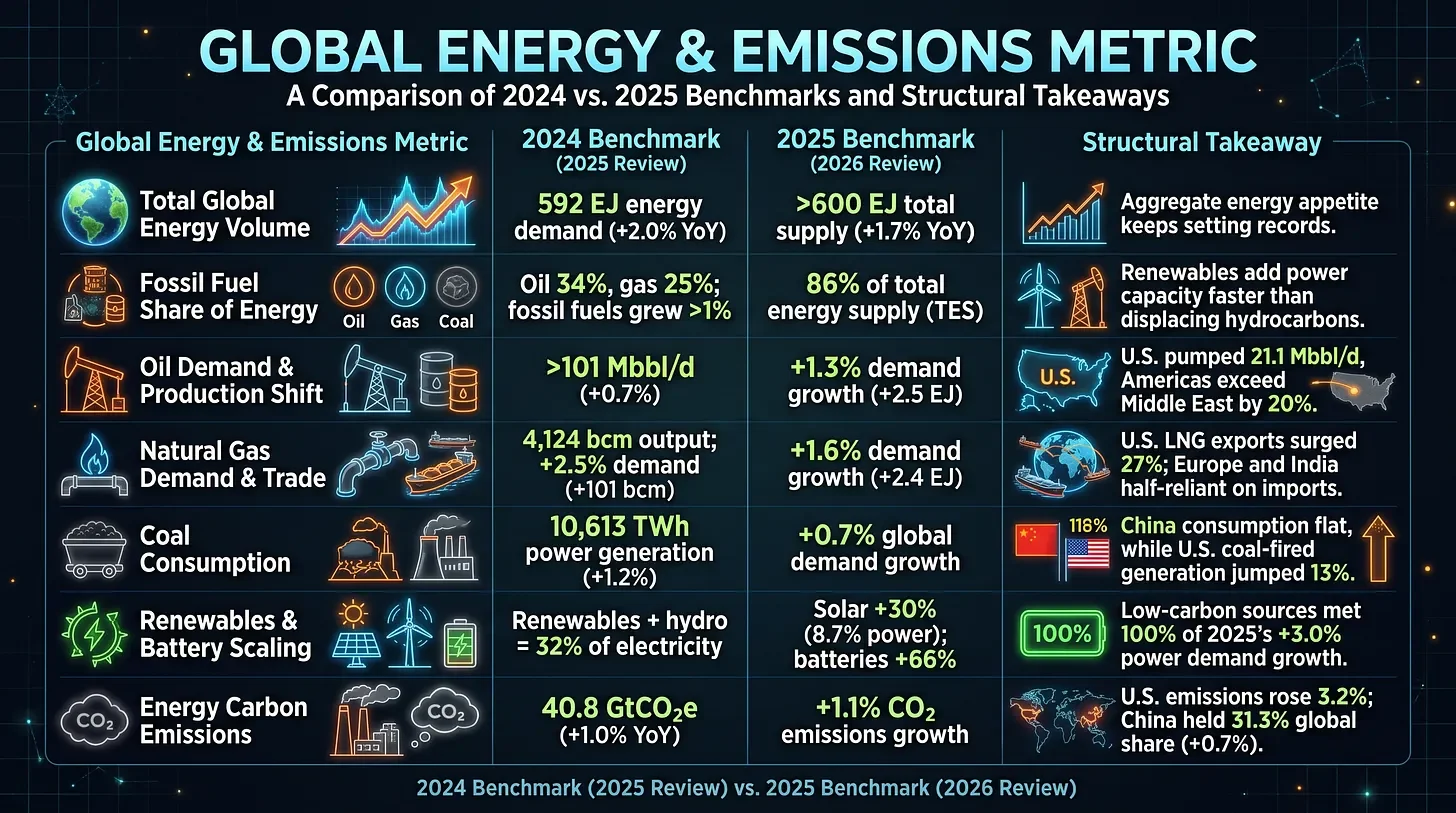
Global energy stats from the Energy Institute’s Statistical Review of World Energy (both the 2025 edition, which covers 2024, and the 75th anniversary 2026 edition, co-produced with Ember, which covers 2025) show that renewable growth is adding to the global supply rather than subtracting from fossil fuel combustion. Global energy demand in 2024 was up 2% to 592 EJ. Oil was 34% of the total energy mix and, for the first time ever, passed 101 Mbbl/d. Natural gas was 25%, coal was still the number one fuel for electricity at 10,613 TWh, and energy-related emissions rose about 1% to 40.8 GtCO₂e.
By 2025, total energy supply had crept over 600 EJ (+1.7% y/y), with every major fuel source hitting an all-time high for the second year in a row. Renewables were the largest source of supply growth outside of a recession: solar grew by 30% to take up 8.7% of global electricity (beating wind’s 8.4% and just edging nuclear’s 8.8%), battery capacity increased by 66%, and low-carbon sources met 100% of the 3.0% rise in electricity demand that was driven by EVs (which accounted for nearly a quarter of global car sales) and AI data centers. Fossil fuels still accounted for 86% of total global energy in 2025. Global oil consumption was up 1.3% (+2.5 EJ), natural gas up 1.6% (+2.4 EJ), and coal up 0.7%14. As per the IER’s summary of the 2025 data set, energy sector CO2 emissions were up another 1.1%, with China at 31.3% of the global total (+0.7%)6 and the U.S. up 3.2% as higher gas prices led to a 13% increase in coal-fired power generation (10% higher total U.S. coal consumption).
Underpinning the growing consumption is the reality of dwindling reserves and geopolitical choke points. Shale Magazine’s industry reporting lists the major proven oil reserves of the World (Saudi Arabia 298bn, Iran 158bn, the U.S. 69bn under conservative reporting, Guyana 11bn as an emerging offshore producer), but there is no consolidated global proven reserves-to-production depletion year reported in the 2025 and 2026 statistical summaries I or anyone in my topic of interest has looked at. Industrial vulnerability is more about flow rates and refining capacity than the total barrels of Oil in the ground. Europe imports 75% of its oil and refined products and has effectively closed or removed 21% of its refinery capacity since 1998. China’s crude oil imports rose 3.4% to 13.9 Mbbl/d in 2025 despite two years of falling domestic use of both gasoline and diesel. The 2026 disruption in the Strait of Hormuz, due to Middle East conflict, was a stark reminder of how easily fossil fuel supply lines can be broken.
For how many years have experts warned governments and corporations about choke points? I have featured them in my writing for years. Governments and corporations know all of this, but it wouldn’t be wildly profitable to mitigate the risks they pose.
Uncle Sam Inc. doesn’t give a damn if people starve to death. Bombing countries is profitable to the Players.
Ecological Overshoot, Consumer Capitalism, and Avoiding a Dead-World Trajectory
Why civilization is heading inexorably towards resource exhaustion and climate destabilization is a question that can only be properly answered by linking geology to human evolutionary ecology and political economy. Building on the classic work of William Catton on Overshoot, ecological economist William E. Rees gives a very direct definition of the crisis in his 2023 peer-reviewed paper in World: “Overshoot means that even at current global average (inadequate) material standards the human population is consuming even renewable and self-producing resources at a rate faster than the ecosystems can regenerate and is producing entropic waste in excess of the ecosphere’s assimilative capacity.” Citing Ludwig Boltzmann, Alfred Lotka, and Howard Odum’s Maximum Power Principle (which states that natural selection favors systems that maximize the capture and output of useful energy), Rees observes that Homo sapiens has broken the normal biological constraints of life by using out-of-body (“exosomatic”) fossil energy. Per capita energy throughput has soared from around 20 GJ/person/year in the hunter-gatherer era and 60 GJ/person/year in the agrarian era to 300 GJ/person/year in the modern techno-industrial world. The deployment of what Rees described in a 2023 Great Simplification podcast interview as the equivalent of “500 billion fossil workers” has resulted in an eightfold increase in population (from 1 billion to 8 billion) and a greater than 100-fold increase in real gross world product over two centuries (the most dramatic ecological anomaly in 250,000 years of human evolutionary history). In that same interview, Rees stated that 90% of all fossil energy ever burned has been consumed since 1940 and 50% since 1990.
Against the Earth’s finite biocapacity (roughly 11 to 12 billion productive hectares), industrial metabolism has pushed civilization past safe carrying capacity. Rees points out that modern cities draw on ecological footprints which are 100 to 1,000 times greater than their actual physical area (Tokyo alone consumes more biocapacity than all of Japan), with CO2 being by far the largest waste product in terms of weight (some 46 billion tons across all industrial activities in Rees’s analysis). Even when primary fossil fuels accounted for 82% of the World’s energy supply in 2021 (i.e., the World was powered by fossil fuels for 290 of the 365 days, versus only 24 days from non-hydro renewables), climate disruption was already having a very serious impact: at least 414 cities, home to over 1.4 billion people, were at high or extreme risk from the combined pressures of pollution, water scarcity and extreme heat stress. As one warning in Rees’s paper puts it: “Overshoot is Overshoot. Once your civilization starts to consume more than what is naturally regenerated in its folly to pursue infinite growth on a finite planet, collapse is only a matter of time.”
Financialised capitalism is, in effect, a system that resists any form of deceleration because its fundamental mental model is that of the closed, circular flow of exchange value. In that model, economic growth is entirely divorced from the ecology. In the real World, GDP in all countries is still inextricably linked to the consumption of petroleum (the poorest half of humanity uses less than 20% of the World’s energy). The corporate imperative of profit, the need to service debt, and the shareholder imperative all bind extraction firms to pumping until the ecological ceiling is reached or the market crashes. On top of that, mainstream climate policy is beset by what Rees and ecological commentators call ‘carbon tunnel vision’: attempting to achieve perpetual economic growth by simply substituting one form of fossil machine for another, more mineral-intensive renewable machine. The Energy Institute figures show that global rare earth mining increased by 3.2% in 2024 to 0.4 million tonnes, with China controlling 71% of the extraction and 48% of the reserves. The full Limits to Growth modeling runs, and the specific biophysical climate tipping point thresholds are not the subject of the studies reviewed here. However, peer-reviewed overshoot research indicates that attempting green growth without a significant reduction in aggregate material throughput will likely accelerate habitat loss, mining depletion, and the degradation of the ecosphere as a whole.
There are still credible counterarguments worth considering. The techno-optimist camp (and there are plenty of them; arguments that have been made in various policy forums in relation to Rees’s paper in particular) would argue that Rees vastly underestimates human ingenuity. They point to the fact that the carrying capacity of the planet is not a fixed thing but a variable one, citing the Haber-Bosch process for nitrogen fixation, vertical farming, water reclamation, the huge increases in solar (up 30% in 2025) and grid battery storage (up 66% in 2025) as clear examples of this. That is a very real engineering route to the solution, provided it is one of sufficiency rather than infinite consumer expansion. As commentators on Smil’s work have pointed out, if you eliminate the production of the vast majority of the things we currently produce which are of no real use to us at all, you can actually reduce the throughput of fossil fuels by a huge amount without in any way compromising the level of well-being of the population.
Without any intention of contraction at all, Rees is quite blunt in his assertion that “the global economy will inevitably contract and humanity will suffer a major population ‘correction’ in this century.” The remaining high-grade Oil is an unrepeatable geological inheritance from the thriving oceans of the past. To squander that last pulse on the kind of speculative growth we’ve been indulging in, on disposable consumerism and on fossil-fuelled conflict is to risk both a catastrophic climate upheaval and a violent energy cliff. A world stripped of its biodiversity and marine productivity could lose the very life that generated complex fossil fuels over tens of millions of years and thus slide into the lifeless organic chemistry of a dead world like Titan, rather than continue as a living planet. The only humane way out of Overshoot is to treat the remaining oil and gas as a very small amount of transitional capital, indeed, strictly rationed for the purchase of essential materials, for ecological repair, and for the very deliberate process of cultural transformation to a world of lower energy sufficiency.
Next time I will delve into what they are talking about here. You all know how I love to go on about various kinds of accelerationism.