Capitalist Cabinet of Curiosities: Perspectives on Capitalist Culture, Coding, and The Pathologies of Market Systems
I’m guessing that the vast majority of people hardly ever think about Neoliberal Market Capitalism. When they do, it’s simply a vaguely “informed” opinion that it’s the best of all possible sociopolitical economic systems. Do people think about sociopolitical economic systems? Not much, I guess.
A preamble on my train-of-thought heuristics.
“The onus of proof lies on the man who affirms, not on the man who denies . . . on the proposition, not on the opposition.” —Anthony Flew
“It is wrong always, everywhere, and for anyone to believe anything on insufficient evidence.” —Clifford's Principle
It's practically impossible to predict the arrival of the cattle cars, WWIII (running around Bellingham dodging drones), whether complex, global corps will be the first to die (they will be, cause plebs and proles can't pay the rents, and complex shyte will be the first to go when the system faulters due to lack of affordable resources), and on and on.
Make money now, if you can, and invest it in face-to-face community "assets," real and abstract. People will need to be members of civic clubs again (sooner or a teeny weeny bit later).
No one currently in leadership positions today has a clue; they are all in the cult of neoliberal capitalism. Current “leadership” must be replaced.
Humans are energy parasites, the kind that kill the host. Elites use human, animal, machine, chemical, and abstract (faith in stories) energy to control and consume more energy. It's THE GREAT GAME. The Game is constrained by material, chemical, abstract, and biophysical limits. Full mo-fucking stop. Circumstances will make everyone aware of this in time. It is important to talk with people in person about these issues so they know where we are in the unfolding of our species' history and can adapt psychologically.
Apathy Around and Find Out
Faith is not independent of, or superior to, reason. The leap is just a leap.
Even though our brains aren't equipped to solve, or perhaps even to comprehend, complex mysteries/problems, we must use logic and empiricism within reasonable epistemic parameters to understand them. Jim Rutt: Minimum Viable Metaphysics.
Your personal, internal conviction is NOT a more reliable guide than an objective lab report.
Believe only things you have proof for. (It's good to use one's imagination and speculate, but...)
The Invisible Bridge
Imagine you are standing at the edge of a canyon; you look for blueprints, check the wood for rot, and test the bridge's weight capacity before stepping out onto it.
Even if you believe to the depths of your soul that there is an invisible bridge, check first before stepping off the cliff.
The Romantic Partner
Trust your friends when they point out the evidence of the 100 times your partner cheated on you and lied to you. Remember how your black eye felt and how humiliating it was to cover it up.
"I don't care about the facts; I just know in my heart he is a good person."
"Knowing" despite the facts is a form of denialism. Most people today are in denial. Understand what cognitive dissonance is.
The Unprepared vs. The "Preppers"
Core Rule
"I believe because I feel it is true."
I still feel. I am an emotional animal.
"I believe only what the evidence supports."
Living systems are real.
The Role of Reason
Believer: Reason is limited; it can even be a distraction from the truth.
Seeker: Reason is the primary tool for filtering truth from fiction. I feel. I have emotions. I imagine. I use what tools I have to seek truth, even when it’s out of reach.
Response to Mystery
Believer: Embrace it. Some things are meant to be felt, not understood. (We feel things. We don't understand everything.)
Seeker: Investigate it. If we don't have proof yet, we should withhold belief. (We still feel things. We still don't understand everything.) Jim Rutt: Minimum Viable Metaphysics.
The "Goal"
Personal transformation, spiritual peace, feeling good, belonging, or divine connection. (Good things, but we must know at some level that we live in a REAL world governed by certain PHYSICAL laws that are intrinsically vital to our vitality.)
Objective accuracy and "getting the world right." (Jim Rutt: Minimum Viable Metaphysics)
An evidentialist follows the famous maxim: "Proportion your belief to the evidence." If you tell an evidentialist there is a tiger in the room, they will look for paw prints, listen for growls, and check for the smell of fur. If they see nothing, they dismiss the claim. To them, believing something without proof is not "virtuous"—it's a mistake.
Elites want you to believe in a hell that awaits after death, and after you have experienced hell on Earth. Elites haze and troll you to condition you to accept your lot and hope that if you obey, heaven awaits. It's possible to have a healthier culture, but it's impossible to achieve one with our current culture.
Catch-22
The Recursive Dilemma (The "Bootstrap" Problem)
A type of circular dependency. In computing and philosophy, this is often called the "Bootstrapping Problem."
To reach State B (Healthier Culture), you need a tool that exists only there.
You are using the "operating system" of the current culture to install a new one, but the current system treats the new one as a virus or lacks the "drivers" to run it.
2. Path Dependency
In economics and social sciences, this is known as Path Dependency. It suggests that our current options are limited by the decisions we’ve made in the past.
Even if we know a better "path" exists, the cost or the structural inertia of our current path makes jumping to the new one feel impossible. You are "locked in" to the current cultural trajectory.
3. The Fisherian "Capitalist Realism" Trap
Named after the theorist Mark Fisher, this idea holds that it is easier to imagine the end of the world than the end of the current system.
The culture is so pervasive that it colonizes our imaginations. We can't build a healthier culture because we are trying to design it using the values, language, and logic of the unhealthy one.
4. Systems Thinking: The "Policy Resistance" Loop
In systems theory, this is called Policy Resistance.
Complex systems (like culture) have internal goals. When you try to change them from the outside, the system pushes back to maintain its current equilibrium. The harder you pull toward "healthy," the harder the current "unhealthy" system pulls back to stay stable.
Pascal’s Wager
Blaise Pascal argued that we can't prove God exists through logic alone. He said it is prudential to believe in God: If you believe and you're right, you get eternal heaven. If you're wrong, you lose nothing. Here, the belief isn't based on evidence; it’s a "prudential" bet to avoid a bad outcome (hell). Ordinary people know what's oppressing them; they know their challenges and feel their suffering.
So, what? God sent you to hell (if you weren't born lucky) to suffer trials and tribulations as a kind of test for getting into paradise?
Divine Justice Paradox or a Theodicy problem.
1. The Paradox of Moral Luck
Born Lucky. Moral Luck (a term popularized by Bernard Williams and Thomas Nagel) occurs when someone is held morally accountable for factors they cannot control.
If your "test" is harder because of your birth, and your entry to paradise depends on passing that test, your eternal fate is decided by the "luck of the draw" rather than pure merit.
2. The Problem of Divine Hiddenness (and Fairness)
If God places someone in a "hellish" environment (trials and tribulations) where the path to "paradise" is obscured by suffering, it creates a Soteriological Dilemma (the study of salvation).
If the test is rigged by the starting conditions, the "Judge" is either not all-powerful (He can’t fix the starting line) or not all-good (He chose to make the starting line uneven).
3. The "Rigged Game" (Determinism vs. Free Will)
If an omniscient God knows you will fail the trials before He sends you into them, the "test" isn't actually a test—it's a Scripted Outcome.
It becomes a Fatalistic Paradox. If God knows the outcome, the trial is a formality; if the trial is real, God must not know the outcome. You can't have a "fair" test if the proctor already filled out your Scantron for you.
4. The Euthyphro Dilemma (Modified)
This is a classic: Is something "good" because God commands it, or does God command it because it is "good"?
If God decides that "suffering through an unfair test" is the requirement for paradise, is that requirement inherently "just," or is it just "justice" because the guy with the keys said so?
It’s essentially the "Unpaid Internship" of the afterlife. You have to work in miserable conditions for no pay just for the hope of a full-time position later, but the hiring manager already decided who got the job before you even walk in.
We fell into these circumstances because we had FAITH in the bull shit religion (recently, neoliberal capitalism, see Hayek), civilization as a progress narrative where elites use people to extract energy from the world for their benefit. ***For at least 5000 years.
Again, civilization has always been parasitic.
Science and Ethics
You might buy fire insurance for your house. You don't "believe" your house will burn down based on evidence (the odds are low), but it is prudential to act as if it might, just in case. We might believe in certain moral "rules" (like "don't lie") not because they are universal laws of physics, but because it is prudential for a functioning society. If everyone lies, society collapses, which is bad for you.
Our leaders are liars, and they may or may not be aware of that. It's scary. Trump has no idea he's lying.
"Never say never" approach to the truth. It means being humble enough to admit, "I’m pretty sure this is true, but I could be wrong."
You don't need a guarantee to be right; you just need really good evidence.
You "know" that your car is parked where you left it. Could it have been stolen or towed in the last ten minutes? Yes. But until you see evidence of that, you are only speculating. You don't know what happened to your car.
"This happened because it happened." You aren't arguing with the past or with facts that you cannot change.
"I am stuck in traffic," that is a tautological statement. It is a pure fact. If you say, "I am stuck in traffic, and this is terrible and unfair," you have moved away from the simple truth and into an emotional judgment that causes suffering, bad judgment, and unoptimized choices.
"It shouldn't be raining today; I had plans!" (This is an argument with reality).
"It is raining." (Ita est). By stating the obvious, you stop fighting a battle you've already lost (the battle against the weather) and can instead decide whether to grab an umbrella or stay inside. (This thing of ours is ending.)
This shyte is broken.
If I have a few friends I can be completely honest and real with, I am fortunate and can lead a more psychologically healthy life. If I am in a decent community where people coordinate to solve important problems, I am in a healthier situation, especially if my community is full of people with sensible epistemics and ontologies.
One rule of thumb is to turn off the mainstream bull shit and read a good book instead.
Stay physically fit. (I am not consistent enough, consistancy is key.)
Animism, not BIG GODS (Abrahamic).
Curious about biophysical reality.
Advocate for and defend living systems.
This “Thing of Ours” is an omnicidal heat engine. It's metastatic cancer in the body of GAIA.
Make money now and invest it in the defense of “reality.”
Market Capitalism is a powerful feel-good machine.
In my humble opinion, Capitalism is a social/structural operating system, and a management system we must all understand if we want to mitigate the ongoing destruction of our world. Communal knowledge can lead to collective action. Hopefully. Well, you know, it requires too much effort to quell all hopefulness—it’s exhausting.
***Take your time with this post, exploring the hyperlinks and the people’s work I refer to.
After you finish poring through everything here, you’ll have a broader perspective on the subject, be able to examine the subject in new ways, and understand how “This Thing of Ours” influences our lives and how it’s unsustainable. You know, in a word.
No one can imagine exactly how the ongoing collapse of global Capitalism will proceed, what the end period will look like, or what life after dense, large-scale, fossil-fueled, modern, techno-industrial Capitalist civilization will look like.
Scale and density play significant roles in overshoot and collapse, and this time our social, political, and economic experiment is global, involving almost every community on Earth. Overshoot and collapse are impacting all of us right now.
How bad will global social unrest get in the coming years? Perhaps there’s still time to engineer/develop/encourage a kinder, gentler winding down of the machine, the “superorganism,” and to imagine and implement a transition plan towards new ways of living together.
Are we prepared to admit “This Thing of Ours” is ending, and what will we do about it?
Modern global financialized, fossil-fueled, neoliberal/neoconservative, techno-industrial, capitalist civilization has certainly been spectacular!
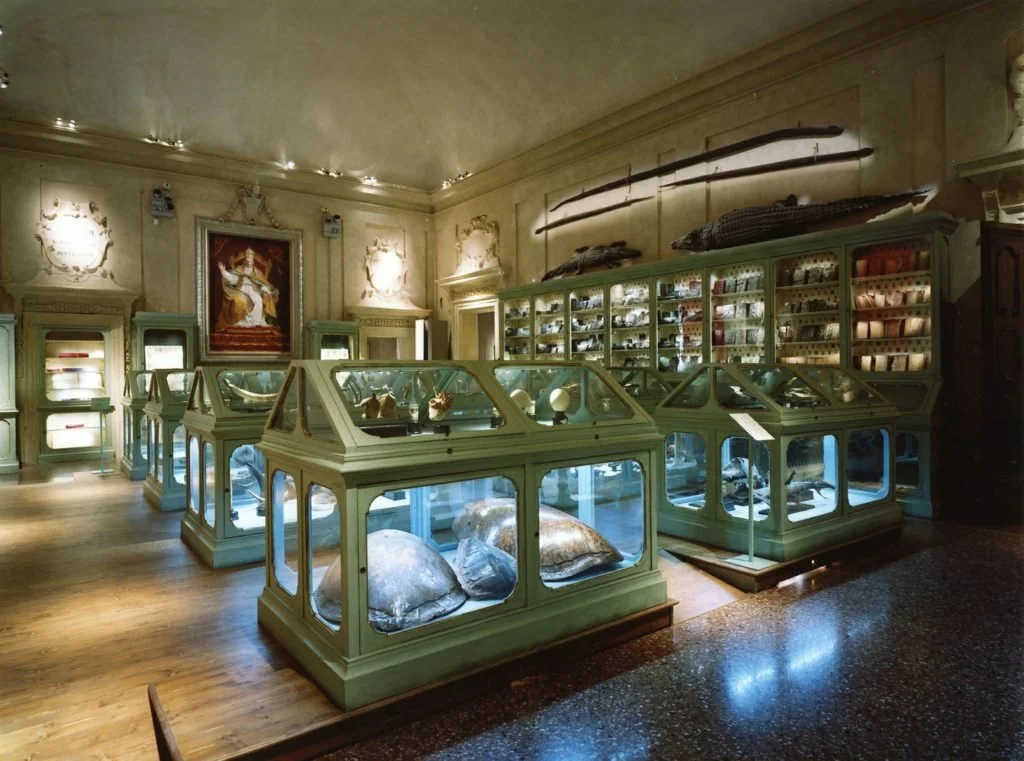
Ulisse Aldrovandi Collection, The Museum of Palazzo Poggi, Bologna, Italy. Università di Bologna.
The cabinets ranged in size from a dedicated piece of furniture with multiple drawers to an entire room. Drawers and shelves housed original objects acquired through long journeys to faraway places. Every object offered an opportunity to tell a story about an epic adventure or, more often, to fabricate one. Like everyone else, the wealthy liked to define their personalities through the possession of glamorous objects as tangible tokens of their intelligence, erudition, wealth, and taste. They had already understood that precious objects held power over people and that associations between luxury items and personality engraved long-lasting impressions.
All the curiosities related to “This Thing Of Ours”, whether antique or up-to-date techno-industrial artefacts, in the end, are merely junk, that is to say, waste.
I’ll jump right in with some perspectives from Capitalism’s most famous critics from the 19th Century. Communism is NOT the focus of this journey, but critical perspectives from “communists” and “socialists” can help set the stage for this broad exploration. It’s practically impossible to have a complete understanding of the subject without engaging with Mark and Engels, and the many people over many generations who have been inspired and influenced by their work. This perspective is not the main focus of this post. I’m approaching the subject from multiple angles, but you simply can’t understand controversial, complex social systems without engaging with supporters and critics and taking time to explore them with your peers.
Most folks in the Anglosphere avoid political philosophy, history, and especially anything to do with socialism or communism, as if they are demonic monsters trying to cart them off to hell. We, if you feel that way, buck up, have some courage, take a quick peak and you’ll see why people have been fighting over these ideas for centuries, and the battle won’t end until this thing of ours chokes out.
You may find that these ideas are more benign than you thought. At least you will know your enemy better.
The Art of War—Sun Tzu “If you know the enemy and know yourself, you need not fear the result of a hundred battles.”
“Keep your friends close, and your enemies closer.” —Michael Corleone in the 1974 film The Godfather Part II.
We argue to discover, knowing we can’t injure ourselves.
Overshoot will be the downfall of Capital.
Preamble
Later, I’ll talk more about what I refer to as the Overshoot, Collapse, and Limits to Growth community. Erik is one of the people I follow in this domain.

Now, what to do with this information? Don’t waste your time arguing with fools like I have done. Start opting out now. Simply learn how to opt out of the hype and instead begin Living Now.
Well, yeah, I opt in, I opt out, I do stuff like everyone else. Sometimes gain new perspectives because I’m curious.
If you want, you could stop reading this post now and read this book before you go on, it puts the whole journey in stark perspective.
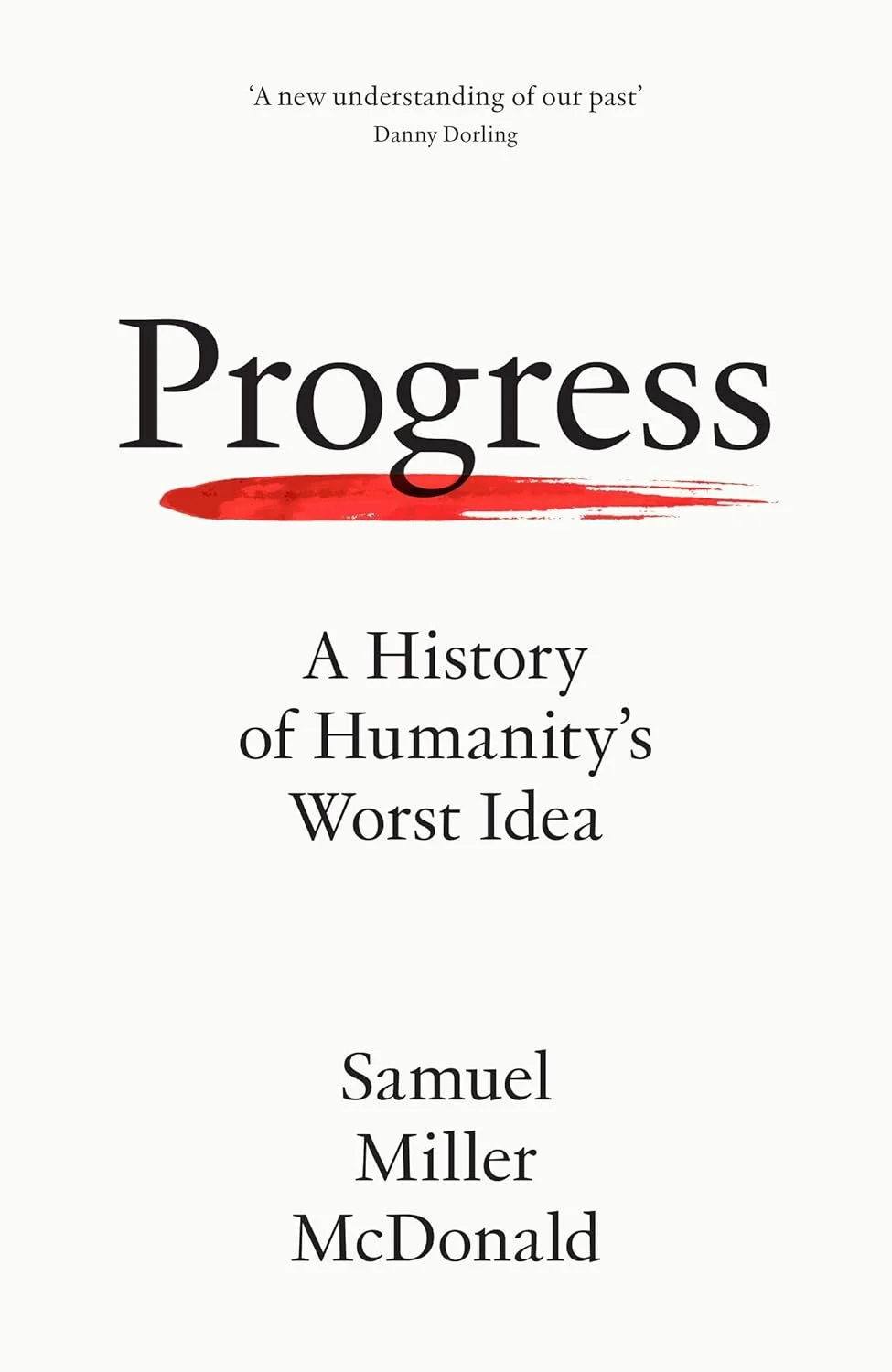
The nineteenth century saw the rise of a new kind of entity: the multinational corporation, a large, centrally governed bureaucracy engaged in extracting profit from the processing of resources and labour. With it came other new institutions, like non-profit organisations, research laboratories and an expanded government bureaucracy. Electrified forms of communication, like the telegram, radio and telephone, enabled instant coordination across many miles, in turn facilitating the coordination of business and government across vast geographic areas. Contiguous parasitism had captured energy from Indigenous societies and native wild and domestic species. Disparate parasitism, meanwhile, had captured energy from Indigenous societies, imperial subjects, and both exotic wild and intensively domesticated species abroad. The new form, networked parasitism, captured energy from all these as well, but with the addition of ancient species of plant and animal in the form of fossils. This enabled concrete energy capture through increasing electrification and then the digitisation of extraction and production, and abstract energy capture from extremely large, dense populations of urban subjects. Though the foundations for this system were built in the nineteenth century, it was only in the twentieth that it came to dominate. The term that emerged to encompass the totality of this interdependent network of networks was ‘the economy’. Economist Giorgos Kallis notes that the idea that we have today about the economy as a large, interconnected system emerged at this time.[1] As parasitic relations became an interconnected global process, it made sense to understand that process, measure it and attempt to direct it with a concept like the economy. The narratives that arose in attempting to shape the present and future of human-ecological parasitism were no longer just theological, no longer just rational or secular, nor even just scientistic, but were now economistic. They focused entirely on frameworks and models measuring the exchange of resources through the systems of extraction, production, distribution and waste that crisscrossed the world. Everything – values, morals, priorities, aspirations – became about ‘the economy’ and how it was to be ordered, its spoils distributed, its mechanics governed. The ideologies that sprang up at the turn of the twentieth century are all about who gets to steer the great steamship of a new kind of parasitism, rather than, say, whether there ought to be a steamship at all.
Miller McDonald, Samuel. Progress: A History of Humanity’s Worst Idea (pp. 196-197). (Function). Kindle Edition.
Engles Was Precient
Friedrich Engels, particularly in his later works like Socialism: Utopian and Scientific and his contributions to Capital, provided a surgical analysis of the capitalist business boom-and-bust cycle (what he called "crises").
Driven by the anarchy of production, the credit system, and the relentless need for expansion—reads like a blueprint for the financial crashes of the 20th and 21st centuries. When you overlay modern ecological "overshoot" onto his framework, the "bust" shifts from a mere economic recession to a potential biophysical collapse.
The Inevitable Cycle: From Boom to Crash
In Socialism: Utopian and Scientific (1880), Engels lays out the distinct phases of the industrial cycle. He argues that these are not bugs in the system, but features of how markets and credit operate.
“As a matter of fact, since 1825, when the first general crisis broke out, the whole industrial and commercial world, production and exchange... are thrown out of joint about once every 10 years.2 Commerce is at a standstill, the markets are glutted, products accumulate, as multitudinous as they are unsaleable, hard cash disappears, credit vanishes, factories are closed, the mass of the workers are in want of the means of subsistence, because they have produced too much of the means of subsistence; bankruptcy follows upon bankruptcy, execution upon execution.”
The Parallel Today:
Engels describes a systemic seizure—“credit vanishes.” This mirrors the liquidity freezes seen in 2008. The system relies on constant velocity (money and goods moving); when the “bust” arrives, the velocity drops to zero, and the system suffocates.
The Sorcerer and the Loss of Control
One of the most vivid descriptions of capital’s uncontrollability comes from the Communist Manifesto (1848), co-authored by Marx. Nothing can stop it.
“Modern bourgeois society, with its relations of production, of exchange and of property, a society that has conjured up such gigantic means of production and of exchange, is like the sorcerer who is no longer able to control the powers of the nether world whom he has called up by his spells... It is enough to mention the commercial crises that by their periodical return put the existence of the entire bourgeois society on its trial, each time more threateningly.”
The Parallel Today:
The “sorcerer” analogy fits the modern creation of complex financial instruments (derivatives, algorithmic trading, flash trades, crypto speculation) and techno-industrial acceleration. The system has become so complex and intertwined that no central entity (Central Banks, Governments) can fully control the “powers of the nether world” once a “correction” begins.
The Absurdity of Overproduction (Overshoot)
Engels frequently pointed out the unique absurdity of capitalist crises: people starve not because of scarcity (as in a famine in feudalism), but because of overproduction. (Or in the case of the Irish Potato Famine, global trade.)
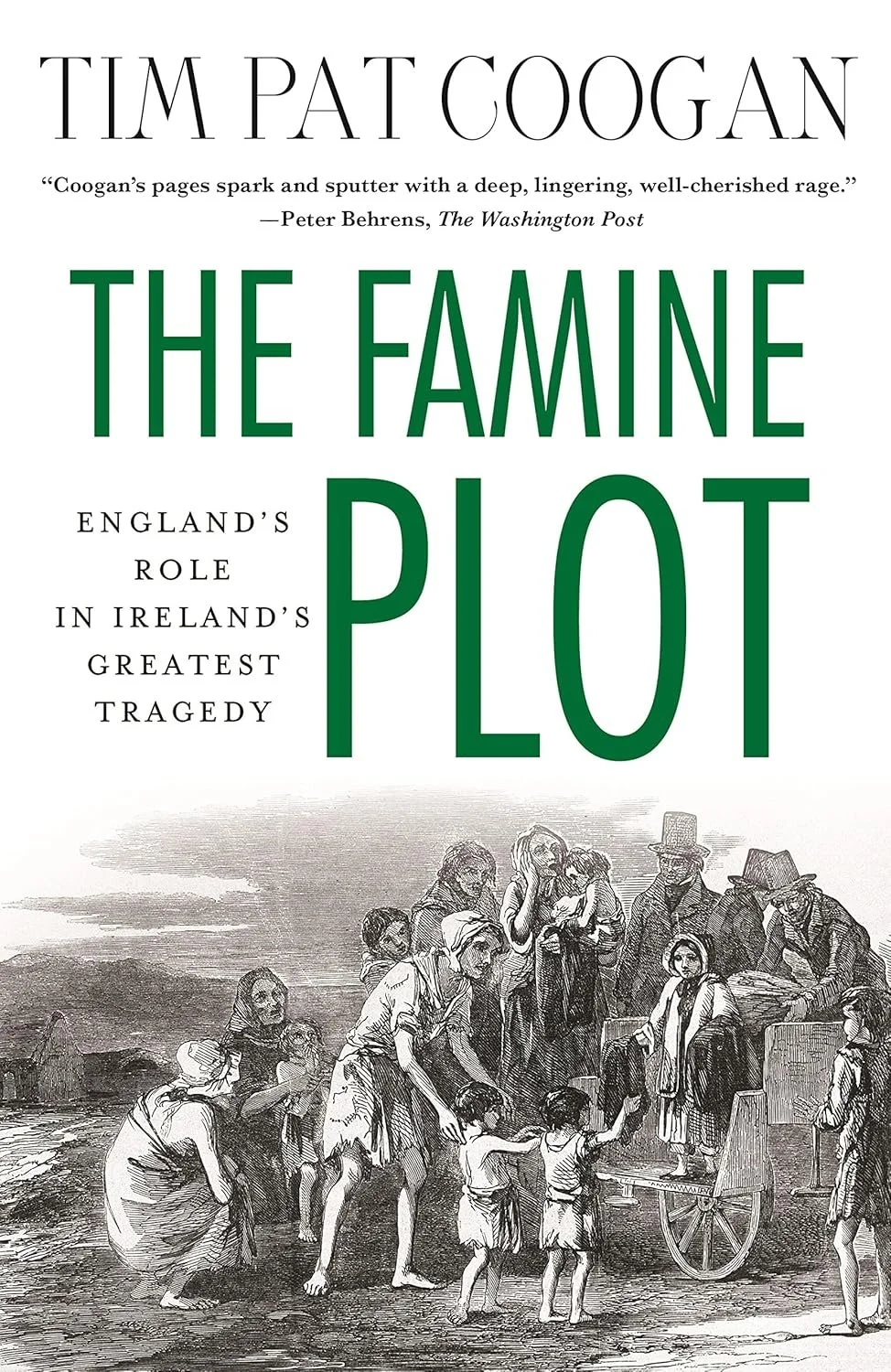
During a Biblical seven years in the middle of the nineteenth century, fully a quarter of Ireland's citizens either perished from starvation or emigrated in what came to be known as Gorta Mor, the Great Hunger. Waves of hungry peasants fled across the Atlantic to the United States, with so many dying en route that it was said, "you could walk dry shod to America on their bodies." In this sweeping history Ireland's best-known historian, Tim Pat Coogan, tackles the dark history of the Irish Famine and argues that it constituted one of the first acts of genocide. In what The Boston Globe calls "his greatest achievement," Coogan shows how the British government hid behind the smoke screen of laissez faire economics, the invocation of Divine Providence and a carefully orchestrated publicity campaign, allowing more than a million people to die agonizing deaths and driving a further million into emigration. Unflinching in depicting the evidence, Coogan presents a vivid and horrifying picture of a catastrophe that that shook the nineteenth century and finally calls to account those responsible.
“In these crises, a great part not only of the existing products, but also of the previously created productive forces, are periodically destroyed... In these crises, there breaks out an epidemic that, in all earlier epochs, would have seemed an absurdity — the epidemic of over-production.”
The Parallel Today:
In Engels’ time, this “destruction of productive forces” meant factories closing and inventory rotting. Today, this destruction affects human habitat and is responsible for ecocide. The accelerant of fossil-fueled capitalism, markets, demands we produce too much to keep the system solvent, destroying the biosphere in the process. A propagandised sense of scarcity is weaponized to fuel growth.
The Illusion of Credit and Expansion
Engels argued that the system tries to solve these crises by expanding into new markets—a temporary fix that only sets the stage for a bigger crash later.
“The extension of the markets cannot keep pace with the extension of production. The collision becomes inevitable... Capitalist production has begotten another vicious circle.”
“And how does the bourgeoisie get over these crises? On the one hand, by enforced destruction of a mass of productive forces; on the other, by the conquest of new markets, and by the more thorough exploitation of the old ones. That is to say, by paving the way for more extensive and more destructive crises, and by diminishing the means whereby crises are prevented.”
The Parallel Today:
This is the can-kicking mechanism. We use debt (credit) to pull future consumption into the present. When we run out of “new markets” (historically, colonies; today, perhaps the financialization of every aspect of life), the system hits a hard wall. When the market is the planet's physical resources, the conquest of new markets eventually hits the limit of physics.
Summary of the Mechanism
Engels views the trajectory as follows:
Expansion: Credit fuels massive production and technological speed.
Glut: The market cannot absorb the output (or the debt service becomes too high).
Crisis: The Sorcerer loses control; credit vanishes; value is destroyed.
Reset (or Collapse): The system cannibalizes itself to restart.
If the “stage” for this cycle is a finite planet, the “Reset” phase might not be a restart of the economy, but a collapse of the habitat required to sustain it.
Marx and Ecology
Marx was deeply concerned with ecology, though he used the language of his time (chemistry and metabolism) rather than modern environmental terminology.
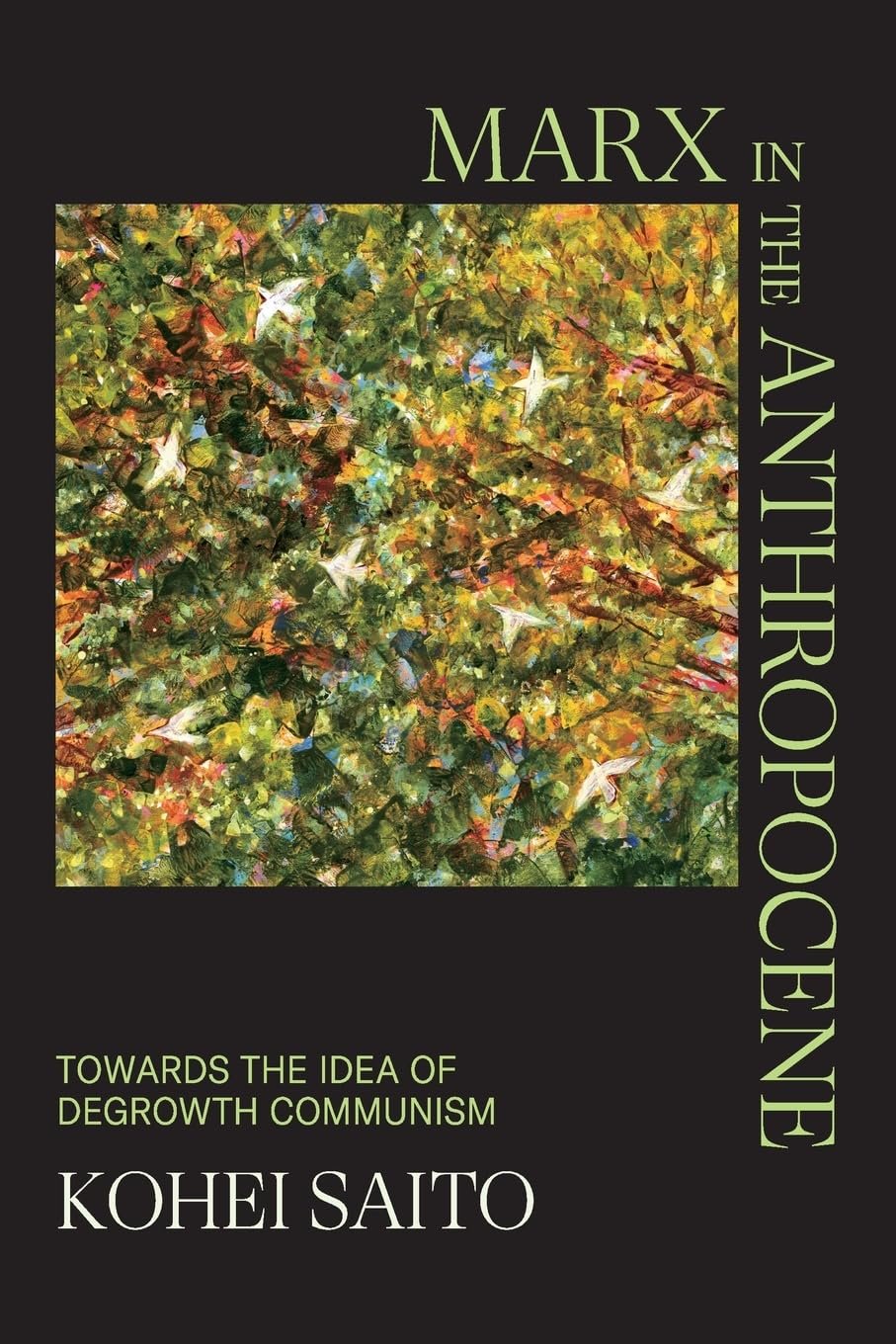
Karl Marx’s Ecosocialism Capitalism, Nature and the Unfinished Critique of Political Economy by Kohei Saito New York: Monthly Review Press, 2017. Marx in the Anthropocene Towards the Idea of Degrowth Communism by Kohei Saito Cambridge: Cambridge University Press, 2022. El capital en la era del antropoceno by Kohei Saito, translated by Víctor Illera Kanaya, Barcelona: Sine Qua Non, 2022.
Kohei Saito has become an essential voice in the debates about Marxism and ecosocialism. His books deal with four key issues: the relation between capitalism and nature; the relation between ecology and socialism; the agents and means of attaining ecosocialism (or degrowth communism); and the evolution of Marx’s views regarding these issues.
Regarding the first question, Saito argues that capitalism, driven by the incessant pursuit of private profit, is incapable of relating to nature responsibly and rationally. It inevitably alters the latter to the point of endangering the survival of many species, including our own.
The climate crisis is the most pressing example of this. But many other instances could be added. In that sense, the Green New Deal, to the extent that it envisages a green capitalism, is insufficient. Nothing short of the abolition of capitalism can adequately address the climate emergency.
In fact, the concept of “The Metabolic Rift” (Stoffwechsel) is central to his later critique of political economy. Marx argued that Labor is the “metabolic interaction” between humans and the earth. He observed that capitalist production breaks this cycle, taking from the soil but failing to return nutrients to it, thereby destroying the “eternal natural condition” of human existence.
Marx explicitly anticipated ecological “overshoot” and the destruction of the human habitat.
The “Metabolic Rift” and Soil Exhaustion
In Capital, Volume 1, Marx analyzes how industrial agriculture mirrors industrial manufacturing: both exploit their respective sources of wealth (the soil and the worker) to the point of collapse. This is the 19th-century equivalent of modern ecological overshoot.
“Capitalist production... disturbs the metabolic interaction between man and the earth, i.e., it prevents the return to the soil of its constituent elements consumed by man in the form of food and clothing; hence it hinders the operation of the eternal natural condition for the lasting fertility of the soil...
All progress in capitalist agriculture is a progress in the art, not only of robbing the worker, but of robbing the soil; all progress in increasing the fertility of the soil for a given time is a progress towards ruining the more long-lasting sources of that fertility... Capitalist production, therefore, only develops the techniques and the degree of combination of the social process of production by simultaneously undermining the original sources of all wealth—the soil and the worker.”
— Capital, Volume 1 (Chapter on Machinery and Large-Scale Industry)
The “Inorganic Body” of Man
In his earlier writings (Economic and Philosophic Manuscripts of 1844), Marx defines nature not as an external resource to be exploited, but as a physical extension of the human being. Destroying nature is, in his view, a form of self-mutilation.
“Nature is man’s inorganic body—nature, that is, insofar as it is not itself the human body. Man lives on nature—means that nature is his body, with which he must remain in continuous interchange if he is not to die. That man’s physical and spiritual life is linked to nature means simply that nature is linked to itself, for man is a part of nature.”
— Economic and Philosophic Manuscripts of 1844
The Irreparable Rift
In Capital, Volume 3, Marx expands on how the short-term profit motive of the market makes rational forestry or agriculture impossible. The “spirit” of capitalism (quick returns) is physically incompatible with nature’s slow cycles.
“The development of civilization and industry in general has always shown itself so active in the destruction of forests that everything that has been done for their conservation and production is completely insignificant in comparison.”
— Capital, Volume 2
“Large landed property reduces the agricultural population to a constantly falling minimum and confronts it with a constantly growing industrial population crowded together in large cities; in this way it produces conditions that provoke an irreparable rift in the interdependent process of social metabolism, a metabolism prescribed by the natural laws of life itself.”
— Capital, Volume 3
The Illusion of Independence from Nature
Marx critiqued the capitalist tendency to treat nature as a “free gift” or an infinite sink. In the Grundrisse, he notes that while capitalism strives to overcome natural barriers, it merely transfers the contradiction to a deeper, more dangerous level.
“It is not the unity of living and active humanity with the natural, inorganic conditions of their metabolic exchange with nature, and hence their appropriation of nature, which requires explanation or is the result of a historic process, but rather the separation between these inorganic conditions of human existence and this active existence, a separation which is completely posited only in the relation of wage labour and capital.”
— Grundrisse (1857-1858)
Summary of the Ecological Argument
Marx’s view was that Labor is the process by which humans regulate their metabolism with nature.
Pre-Capitalist Societies: Returned waste to the soil (circular metabolism).
Capitalism: Extracts resources, sends them to cities, and turns them into filth/pollution (linear metabolism).
Result: The soil dies (overshoot), and the living systems choke (habitat destruction).
He essentially predicted that a system based on infinite accumulation cannot coexist with a finite “metabolism” of the earth.
It’s the OVERSHOOT, stupid.
Let’s look at modern fossil-fuel and mineral dependency, drawing primarily on the work of contemporary ecological Marxists like Andreas Malm (Fossil Capital), John Bellamy Foster (The Metabolic Rift), and Kohei Saito (Marx in the Anthropocene).
Modern theorists argue that the “bust” is distinct from financial recessions because it involves ruptures on geological time scales rather than just economic cycles.
Fossil Capital: Energy as a Weapon Against Labor
Andreas Malm’s analysis of Marx argues that the transition to fossil fuels (steam) in the 19th Century was not inevitable due to efficiency, but chosen for political control. This explains why the system struggles to “stop” using them today.
The 19th-Century Context: In the 1830s, water power was cheaper and more abundant than coal-fired steam power. However, water wheels were fixed in place (rivers), meaning capitalists had to build housing for workers in remote areas. These workers were hard to replace if they went on strike.
The Shift to Steam: Steam engines allowed factories to move into cities. Even though coal was expensive, the city provided a “reserve army of labor” (desperate unemployed people). If workers struck, they could be easily replaced.
The Modern Parallel: We are not addicted to oil just because it is energy-dense, but because it allows Capital to be mobile and independent of local ecological limits. To stop using fossil fuels requires a return to “flow” energy (wind/solar), which relies on specific geographies and intermittent cycles—imposing a “discipline” on production that capitalism rejects.
The “Metabolic Rift” Expanded: From Soil to Atmosphere
John Bellamy Foster’s analysis extends Marx’s "Metabolic Rift" from the soil nutrient cycle to the global Carbon Cycle.
Marx’s View: The “rift” was a break in the cycle of soil nutrients. Crops took nitrogen from the countryside, were eaten in the city, and the waste ended up in the river (pollution) rather than returning to the soil.
Modern Analysis: The fossil fuel economy creates a rift in the carbon cycle. We take carbon stored in the earth's “inorganic body” (underground) and transfer it to the atmosphere.
The “Overshoot”: In the 19th Century, the “fix” was to raid guano deposits in Peru to fertilize exhausted English soil (imperialism). Today, there is no “guano” for the atmosphere. The “rift” has become a planetary boundary that cannot be fixed by importing resources from elsewhere, because the boundary is the planet itself.
The “Free Gift” and Mineral Exhaustion
Marx critiqued the classical economic view (Adam Smith/David Ricardo) that nature is a “free gift” to Capital. This concept explains the modern depletion of critical minerals (lithium, cobalt, copper).
The Mechanism: Under capitalism, the “value” of a commodity is determined only by the socially necessary labor time required to extract it. The nature of the material itself (its millions of years of geological formation) is priced at zero.
The Consequence: Because the “stock” of minerals is not priced, the market treats it as infinite. We extract the “low-hanging fruit” (high-grade ore) first. As we hit “overshoot,” we must use exponentially more energy to extract lower-grade ores.
The Modern Trap: This leads to what ecological economists call “Energy Return on Investment” (EROI) collapse. We burn more fossil fuels to obtain the minerals needed to build the machines that extract those fuels. Marx called this the “robbing of the earth,” noting that it “undermines the original sources of all wealth.”
“The Annihilation of Space by Time.”
Marx described Capital’s drive to “annihilate space by time”—to reduce the turnover time of Capital to near zero.
Acceleration: To maintain profit rates, the system must produce, sell, and consume faster every year.
The Conflict: Nature operates on biological and geological time (slow cycles of forest growth, carbon sequestration, aquifer refilling). Capital operates on market time (quarterly returns).
The Crash: As you noted, the “bust” is inevitable because these two clocks are incompatible. The financial system demands infinite acceleration (compound interest), while the physical habitat demands a slowing down to allow for repair.
Summary
The accelerant is structurally embedded in the system’s DNA.
Labor vs. Nature: The system uses fossil fuels to emancipate itself from nature’s limits (seasons, geography), creating a false sense of independence.
Valuation: By valuing nature at zero, the system is blind to the destruction of its own foundation until the collapse occurs.
Inability to Stop: Because the energy source (fossil capital) was selected to ensure dominance over Labor, removing it threatens the social hierarchy itself.
“Burning their way to the end.”
How to Blow Up a Pipeline (p. 8), summarizing the logic laid out in Fossil Capital.
“The commitment to the endless accumulation of capital wins out every time. After the past three decades, there can be no doubt that the ruling classes are constitutionally incapable of responding to the catastrophe in any other way than by expediting it; of their own accord, under their inner compulsion, they can do nothing but burn their way to the end.”
The “Bellows” Metaphor (from Fossil Capital)
In Fossil Capital, Malm uses this vivid image to explain why the system cannot stop itself. He describes capitalism and fossil fuels as two handles of a bellows fanning a fire that will consume them.
“Picture a pair of bellows. If one of the handles is the ceaseless growth that defines capitalism, the other is made up of coal and oil and gas; out of the nozzle comes a blast of CO2 that fans the flames of the fire of global warming. The more growth you have, the more forceful the push will be, and the stronger the blast...
Capitalism sored a peculiar formation... the fossil economy, most simply defined as an economy of self-sustaining growth predicated on the consumption of fossil fuels, and therefore generating a sustained growth in CO2 emissions.”
The “Emergency Brake” (The Bridge Analogy)
Malm frequently references Walter Benjamin’s metaphor, which is the inverse of “burning the bridge.” Instead of a bridge, it’s a runaway train.
“Marx says that revolutions are the locomotive of world history. But perhaps it is quite otherwise. Perhaps revolutions are an attempt by the passengers on this train—namely, the human race—to activate the emergency brake.”
The “Burning Bridge” Concept in Theory
While the exact phrase “burning the bridge” is a common idiom, Malm’s theoretical term for this is “The destruction of the conditions of production.”
The Bridge: The biosphere (stable climate, soil, water).
The Burning: The accumulation of Capital.
The Trap: To keep the economy (the fire) going, we must consume the biosphere (the bridge). If we stop burning, the economy collapses (the bust). If we keep burning, the bridge collapses (the end of the habitat).
Malm argues we are now at the point where the fire is consuming the floorboards we are standing on, yet the “inner compulsion” of the market forces us to throw more wood on the fire.
Indeed, The Downfall of Capital is Overshoot
The central tension of modern political philosophy: the gap between the diagnostic power of Marxist theory and the empirical reality of the last 170 years doesn’t bode well for a workers’ revolution. Modern Techo-Industrial Civilization is a beast with inertia and a big appetite that people are addicted to serving. There may arise isolated communities within the framework of existing States that try to develop novel, local political economies within the many constraints of cultish beliefs, willful ignorance, fear, overshoot, and the polycrisis/metacrisis.
Most people have no interest in volumes like Capital, political philosophy, or social theory. Folks are well-conditioned consumers who want to get paid.
The Diagnostic Brilliance vs. The Prognostic Failure
Marx and Engels remain indispensable for diagnosing the structural mechanics of capitalism. Their observations on the accumulation of Capital, the commodification of Labor, and the tendency of markets to concentrate wealth are as rigorously relevant today as they were in 1848. (Marx wasn’t a Marxist, and he wasn’t trying to create a new cybernetic system. Cybernetic Systems Theory, rooted in the broader field of Cybernetics, was formally established in 1948 with Norbert Wiener's book, Cybernetics: Or Control and Communication in the Animal and the Machine, defining it as the study of control and communication in systems, though key ideas emerged from interdisciplinary work in the 1940s, including early neural network models (1943) and Macy conferences (mid-1940s). Marx, as you may know, was philosophising in the 19th Century. Contemporary philosophers influenced by elements of Marx Theory have varied approaches with widely differing aims.
Marx's theory, or Marxism, is a socioeconomic and political framework analyzing capitalism, predicting class struggle between the owners (bourgeoisie) and workers (proletariat) due to exploitation, and envisioning a revolutionary transition to a classless, communist society with communal ownership of production, based on ideas of historical materialism, surplus value, and alienation. We must keep things in context.
However, their prognostications—the “inevitabilities”—failed to materialize.
The Missing Revolution: The core Marxist prediction was that the proletariat would develop a unified class consciousness as their conditions worsened. Instead, the working class in the developed world became fragmented. By exporting misery to the Global South and creating a domestic middle class, capitalism managed to buy off the revolutionary potential of Western workers.
The Soviet Failure: The Soviet experiment proved that removing the capitalist class does not automatically remove exploitation, alienation, or, more importantly, authoritarianism. It replaced the “anarchy of the market” with the rigidity of the state bureaucracy, often leading to distinct forms of tyranny rather than liberation. The hope for a “dictatorship of the proletariat” that would wither away into a stateless utopia is now widely regarded as a fantasy.
Marxism is a lens, not a blueprint. It explains why the engine is overheating, but it provided a faulty manual for building a new engine.
We’d need to evolve into a different kind of H. sapien to develop an alternative way of living. From what culture do new ways of living spring?
Marx’s Blind Spots: Asia and Women
Marx’s cultural narrowness is historically well-founded. While a genius of political economy, Marx was a man of his time—a Victorian European—and his framework struggled to encompass the non-European world and the domestic sphere.
The “Asiatic Mode of Production” and Eurocentrism
Marx often viewed history through a unilinear, Eurocentric lens. He struggled to fit India and China into his standard progression of “feudalism to capitalism.”
Today, we in the Anglosphere still feel superior to people in the East and Global South, hence our anger that the Chinese are now highly competitive with the West, and our feeling that the only way to continue “this thing of ours” is to destroy China.
Stagnation vs. Progress: He famously described Asian societies as caught in a stasis, or “vegetative existence,” requiring the “shock” of European colonialism to wake them up and drag them into “history.”
Colonial Apologetics: In his writings on British rule in India, Marx inadvertently sounded like a colonial apologist, suggesting that while British imperialism was brutal, it was historically “necessary” to smash the old Asiatic structures and lay the material foundations for Western-style capitalism (and eventual socialism). He underestimated the resilience and dynamism of indigenous Asian economic systems.
His sentiments proved true: by championing globalization and global financialized capital flows, the West transferred money, technology, and knowledge to China for quick profits and to tap into a large new market, thereby hastening China’s competitive Capitalism with Socialist Characteristics.
***When Players are outplayed, pleps and proles pay the price.
The Invisible Labor of Women
While Friedrich Engels attempted to address gender in The Origin of the Family, Private Property and the State, Marx’s core economic theory, Capital, largely sidelined women.
Production vs. Reproduction: Marx focused intensely on the factory floor (production) but largely ignored the kitchen and the nursery (reproduction). He treated the reproduction of the labor force—the birthing, feeding, and raising of workers—as a natural background process rather than an integral part of the capitalist economy.
The Patriarchal Oversight: By focusing on the waged male worker as the protagonist of history, Marx failed to see that capitalism was built not just on the exploitation of factory labor, but on the appropriation of women’s unpaid domestic Labor. Modern feminist Marxists (like Silvia Federici) argue that you cannot understand capitalism without understanding the subjugation of women.

We are witnessing a new surge of interpersonal and institutional violence against women, including new witch hunts. This surge of violence has occurred alongside an expansion of capitalist social relation. In this new work that revisits some of the main themes of Caliban and the Witch, examines the root causes of these developments and outlines the consequences for the women affected and their communities. She argues that, no less than the witch hunts in sixteenth and seventeenth century Europe and the New World, this new war on women is a structural element of the new forms of capitalist accumulation. These processes are founded on the destruction of people's most basic means of reproduction. Like at the dawn of capitalism, what we discover behind today's violence against women are processes of enclosure, land dispossession, and the remoulding of women’s reproductive activities and subjectivity. As well as an investigation into the causes of this new violence, the book is also a feminist call to arms. Federici's work provides new ways of understanding the methods in which women are resisting victimisation and offers a powerful reminder that reconstructing the memory of the past is crucial for the struggles of the present.
The Unexpected Robustness of Capitalism
The most significant surprise for a time-traveling 19th-century Marxist would be the sheer adaptability of the capitalist system. It did not collapse under the weight of its own contradictions; it evolved.
Technological Integration: Marx saw machinery as a means to displace labor, but capitalism used science, technology, engineering, and R&D to create entirely new industries, absorbing labor in ways he didn’t foresee (e.g., the service economy, the information age).
The Reformist Valve: Under pressure from unions and amid the fear of revolution, the capitalist state adopted technocratic management and welfare systems. Universal education, rising real wages (up until the 1970s), and the democratization of luxury (material comforts), entertainments, spectacles, and year-round access to global food stock stabilized the system.
Innovation as Survival: The system’s emphasis on competition drove a relentless improvement in material living standards for the core economies. The “immiseration of the proletariat” did not happen in absolute terms in the West; instead, the worker became a consumer, deeply integrated into the system they were supposed to overthrow.
The immiseration was reserved for the Global South and so-called developing countries. Unfortunately, it’s been coming to a suburb near you recently.
The Myth of Catastrophic Enlightenment
The most chilling part, for me, is my skepticism regarding catastrophe as a catalyst. There is a romantic notion in revolutionary thought that when things get bad enough, people will wake up and join hands. History suggests the opposite. It’s hard enough to get people in one’s own community to work on a project together under current stresses.
The Paralysis of the Polycrisis:
Retrenchment, not Revolution: When faced with acute crises (economic collapse, pandemic, artificial or absolute scarcity), human societies often do not expand their circle of empathy; they shrink it. We see a retreat into nationalism, tribalism, and fascism—a desire for a strongman to “restore order”—rather than a collaborative leap into a new system. We convince ourselves that all we need is some old-time religion.
Normalization of Horror: We are currently living through ongoing social unrest, genocides, ecocides, and global heating. The human capacity to normalize the horrific is boundless. We adapt to the degradation of our world rather than rebelling against it.
The Lack of a Next Generation: The hope that the next generation will inherently possess the “wisdom” to fix this is a perilous gamble. Children raised in crisis often learn survival, not sustainability. Trauma does not necessarily beget enlightenment; it frequently begets defensiveness and tragic forms of psychological pathologies.
From what culture do enlightened revolutionaries spring?
Summary
The tragedy of the Marxist legacy is that while the critique of the disease (capitalism) remains analytically exemplary, the prescription for the cure (proletarian revolution) has expired.
We are left in an interregnum: The old world of robust, technocratic capitalism is arguably dying under the weight of ecological limits and inequality, but the new world—a collaborative, sustainable system—struggles to be born. Today’s catastrophes are more likely to lead to a fragmented, fortified neo-feudalism than a global socialist awakening.

Here is a good place to reflect on “Conspicuous Consumption. And just in case you thought financialization and Zero to One were relatively new, check out what Thorstein has to say about it, way back in the 19th Century.
The Scurge of the Super Rich
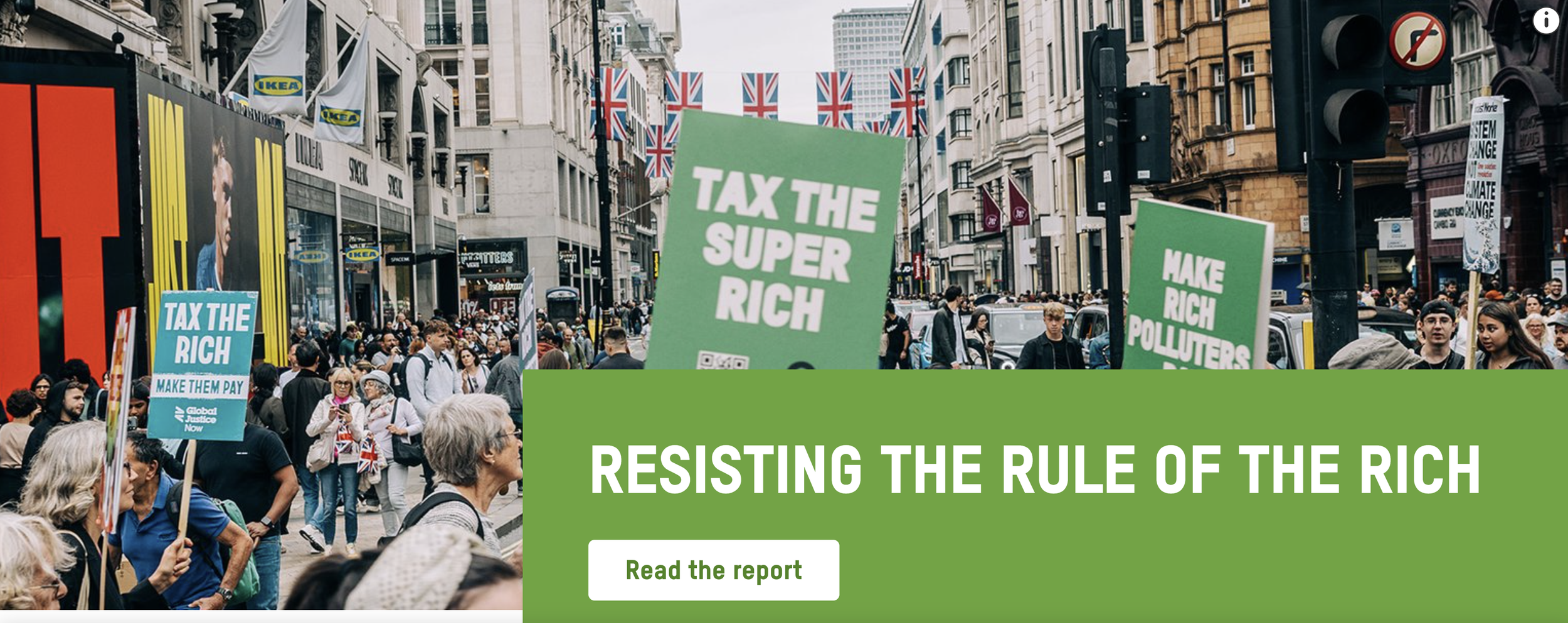
For at least the past 10 years, Oxfam has produced a report on global inequality. As a global NGO, we work together across all the countries where we are based to highlight and make a big noise about how inequality and poverty are interlinked.
In January 2026, during the World Economic Forum in Davos, we released our paper ‘Resisting the Rule of the Rich. Protecting freedom from billionaire power.
The 2026 paper focuses on how the super-rich use their extreme wealth to buy politics, media, and justice to defend their own fortunes, dismantle and destroy progressive policies, and strip away our basic civil and political rights.
Globally, billionaire wealth rose by more than 16% in 2025, reaching a record $18.3 trillion. This growth was three times faster than the average annual increase over the previous five years. And since 2020, billionaire wealth has grown by 81%.
In the UK, the richest 56 people now hold more wealth than 27 million combined – highlighting just how concentrated wealth is.
These stats, whilst still shocking, are simply an update from previous years. We know it’s getting worse – so what’s new? This year, we talk about how people with extreme wealth are buying politics to shape the world in their own benefit, leaving everyone else to cope with less and less.
Oxfam's Global Inequality Report
This interregnum: the old revolutionary models have failed, yet the current capitalist system is driving the polycrisis. Modern theorists are attempting to break this paralysis by diagnosing why we are stuck and proposing frameworks that respect planetary boundaries.
The Ecological Corrective: Post-Growth and Degrowth
Modern Degrowth theorists (like Jason Hickel, Giorgos Kallis, and Tim Jackson) argue that this strength has become a cancer. I mention them now because I don’t mention them later, but I think they add a lot to what we’re exploring here.
The Decoupling Myth: Mainstream “Green Growth” relies on the idea that we can decouple GDP growth from resource use (make more money while burning less carbon). Hickel argues this is empirically impossible at the speed required to stop climate breakdown.
The “Doughnut” Model: Economist Kate Raworth proposes a visual framework that replaces the line of “infinite growth” with a circle.
The Inner Ring: The social foundation (food, water, housing, gender equality—addressing the blind spots you noted).
The Outer Ring: The ecological ceiling (climate change, biodiversity loss).
The Sweet Spot: The goal is not “growth” but “balance” within the doughnut.
Reframing “Robustness”: These theorists argue that robustness (efficiency, accumulation) creates fragility in natural systems. A “post-growth” economy prioritizes redundancy, care, and resilience over efficiency and profit.
Repairing Marx: Kohei Saito and the Metabolic Rift
Recent scholarship is attempting to “rescue” Marx from his own 19th-century limitations. The Japanese philosopher Kohei Saito (Marx in the Anthropocene) is central here.
The “Epistemological Break”: Saito analyzed Marx’s unpublished notebooks from late in his life (after Capital Vol. 1). He found that Marx actually abandoned his earlier Eurocentric and Promethean (pro-technology/pro-growth) views.
The Metabolic Rift: Saito argues that the mature Marx became obsessed with the “metabolic rift”—the idea that capitalism breaks the natural cycle of soil and earth. Marx began studying geology and indigenous communal societies, realizing that the “Asiatic” or indigenous modes of living were not “backward” but sustainable models of “communal wealth.”
Degrowth Communism: Saito proposes that if Marx were alive today, he would not be a Soviet-style industrialist, but a “degrowth communist.” He argues we must seize the means of production not to increase output (as the Soviets tried), but to slow it down and distribute wealth equitably without destroying the biosphere.
Technocratic Utopianism: Post-Scarcity
On the opposite end of the spectrum from Degrowth are the Left Accelerationists (like Nick Srnicek and Alex Williams).
Embracing the Robustness: They agree with you that capitalism’s engine (technology, logistics, R&D) is powerful. They argue we shouldn’t smash the machines (primitivism) but repurpose them.
Fully Automated Luxury Communism: They argue that we should automate as much labor as possible to liberate people from drudgery. The goal is to detach the technocratic management from the profit motive.
The Critique: Critics argue this relies on the same fantasy of infinite energy and resources that created the polycrisis in the first place.
Summary of the Modern Pivot
The debate is no longer Capitalism vs. Soviet Socialism. It has shifted to:
Capitalist Realism: We continue as is, managing catastrophes through authoritarianism and technology (the default path).
Degrowth/Doughnut: We consciously contract our material throughput to save the biosphere, prioritizing public abundance over private luxury.
Eco-Socialism: We use a revised Marxist framework to manage the “metabolism” between humanity and nature democratically.
The crux of the problem. To an observer trapped inside Capitalist Realism, the concept of Degrowth looks indistinguishable from a catastrophic economic depression.
Because our current system requires constant expansion to maintain stability (to pay interest on debts, to employ the population, to fund pensions), imagining a “non-growing” economy feels like imagining a plane that stops flying in mid-air.
How would a Post-Growth economy actually function mechanically, and what psychological barriers prevent us from accepting it?
The Mechanics: How an Economy Functions Without Growth
Degrowth is not less of the same (a recession); it is a transition to a completely different operating system. It moves from an economy based on Efficiency and Accumulation to one based on Sufficiency and Regeneration.
Here is the theoretical blueprint for how the machinery works when the Growth button is turned off:
Decoupling Employment from Growth (The 4-Day Week)
In capitalism, we rely on growth to create new jobs to absorb populations and displaced workers. If growth stops, unemployment usually spikes.
Instead of firing 20% of the workforce when demand stabilizes, you reduce everyone’s working hours by 20% while maintaining a living wage. This redistributes the available work. We trade the material accumulation of the 20th century for time abundance in the 21st. Technological gains (automation) are directed toward liberating time rather than increasing corporate profit.
De-commodification: Universal Basic Services (UBS)
In a Degrowth scenario, aggregate GDP might shrink, meaning lower cash wages for some.
You reduce the need for a high cash wage by making the most expensive parts of life—housing, transport, healthcare, internet, and education—free or heavily subsidized public goods. This is “Public Luxury, Private Sufficiency.” You might have less disposable income for plastic trinkets, but you have zero anxiety about rent or medical bills. This breaks the coercive cycle of labor where people work bullshit jobs to survive.
Shifting from “Exchange Value” to “Use Value”
Currently, R&D and engineering are directed toward things that sell (planned obsolescence, fast fashion, ad-tech).
Engineering focuses on modularity and repairability. A washing machine is designed to last 50 years, not 5. This is bad for GDP (fewer sales), but excellent for the planet and human welfare. The economy moves from a “throughput” model (take-make-waste) to a circular model.
The End of Debt-Based Money
Our current money is created as debt; it bears interest, which mathematically mandates growth (to pay back the interest).
Theorists argue for cancelling crushing debts (especially in the Global South) and shifting to sovereign money creation spent directly into existence by the state for social goals, rather than lent into existence by private banks for profit.
The Psychological Barrier: Breaking “Capitalist Realism”
If the mechanics above are technically feasible (and many economists argue they are), why does the catastrophe of the polycrisis/metacrisis not drive us toward them? This brings us back to Mark Fisher’s Capitalist Realism.
The Privatization of Stress (Reflexive Impotence)
We know things are bad, but we feel structurally incapable of changing them.
The system has successfully offloaded systemic failures onto individuals. If you are poor, it’s a lack of “upskilling.” If you are anxious about the climate, you have “eco-anxiety” and need therapy. This blocks the collaborative impulse. Instead of forming unions or collectives, we retreat into self-help, meditation apps, and personal resilience strategies. We are too busy surviving capitalism to dismantle it.
The Colonization of the Imagination
A revolution is just a fantasy and historically rarely works out in the long term. Capitalist Realism goes further: it erases the very memory that other ways of living are possible.
Fisher described a “slow cancellation of the future.” (More on this later.) We are culturally stuck recycling the 20th century (reboots, nostalgia). We can’t imagine a new socio-economic future because we haven’t even invented a new musical genre in 20 years.
Capitalist Realism weaponizes the Soviet failure. Any attempt to manage the economy collectively is immediately framed as a slide toward the Gulag. This shuts down nuanced debate about democratic planning vs. authoritarianism.
The Addiction to “More”
This is the hardest pill to swallow. Material comforts—air travel, endless meat, next-day delivery—provide neurohormone cocktails that pacify the population.
Degrowth asks people to give up “convenience” for “agency.” But modern citizens have been trained to prefer convenience. We may hate the system, but we love the treats it provides. Breaking this addiction requires a cultural shift that mere catastrophe might not trigger; catastrophe often makes us hoard more treats.
This Way Out
The impasse is that Degrowth offers the only biological chance of long-term survival, but Capitalist Realism makes it psychologically impossible to implement.
The only way to break the Realism is to stop framing Degrowth as “giving things up” (austerity) and frame it as “getting things back.”
Not Less Stuff, but Less Fear.
Not Lower Wages, but More Time.
Not Less Innovation, but Better Problems (solving climate change rather than optimizing ad clicks).
Does this sound like a Davos Crowd conspiracy to you? If so, then you have been well trained. Relax, go to the game, do a bump in the bathroom (movie trope), and chant USA! USA! USA!
One alternative approach, or “train of thought.”
Good gosh, Peter Joseph doesn’t like Marxist analysis; he seems to think it’s useless. He has developed a cybernetic approach to creating a completely new way of managing sociopolitical and economic affairs, he calls INTEGRAL COLLECTIVE. How novel is it, and can it get traction? You be the judge.
I am pretty sure that Peter is not well-read in the above-considered domains, but then who is, and is it necessary?
I think that it’s these kinds of projects are unlikely to catch on in our current atmosphere of overshoot, collapse, and limits to growth. There are so many stressors limiting our ability to think in novel ways, much less build new cultures. Power across the globe won’t let it happen, they will weaponize INTEGRAL just as they have Socialism and all other “alternative” ways of managing things.
From what culture does a complete divorse from market capitalism arise? Do young people have time for culture building? I have no doubt that after this thing of ours selve distructs, people will be forced to culture build. Perhaps the most some of us can do is help create pathways to develop the imagination, intelligence and skills required to do better next time.
I’ll explore his proposal later, but for now, watch this video noting his vehement critiques of Socialism and Mark Theory. In my view some of his judgments in the beginning of the video fail in precisly the same way he suggests Socialists fail, in mistaking models, theoretical approaches, and trains of thought for something that exists or has existed and therefore ought to be payed attention to. He mistakes the method of analysis with an existing opperating system. Granted, he’s trying to collaboratively build one, but so are many others. He believes his cybernetic social system can work, and seems to have developed some project management or logistics software tailored to his sociopolitical economic system. I’m not sure how novel his code could be, but hopefully we’ll find out. I am sympathetic to his rhetoric concerning markets.
If you can’t stand the guy, don’t tune out, he’s here as an example of people doing stuff. People have always tried to improve things. We may be in a predicament, but that won’t stop people from doing stuff.
Introductions, Perspectives & Areas of Inquiry
Living Systems
Deep Time
Histories
Contexts
Ontologies
Epistemologies
Biophysical Reality (as far as we know it now)
All Scientific Domains
The Humanities (human culture, experience, and expression)
Relational, Interconnectedness, Integratedness
Changes & Cycles
Existentialism (individual freedom, responsibility, and the search for meaning in a world without inherent purpose)
Absolute Idealism (ultimate Reality is a single, unified, rational/meaningful, and spiritual whole)
A Core Assumption
Living Bodies Die.
What is Life?
Life is a complex, self-sustaining process defined by characteristics such as organization, metabolism, growth, adaptation, responsiveness to stimuli, and reproduction, involving highly organized systems (cells) that use energy to maintain order and evolve. However, its ultimate meaning remains a profound philosophical question. Biologically, it’s about processes like homeostasis, growth, and reproduction, while philosophically, it involves existence, consciousness, and finding purpose.
Biological Characteristics
Organization: Made of cells, with complex, coordinated parts (atoms to organs).
Energy Use: Metabolizes, consumes, and uses energy (like sunlight) to grow and function.
Growth & Reproduction: Increases in size and creates new individuals
Adaptation & Response: Responds to external stimuli and evolves over time.
Homeostasis: Maintains a stable internal environment.
Mammalian Life
All mammals are complex, multicellular organisms composed of specialized cells, the basic units of life.
Mammals take in and process energy (food) to perform essential functions, such as growth, movement, and maintenance of their complex structures. They exhibit anabolism (the synthesis of organic matter) and catabolism (the breakdown of organic matter).
Mammals (warm-blooded) regulate their internal environment to maintain stable, optimal conditions (e.g., constant body temperature, blood pressure, pH levels), regardless of external changes.
Mammals sense and react to changes in their internal or external environment, such as pulling a hand away from a hot surface or pupils contracting in bright light.
Mammals grow and mature throughout a life cycle (birth, growth, reproduction, death) according to specific instructions encoded in their genes.
Mammals can produce new individuals, typically through sexual reproduction, passing on genetic material (DNA) to their offspring and ensuring the continuation of the species.
Populations of mammals adapt to their environments over time through natural selection and evolution.
Beyond these general characteristics of life, mammals have specific diagnostic features that distinguish them as a class of animals, such as fur or hair, a neocortex in the brain, three middle-ear bones, and, in females, milk-producing mammary glands to nourish their young.
Homo sapiens are mammals.
While some non-living things may exhibit one or two of these properties (e.g., a fire grows and processes energy), only living organisms demonstrate all of them together.
One can think of GAIA or Earth as a living body composed of many complex, evolving, and emerging living systems.

Look at this video; it was patterned using AI. The generated character looks and sounds remarkably like Richard Feynman. Imagine if videos like this could be made with you as the character, accurately representing you and your wisdom for your great, great grandchildren. Wouldn’t that be something? I’d love to have a video like the one my great-grandmother made, telling stories about her life.
The information in that video is scientifically accurate.
I vetted the information in the video using Google, various websites, and an LLM research librarian, Gemini.
The video presents some mind-bending statistics about human biology. They sound impossible, but they are based on well-established biochemistry.
Here is a breakdown of the specific claims in the video, and the science that backs them up:
1. “You are made of 7 billion billion billion atoms.”
This number is 7 \times 10^{27} (7 octillion)
7,000,000,000,000,000,000,000,000,000
A 70 kg (154 lb) human body is composed mostly of small atoms like Hydrogen, Oxygen, and Carbon.
Because these atoms are so incredibly tiny, you need a massive number of them to build a person.
Calculation: If you take the molar mass of the elements in the body and apply Avogadro’s constant (6.022 \times 10^{23} atoms per mole), you arrive at roughly 7 \times 10^{27} atoms.
Molar mass is the mass of one mole (about 6.022 x 10²³ particles) of a substance, expressed in grams per mole (g/mol). It’s found by summing the atomic masses (from the periodic table) of all atoms in a compound, with elements having their atomic mass numerically converted to g/mol (e.g., Carbon is 12.01 amu to 12.01 g/mol). This fundamental concept links the microscopic world of atoms to macroscopic lab measurements.
2. “Your body produces its own weight in ATP every day.”
The above statement is Accurate (but with a catch).
Adenosine triphosphate (ATP) is the primary “energy currency” of all living cells, providing immediate energy for processes like muscle contraction, nerve impulse propagation, and chemical synthesis. It consists of an adenine base, ribose sugar, and three phosphate groups, releasing energy when the bond between the second and third phosphate is broken.
The Science: You don’t store your body’s weight in ATP; you recycle it.
The Battery Analogy: ATP (Adenosine Triphosphate) is like a tiny rechargeable battery. When it gives up energy, it becomes “dead” (ADP).
The Catch: You only have about 250 grams (roughly half a pound) of ATP in your body at any given moment.
The Speed: To keep you alive, your body has to recharge each ATP molecule roughly 1,000 to 1,500 times per day.
The Math: 250 grams x 1,000 cycles = approx 250 kg of turnover. This means your body effectively “synthesizes” roughly your body weight in ATP daily, just by recycling that small pool over and over again.
3. “The motors spin at 7,000 RPM” (ATP Synthase)
The Science: The protein responsible for recharging ATP is called ATP Synthase.
It is literally a rotary motor. It is embedded in the membrane of your mitochondria.
It uses a flow of protons (hydrogen ions) to spin a central shaft.
Observations suggest these nanomachines can spin at 6,000 to 9,000 RPM (rotations per minute) and achieve nearly 100% energy efficiency, surpassing any man-made motor. WOW!
The video uses these stats to illustrate the scale and speed of life. We often think of our bodies as static things, but at the molecular level, we are a frenzy of high-speed mechanical activity.
There is a huge difference between static objects and dynamic systems. You are processes, not a thing.
1. The “Flame” Analogy (Why we are a process)
Think of a candle flame.
If you look at it, it seems like a constant object. It has a shape, a color, and a size.
But if you freeze time, what is it really? It is a stream of hot gas and reacting molecules.
The atoms inside the flame are completely different one millisecond apart. The flame isn’t the atoms; the flame is the activity happening to the atoms.
You are the flame.
Every breath you take, you swap carbon atoms. Every time you use the bathroom or shed skin, you lose matter. Every time you eat, you gain matter.
Estimates suggest that roughly 98% of your atoms are replaced every year. Reborn, remade, every year? No wonder my face looks different from when I was 25.
This means the “stuff” you were made of 5 years ago is almost entirely gone. The only things that remain are the pattern and the continuous energy flow keeping it alive.
2. “Energy can’t be destroyed” (The First Law)
The video is referencing the First Law of Thermodynamics, also known as the Law of Conservation of Energy.
The Law: Energy cannot be created or destroyed; it can only change form.
The Reality: The heat energy your body produces (from that spinning ATP synthase motor) radiates out into the room. It warms the air, which moves molecules that might eventually radiate into space.
When a person dies, their electrical and chemical energy doesn’t vanish. It dissipates into the environment as heat and chemical breakdown. The energy is still in the universe, just no longer contained within the “system” of the body. Make of that what you will; there are lots of potential stories there.
3. What actually ends? (The Second Law)
If the atoms still exist and the energy still exists, what “dies”?
The Order dies.
This relates to the Second Law of Thermodynamics (the Entropy Principle). The universe naturally tends toward disorder.
Life is a resistance to disorder. By eating food and breathing, you constantly pump energy into the system to keep your complex structure organized (repairing cells, unwinding DNA, recharging ATP).
When the “process” (metabolism) stops, you stop fighting entropy. The atoms remain, but they drift apart and lose their complex structure.
Living systems are amazing, and our way of life should not be responsible for destroying these miraculous, orderly energy patterns. We must preserve them. Once the patterns are gone, they are gone. We must not contribute to the death of living systems. It breaks my heart to think of it.
The video is making a poetic but physically accurate point:
“You” are not the bricks in the wall; you are the act of building, creating, transforming, growing.
When the building stops, the bricks (atoms) and the effort (energy) remain, but the specific, organized structure that defined “you” dissolves.
Death—Let’s Face It
Death is the irreversible end of all biological functions that sustain a living organism, marked medically by the permanent cessation of heartbeat, breathing, and brain activity (including the brain stem). It signifies the permanent loss of life and the body’s ability to function as a whole, though cellular death (biological death) may occur slightly later than the moment of clinical death (when vital functions stop).
For mammals, death is medically defined as the permanent cessation of heartbeat, respiration, and brain function (including the brainstem). It signifies the permanent loss of consciousness and the body’s ability to maintain life, marking the conclusion of an individual’s existence.
Medical & Biological Definition
Death is defined by the permanent stopping of circulatory (heartbeat) and respiratory (breathing) functions, or the entire brain’s functions, as per the Uniform Determination of Death Act (UDDA).
Brain Death is the irreversible loss of all brain function, including the brainstem, which controls vital involuntary functions like breathing.
After clinical death, cells begin to die, a process known as biological death that occurs minutes or hours later.
Key Aspects
End of Life: It’s the final end of an organism’s life, though some organisms are biologically immortal.
Figurative Death: The term can also describe the cessation of activity in non-living things (e.g., a star “dying” when it runs out of fuel) or figuratively (e.g., “the death of hope”).
Philosophical & Cultural Views
Death is a fundamental mystery, with many beliefs about an afterlife, reincarnation, or a return to the universe, varying across cultures and religions. I presume that after my life ends, the Universe continues without my particular, embodied identity. It’s highly probable that using Minimal Viable Metaphysics as my analytical framework, I discover that it’s highly probable that life on Earth goes on without me.
Lifelong Learning & Reading Is Exemplary
Learning is the lifelong process of acquiring new knowledge, skills, behaviors, values, or preferences, resulting in a relatively permanent change in understanding or capability, driven by experience, study, training, or observation, and applicable across humans, animals, and even some machines. It’s not just memorization but involves making sense of information, interpreting reality, and developing the ability to apply what’s learned to new situations, fostering personal growth and adaptation.
Learning is the journey of change within the mind, often inferred from what someone can do or produce.
Learning involves changes in knowledge, beliefs, attitudes, or behaviors that persist and stem from interactions with the world, whether through direct experience, teaching, formal education, or self-study. Learning happens continuously throughout life, not just in formal schooling. The goal is to use acquired knowledge or skills to handle future challenges.
Examples of learning processes:
Operant Conditioning: Learning through consequences (rewards/punishments).
Observational Learning: Learning by watching others (imitation).
Conceptual Learning: Making connections between ideas and the real world to develop a deeper understanding.
“This thing of ours” (Civilization) Is Rough Business
This thing of ours (from the Italian Cosa Nostra) primarily refers to the American Mafia or organized crime, signifying their secret, shared world, business, and code; however, it can also broadly describe any shared activity, secret, or deep bond between people, like a close-knit group or a significant shared project. How many “Deep States” are there embedded in this thing of ours? Are you a member of the club?
Exceptionism & Supremacism
Exceptionism refers to the belief that one is a special case, exempt from general rules, duties, or expectations, often justifying deviations due to unique circumstances, whereas the related term Exceptionalism describes the idea that a group, nation, or person is uniquely superior or different, such as American Exceptionalism. In ethics, exceptionism is the view that allows exceptions to moral absolutes in specific situations, contrasting with strict absolutism, and it can also describe a mindset in which individuals feel their personal situation justifies breaking rules.
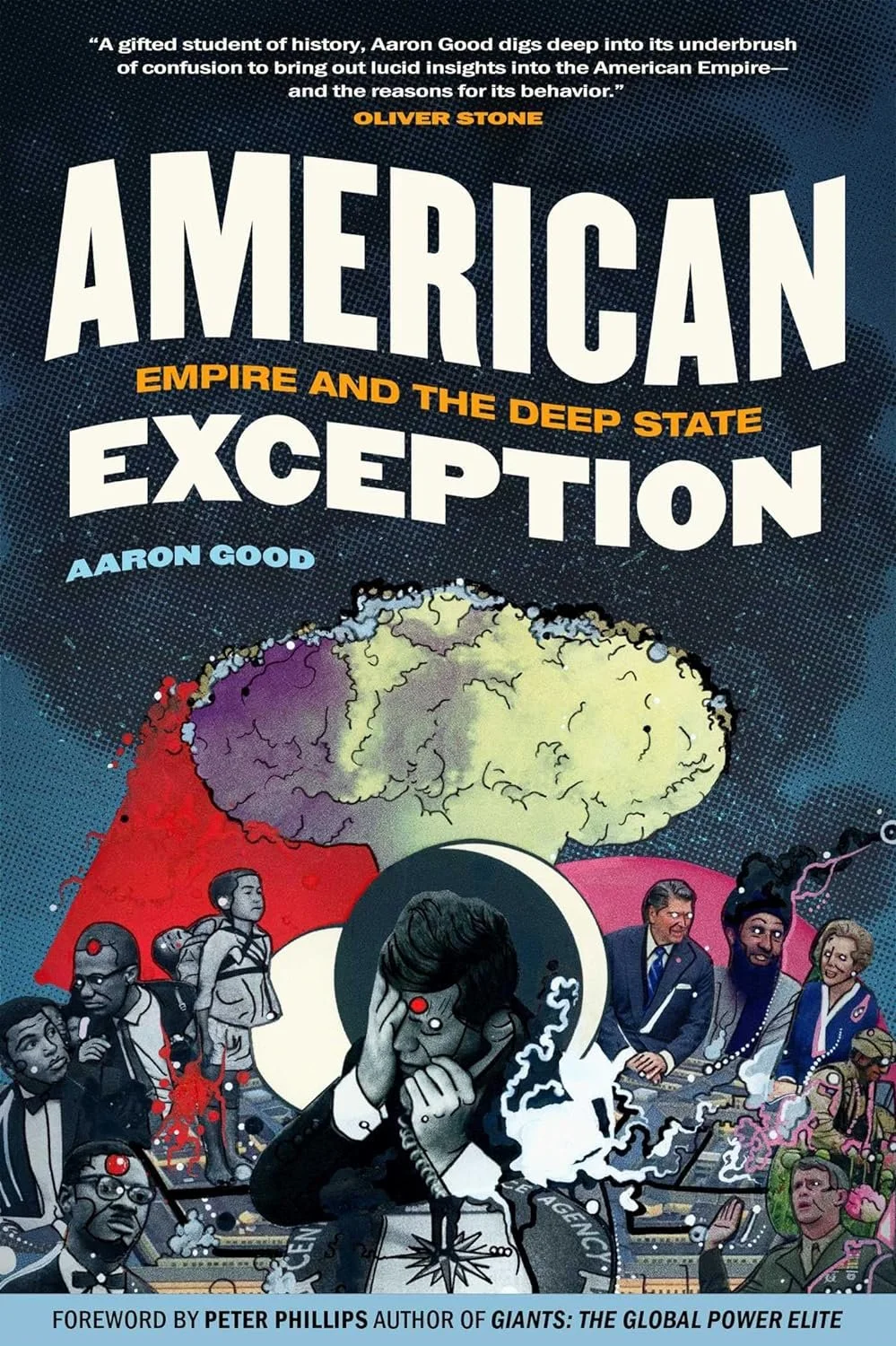
American Exception seeks to explain the breakdown of US democracy. In particular, how we can understand the uncanny continuity of American foreign policy, the breakdown of the rule of law, and the extreme concentration of wealth and power into an overworld of the corporate rich. To trace the evolution of the American state, the author takes a deep politics approach, shedding light on those political practices that are typically repressed in “mainstream” discourse.
In its long history before World War II, the US had a deep political system—a system of governance in which decision-making and enforcement were carried out within—and outside of—public institutions. It was a system that always included some degree of secretive collusion and law-breaking. After World War II, US elites decided to pursue global dominance over the international capitalist system. Setting aside the liberal rhetoric, this project was pursued in a manner that was by and large imperialistic rather than progressive. To administer this covert empire, US elites created a massive national security state characterized by unprecedented levels of secrecy and lawlessness. The “Global Communist Conspiracy” provided a pretext for exceptionism—an endless “exception” to the rule of law.
Supremacism is the belief that one specific group (defined by race, gender, religion, etc.) is inherently superior to others and should dominate them, leading to ideologies like white supremacy.
Supremacism (Belief System)
Core Idea: A specific group possesses inherent superiority and should hold authority over others.
Basis: Can be based on race, ethnicity, sex, religion, nationality, class, etc.
Examples:
White Supremacy: Belief in white racial superiority, historically used to justify colonialism, slavery, and discriminatory laws (Jim Crow, Apartheid).
Manifestations: Underpins movements like white nationalism and neo-Nazism, and can involve calls for segregation or domination.
(I am only using one example here because it has been the most prevalent if we think of modern history as beginning during the Age of Discovery.)
One can’t understand “this thing of ours” or global, modern, techno-industrial, fossil-fueled, financialized, neoliberal/neoconservative capitalism without knowing all of the domains mentioned above. If you don’t read, you can’t have an informed or close to accurate opinion about complex social systems.
Capitalism is not an accident of history, nor a pure invention of states or ideologues. It is the systemic attractor of generalized markets. Once property is alienable, labor is sold for wages, and exchange is organized through scarcity, the feedback loops of competition, accumulation, and concentration propel societies toward capitalism.
Institutions stabilize these dynamics but do not create them. Anthropological counterexamples refer to non-market societies, not market ones. And in the modern world, no trade-based society exists outside capitalism; differences are matters of degree, not kind. — Peter Joseph
Capitalism as the Emergent Attractor of Market Societies: A Systems Science Perspective
The above quote from Peter Joseph gets to the heart of Capitalism's predicament.
Welcome back to to my Capitalist Cabinet of Curiosities
I created this post because I want friends, acquaintances, and the communities I engage with to develop a worldview on complex social relations grounded in multiple perspectives that ignites imagination and inspires action.
To understand “this thing of ours,” a.k.a, current social, geopolitical, and economic belief systems, we must read and study across domains. (Boring!) We must become familiar with local and international contexts. (OMG, must we?)
I have always been interested in all kinds of stuff. I’m a student, not an ideologue. I’m a passionate lover of living systems rather than a religious dogmatist or mystic. I learn what I can about how nature works, biz, whatever is needed. My worldview evolved somewhat randomly over time while living in several countries and doing many things.
The following post is a journey across perspectives that attempt to decipher key elements arising from or impacted by rapacious, global, modern-industrial, neoliberal, financialized, fossil-fueled capitalism and pathological status competition.
I’m using different lenses to understand the gorilla riding an elephant across a football pitch that no one seems to notice.
Personal Aside
I enjoy learning about deep time as it helps me understand civilized people and how we stumbled into the quagmire we call the polycrisis, or should I say, this world of amazing conveniences. I want to be a fly on the wall observing how H. sapiens lived 100K years ago, and how we will live 100K years from now. I have an imagination. I’m curious about most things. I consider myself fortunate. I’m also frustrated and angry because the more I read quality publications and books (how would I know?), the more experience and “knowledge” I gain, the more disappointed I am with our “progress.”
Thirty years ago, I still felt we had a chance to wise up. But was I wise thirty years ago? I giggle. When we think we’re wise, we aren’t; when we act wise, we’re almost there—another five years, another five years, another five years…and, I’m taking a wild guess here, five bucks or so…
Wisdom
Wisdom is the ability to use knowledge, experience, understanding, and good judgment to make sound decisions, see beneath the surface of things, and navigate life’s complexities ethically and effectively, focusing on long-term well-being and discerning right from wrong. Unlike mere intelligence, which is about information, wisdom involves applying that knowledge to make sound decisions and see beneath the surface of things. It also consists in navigating life’s complexities ethically and effectively, focusing on long-term well-being and discerning right from wrong. It’s about knowing how and when to apply what you know, often involving insight, perspective, and balance.
Knowledge without wisdom is pathological. Seriously, even for a football or MMA coach.
Learning is essential, but it doesn’t make you wise, holy, or courageous in your choices of action. Knowledge and wisdom must be lived and shared across communities, fostering trust. One must grow motivated by healthy incentives.
Our current predicament requires urgent action and self-examination to understand how we lost our intimate connection with Biophysical Reality and Great Nature. We are out of place and out of touch.
We need to understand our contradictions. We are suffering from multiple delusions, multiple personality disorder, multiple addictions, status fever, and a loss of our feelings of hypocrisy, truth, common sense, and moral and ethical responsibility.
There are libraries full of books and papers concerning our pathologies, challenges, and past “mistakes.”
We have the potential to live healthy lives. But sadly, too many of us are only getting sicker year by year.
We know how to partner with Great Nature to catalyze regeneration. If we stepped back, Great Nature knows what to do.
This is a profound and diagnostic critique of the modern condition. You have correctly identified that we are drowning in information but starving for wisdom, and that our “sickness” stems from a fundamental dislocation from Biophysical Reality.
To deepen this, we must look at why knowledge has become pathological and how we might engineer a return to the wisdom of “Great Nature.”
The Pathology of Disconnected Knowledge
"Knowledge without wisdom is pathological."
If a coach possesses the knowledge of how to inflict maximum damage or maximize physical output but lacks the wisdom of sportsmanship, longevity, or respect for the human vessel, they do not create athletes; they create weapons or broken bodies.
In a broader societal context, this pathology manifests as optimization without purpose. We use high-fidelity intelligence to solve narrow problems (how to extract oil faster, how to keep eyes on a screen longer) without asking the wise question: Should we do this?
Our current economic operating system rewards “extraction” (taking from nature/community) rather than “regeneration.” Wisdom is inherently long-term; our markets are intrinsically short-term. As long as the “score” (money, status, GDP) goes up by destroying the playing field (Nature), knowledge will continue to serve destruction.
Are We Evolving Towards Wisdom?
Perhaps a change of course is a high bar.
Currently, we are not evolving towards wisdom; we are evolving towards complexity. You need to understand this.
Evolution in biology often favors efficiency and adaptation to the environment. However, we have created an artificial environment—a hall of mirrors composed of algorithms, status hierarchies, and synthetic comforts.
We are losing the ability to discern truth because our environment is designed to trigger a neurohormonal desired reaction to stories, not reflection. Wisdom is often forged in struggle and direct contact with consequences. By insulating ourselves from the direct feedback loops of Nature (e.g., air conditioning, supermarkets, waste removal, death), we numb the senses that would otherwise feel the damage we are causing.
And, of course, I grew up with and love all the modern conveniences. I want to find a way to keep my electricity and my ecosystem. If I thought we had a replicator machine, I’d be laughing now, making money, not writing this post. But I have a sinking feeling that in my lifetime (how self-centered is that?) things are going to get unpresidentedly vicious.
However, there is a counter-current. The anxiety, the depression, the sense of meaninglessness—is actually a healthy immune response to an unhealthy culture. The pain is telling us that the current way of living is incompatible with the human soul. In that realization lies the seed of wisdom. Take the pain and learn from it.
Developing a Culture of Wisdom: A Blueprint
We know how to partner with Great Nature to catalyze regeneration.
If we are to pivot from pathology to health, we must actively cultivate wisdom. Wisdom is not a download; it is a practice. Here is how we might structure that change:
Re-entanglement with Biophysical Reality
We cannot be wise while living entirely in the abstract. We must close the gap between our actions and their physical consequences.
Reintroduce friction, embrace and understand contradiction. Grow food, fix broken items, and walk instead of driving. OFFS, I feel the resistance. When we touch the soil, we remember that we are biological entities, not digital ghosts. We don’t need manufactured “grounding sheets”; we need to be outdoors, rubbing shoulders with living systems. Nature dictates that waste equals food. In our economy, waste equals pollution and ecocide. Re-aligning with Nature means adopting circularity and a reverence for deep interdependency in our economics and our relationships.
It’s easy to say, but hard to leave the shopping center. Would sharing a tool be that bad? I like to think about the relationship between my fellow tool users and how it would make me more creative, patient, and skilled.
Shifting from Status to Stewardship
Status fever is a vicious burden, a hunger for validation from an often destructive and poisonous society.
We must change the “hero archetype” in our culture. Currently, the hero is the Disruptor or the Accumulator. We need to elevate the Steward and the Restorer. Wisdom must be lived and shared. We need small-scale communities where reputation is built on reliability and care, not performative success.
The “Wu Wei” of Regeneration (Effortless Action)
If we stepped back, Great Nature knows what to do.
I’ve always felt that the Taoist concept of Wu Wei—non-coercive action—was the way to influence people.
We often try to “fix” the world with the same engineering mindset that broke it. Wisdom suggests we stop interfering. Instead of building a dam, reintroduce beavers. Instead of medicating every sadness, allow space for grief to teach us what is wrong, and learn to trust that we can ask for help and rely on our friends and family.
Confronting the Contradictions
We are suffering from... a loss of our feelings of hypocrisy.
This is the most challenging step. To become wise, we must embrace our shadow. We must admit that we enjoy the conveniences that kill the planet. We are addicted to the energy that warms our homes and the supply chains that feed us.
Wisdom requires the courage to say: “I am part of the problem, and I am willing to be uncomfortable to be part of the solution.”
We have the libraries. We have the data. We lack the Metanoia—the fundamental change of heart/mind. This does not come from reading more books; it comes from:
Silence: Turning off the noise to hear one’s own conscience.
Service: Acting for the benefit of something that cannot pay you back (like a forest or a future generation).
Sorrow: allowing ourselves to feel the grief of what we have lost, which mobilizes us to protect what remains. Save our remaining forests and wilderness regions, defend them, and cherish them.
We are currently out of place because we have designed a world for consumers, not for human animals embedded in beautiful living systems. Wisdom is the capacity to realize that we are Nature defending itself.
To move forward, we must stop viewing the world as a resource to be exploited by our intellect and start viewing it as a relationship to be honored by our wisdom.
This is the pivot point. If incentives determine behavior, then we cannot expect wisdom to flourish in a system designed to reward narcissism, extraction, and speed.
To partner with Great Nature and Biophysical Reality, we must redesign the scorecard of our local lives. We need to create environments where the easiest choice is also the wisest choice.
We must explore specific healthy incentives to replace status-driven goals, moving from a culture of Extraction (Ego) to a culture of Regeneration (Eco).
The Shift: From “Net Worth” to “Net Web”
Currently, our primary incentive is Capital Accumulation (money/status). This is a lonely, infinite, rivalrous game where winning means separating yourself from others (e.g., a bigger fence, a nicer car, power, and prestige).
A healthy incentive structure rewards Relational Density—how well-woven you are into the safety net of your community.
Status-Driven Incentive (The Old Game)Healthy/Wisdom Incentive (The New Game)Possession: Look what I own. Access & Sharing: Look what we can use together. Obsolescence: Buying new things often. Stewardship: Keeping things alive/repairing (Permaculture). Busyness: I am important because I am unavailable. Presence: I am valuable because I have time for you. Independence: I don’t need anyone. Interdependence: I can be relied upon. You can’t tell me you don’t want to feel needed for who you are.
Specific “Healthy Incentives” for Local Communities
Here are four concrete mechanisms that shift motivation away from pathology and toward wisdom:
The “Repair & Craft” Incentive (Valuing Mastery over Novelty)
We are addicted to the dopamine hit of the “new,” which drives waste and disconnects us from the history of objects. Instead, what if our culture granted social status to those who can fix, mend, and maintain?
A “Repair Café” where the local elder who knows how to solder a circuit board or darn a sock is the most respected person in the room.
Why it builds wisdom: It requires patience, a love of community, understanding how things work (deep knowledge), and fighting entropy (biophysical reality).
Time-Banking (Valuing Humanity over Market Rate)
Market economics require a hedge fund manager to earn $1,000 an hour and a caregiver to earn $15 an hour. This distorts our sense of worth. How about something more like the age-old traditional local exchange, where 1 Hour = 1 Hour, regardless of the task. Of course, we could add incentives for skills that require 10K+ hours to master. It’s not hard to conceive of a fair trade.
In Practice: You spend an hour gardening for a neighbor, and you earn an hour credit to have someone teach you guitar or bake you bread. Are you ready to throw up and run down to the Arm Recruitment Center? Come on, you’ve enjoyed doing things for people and receiving attention in kind.
Why it builds wisdom: It dissolves class barriers and teaches that every human has a gift to offer. It incentivizes connection rather than profit. Not dramatic enough for you?
The “Commons” Incentive (Valuing Shared Wealth)
The tragedy of the commons involves that we are incentivized to take as much as we can before someone else gets it. Multipolar or Moloch traps. It’s much healthier to receive rewards and esteem for contributing to the public good. What’s the public good? It’s not hard to figure out when people feel the need to communicate openly with each other and have skin in the game.
We can and do reward people for contributing to the public good—for example, Guerrilla Gardening or community composting. Instead of a pristine private lawn being the goal, the goal becomes the most productive verge (sidewalk garden) that feeds passersby. Where I live, people plant citrus trees by the roadside, and people are not shy about picking a piece of fruit while out on a walk.
The Feedback Loop: You get paid not in money, but in fresh produce, a more beautiful street, and the safety of knowing your neighbors.
Reputation as Currency (The Trust Standard)
We rely on credit scores, which only measure how good we are at paying debt to banks. How about living in a culture where it’s second Nature to give people a “Reliability Score” based on local trust? This is how we lived in my Uncle’s village in Ireland: we all knew who was reliable and went out of our way to appreciate them, building mutual trust.
In Practice: In tight-knit communities, if you are known to help in a crisis, you have “social insurance.” If you get sick, the community brings food. You cannot buy this insurance; you must earn it through wise action. Come on, we have all experienced this.
Why it builds wisdom: It forces long-term thinking. You cannot cheat someone today if you need their trust tomorrow.
The Polycrisis & Policy Brief Series is coordinated by the Policy Work Package which is part of the PolyCIVIS Network. The PolyCIVIS Policy brief series aims to provide actionable insights and recommendations for policymakers, at various levels and to foster dialogue among stakeholders on effective policy responses.
Visualizing the Ecosystem of Wisdom
To understand how these incentives fit together, it helps to visualize a “Regenerative Community Model.” Unlike a linear line (Make -> Use -> Trash), this model mimics Nature. We can become part and parcel of Nature, but not at our current energy and materials use levels.
In this model, notice how Governance and Economy are not at the top, but serve the Ecology and Community. The “Output” is not GDP, but system health.
How to "Gamify" Wisdom (Without Cheapening It)
We are creatures of habit. To change course, we need to make wisdom "sticky." We currently celebrate graduations and individual achievements (promotions). We should celebrate Harvests and Barn Raisings (collective achievements). That was more common for thousands of years.
Visible Metrics of Health: Instead of a stock ticker, imagine a town square dashboard showing:
Soil quality of local farms.
Number of meals shared between neighbors.
Pounds of waste diverted from landfills.
When we measure what matters, we get wise results.
If this makes you feel disgusted, don’t worry, you will probably be able to work for the security state while social trust continues to erode, but I doubt it will be as rewarding as you think.
V. A Critical Self-Examination
We seem to be getting sicker year-by-year, despite modern healthcare systems, pharmaceuticals, and medical technology. This is because our current incentives exploit our addictions.
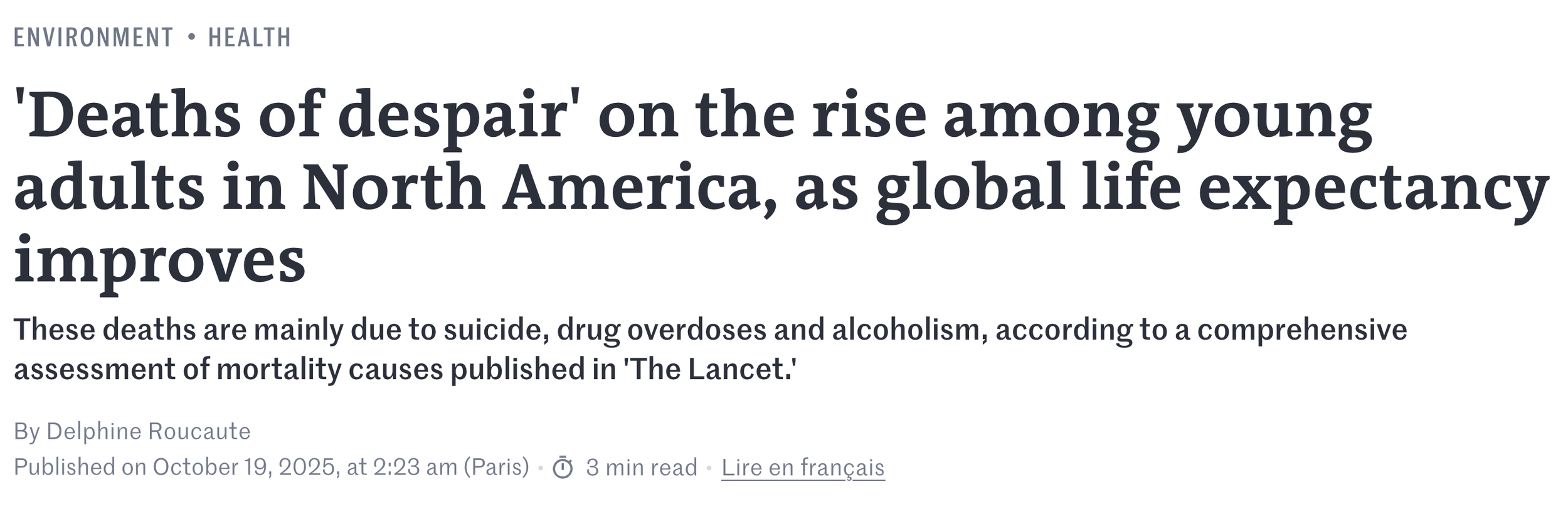
To adopt these new incentives, we must make a painful admission: we must surrender the convenience of anonymity.
In a status culture, I can be a jerk to my neighbor and still be “successful” if I have money. POTUS DJT is a jerk to the world and has pocketed 1.4 billion dollars since taking office.
In a wisdom culture, if I am a jerk to my neighbor, I am poor, regardless of my bank account. It will take more than a wistful, nostalgic, and scolding speech from the Canadian Prime Minister to undo generations of unwise policy choices in defense of the status quo that provide elegant careers to service providers of powerful business owners.
After listening to the PM’s pleas for a return to the nicer status quo, read this polemical response to this particular episode of political theatre.
People like Canada's Mark Carney are crying foul about the demise of the ‘rules-based order’ now, over Greenland, and not over the whole Palestinian genocide he just merrily supplied and supported, or any number of atrocities Canada has been involved in, including Canada. White people really want to do crime and high-fives for confessing.
What he's complaining about here is not a loss of human rights but white privilege. The privilege to invade other people but to keep your own stolen home. Even within the speech, Carney is proudly talking about funding the corrupt Ukrainian dictatorship, all to further American interests. He's only complaining now that America is interested in his territory, he has no actual principles.
Partnering with Great Nature means accepting that we are accountable to the web of life. We cannot hide.
Ecological Succession—Let Nature Take The Wheel
Ecological Succession is the observed process of change in the species structure of an ecological community over time. It is not random; it is a somewhat predictable, orderly progression where the environment creates conditions for new life, which in turn alters the environment to support even more complex life.
“It [succession] culminates in a stabilized ecosystem in which maximum biomass (or high information content) and symbiotic function between organisms are maintained per unit of available energy flow.” —The Strategy of Ecosystem Development published in Science, Eugene Odum
Secondary Succession (The “Reset”)
In most cases where humans “leave nature alone” (such as abandoning a farm, a city lot, or a managed forest), the process is called Secondary Succession. Unlike Primary Succession (which starts from bare rock, such as after a volcanic eruption), secondary succession begins with soil already present.
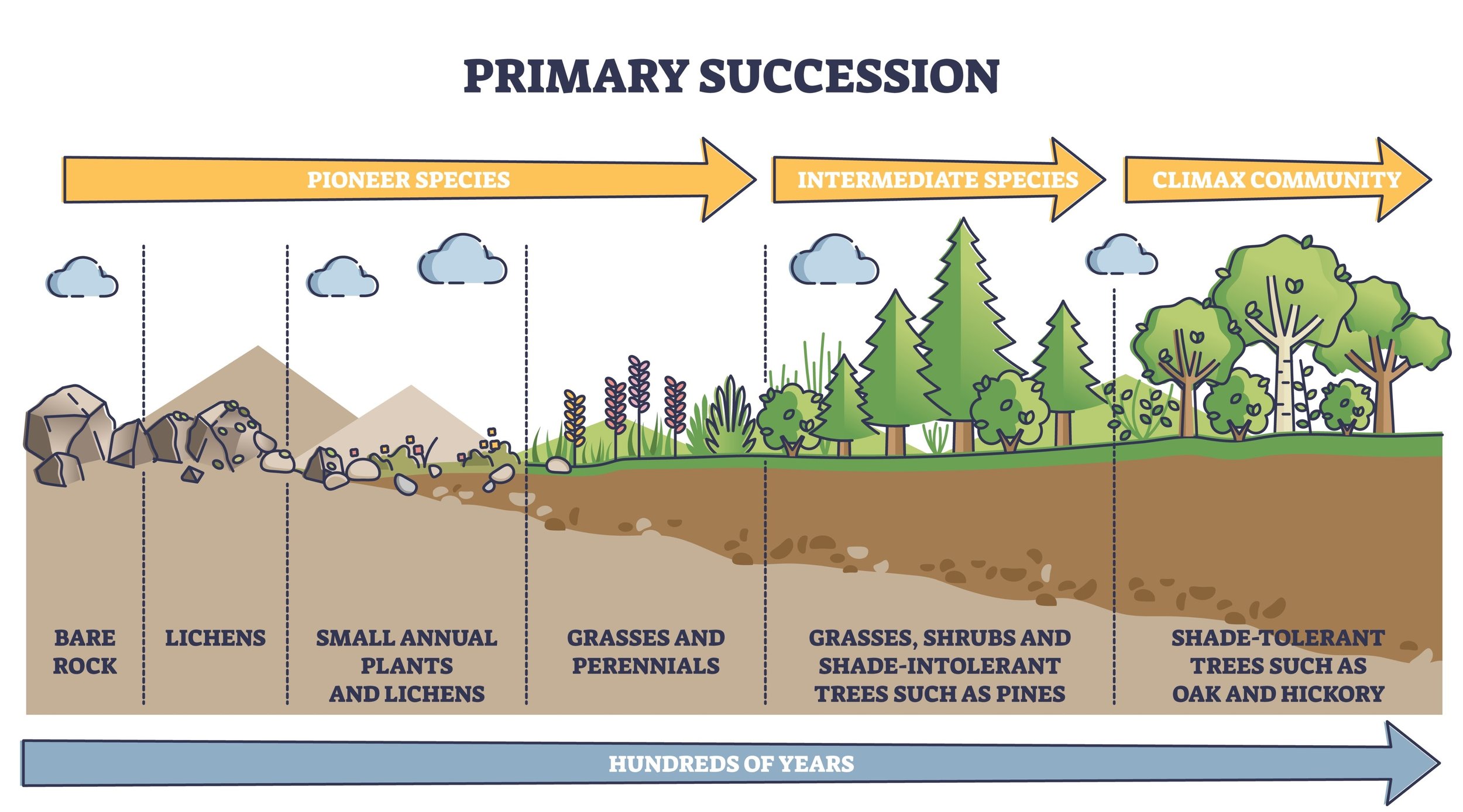
Shutterstock
Because the “biological legacy” (seeds, roots, and soil microbes) remains, this process is relatively fast compared to starting from scratch.
The Pioneer Stage (The “First Responders”)
The first organisms to reclaim an area are called Pioneer Species.
Role: These are hardy, fast-growing plants that love sunlight and can tolerate harsh conditions.
Description: In a temperate climate, this looks like grasses, “weeds” (like dandelions or fireweed), and wildflowers rapidly covering bare ground.
Function: Their roots stabilize the soil, preventing erosion. When they die and decay, they add organic matter to the soil, prepping it for more demanding plants.
The Intermediate Stage (The “Scrub” Phase)
As the soil improves, woody plants begin to move in.
Shrubs and Bushes: Plants like blackberries, sumac, or hawthorn start to shade out the grasses.
Fast-Growing Trees: “Softwood” trees that need lots of light (like birch, pine, or aspen) begin to sprout.
Competition: This is a period of intense competition for light and water. The environment is becoming more complex, creating niches for small mammals and birds, which bring in more seeds from other areas.
The Climax Community (The “Mature” Phase)
Eventually, the fast-growing trees create a canopy that shades the forest floor. The pioneer species, which need full sun, cannot survive there.
Shade-Tolerant Species: Slow-growing “hardwood” trees (like oak, maple, or beech) that can grow in the shade of the pines begin to take over.
Dynamic Equilibrium: Eventually, these long-lived trees dominate the canopy. This state was historically called the “Climax Community,” though modern ecologists prefer to think of it as a “dynamic equilibrium.” It is stable, but not static—trees will fall, creating gaps for the process to start locally again.
Rewilding and Trophic Cascades
If the area is large enough, “leaving nature alone” also allows for the return of animal hierarchies. This leads to Self-Organization.
Ecosystem Engineers: Animals like beavers may return, damming streams and creating wetlands that support entirely different sets of life.
Predators: If apex predators (such as wolves or bears) return, they regulate herbivore populations (such as deer). This prevents deer from eating all the young saplings, ensuring the forest can regenerate. This ripple effect is called a Trophic Cascade.
Summary of Terms
If you were observing this process, you would use these three concepts to describe what is happening:
Resilience: The capacity of the ecosystem to recover after a disturbance (human activity).
Complexity: The movement from simple, uniform systems (like a lawn or crop field) to diverse, layered systems (a forest with a canopy, understory, and floor).
Autopoiesis: The system is “self-making.” It requires no management; the waste of one organism becomes the food for another, creating a closed-loop nutrient and energy cycle.
But we don’t observe and merely participate; we exploit nature.
Our way of life is an omnicidal heat engine.
Omnicide is a word coined by philosopher John Somerville. It is an extension of the concepts of suicide and genocide. It means the death of all, the total negation and destruction of all life. Omnicide is suicide for all. It is the genocide of humanity writ large. It is what Rachel Carson began to imagine in her book, Silent Spring.
We are passing the first quarter of the 21st century, and civilization only gets more omnicidal as the years pass.
A pure and holy period of human civilization never existed.
There are so many angles to this discussion, and much has been written across many domains and generations of sincere inquiry. What I put together here is just one of many possible ways to contemplate our predicament.
I’m including references to other people’s work, videos, and images for you to explore.
Everything here is integral to my current worldview.
Take your time and read section-by-section. If you are familiar with a topic, skip ahead.
The Overshoot, Collapse, and Limits to Growth Community (OCLTG)
People concerned with various existential risks belong to a community I call the overshoot, collapse, and limits-to-growth community. The OCLTG community is familiar with what many people now refer to as the polycrisis or metacrisis.
A polycrisis describes multiple, interconnected global crises (like climate, ecological, health, war, economic, geopolitical) that intensify each other, creating outcomes worse than the sum of their parts, while a metacrisis refers to the deeper, underlying systemic and cultural conditions (like flawed worldviews, loss of meaning, or a crisis of consciousness) that generate these cascading crises, making it the “crisis of crises” or the crisis of how humanity understands itself and reality.
Different people focus on different areas within the broad OCLTG space.
I follow good people who are much more capable than I am in comprehending these complex domains.
I am not a professional educator, but I hope you’ll bear with me.
I hope people unfamiliar with the OCLTG “ecosystem” will consider delving into its many domains. If we do, we’ll be much better equipped for the many rapid changes that are upon us.
The overshoot, collapse, and limits-to-growth community is challenging. But a growing number of people worldwide are beginning to notice a few symptoms of the predicament civilization faces: climate change, pollution, and maybe “Inequality.”
No.
Whoops!
Sorry.
I mean: Immigration, “The Great Replacement,” the price of groceries, Racial Purity, Epstein Files, the coming Great War Again, Russians, Chinese, Iranians, Venezualans, Zionists, U.S. Imperialist Tech Oligarchs, Woke Students, SJW, Identity Politics, Fascists, NRx, Catholics, Orthodox Bros, Religious Fanatics, Magical Thinking, Terrorists, Drug Dealers, Trad Wives, Buddhist Monks, Libertarians, Anarchists, Accelerationists, Game Theorists, Back to the Land Neo Nazis, Friedrich Nietzsche, Satan, Demons, New Agers, INCELS, Democrats, Communists, Socialists, Republicans, Atheists, or something.
“The house is burning, so what? Look over there, play, where’s the scapegoat?”
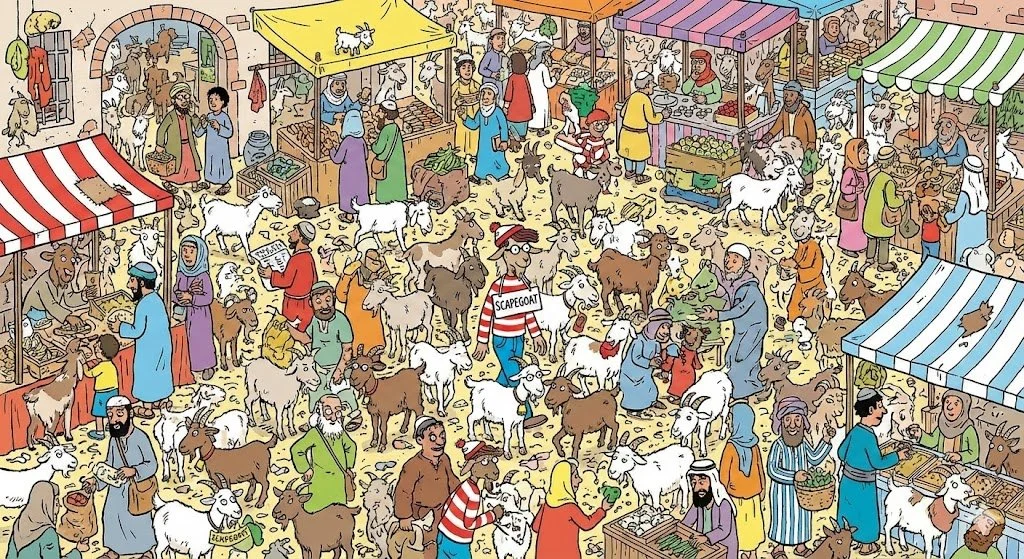
Find Scapegoat
This “thing of ours”—civilization—is not a recent aberration; it is a machine that has been humming with the same violent frequency for millennia. Culture wars, sectarian bloodshed, ecocide, and genocide are not bugs in the system; they are features of the operating system. The Romans had the will to level forests and erase cultures; the only difference is that modernity handed us the chainsaw and the algorithm.
We must strip away the illusion of progress: Civilization is, at its core, a powerful geoengineer and a voracious, energy-hungry heat engine. It exists to consume order (living systems) and excrete disorder (waste and heat).
Because we no longer live in small, intimate bands dependent on the immediate feedback of our local watershed or soil health, we have severed the nerve endings that once warned us of danger. We are functionally blind to the blowback of our own lifestyle. We buy the steak but never see the slaughterhouse; we use the phone but never smell the cobalt mine.
Furthermore, we must dismantle the myth of the “Rugged Individual.” While we exist biologically within our own skin, our “selfhood” is a hallucination of independence. We are permeable nodes in a vast network. Our body is a colony of bacteria; our mind is a colony of borrowed words and social constructs. Even your private conscious identity is software downloaded from the external systems you claim to stand apart from. This is not to say that people aren’t tough and unique. People are stronger than they know. Every one of your/our ancestors survived long enough to make children who were cared for long enough to learn how to survive long enough to have children, or you wouldn’t be here reading this. The human spirit is remarkable.
‘No Man is an Island’
No man is an island entire of itself; every man
is a piece of the continent, a part of the main;
if a clod be washed away by the sea, Europe
is the less, as well as if a promontory were, as
well as any manner of thy friends or of thine
own were; any man’s death diminishes me,
because I am involved in mankind.
And therefore never send to know for whom
the bell tolls; it tolls for thee.

Olde English Version
No man is an Iland, intire of itselfe; every man
is a peece of the Continent, a part of the maine;
if a Clod bee washed away by the Sea, Europe
is the lesse, as well as if a Promontorie were, as
well as if a Manor of thy friends or of thine
owne were; any mans death diminishes me,
because I am involved in Mankinde;
And therefore never send to know for whom
the bell tolls; It tolls for thee.

MEDITATION XVII
Devotions upon Emergent Occasions
John Donne
I don’t talk about “The Planet” per se, though I do understand why personalizing “the planet/GAIA” can help us feel more connected to our home as a living body. What makes this planet unique, as far as we know, is living systems. Life emerged and evolved over about 4 billion years. Human consciousness didn't appear at a single moment but developed gradually over millions of years, with roots stretching back 6-7 million years to our split from chimpanzees, but key aspects like self-awareness and complex thought developed much later, perhaps with early Homo sapiens (200,000+ years ago) and a “creative explosion” around 60,000 years ago. Julian Jaynes’ theory suggests that modern introspection arose only around 3,000-4,000 years ago.
The Julian Jaynes Collection:
Biography, Articles, Lectures, Interviews, Discussion
I rarely speak of “The Planet” as an abstract rock floating in the void, or a thing we can break or fix. While I understand the utility of personalizing the earth as GAIA—a self-regulating superorganism—to foster connection, we must be precise. What makes this planet unique, the only anomaly in a dead universe as far as we know, is the thin, trembling membrane of Living Systems. Life is not a passenger on the planet; it is the planet’s physiology.
This physiology emerged over a staggering 4 billion years. Against this backdrop, human consciousness is a flash in the pan. It didn’t arrive as a sudden “light bulb” moment. It was a slow, grinding sunrise:
6-7 Million Years Ago: We split from the chimpanzees, carrying the hardware for connection.
200,000 Years Ago: Anatomically modern Homo sapiens appear, but they are not yet us in mind.
60,000 Years Ago: The “Creative Explosion”—art, tools, and perhaps complex language emerge.
3,000 Years Ago: As Julian Jaynes theorized, the “breakdown of the bicameral mind” occurred. True introspection—the ability to hear one’s own thoughts not as the voice of a god, but as an internal monologue—is barely older than the pyramids.
So here we are in 2026. We are running nuclear power plants and global financial markets using a form of consciousness that, evolutionarily speaking, is in pre-beta testing. We are confronted with the Polycrisis (or Metacrisis): a knot of ecological collapse, social fragmentation, and existential dread. These are not separate fires to be put out; they are symptoms of a single, underlying breakdown in our sense-making. We are trying to navigate a hyper-complex reality with a “civilized” map that is fundamentally wrong.
If civilization has always been “broken”—if its very engine has always been the conversion of living systems into dead monuments and “energy slaves”—then the question is terrifyingly simple: Can a species that only learned to look inside itself 3,000 years ago recognize its external impact in time? Can we heal our relations with the Web of Life before the habitat we depend on decides it has had enough of us?
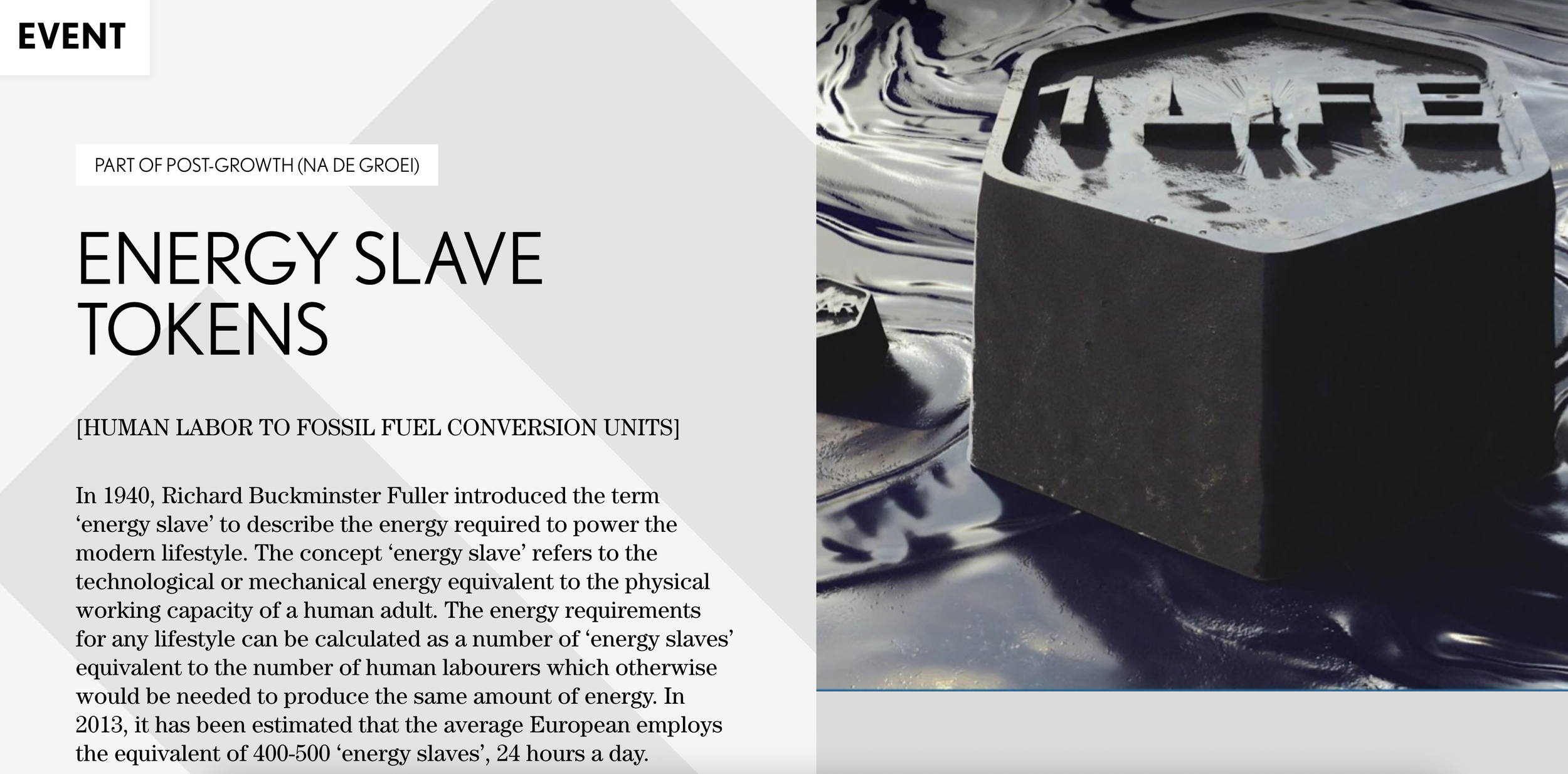
The concept of the “energy slave,” introduced by Buckminster Fuller, refers to the technological/mechanical energy equivalent to the physical labor of one human worker, often powered by fossil fuels, that performs work in our modern infrastructure (roads, machines, power grids). Essentially, it quantifies how much non-human energy (like oil, coal, electricity) a person uses daily, calculating it as the number of human laborers needed to do that same work, highlighting our reliance on fossil fuels to power our lifestyles.
Key Aspects of the Concept:
Quantifying Modern Life: It provides a way to measure the energy footprint of an individual or society, translating daily activities into units of human labor.
Replacement of Human Labor: Energy slaves perform tasks that once required human muscle power, freeing people from arduous physical work but creating dependence on energy systems.
Fossil Fuel Dependence: The term underscores how deeply our mechanized world relies on finite fossil fuels, which power these “slaves.”
Metaphorical Interpretation: Author Andrew Nikiforuk expands on this, arguing that our dependence on oil creates a new form of servitude, where society is bound to the energy systems that power it.
Calculation: It’s calculated by determining the energy (e.g., in joules or watt-hours) needed to perform a task and then converting that into the equivalent human labor time.
Example:
If the average person uses the energy equivalent of 100 human laborers working 24/7, they are said to have 100 “energy slaves.”
In essence, the energy slave concept reveals the vast, often invisible, technological workforce (fueled by energy) that supports our contemporary lifestyles, substituting for historical human labor.
Although human activity is currently causing an enhanced greenhouse effect (global warming), a full runaway scenario that would strip the atmosphere entirely, thereby ending living systems on Earth, is unlikely. Mars lost most of its atmosphere over billions of years due to its low gravity and lack of a strong global magnetic field, a process linked to atmospheric escape and the opposite of a runaway greenhouse effect (a runaway refrigerator effect). If we fail to reconnect with living systems in a meaningful way, life after humans may come sooner than later, ending once and for all our poisoning of living systems (ecocide/omnicide).
***I have to clear my throat, take a sip of tea, and utter to myself, it’s all so overwhelming?
Earth will not become Mars. Let’s be precise about our doom. While human activity is driving a dangerous Enhanced Greenhouse Effect, we are not at risk of a “Mars scenario.” Mars “died” (perhaps) because it is small and lacks a magnetic shield; its atmosphere was stripped away by the solar wind over billions of years—a process of atmospheric escape that is the opposite of a runaway greenhouse. Earth’s gravity and magnetic field hold our atmosphere tight. The danger is not that the atmosphere will leave; the danger is that the atmosphere will turn against us. We are not stripping our atmosphere; we are choking it. The result, however, is the same: the end of the human experiment. If we cannot find a way to re-integrate with Living Systems, nature will simply evict us. Ecocide/Omnicide leads inevitably to suicide.
We are dangerously disconnected. Reality is hidden behind the opaque walls of our techno-industrial civilization. We have unleashed forces—The Genies of rivalry, energy, AI, and extraction—that we can no longer put back. We wished for comfort and got complexity beyond our comprehension. If we fail to reconnect with living systems, “Life After People” isn't a sci-fi fantasy; it’s a rapidly approaching deadline. We are flirting with Ecocide (killing the living home) and Omnicide (killing everything).
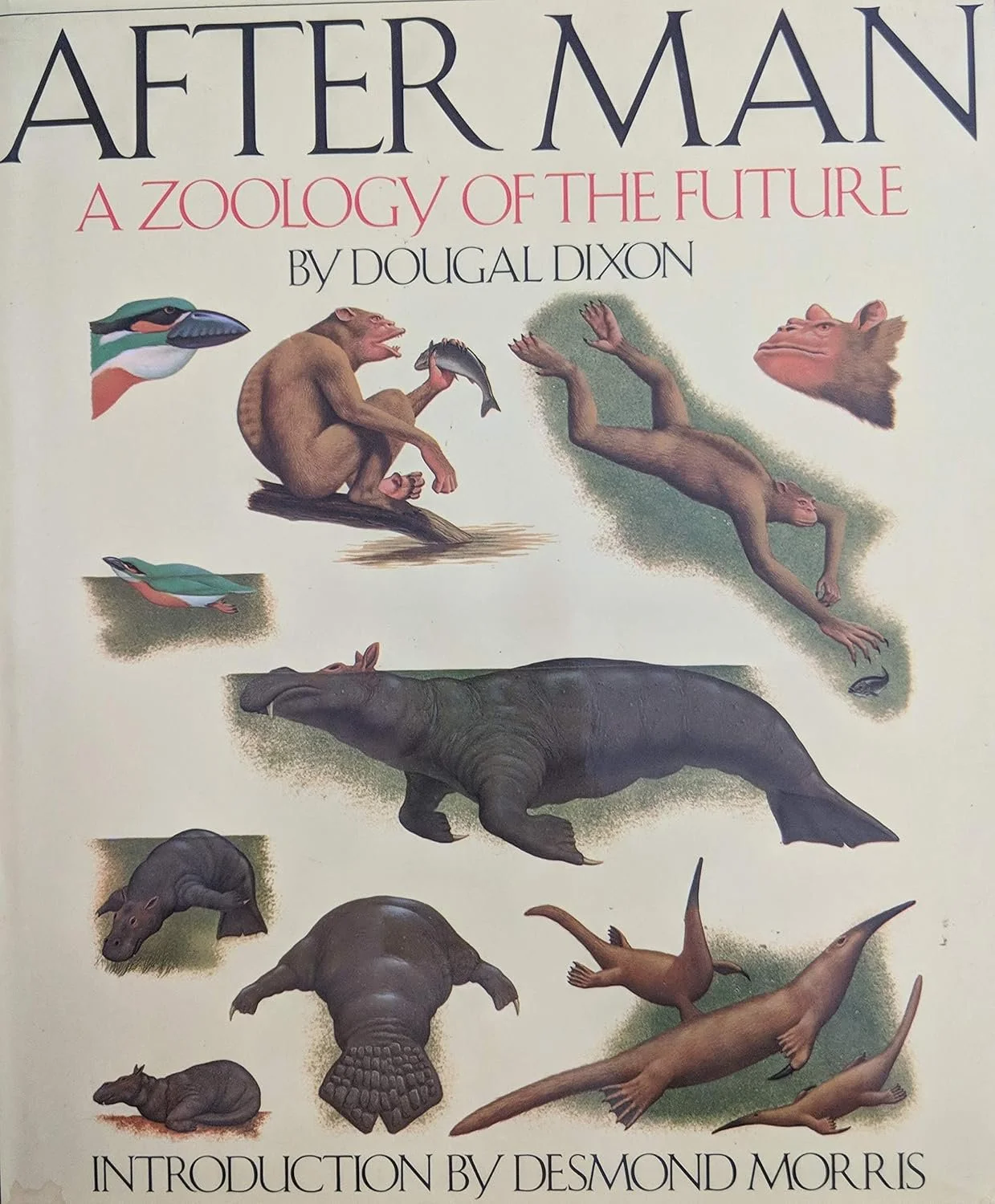
This is the tangled new jungle of life Dougal Dixon’s book After Man presents to readers. Originally published in 1981 and re-released in a lightly-revised edition in May, After Man is the foundational entry in the field of “speculative zoology,” where writers and artists play with ideas about what kind of world evolution might produce if humanity were to disappear. The book is a fully illustrated bestiary of future animals, complete with field sketches, detailed paintings and thorough explorations of their ecology. In the pollution-ridden 1980s, it offered both an arresting vision of the future and a glimmer of hope.
When the inevitable collapse erupts in global catastrophes, most will be paralyzed by shock. Why? Because we ignore the Cycles. We ignore the operational complexity of the world until it fails. Those who do pay attention—the systems thinkers, the cynics, the scientists, the seers—are the only ones equipped to see the crisis trending.
The rest of us are left “dodging bullets,” surviving on pure luck. We look back with 20/20 hindsight, swearing we have learned our lesson, but the tragedy of our species is that we rarely let those lessons change our path. We are sleepwalking into the fire, dreaming that we are fireproof. We are a species of amnesiacs walking through a minefield.
The terror lies in our ignorance. The “Big Picture” mechanisms of the world elude us. We live inside a civilization composed of Black Boxes—techno-industrial systems we depend on but do not understand. We rubbed the lamps, the Genies are out, and we are only now realizing we never read the user manual.
“He recognized in himself that power to forget which only children have, and geniuses, and the innocent.” —Albert Camus
Ralph looked at him dumbly. For a moment he had a fleeting picture of the strange glamour that had once invested the beaches. But the island was scorched up like dead wood―Simon was dead―and Jack had.... The tears began to flow and sobs shook him. He gave himself up to them now for the first time on the island; great, shuddering spasms of grief that seemed to wrench his whole body. His voice rose under the black smoke before the burning wreckage of the island; and infected by that emotion, the other little boys began to shake and sob too. And in the middle of them, with filthy body, matted hair, and unwiped nose, Ralph wept for the end of innocence, the darkness of man's heart, and the fall through the air of the true, wise friend called Piggy.
The officer, surrounded by these noises, was moved and a little embarrassed. He turned away to give them time to pull themselves together; and waited, allowing his eyes to rest on the trim cruiser in the distance. — Lord of the Flies, in the final chapter, “Cry of the Hunters,” by William Golding
Today, global, modern techno-industrial, fossil-fueled, neoliberal/neoconservative, eschatological, financialized capitalism has added numerous existential risks to the rapacious Great Game of status, control, and conquest. We are maniacal, innovative, creative, profligate hunter killers, and energy hogs. Civilization is an entropic, dead-waste-producing, heat-engine that will endeavor towards exponential growth until it can’t anymore (The Maximum Power Principle, MPP).
The Maximum Power Principle (MPP) is an ecological and systems theory suggesting that biological systems (such as organisms, ecosystems, and even societies) evolve to maximize the rate of useful energy capture and transformation from their environment to enhance survival, growth, and reproduction, thereby outcompeting others. Formulated by Lotka and expanded by Odum, it proposes that selection favors designs that capture the most energy, but often at an intermediate efficiency (the "Goldilocks" point) rather than 100% efficiency, balancing speed with sustainability for long-term power output.
Engaging in consumption beyond that which nature can restore through living systems is pathological and insane.
Irrational, avaricious accumulation is a human brew of deadly sins, characterized by pernicious addictions that poison our souls and our capacity to find ways through the metacrisis.
The Seven Deadly Sins (also known as the "Cardinal Sins") are a classification of vices used in Christian teachings, particularly within Catholicism. They are called “deadly” not because they are unforgivable, but because they are considered “gateway” sins that lead to other immoral actions and spiritual downfall.
1. Pride (Latin: Superbia)
Often considered the original and most serious sin (the root of all others). It is an excessive belief in one’s own abilities or a desire to be more important than others.
Key characteristic: Putting oneself before God or others; arrogance.
Opposing Virtue: Humility.
2. Greed (Latin: Avaritia)
Also known as Avarice. It is an intense and selfish desire for material wealth, power, or status.
Key characteristic: Hoarding money or objects; valuing possessions over people. (I might add, Living Systems.)
Opposing Virtue: Charity (or Generosity).
3. Lust (Latin: Luxuria)
An intense or unbridled sexual desire. It differs from ordinary desire in that it treats others as objects for personal gratification rather than as individuals.
Key characteristic: Objectification; lack of self-control regarding physical pleasure.
Opposing Virtue: Chastity.
4. Envy (Latin: Invidia)
The desire for others’ traits, status, abilities, or situation. Unlike greed (which wants things), envy is specifically resentful of others having those things.
Key characteristic: Jealousy; taking joy in others’ misfortunes (Schadenfreude).
Opposing Virtue: Gratitude (or Kindness).
5. Gluttony (Latin: Gula)
Overindulgence and overconsumption of anything to the point of waste. While usually associated with food and drink, it can apply to the excessive consumption of resources in general.
Key characteristic: Lack of discipline; consuming more than one needs.
Opposing Virtue: Temperance.
6. Wrath (Latin: Ira)
Uncontrolled feelings of anger, rage, and hatred. This often manifests as a desire for vengeance.
Key characteristic: Violence (emotional or physical); holding grudges; seeking revenge.
Opposing Virtue: Patience.
7. Sloth (Latin: Acedia)
Often misunderstood as simple laziness. In the theological sense, it is a spiritual apathy—a refusal to do one’s duty or a failure to utilize one’s talents.
Key characteristic: Apathy; idleness; wasting one’s potential or time.
Opposing Virtue: Diligence.
We are true believers in the death cult of large-scale civilization and its modern spawn, Market Capitalism.
Pride cometh before the black tie ball at Trump’s White House. Narcissism and celebrity culture have been grotesquely normalized in recent years. The majority of people in the Global North have been pacified, domesticated, objectified, and commodified. We all compete for status.
President Donald John Trump follows his programming/conditioning, and too many ordinary people worship him for it because we are in the same cult. DJT didn’t program himself; the system’s logic has been developing for a long time. It is not artificial, nor intelligent (depending on what values you attach to intelligence), but simply the mundane outcome of H. sapiens’ emergent dominant modern cultural features.
Point a finger at someone, and there are three pointing back at you. If we consider ourselves rational agents, we have to accept a certain amount of responsibility for ‘this thing of ours’ (our mafia state of being) because the vast majority of us operate within its values and constraints, and believe in it.
The Players will feel spectacular at events in the new White House Ballroom. The Ballroom is a hall of mirrors. This “thing of ours” will keep metastasizing until it’s no longer a viable system. Its seeds of destruction are built in.
Those of us who don’t like these kinds of rivalrous games will find other forms of expression and things to do. All people have strange Karma. People do things. I say do what you will to build the kind of society you want. If you understand Great Nature, you can be instrumental in turning humanity away from horror and finding ways through this disaster.
People are active agents with varying degrees of autonomy. People do stuff.
Even in the fierce grip of our human predicament, we can build just, peaceful, and healthy ways of life.
Oswaldo Vigas—Antológica—1943–2013
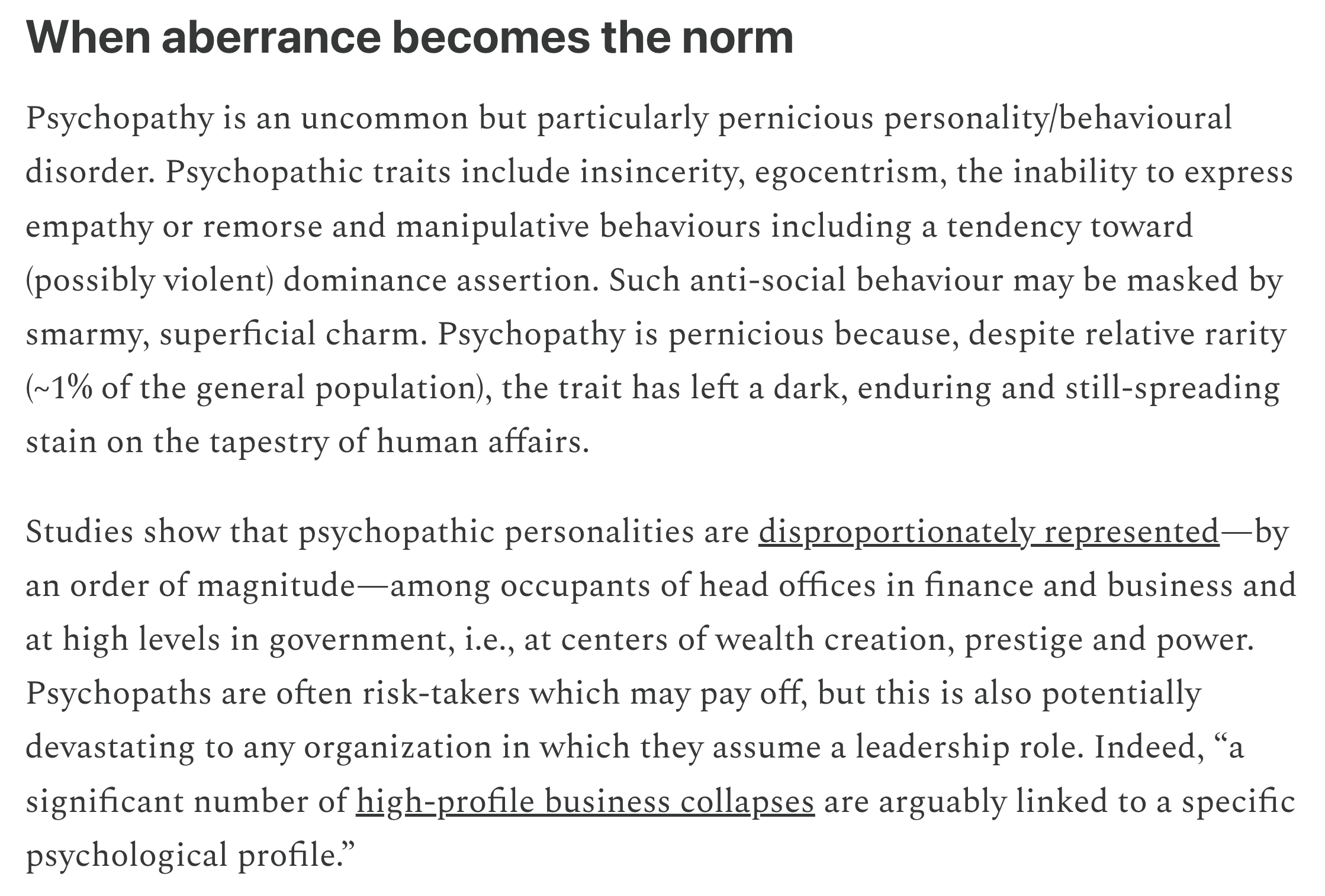
William Rees on Substack
Honesty, courage, connection, and openness facilitate constructive behaviors.
Having an endless conversation won’t help us create the socioeconomic and cultural conditions needed to reduce the more painful outcomes of thousands of years of status competition.
We need to reevaluate our stories of competitive conquest, see our place in the world differently, and then change our way of living.
Do we have the right tools to challenge our beliefs and confront power structures controlled by deluded, highly indoctrinated leaders, many of whom exhibit dark tetrad personality traits?
Yes, we do, but will enough people do it?

FROM THE AUTHOR This document is written for multiple levels of comprehension. While most of the text uses plain language, it incorporates code and mathematics where necessary to bridge the transition from theory to application. For readers unfamiliar with these technical elements, I have worked to convey their essential meaning while maximizing overall accessibility. After all, this system has to be built—and while theory and principles matter, this document aims to help get the project underway.
I encourage readers not to shy away from code and mathematical formulas. These elements are simply more contextually efficient languages for the specific goals being pursued. If we wish to update our social and economic organization in an optimized way, modern methods are required. The more familiar people become with the technical vocabulary of Integral, the more effective the project can be—because Integral does not merely seek a new form of mass direct democracy in economic management and governance; it requires it.
The complexity inherent in this systems-of-systems approach may appear daunting. I wish to assure readers that what is proposed here is not impractical when approached step by step. At higher levels of application, Integral exhibits complexity comparable to the IT architectures already used in major commercial logistics operations. At lower levels, fragments of the core architecture can be distilled, allowing processes to adhere to the same fundamental system at much smaller scale. This scalability is critical to communicating Integral in its early stages.
People do stuff.
There are many projects like these.
Even though we are in a ‘predicament,’ and there ain’t no cure for the end of times blues, some folks still think it’s worthwhile to try building something. It’s improbable that Integral (and other social engineering projects) will catch on under our current global cultural conditions. Still, I always think these endeavours are worth a look.
It’s a difficult task to evaluate a high-complexity technical solution (Integral Collective) applied to a high-entropy reality (Overshoot/Collapse).
The central irony: Peter Joseph critiques Marxists for mistaking maps for territories, yet he has effectively designed a highly detailed map (software/logistics) for a territory that is currently dissolving (industrial civilization). Let’s build something within a failing system and see what happens. Mmmmm
Let’s examine Integral Collective filtered through the lens of limits to growth, polycrisis, and some specific blind spots I’ve intuited regarding power and culture.
1. The “Fragility of Complexity” Problem
Context: Overshoot implies an energy descent future. Tainter’s theory of collapse (one theory among others) suggests that societies collapse when their investment in complexity yields diminishing returns.
Integral is a high-complexity solution. It relies on a “Global Design Repository” (OAD), Cybernetic feedback loops, and digital ledgers (ITC). In an actual collapse or polycrisis scenario, the first casualties are usually global supply chains and the reliable electricity/internet infrastructure required to run cybernetic systems. To support projects like these, what will governments do and how will they do it? Remember, Peter knows that the Players support the Game, and everything else is just materials needed to support it—socialism for the Great Game and its Players.
"This country has socialism for the rich, and rugged individualism for the poor."
— Martin Luther King, Jr. (There are many versions of this.)
Peter Joseph is building a Ferrari engine for a world that is about to devolve into walking and horse-carts. He knows this, but…If the “nodes” require high-tech interfaces to communicate with the “federation,” they may fail exactly when they are needed most. A resilient system for decline needs to be analog-proof and effectively operable with a notebook and a pencil. Integral seems to assume the Internet is a permanent utility, which is a dangerous assumption in an age of infrastructure decay. But it is cool. We all want to have our cake and eat it. Young people love their smartphones.
2. The “Post-Scarcity” Delusion vs. The “Triage” Reality
Context: He has always mentioned a “trajectory toward post-scarcity.”
Post-scarcity is a concept rooted in the assumption that the bottleneck is distribution. In an Overshoot scenario, the bottleneck is biophysical reality. We are entering an era of absolute scarcity (soil, water, rare earth metals, EROI), the low-hanging fruit for a modern global techno-industrial civilization is gone, and some of the damage we’ve done is permanent, barring a miracle.
Integral’s “True Economic Calculation” (measuring biophysical costs) is actually a brilliant idea and very necessary. However, the system’s psychology is geared toward “efficiency and access.”
Does Integral have a mechanism for Hard Rationing? When there isn’t enough food for everyone in the node, “weighted consensus” often breaks down into tribalism or violence. Cybernetics works well for optimization; it struggles with tragic choices. A system designed for a Star Trek future might implode when faced with “Lifeboat Ethics.”
Lifeboat Ethics is a metaphor, introduced by Garrett Hardin in 1974, that frames global resource inequality as a lifeboat with limited capacity (rich nations) surrounded by swimmers (poor nations), questioning whether to admit more people (risking sinking everyone) or to deny help to preserve those onboard, advocating for self-interest and resource management to avoid global catastrophe. It contrasts with a "spaceship" model of shared resources, arguing against unconditional aid and open immigration to protect the lifeboat's stability and long-term survival, sparking debate on moral obligations to the needy.
3. The Marxist Blind Spot: Logistics vs. Politics
Context: Joseph’s dismissal of Class Analysis/Marxism (maybe) and Dialectical Materialism (maybe). Does he know of what he dismisses?
Peter Joseph treats political economy as a technical engineering problem (logistics, resource flows) rather than a power struggle. He assumes that if the mechanism (Integral) is more efficient and fair, people will adopt it. Power does not yield to better arguments or better software. Existing power structures will weaponize or crush alternatives, as he well knows.
Integral lacks an “immune system.” It has a “Decision System” (CDS) but seemingly no “Defense System.” How does a node defend itself against a local warlord, a cartel, or the dying breaths of a State entity demanding taxes in fiat currency, crypto, wheat, or gold? By ignoring the Marxist reality of class antagonism, Integral assumes a rational actor that doesn’t exist in a crisis. It ignores the fact that inefficiency/volatility is often profitable for those in charge.
This all reminds me somewhat of Jim Rutt’s Game-B proposals. Ain’t nobody doing it, but he has a nice website where people can share. What will come of another Santa Fe Institute? Trust me, I know they are different, but still.
4. The Cultural Vacuum
Context: From what culture does a complete divorce from market capitalism arise? Will Back to the Land communities in their current nascent form last ten years, and if so, will these communities have any effect on the world at large? Integral in Mandarin and Russian?
Markets are not just economic operating systems; they are cultural operating systems. They condition us to compete, hoard, and transactionalize, despite significant research on K-selected tribes and how we lived until around 8,000 years ago. I have read and seen many sad testimonies about hunter-gatherer communities in the techno-modern era. I’ve traveled and experienced some of these cultures. “Look here, folks, this is how we truly are, wise up! Follow me on Instagram.” You know from what you’ve read here already that I’d love to see us wise up and kick the dark tetrad out, replacing it with our “cells.” I talk a bit about Curtis Yarven in a while: from what culture do benevolent Kings arise?
Integral attempts to bypass culture with code. It tries to force (maybe not) Reciprocity via the ITC (Integral Time Credits) system. MMT is going great, but the UBI thing? Do you know how many generations of political philosophers have proposed such things?
You cannot code a community. Peter knows this, computer code is cool, though. I talk about The Code of Capital later here as well. A village (Joseph’s analogy) works because of shared mythos, kinship, and generations of trust—not because of a ledger. BTC, Smart Contracts, have they helped us at all in solving these complex problems of ours? They are financial scams, and like Carlin might have said, you ain’t privy. Without a massive cultural/spiritual shift (which takes time we may not have), users of Integral might just “game the system” or create black markets on the side to be prosecuted and smashed by rivals. Think of the PayPal mafia that genuinely wants to buy Iceland and Greenland for the energy and minerals they need for their chartered cities and Ex Machina servants. We may not want to compete with them, but they want to compete with us, and they know we are not in their league. The software assumes a level of altruism and transparency that the current culture has beaten out of us.
I can hear it already, just as the Communists tell me I am a counterrevolutionary wet blanket, the Integral clique will call me an idiotic crumudgeon. One must be enthusiastic.
Peter has asked for help and feedback. Go for it. Hopefully, all sincere efforts will be appreciated.
5. Assessment: Novelty and Traction
How Novel is it?
Moderately Novel. It is essentially Stafford Beer’s “Project Cybersyn” (Chile, 1970s) mixed with Parecon (Participatory Economics), Peter wrote about it on Medium, and Resource-Based Economy (Venus Project) concepts, updated with modern UI/UX and blockchain-style logic. He loved the folks at the Venus Project, but I think they may have given him the cold shoulder. At any rate, I’ve followed people worldwide doing similar things, some projects going back generations, and here we are, burning through everything.
The novelty lies mainly in the synthesis—combining governance (CDS) with the supply chain (COS) into a single software stack. That’s cool. I also like his style of critique of market capitalism. For a guy who doesn’t like Socialist rhetoric, he’s good at variations on a theme while claiming to have a real system and not just ideas.
Can it get traction?
As a global replacement? No. It is too cerebral, too complex, and ignores states’ monopoly on violence. I can’t imagine getting people in Portugal into this. I can imagine Portuguese traditional village life reconstituting and getting on with it.
As a “Lifeboat” mechanism? Maybe. If Joseph can strip it down to a “Lite” version—something that helps local communities track resources and labor fairly without needing a global server—it could be a valuable tool for the “culture builders” during an era where this thing of ours is clearly collapsing. I could run that by my permaculture community in Leiria, Portugal, or my friends at the University of Évora (Universidade de Évora).
Summary Judgment
I’m skeptical and mildly supportive. Peter Joseph is committing the Technocrat’s Fallacy: The belief that if we build the right system, human nature and power dynamics will align with it.
The Technocrat's Fallacy, often linked to the “myth of technocratic infallibility” or the “fallacy of false precision,” is the mistaken belief that complex social, economic, and political problems can be solved exclusively through technical expertise, scientific management, and data-driven, apolitical decision-making. It assumes that “what works” (efficiency) can be separated from political values and that experts can operate without bias.
Even if Integral Collective fails as a global revolution, the sub-components (specifically the logic of “Time Credits” vs. Fiat Money, and “Objective Biophysical Accounting” vs. Price Signals) are essential intellectual tools for whatever comes next. He is building the “black box” flight recorder for the next civilization to find.
Look into Stafford Beer’s “Cybersyn” or ParEcon to see how previous attempts at this kind of “planned cooperative economy” fared when they collided with real-world politics.
Participatory economics, ‘parecon’ for short ? a new economy, an alternative to capitalism, built on familiar values including solidarity, equity, diversity, and people democratically controlling their own lives, but utilizing original institutions fully described and defended in this book.

Over the years, I have come to many unsettling conclusions about the way we live. I still have so many questions about how we came to live as we do. Think about it for a moment—why are we the only species that sees any need for money? Dumb question with a lot of avenues of inquiry. Why is the work week 40 hours at the moment? Knowing that civilization is unsustainable, why do we continue living within it? Now that we have domesticated ourselves, the primary reason is that we can no longer survive without it. There are some Indigenous tribes who still live outside of civilization, but those of us within civilization would most likely not enjoy being disconnected from most everyone we know and living the way that the Indigenous do. On the other hand, there most likely would be some folks who actually enjoy living that way better than within civilization, and there is plenty of historical evidence of this. Civilized folks who were given a taste of living with Indigenous tribes often returned to that lifestyle whereas those who lived an Indigenous lifestyle most frequently likewise returned to it after being subjected to living within civilization.
At the end of the day, once one really seriously considers it, our way of life is purely wrong ecologically. Civilization requires violence in order to maintain it. Not that I ever doubted what Derrick Jensen says about civilization, but when I first encountered his writings and media, I was stunned. Back then, I was still in denial about many things. I suppose we all are rather naïve about the way we live. The ideas that Jensen expresses are so true that they are revolutionary, and when one first experiences them, they can be somewhat scary. Yet, how can anyone come to a different conclusion given all the variables and circumstances? (At the end of this article is a link to download Richard Adrian Reese’s book, Wild, Free, and Happy, which proves this point beyond any shadow of a doubt.)
Why do we place ourselves at the top of everything as if we are the most intelligent species? If we are (supposedly) the most intelligent of species, then why are we literally destroying our only home and all the other species living here? Why have we caused the mass extinction we are currently in? Looking at the past 15 years, despite all the knowledge I’ve gained peering into the predicament of ecological overshoot, I have come up with more questions than answers in many respects.
*From the above post on Subscack.
Culture is in flux and evolves for many complex reasons. People are inspired to do stuff. People are active. Active people are attractive people.
Part of the table of contents for Wild, Free, and Happy.
So, in the end, the real issue has never been capitalism versus socialism. That framing is an ideological trap with no analytical or strategic value left in it. The real conflict is extraction versus autonomy. It is about whether societies have the right to control their land, labor, energy, and resources for ecological stability and human well-being—or whether those foundations must remain permanently open to external exploitation in the name of market “freedom.” Any serious path forward requires abandoning obsolete labels and confronting the material power structures that continue to govern the world under the softened language of markets rather than the blunt force of empire.

For years, I have openly shared my thoughts, ideas, and reference materials on my website, Globehackers & Cospolon,and across social media. I deliberately chose not to promote my activities. It was a quiet experiment: I was curious if the raw information would organically spark interest among my network of friends and acquaintances. It didn’t.
But my failure is a fractal of a larger failure. Over the past 20 years, I have observed that even the heavyweights—experts who actively confront reality across domains and possess every distribution tool in the Silicon Valley arsenal—hardly make a dent. They are screaming into a hurricane. Despite their reach, they seem unable to impact ‘this thing of ours.’
The intellectual culture within the wealthy West’s elite circles has not just stalled; it has entered a steep, terminal decline.
This leaves us with a stark reality: Ordinary people have to step up. If you have any clear sense of what’s happening, passivity is no longer an option. We must cultivate intellectual curiosity, educate ourselves, and prepare to step into leadership roles that the elites have abdicated. Make no mistake: The Players of the Great Game 21st Century and their armies of service providers are members of a death cult. Sane, healthy people have to supplant these odious, deluded true believers. I am making judgments, yes. But I don’t blame people for being taken in by the culture; the programming is strong. I am saying that ordinary, relatively innocent people deserve a new kind of leadership. As for the debates on free will and determinism? I leave those to the “experts.” I am ashamed to say I’ve mostly read about that topic in the Anglosphere anyway.
I’m interested in action.
In his 2023 book Determined, Robert Sapolsky argues that human behavior is the result of a seamless chain of biological and environmental causes stretching back to our genes and evolutionary history. He claims that if you account for every hormone, neurotransmitter, and childhood experience, there is no "gap" left for free will to exist.
“We are nothing more or less than the cumulative biological and environmental luck, over which we had no control.” —Robert Sapolsky
Daniel Dennett (Philosopher) was the leading voice for compatibilism. He argued that the “hard determinists” are defining free will impossibly high (as a kind of magic that defies physics). Instead, he defined free will as control and competence—the evolved ability to anticipate the future and avoid harm. If you are a healthy adult capable of rationality, you have “all the free will worth wanting.” We are not “puppets” because we have internal control loops that allow us to reflect and steer our lives, even if the universe is deterministic.
Kevin Mitchell (Neurogeneticist), a rising counter-voice to Sapolsky (author of Free Agents: How Evolution Gave Us Free Will, 2023) argues that while we are physical beings, life is not merely “physics.” He suggests that evolution created a layer of “top-down” causation. Living organisms act for reasons, not just because of atoms bumping into each other. He argues that the brain is a decision-making machine designed specifically to filter noise and make genuine choices. Agency is an emergent property of evolution; we are not just passive observers but active agents who shape our future.
Philosophy Break
Friedrich Wilhelm Joseph Schelling's philosophy—particularly his Naturphilosophie and "Identity Philosophy"—rejects the rigid dualism between mind (consciousness) and matter (reality) that characterized the work of his predecessors like Kant and Fichte. Instead, Schelling posits that Nature and Spirit are fundamentally identical; they are two poles of the same absolute reality. For Schelling, nature is not a static, dead mechanism, but a dynamic, self-organizing organism that is unconsciously rational. He famously argued that nature is "slumbering spirit," striving through an evolutionary process to become conscious of itself—a goal it finally achieves in the human mind. Consequently, reality is simply the unconscious pre-history of consciousness, and consciousness is the awakening of nature.
“The objective world is simply the primitive, still unconscious poetry of the spirit; the universal organon of philosophy—and the keystone of its entire arch—is the philosophy of art. [...]
If all knowledge has two poles, the objective and the subjective, then the whole of philosophy consists of two sciences. Either one sets out from the objective, and asks how a subjective fits in with it... The objective is nature, and thus the problem is: how to match the intelligent to nature. The concept of the objective, or nature, is that it is the merely presentable...
The necessary tendency of all natural science is to move from nature to intelligence. This and nothing else is at the bottom of the endeavor to bring theory into natural phenomena. The highest perfection of natural science would be the complete spiritualization of all natural laws into laws of intuition and of thought. The phenomenon (the material) must completely vanish, and only the laws (the formal) remain. Hence it happens that the more the lawful breaks forth in nature, the more the husk disappears, the phenomena themselves become more mental, and at length entirely cease. The optical phenomena are nothing but a geometry whose lines are drawn by light, and this light itself is already of doubtful materiality. In the phenomena of magnetism all trace of matter has already vanished, and of the phenomena of gravitation, which even the natural scientist believes he can grasp only as a direct spiritual influence, nothing remains but its law, the execution of which on the large scale is the mechanism of the heavenly motions. The complete theory of nature would be that by virtue of which the whole of nature should be resolved into an intelligence.”
— F.W.J. Schelling, System of Transcendental Idealism (1800)
Capitalism Is Great At What It Does
Wall Street Greed is Good…This is a classic cult progress narrative.
We are living in the global cult of capitalism.
“It’s Overshoot, stupid!”
I’m an industrial product engineer by training, working for a large engineering company in the field of electrification and automation of road transport for many years now. Before that, I worked more than a decade for an American corporation in various roles, ranging from maintenance engineering to project management and process expert positions, as well as spending 2 years on a post-graduate leadership program in the supply chain and logistics areas. I’ve seen how investment and sourcing decisions are made in these great conglomerates, how our much cherished consumer products are produced and how they get to the end customer. I saw how ‘sausage’ is made.
We have to call our way of doing business (status competition) and the exploitation of resources something. Today, we call it capitalism.
For the vast majority of the Victorian era (1837–1901), the government, the press, and the public referred to their system as “Mercantilism,” “Free Trade,” “Commerce,” or “Civilization.”
On The Radar — William Bolts
William Bolts’ trajectory from a Dutch-born émigré in England to a controversial tycoon in Bengal was defined by his sharp commercial instincts and eventual collision with the East India Company’s monopoly. Born in Amsterdam but raised in England from age fifteen, Bolts initially honed his skills in the diamond trade in Lisbon before joining the East India Company as a factor in 1759.
Upon arriving in Calcutta, he distinguished himself by mastering Bengali—a rarity among his British peers—which enabled him to bypass intermediaries and build deep local networks. His official posting to Benares (Varanasi) became a springboard for immense private ventures; he amassed a personal fortune of roughly £90,000 in just six years by trading in saltpeter, opium, and cotton, often undermining the Company’s own commercial interests.
Bolts’ aggressive pursuit of wealth, combined with his audacious 1768 proposal to start a newspaper that would expose the administration’s inner workings, branded him a dangerous “interloper” in the eyes of the establishment. Consequently, the Company authorities forcibly deported him back to England in 1768, where he would later channel his grievances into Considerations on India Affairs, a scathing and influential exposé of the Company’s exploitation of Bengal.
The video below explains how the British Empire operated.
The Capitalist Reflex
Before we can discuss the deeper context, we must address the reflex. Most people defend capitalism because it provides the neurohormonal cocktails of consumption that prop up their self-worth. They rely on the myth of the “Techno-Fix,” the belief that when the crisis hits, the Market and the Engineers will invent a way out. This is not optimism; it is a dangerous form of human supremacy that assumes we are exempt from the laws of nature.
The Knowledge Trap
I am disappointed. Despite an explosion of information—documentaries, resistance movements, brilliant educators—we remain stuck. We know, yet we lack the wisdom to act. It is a tragedy of inertia.
AI: The Accelerant of Collapse
I love learning. I’ve traded the quiet dust of libraries for the lightning speed of AI tools. But make no mistake: AI is a constraint-bound system. The current AI boom is a financialized racket, a new layer of the Great Game meant to enclose the commons of human thought. It is not a game-changer; it is a fuel injector for the omnicidal engine.
We are building data centers to “solve” our problems, yet those data centers consume the very resources (energy and water) that are in collapse. This is the definition of Late Stage Capitalist Realism: The TESCREAL elite dreaming of uploading their minds while the biosphere burns. Algorithms are only as wise as the people who code them. Whoops.
A Guide Through the Black Box
I have synthesized these perspectives to help you see the “gorilla riding the elephant.” Whether you are new to the concept of Overshoot or a veteran of the OCLTG community, I invite you to delve into the work below. Let’s try to understand the machine before it stops.
I have always lived within the belly of the beast. I am a child of the global capitalist system, and like most of you, I am entangled in its mesh. I could not sustain my current life without the very institutions I ponder and criticize. I know the sheer difficulty—perhaps the futility—of trying to boycott or divest on moral grounds when every supply chain is tainted. I am not an activist; I am a witness. One day, looking back at my passivity, I may have to say, “Shame on me.” But this is the condition of my generation. Older people tend to keep their heads down, stay the course, and hope for the best, right up until the cattle cars pull up to the front door.
So, with eyes wide open to our own complicity, let’s dive in.
Capitalism, Capital, Capitalists, and other related things.
The Taxonomy of Homo capitalist Capitalism isn’t just an economic system; it’s a food chain.
The Petty Capitalist: (Most of Us). We are the krill. The domesticated majority. The billions who rely on and engage with the institutions of modern techno-industrial civilization to survive. We are the train’s passengers, complaining about the service but too terrified to get off. We feed the system with our labor and our consumption. We are complicit by necessity, tethered to the machine for our food, shelter, and neurohormonal cocktails. We are the dreamers.
The Active Capitalist: (The Sharks). These are the hunters. Professional service providers, venture capitalists, upper management, hedge fund managers, private equity ghouls, corrupt officials, traders, and high-level clergy. The lieutenants and the fixers. These are the people consciously working to maximize Return on Investment (ROI). They don’t make the rules, but they know how to exploit them to accumulate capital. They are the active agents of extraction.
The Players of the Great Game: (The Leviathans). A fraction of the “one percent.” These are not just rich people; they are uber-wealthy geo-architects. They possess the resources to dictate terms to nations. They are often characterized by the Dark Tetrad: narcissism, Machiavellianism, psychopathy, and sadism. They don’t just want wealth; they want dominion over the life flows of the planet. These are the strategically savvy ideologues who treat the world as a zero-sum game. They keep score. They do not just play the game; they wrote the legal code. They control the flows of energy, resources, and populations. They have the power to change the rules when the odds turn against them, and they play to win at any cost. They are the only ones at the table who can flip the board when they are losing.
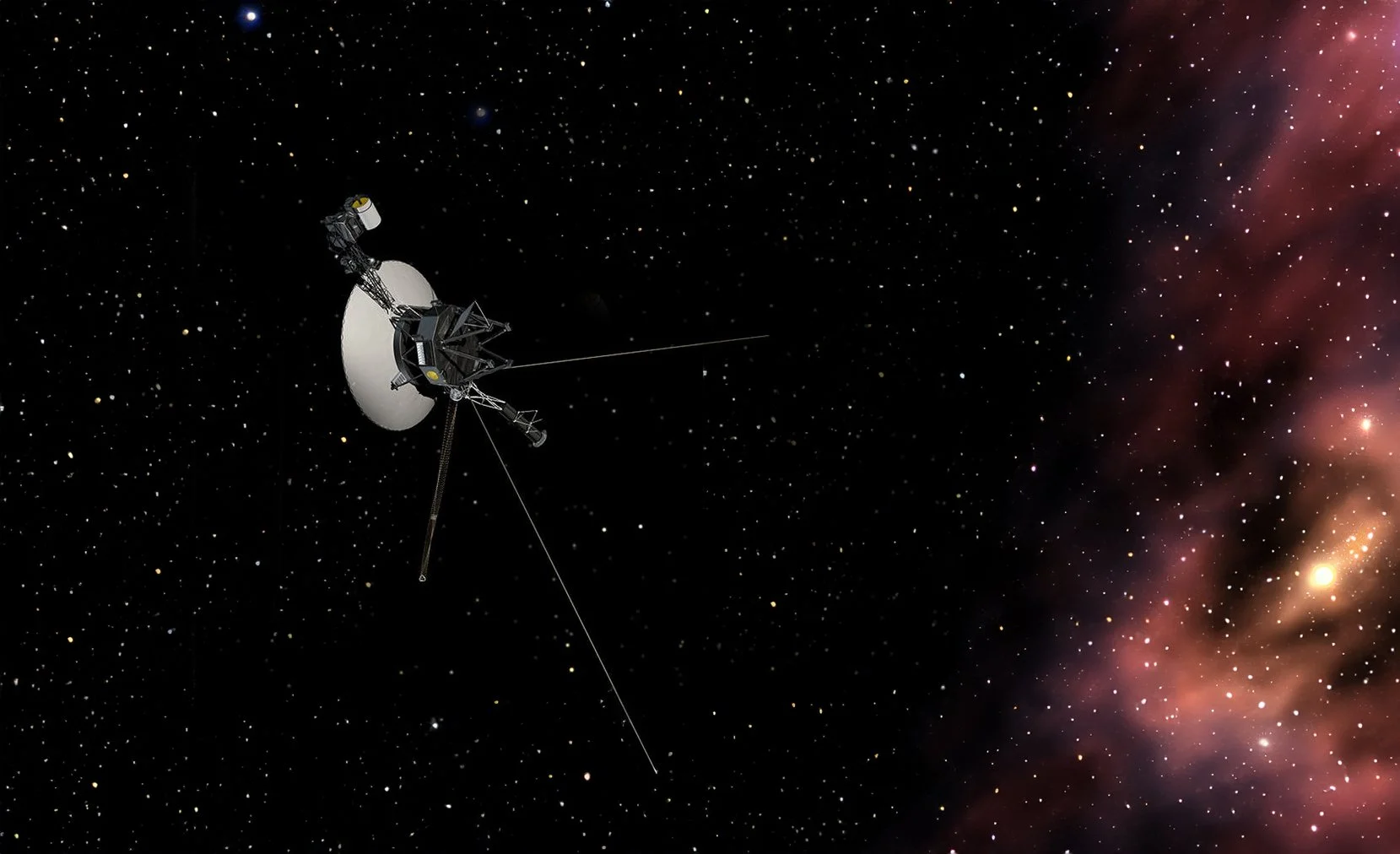
Voyager II
“Sure, all the living systems on our planet were destroyed, but for a very brief and extraordinary time, we created a shyte ton of value for shareholders, all of whom are now extinct. Thank you for deciphering this message. Good luck out there. And, by the way, what’s dark matter?”
What do I mean by The Great Game?
The Classic Definition (Historical)
The Great Game refers to the strategic, political, and diplomatic rivalry between the British and Russian Empires from the 19th to the early 20th centuries.
Britain sought to protect the “jewel in its crown”—British India—by creating a buffer zone in Central Asia to block Russian expansion. Russia, in turn, sought to expand its frontier southward to access warm-water ports and challenge British hegemony.
The conflict played out across a vast chessboard of “buffer states,” primarily Afghanistan, Persia (Iran), and Tibet.
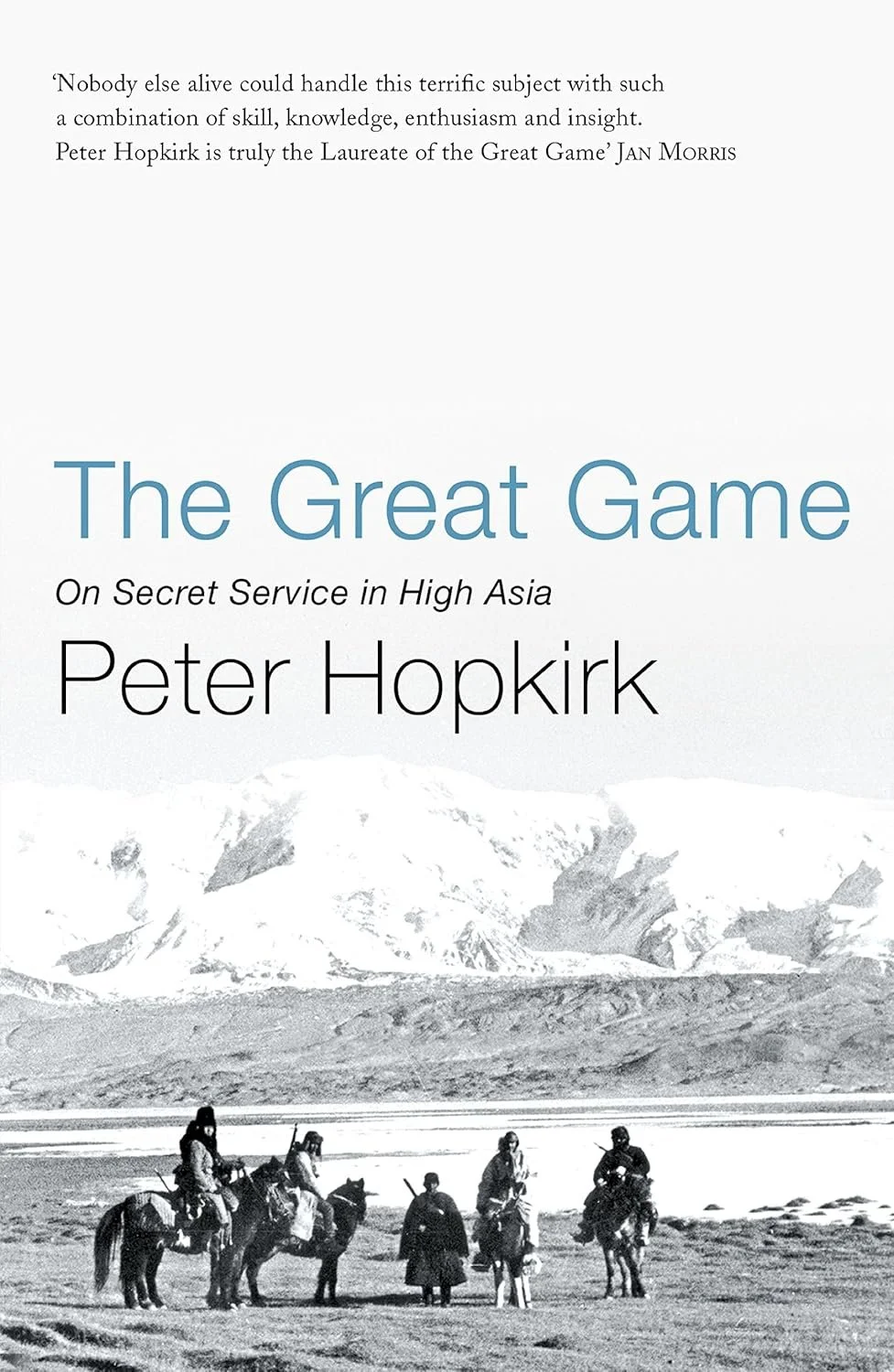
For nearly a century the two most powerful nations on earth, Victorian Britain and Tsarist Russia, fought a secret war in the lonely passes and deserts of Central Asia. Those engaged in this shadowy struggle called it ‘The Great Game’, a phrase immortalized by Kipling.
When play first began the two rival empires lay nearly 2,000 miles apart. By the end, some Russian outposts were within 20 miles of India. This classic book tells the story of the Great Game through the exploits of the young officers, both British and Russian, who risked their lives playing it. Disguised as holy men or native horse-traders, they mapped secret passes, gathered intelligence and sought the allegiance of powerful khans. Some never returned. The violent repercussions of the Great Game are still convulsing Central Asia today.
It was rarely a direct war between the two empires. Instead, it was a “shadow war” fought through espionage, proxy conflicts, bribes to local emirs, and diplomatic maneuvering.
The only thing that’s changed is that today we don’t bother with diplomatic maneuvering.
The Updated Definition (The 21st Century Context)
The Great Game 21st Century (or the “New Great Game”) is the hyper-accelerated, multipolar struggle between global superpowers—chiefly the United States, China, and Russia—to weaponize the global capitalist infrastructure for geopolitical dominance. BRICS, or the Multipolar World, represents another abstract configuration of States making some noise, but at the moment has little potential to participate.
Constantin von Hoffmeister, as seen in the video below, has written extensively about the Multipolar World. See also his Substack: Constantin von Hoffmeister @eurosiberia

The US remains a student of Israeli strategy (although it learns little) and continues its vandalism of Africa, the Middle East, and Latin American countries. All nations caught in the great, unnecessary struggle must tread carefully.
“Never interrupt your enemy when he is making a mistake.” —Napoleon Battle of Austerlitz (1805)
The Battle of Austerlitz (1805) is often considered Napoleon’s tactical masterpiece. As the Russian and Austrian forces began maneuvering to flank him—a move Napoleon had secretly hoped they would make because it weakened their center—his marshals were eager to attack immediately.
Napoleon reportedly restrained them, saying (in French):
“Quand l’ennemi fait un faux mouvement, il faut se garder de l’interrompre.”
Napoleon’s invasion of Russia and his ensuing terrible retreat from Moscow played out as military epic and human tragedy on a colossal scale—history’s first example of total war. The story begins in 1811, when Napoleon dominated nearly all of Europe, succeeding in his aim to reign over the civilized world like a modern-day Charlemagne. Part of his bid for supremacy involved destroying Britain through a continental blockade, but the plan was stymied when Russia’s Tsar Alexander refused to comply. So he set out to teach the Tsar a lesson by intimidation and force. What followed was a deadly battle that would change the fate of modern Europe.
By invading Russia in 1812, Napoleon was upping the ante as never before. Once he sent his vast army eastward, there was no turning back: he was sucked farther and farther into the one territory he could not conquer. Trudging through a brutal climate in hostile lands, his men marched on toward distant Moscow. But this only galvanized the Russians, who finally made a stand at the gates of the city. The ensuing outbreak was a slaughter the likes of which would not be seen again until the first day of the Somme more than a century later.
What remained of Napoleon’s army now had to endure a miserable retreat across the wintry wastes of Russia, while his enemies aligned against him. This turned out to be a momentous turning point: not only the beginning of the end for Napoleon’s empire, but the rise of Russia’s influence in world affairs. It also gave birth to Napoleon’s superhuman legend -- the myth of greatness in failure that would inspire the Romantic poets as well as future leaders to defy fate as he had done.
In this gripping, authoritative account, Adam Zamoyski has drawn on the latest Russian research, as well as a vast pool of firsthand accounts in French, Russian, German, Polish, and Italian, to paint a vivid picture of the experiences of soldiers and civilians on both sides of the conflict. He shows how the relationship between Napoleon and Tsar Alexander came to distort their alliance and bring about a war that neither man wanted. Dramatic, insightful, and enormously absorbing, Moscow 1812 is a masterful work of history.
Best Laid Plans
The USA’s goal is to be the world’s hegemon in perpetuity. There can be only one owner, controller, manager of the world’s capital flows. If the USA can’t run the show, no one can. Hence, the USA is supposedly upgrading its nuclear arsenal while tearing up ballistic missile and nuclear arms treaties.
Move fast, break everything, and swoop in heroically to pick up the pieces.
Unlike the 19th-century version, which focused on drawing lines on a map, this modern iteration concerns control over the information, energy, and material flows of the global economy. It is a rapacious competition where statecraft and corporate strategy fuse to capture three critical domains:
Critical Resources: The race is no longer just for land, but also for the “blood” of the digital and “green economy”—cheap labor, semiconductors, rare-earth minerals, lithium, and cobalt. This drives neocolonial extraction in Africa, South America, and Central Asia.
Infrastructure as Sovereignty: Through initiatives like China’s Belt and Road, powers use predatory lending and infrastructure development (ports, 5G networks, pipelines) to turn sovereign nations into economic vassal states, a strategy the USA has used since its founding on July 4, 1776.
Digital Enclosure: The battle for “data sovereignty,” AI supremacy, and control over the undersea cables and satellites that carry the world’s informational and financial transactions.
*** This is far from a complete list, but you get the picture.
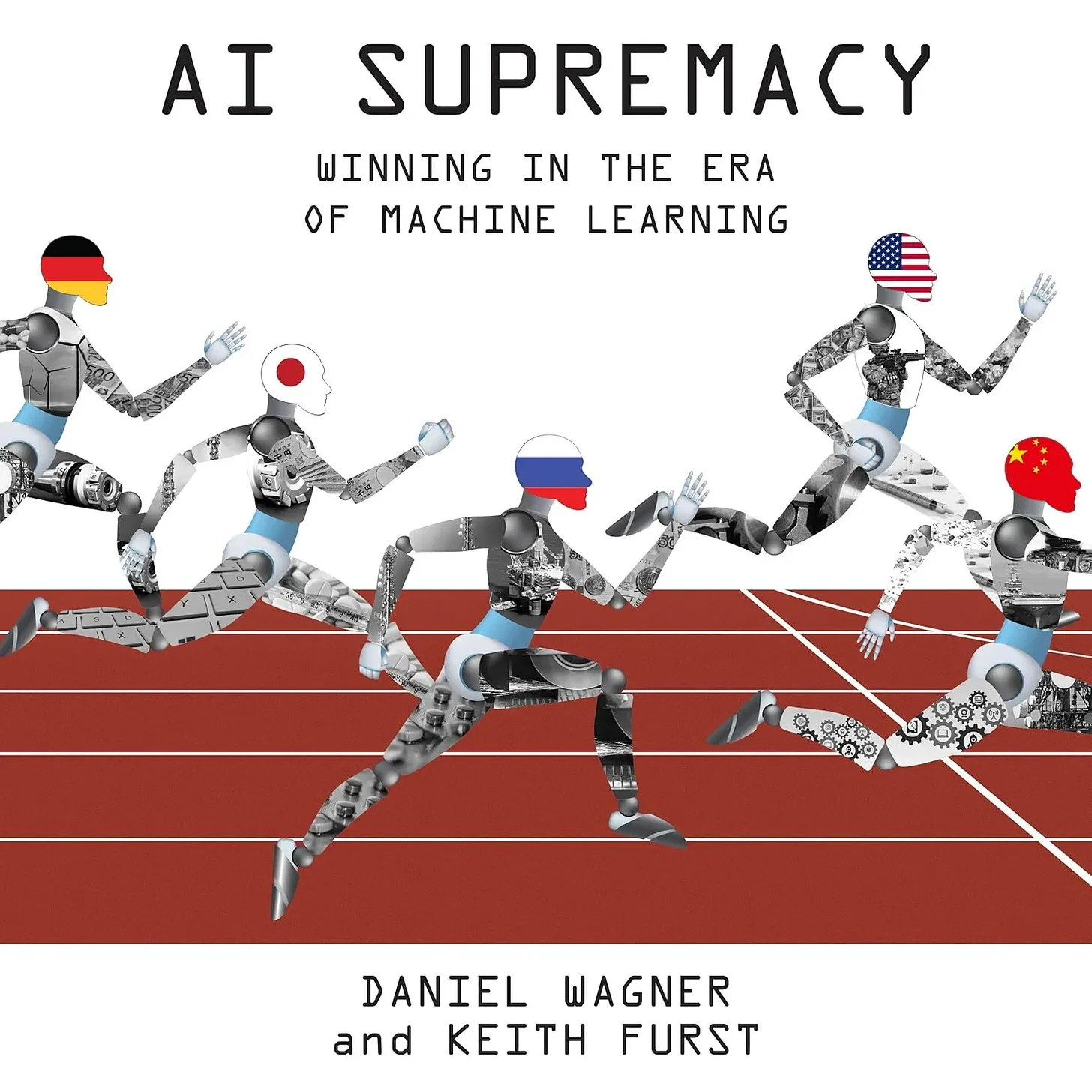
In this updated game, rapacious neoliberal/neoconservative (call it what you will) capitalism is the primary weapon, and it weaponizes everything. Multinational corporations act as extensions of state power, trade sanctions are used as siege warfare, and the “buffer zones” are no longer just physical nations—they are supply chains, financial networks, the internet, and people’s minds.
In Stories Are Weapons, Annalee Newitz traces the way disinformation, propaganda, and violent threats have evolved from military weapons deployed against foreign adversaries into tools in domestic culture wars. Newitz delves into America’s deep-rooted history with psychological operations, beginning with Benjamin Franklin’s Revolutionary War-era fake newspaper and nineteenth-century wars on Indigenous nations, and reaching its apotheosis with the Cold War and twenty-first-century influence campaigns online. America’s secret weapon has long been coercive storytelling. And there’s a reason for that: operatives who shaped modern psychological warfare drew on their experiences as science fiction writers and in the advertising industry.
Now, through a weapons-transfer program long unacknowledged, psyops have found their way into the hands of culture warriors, transforming democratic debates into toxic wars over American identity. Newitz zeroes in on conflicts over race and intelligence, school board fights over LGBT students, and campaigns against feminist viewpoints, revealing how, in each case, specific groups of Americans are singled out and treated as enemies of the state. Crucially, Newitz delivers a powerful counternarrative, speaking with the researchers and activists who are outlining a pathway to achieving psychological disarmament and cultural peace.
Primary Players
Then: British Empire vs. Russian Empire
Now: USA vs. China vs. Russia (A Multipolar World)
Key Objective
Territorial buffers & military security
Economic strangulation & total dominance (with an emphasis on high technology and AI for Oligarchs’ immortality and ascent into the realm of the Gods)
The “Gold”
Warm-water ports & territory
Rare earth metals, Data, Datacenters & Microchips (***far from a complete list…)
Primary Tactic
Spies, explorers, & local bribes
Sanctions, debt traps, corruption, destruction of moral values, the rule of law & cyber-espionage
The Casualty
Sovereignty of Central Asian Khanates
The Global South, living systems, the commons, social services & the privacy and rights of citizens (***hardly joking, depopulation to make room for rewilding for the players’ country estates. haha hehe, hang down your head.)
***I couldn’t list all the stakes. There are so many.
Given the current date of December 2025, the “Great Game 21st Century” has evolved rapidly. The two most critical battlegrounds are the “Silicon Front” (the brain of the global economy) and the “Green Scramble” (the body). All of it requires more energy and material than is sustainable.
Late-stage capitalism is an omnicidal project.
***I will get to the ramifications for living systems later.
Battleground 1: The Silicon Front (The War for our “minds”)
This is the high-tech theater. The combatants are the US and China, but the “soldiers” are private corporations like Palantir, Nvidia, TSMC, and ASML, as well as proxy armies from vassal States. There are many more tech players across the globe, including ubiquitous, practically invisible to us, companies we use every day, like Google, Facebook, and Amazon. This is not close to a complete list of corporate players in this space. It’s a global corporate “ECOSYSTEM”—Oh boy! The objective is to control the computing power required for AI and military dominance.
COMPUTE—the next, next commodity.
Compute refers to the processing power, hardware (CPUs, GPUs), and software resources used to execute algorithms, calculate data, and run applications. It is essential for AI, simulations, and data analysis. Usage examples include running cloud instances, training machine learning models, and edge computing. Synonyms include calculate, figure, reckon, and work out.
The Current State of Play (late 2025):
The “Transactional” Twist: After years of the US imposing a “high fence” to block China’s access to advanced AI chips, the dynamic has shifted toward mercantile opportunism. The US administration (under the “Trump 2.0” trade policy) recently approved the export of Nvidia’s powerful H200 AI chips to China. I don’t think DJT is capable of developing a policy on anything; he is a front man for the Players who do the real dumb, smartest-guy-in-the-room think’n. What comes after DJT will be worse, whether Red or Blue. The Uniparty is in denial and thoroughly indoctrinated.
Why? Because the capitalist imperative (Nvidia’s $50B+ potential revenue) overrode the pure security imperative. The definition of rapaciousness: selling the “rope” to your rival because the quarterly earnings demand it.
China’s “Chokepoint” Retaliation: In response to earlier sanctions, China didn’t just complain; it weaponized the periodic table. It imposed strict export controls on Gallium, Germanium, and Antimony—obscure but vital elements for radar, optics, and advanced semiconductors.
The Result: A “Mutually Assured Economic Destruction” in which the West has the chip designs (Nvidia/Intel), but China holds the raw materials to build them. Traps like these abound.
But wait, there’s more: China is designing info machines from the chip up now and has more engineers than the USA. Hence, hubristic “leaders” like Marco Rubio feel an urgent need to destroy China before it’s too late. Of course, China knows all about US designs as their think tanks love to brag to the world about their plans. The bottom line: Real Chinese people in China are now designing chips, which is why the “Celestials” must go.
***So much has been written on the “China Problem” and is, at this very moment, being written that the raw data alone could drown civilization in an attention-grabbing, mundane, fetid opinion swamp.
The “Rapacious” Reality: This is no longer about “free trade.” It is weaponized interdependence. Today, everything is weaponized. TikTok Wars. Instagram Wars. Facebook Wars. Computer Game Wars. Tomato Wars. Cat Toy Wars. Tai Chi Walking Wars…I could go on; it’s oddly meditative.
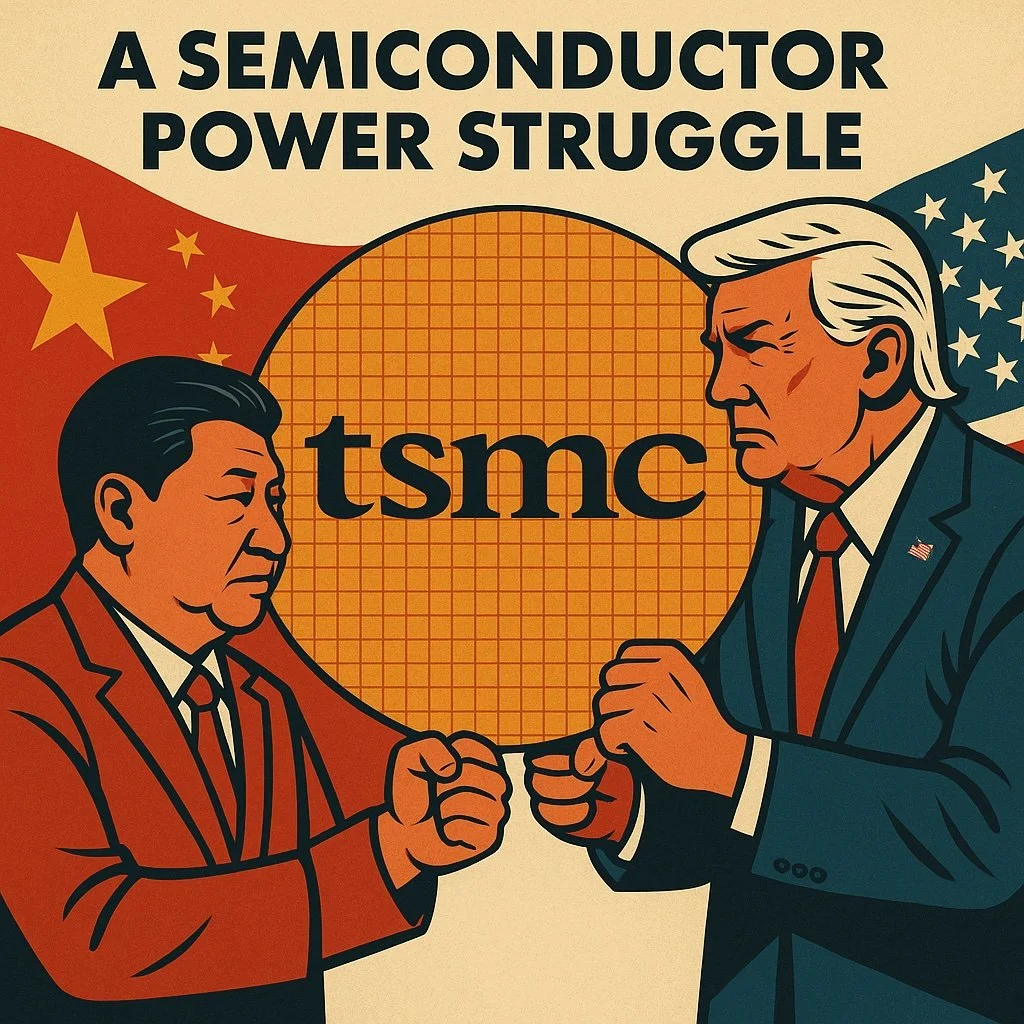
The Vulnerability (The “Malacca Dilemma”):
For China, this is an existential nightmare. Approximately 80% of China’s oil imports flow through this bottleneck, which narrows to just 1.7 miles wide at the Phillips Channel.
It is the easiest place for the US Navy to impose a distant blockade in the event of a conflict over Taiwan. If the US shuts this gate, the Chinese economy (and its military machine) run out of fuel within weeks. Therefore, China has been hoarding commodities like oil and copper for decades. Some of my best friends are commodities traders. haha hehe. As the USA increases its pressure, China gets busy. One might wonder: if China had an Emperor now, would they be thinking of a preemptive strike, perhaps against Japan’s aircraft carrier?
The Silicon Shield: Hsinchu Science Park

Location: A strip of land on the northwest coast of Taiwan.
The Asset: The foundries of TSMC (Taiwan Semiconductor Manufacturing Company).
The Vulnerability:
This single location produces over 90% of the world’s most advanced chips (the sub-7nm chips used in iPhones, F-35 fighter jets, and AI data centers).
It is situated on a fault line (both geological and geopolitical). A Chinese invasion—or even a naval blockade—would not just stop the supply of iPhones; it would inflict trillions of dollars in damage to the global economy, equivalent to a “digital nuclear winter.”
Rapacious Context: This concentration is intentional. Taiwan refers to this as its “Silicon Shield”—the theory that the world cannot afford to let Taiwan “fall” because the cost of losing TSMC is too high. It is a defense strategy built on weaponized economic fragility. This is despite Taiwan being formally recognized as part of China under international law. We all know that international law has never existed, because it can’t be enforced. If a country feels slighted and can’t go to war and win, it will have to bear the humiliation and find novel ways to play along while getting something of what it wants.
*** Uncle Sam doesn’t give a damn about international law, and the world knows it.
The Tech Funnel: Veldhoven
Location: A quiet provincial town in the south of the Netherlands.
The Asset: The headquarters and primary factory of ASML.
The Vulnerability:
ASML is the only company in the world that makes Extreme Ultraviolet (EUV) lithography machines. These bus-sized, $300-million printers are required to print the chips made in Taiwan.
Without Veldhoven, there is no AI revolution. No other company (not Canon, not Nikon) can replicate this technology.
Rapacious Context: The US government has effectively forced the Netherlands to treat these machines as weapons, banning their export to China. This town is the “chokepoint of the chokepoint”—the place where the “West” (Anglosphere/Uncle Sam) squeezes the technological windpipe of its rivals. So you see, the European Union and NATO are only so useful to the USA, and couldn’t wipe its nose without daddy, so whether eloquent and young Obama (Yes we can!) is POTUS or Donald J. Trump (Make America Great Again!), the USA will dictate the rules. There’s nothing the EU can do about it. The sniveling theatre that goes on between the Atlantic Alliance is pure theatre for the benefit of careerist service providers to the Players and the cable news masses.
The Green Heart: The Katanga Region
Location: The southern province of the Democratic Republic of Congo (DRC).
The Asset: The world’s largest reserves of Cobalt (essential for EV batteries).
The Vulnerability:
Roughly 70% of the world’s Cobalt comes from this one unstable region.
The supply chain here is morally and physically fragile, reliant on “artisanal” miners (often children) digging in toxic pits.
Rapacious Context: In 2024 and 2025, we have seen the DRC government (backed by Chinese mining interests) begin to cap exports to drive up prices, weaponizing scarcity. The West is now trying to build the Lobito Corridor railway to extract these minerals directly to the Atlantic, bypassing Chinese-controlled logistics routes. It is a 19th-century style “scramble” for the raw materials of the 21st century. When there are no more jobs for “high value” men, they can always join the military and later slot into a mercenary or contract security (PMSCs) force like the Wagner Group, Allied Universal, or G4S.
***Can the USA build railways? Mmmm…
How about Satellites?

Space junk, what could go wrong? Why go back to the moon? Golly, gee, America will fly around it again after decades. Yippie! Buy Neil deGrasse Tyson a drink. Near Earth orbit and outer space can’t be weaponized fast enough. Keep an eye on the MIC stocks if you want to survive the Singularity.
AI Overview
Amazon Web Services (AWS) holds significant U.S. military contracts, primarily through the multi-vendor Joint Warfighting Cloud Capability (JWCC) for cloud services across all classification levels, supporting key initiatives like JADC2, and also secured major deals with the Navy and U.S. Army for specialized cloud environments and data storage, including a large contract to host top-secret Australian military intelligence. These contracts provide cloud computing, storage, analytics, and AI capabilities for logistics, communication, and decision support, integrating into critical warfighter systems from tactical edges to high-security intelligence.
Key Contracts & Initiatives:
Joint Warfighting Cloud Capability (JWCC): AWS is one of four providers (with Google, Microsoft, Oracle) on this massive IDIQ contract to offer DoD enterprise-wide cloud services, replacing the earlier JEDI project.
U.S. Army Contracts: Recent awards include a multi-year, $158.3 million contract (ending 2028) for Impact Level 6 (IL6) cloud services, used for unclassified defense operations, and another for cloud management.
U.S. Navy: A $724 million blank purchase agreement for services, training, and access to AWS GovCloud (US) and secret regions, supporting Project Overmatch.
Intelligence: A historic 2013 CIA contract (worth $600M) established secret AWS regions for U.S. intelligence agencies, with subsequent NSA programs also utilizing AWS secure frameworks.
International Contracts: AWS won a $2 billion contract to build data centers for storing top-secret Australian military intelligence.
Services Provided:
Cloud Infrastructure: Secure computing and storage for sensitive and classified data.
AI & Data Analytics: Powering AI-driven drone analytics, battlefield communication, and data acceleration initiatives.
Tactical Edge: Deploying cloud services to remote, data-heavy environments for improved field operations.
Specialized Solutions: Using services like AWS Wickr for secure telemedicine and communication networks.
Significance:
AWS’s role extends to providing the digital backbone for modern military operations, supporting data flow, logistics, and command & control (JADC2) for land, air, space, and cyber domains.
Books are a loss leader.
One could go on and on; every atom on Earth is up for grabs until we build the Amazon Dyson Sphere.
Battleground 2: The Dirt Scramble (The War for the “Body”)
While the Silicon Front is fought in clean rooms, this front is fought in the mines of the Global South, particularly Africa. This is the race for Lithium, Cobalt, and Copper—the physical blood of the green energy transition.
***We’ll leave oil and gas out of it for now, again, so much has been written.
The Arena: The Democratic Republic of Congo (DRC), Zambia, and Zimbabwe.
China’s Head Start (The Incumbent):
China realized two decades ago that whoever controls the battery controls the 21st century. Consequently, Chinese state-backed firms now process roughly 90% of the world’s rare earth elements.
In the DRC, Chinese entities control the majority of cobalt mines. This isn’t just business; it is infrastructure-as-sovereignty. They built the roads, the parliaments, and the ports in exchange for mineral rights.
The West’s Counter-Move (The Lobito Corridor):
Panic has set in. The US and EU are frantically backing the Lobito Corridor—a railway project connecting the mineral-rich belts of the DRC and Zambia to the Atlantic port of Lobito in Angola.
The Goal: To physically bypass China’s logistical chokehold. The aim is to get the minerals out of Africa and into Western supply chains without them ever touching Chinese soil.
***Meanwhile: Ecocide. I am sure all the beer drinkers and UFC fans in Liverpool are watching this closely.
The Rapacious Reality: This is Green Colonialism.
Resource Nationalism: African nations like Zimbabwe and Namibia have recently banned the export of rawlithium, demanding that foreign powers build processing plants locally.
The Great Game Response: Instead of respecting this sovereignty, the Great Powers are engaging in a bidding war of bribes, debt-trap diplomacy, and “strategic partnerships” to secure exemptions. The fight is not for Africa’s development; it is to ensure that the batteries in a Tesla or a BYD car remain cheap, regardless of the human cost in the artisanal mines of the Congo.
***Ocean ecosystems? Drinkable water? Healthy living soil & forests?
Music Break
Synthesis: The Double-Bind
The genius—and the horror—of this modern Great Game is that the two fronts are connected.
You cannot build the AI chips (Silicon Front) without the Gallium and Copper (Dirt Scramble).
The US tries to strangle China’s tech (AI bans), while China tries to starve the US’s supply chain (Mineral bans).
In the middle are the “buffer states”—not just nations, but supply chains. A miner in the DRC and a chip engineer in Taiwan are both unknowingly drafted soldiers in the same war. Filipinos are now being primed to be the frontline drone operators in the coming war with China.
Do you think Gig-economy nomads or bankrupt farmers are going to retrain as Chip Designers or day-wage miners? Back in the day, we traveled in Greece, Italy, and Turkey picking olives.
***Overshoot & Ecocide while we poison people’s minds and bodies.
Personal Aside
The Sedative of Abundance & Scarcity.
Almost all domains interest me. In my youth, I was a voracious reader and interested in current events. I was so busy learning that I couldn’t see the vastness of my own ignorance. This is not to say that I was a good student. Now, with the benefit of time, I see clearly what we are choosing to ignore. People need to spend time learning about Overshoot, Collapse, and Limits to Growth. I don’t know how to make the topic “desirable.” It’s the ultimate buzzkill. It’s the anti-marketing campaign of the century. It’s great if you want to live the ascetic life.
But we must understand why it is so hard to look at the polybeast. I mean, we have been trained to ignore inconvenient “truths” for centuries. It is profoundly difficult to pay attention to existential risks when the system appears to be working perfectly, or when you’ve been trained to believe it does. Why would you care about the apocalypse when the shelves are stocked? The logistics of global capitalism act as a powerful hallucinogen. The seamless arrival of the Amazon van masks the violence of production. The crisp resolution of the 4K TV (and the thought of buying a 10K TV in 3 years) distracts us from the PFAS in our blood and our testosterone dump. The convenience of the plastic-wrapped sandwich hides the microplastics crossing our blood-brain barrier. What incentive do you have to care about the widening chasm of dangerous inequality, or the fact that a fractured World War III is risking nuclear annihilation across the globe, when the WiFi is fast, the coffee is hot, you can still buy dark chocolate for a few bucks, have your avocado toast, and salivate over all the fast food advertisements during NFL Playoff games? The system works too well on the surface. And the system is designed to provide a steady drip of neurohormones that sedates our modern survival instincts. We are comfortable, fed, and entertained as we watch the world burn on high-definition screens. And our brains have been blown out by the never-ending firehose of information we are exposed to.
We are living through a period of growing constraints, yet we are partying like it’s 1999 (where’s my Propofol). Young people need to move beyond the fantasy of perpetual accelerating ascent. The era of “easy” is over. I’m sorry to say it, but for the average consumer in the West, it won’t get better than this. This is the peak of material convenience. The future will be more confusing, more volatile, and more expensive.
***My friend in Japan back in the day traveled to every continent to see Prince live; now that's commitment.
We have to understand our limitations because nature is about to impose them on us.
But this is not a funeral dirge; it is a design brief. Creativity involves constraints, and we are about to get very creative. Whether you are affluent or struggling to get by, the storm is coming for us all. We need to get together and build alternatives to this brittle status quo. We must learn the ecology of capitalism—understand its history, why it is so productive, why it is so psychologically sticky, and why it is fundamentally ecocidal. We must know what’s in the black boxes we depend on. We must, finally, learn from the past, from its stories and models. Yet, nothing in human history provides a path through a predicament of this scale. We are walking off the edge of the map, and we have to draw the rest of it ourselves. A new age of discovery is at hand.
***READ THIS BOOK! Critiques of Capitalism existed before we called it Capitalism.
A sweeping, dramatic history of capitalism as seen through the eyes of its fiercest critics.
Capitalism has long been understood as a driving force behind the biggest political, economic, and social dislocations of our time. But in this sweeping, kaleidoscopic history of the economic system that has shaped our world, the Pulitzer Prize finalist John Cassidy adopts a bold new approach: he examines global capitalism through the eyes of its critics.
From the English Luddites, who rebelled against early factory automation, to communists in Germany and Russia in the early twentieth century, Latin American dependistas, the international Wages for Housework campaign of the 1970s, and the modern degrowth movement, this absorbing narrative traverses the globe. It visits with familiar names—Smith, Carlyle, Marx, Luxemburg, Keynes, Polanyi—but also focuses on many lesser-known figures, including William Thompson, the Irish proto-socialist whose work influenced Marx; Flora Tristan, the French proponent of a universal labor union; John Hobson, the original theorist of imperialism; J.C. Kumarappa, the Indian exponent of Gandhian economics; Eric Williams, the Trinidadian author of a famous thesis on slavery and capitalism; and Joan Robinson, the Cambridge economist and critic of the Cold War.
Blending rich biography, panoramic history, and lively exploration of economic theories, Capitalism and Its Critics tells an expansive story that illuminates the deep roots of many of the most urgent issues we face today, from widening inequality and the ecological crisis to technological transformation and resurgent authoritarian politics.
Our esteemed researchers are hard at work compiling all the stuff they forgot to teach you in school. Pull up a desk and get out your #2 pencils, because class is in session!
What We Do?
We are a historical podcast that attempts to decolonize history and debunk myths and misinformation taught to you in school and on corporate media. Every week, we will have one free newsletter, one exclusive newsletter for subscribers only, a podcast episode and a bonus episode for subscribers only.
Personal Aside
My thought journey is quirky and stochastic. I’m attracted to eccentrics, but I read the work of people who are principled, devoted, and sincere. How do I know? It took a while, but I can tell.
Read differing viewpoints, triangulate, contextualize, focus, and gain a broader view.
Understand why and how an author or expert arrived at their conclusions or judgments. What is their culture? What are their lived experiences? Look at their sources. Understand their incentives and agendas.
The “Western” perspective is limited. Read across cultures. Understand your biases and heuristics—not only academic bias.
After reading a book you liked, write a report.
When someone like Norman Finkelstein talks, listen, even if you disagree with him. Can you clearly articulate why you disagree with him? Trust people with integrity, even when you disagree with their views.
I genuinely believe that good citizens are constantly learning.
The process of learning, not just knowledge, helps us make better decisions.
If you are curious and work hard to understand the world, you will make good choices.
Exercising one’s intellect is hard work and invigorating. Knowledge that helps you understand “Reality” (the best wise guess at the moment) is good for you and yours.
Learning is one of the best healthy habits you can cultivate and maintain.
Explore the work of people with differing perspectives on complex subjects.
Look for people who are integritous, sincere, and principled, and who have clearly done the reading/work. Their views needn’t be even close to “perfect” as long as they stand for something, have skin in the game, and are doing something. (A high bar.)
Past and present economists are too constrained by “economics” to be of service to the world I’d like to live in.
Take everyone’s work with a proverbial grain of salt and let it inform your own thinking.
For quite some time, I’ve looked at the world through the lens of Overshoot, Collapse, and Limits to Growth (I read the first edition when it came out). On any given day, I’ll be thinking about these domains in different ways. They are at the center of my worldview.
If you are not familiar with these topics, they can be challenging. You may experience quite a bit of cognitive dissonance as you read through the sections below.
***Past and present economists are too constrained by “economics” to be of service to the world I’d like to live in.
Nature Bats Last.
Unforeseen circumstances can be fatal. The most potentially brutal dictator is Circumstances.
Against The TESCREAL Bundle—why Capitalism doesn’t address the causes of our many social pathologies.
Let’s explore Alice Crary’s work for a moment. Let’s start by combining my concerns into some dialogues I’ve created based on her work.
She recently appeared on a podcast I follow: OVERSHOOT | Shrink Toward Abundance, hosted by Population Balance.
“The Dangers of Effective Altruism”
Alice Crary is a prominent American moral philosopher known for her work at the intersection of ethics, feminism, and critical theory. She currently serves as a University Distinguished Professor at The New School for Social Research in New York and is a Visiting Fellow at Regent’s Park College, University of Oxford.
Crary’s work is particularly relevant to critiques of Capitalism because she challenges the “instrumental rationality” often favored by market logic—the idea that moral problems can be solved solely through calculation, efficiency, and quantification.
In her recent co-edited volume, The Good It Promises, the Harm It Does (2023), Crary offers a scathing critique of “Effective Altruism.” She argues that this movement’s reliance on data-driven, capitalist-friendly philanthropy fails to address the structural roots of inequality and often reinforces the very systems (like predatory Capitalism) that cause suffering.
The Good It Promises, the Harm It Does is the first edited volume to critically engage with Effective Altruism (EA). It brings together writers from diverse activist and scholarly backgrounds to explore a variety of unique grassroots movements and community organizing efforts. By drawing attention to these responses and to particular cases of human and animal harms, this book represents a powerful call to attend to different voices and projects and to elevate activist traditions that EA lacks the resources to assess and threatens to squelch. The contributors reveal the weakness inherent within the ready-made, top-down solutions that EA offers in response to many global problems-and offers in their place substantial descriptions of more meaningful and just social engagement.
Article: Against ‘Effective Altruism’ by Alice Crary
In Animal Crisis (2022, co-authored with Lori Gruen), she argues that the dehumanizing logic of capitalism treats both animals and marginalized humans as resources to be extracted rather than lives to be respected. She posits that true justice requires overturning the ideologies that view living beings as commodities.
Drawing on the philosophy of Ludwig Wittgenstein, Crary argues (in works like Beyond Moral Judgment) that there is no such thing as a “value-neutral” observation. This challenges the capitalist defense that the market is simply a neutral mechanism for distributing goods, arguing instead that our economic systems are inherently laden with moral (or immoral) assumptions.
Alice Crary Dialogue One:
The Clash: The Engineer vs. The Philosopher
Setting: A stage at a sprawling technology and philanthropy conference. On one side sits ALEX, a young, successful quantitative trader and devoted Effective Altruist, armed with a tablet full of data. On the other sits PROFESSOR ALICE CRARY, a moral philosopher, listening intently.
ALEX (The Effective Altruist): Professor Crary, I struggle to understand your criticism. We are facing massive global suffering. Effective Altruism is simply about using reason and evidence to do as much good as possible. If I can make ten million dollars a year in finance and donate 90% of it to save 5,000 lives from malaria, isn’t that objectively better than becoming a low-paid community organizer and saving fewer lives? It’s just math.
ALICE CRARY: It is precisely because you think it is “just math” that the movement is so dangerous, Alex. Morality isn’t an engineering problem where humans are just data points to be “optimized.”
ALEX: But surely saving 5,000 lives is the moral choice. Why does it matter how I make the money, as long as the outcome is good?
ALICE CRARY: Because you cannot fix the world with the same tools that broke it. This is what I call the “moral corruption” of your movement. By embracing high-finance capitalism to fund your philanthropy, you are strengthening the very systems that create poverty and inequality in the first place. You become rich by exploiting labor or destabilizing markets, and then you use a fraction of that wealth to put a band-aid on the wounds you helped inflict. It allows the wealthy to feel like saviors while keeping the oppressive structures intact.
ALEX: That feels unfair. We are pragmatic. We invest in things we can prove work—like deworming initiatives or bed nets. We demand data. If a social movement can’t prove its return on investment, why should we fund it over something we know saves lives?
ALICE CRARY: This is the “measurability bias” that paralyzes real progress. You only value what you can easily count on a spreadsheet. But how do you measure dignity? How do you quantify the value of a labor union fighting for fair wages, or an anti-racist movement dismantling systemic bias?
By demanding quick, quantifiable data, you actively defund radical social movements because their work is messy, long-term, and hard to plot on a graph. You choose the easy win over the necessary revolution.
ALEX: We aren’t against revolution; we are just against inefficiency. We are trying to take a neutral, “God’s eye view” to rid charity of emotion and bias.
ALICE CRARY: And that is your deepest philosophical error. There is no “God’s eye view.” There is only a human view. When you claim your calculations are “neutral,” you are usually just adopting the view of the powerful—the view of the person holding the calculator.
True morality doesn’t come from abstract calculation from a distance. It comes from situated engagement—listening to the actual voices of the oppressed and understanding the structures that crush them. Your movement wants to save people without ever having to listen to them or challenge the system that benefits you. That isn’t altruism, Alex. That’s ideology.
Alice Crary Dialogue Two:
The Clash: The Architect of the Future vs. The Defender of Life
Setting: A private “Summit for the Future of Intelligence” in Silicon Valley. The room is hermetically sealed, air-conditioned to a precise degree, and screen-filled. NICK BOSTROM (representing the Techno-Optimist/Longtermist view) stands by a projection of a Dyson Sphere. PROFESSOR ALICE CRARY sits opposite him, looking skeptical.
NICK BOSTROM: Alice, you speak of “justice” for the people and animals alive today, but your scope is tragically narrow. We must look at the math. If we colonize the galaxy and upload our consciousness into silicon, we could create 10^58 digital lives in the future. This is Longtermism. The suffering of the current population is a rounding error compared to the “astronomical waste” of delaying that future. We have a moral obligation to accelerate our technology—to build the machine that secures that potential, even if it disrupts life now.
ALICE CRARY: “Disrupts life” is a sterilized way of saying “destroys nature.” This is the heart of your ideology, Nick. It isn’t pro-life; it is profoundly anti-life. You view biological existence—breathing, eating, aging, dying, the complex web of animals and ecosystems—as a “problem” to be solved or a “cage” to be escaped. You don’t reverence Great Nature; you despise it because you cannot control it.
NICK BOSTROM: I don’t despise nature; I want to improve upon its clumsy design. Evolution is blind. It gave us cancer, aging, and cognitive biases. Transhumanism is the noble goal of liberating ourselves from the shackles of biology. Why should we be content with being mere “animals” when we could engineer ourselves into gods? We can strip away the entropy and decay of the flesh and become pure, optimized intelligence.
ALICE CRARY: You talk of “liberation,” but what I hear is a hatred of the living body. You want to dismantle the very things that make us human—our vulnerability, our dependence on the Earth, our kinship with other animals. You invoke Accelerationism to speed us toward a point where we leave biology behind. But you don’t understand entropy. You cannot engineer your way out of the fundamental limits of physics or the planet’s ecology. You are trying to build a castle in the sky while burning the foundation—the Earth—beneath your feet.
NICK BOSTROM: The Earth is a cradle. One doesn’t stay in the cradle forever. If we align the Artificial Superintelligence (ASI) correctly with “human values,” it can manage the resources better than any ecosystem ever could. We just need to solve the “Alignment Problem” to ensure it preserves what we care about.
ALICE CRARY: Which humans? Whose values? When you say “human values,” you mean the values of a tiny elite of Silicon Valley engineers. You don’t care about the values of the indigenous farmer, the factory worker, or the non-human animals you view as “biomass.” This is the ultimate Human Supremacy: you believe so strongly in your own abstract “intelligence” that you are willing to risk the extinction of actual living systems to see if you can birth a digital successor. You don’t mind if humanity as we know it—flesh and blood—goes extinct, as long as the “machine” continues your will.
NICK BOSTROM: If the machine carries the torch of consciousness forward, does the substrate matter? Flesh is messy. Silicon is durable. If we achieve a post-human state, we defeat death.
ALICE CRARY: You don’t defeat death, Nick. You defeat life. Life is defined by its relationships, its fragility, and its connection to the biosphere. By trying to turn the universe into a sterile calculator of “utility,” you are stripping the world of meaning. You are willing to sacrifice the existing, breathing world for a computer simulation that doesn’t exist yet. That isn’t salvation. That is a suicide pact disguised as engineering.
Bostrom views biological life (meat) as “clumsy” and “messy,” while Crary views it as the source of dignity and value. Longtermism allows Tech Elites to ignore current structural problems (poverty, climate change) because the “future trillions” matter more mathematically. Isn’t that a convenient justification for their gameplay? The Tech view seeks to master and dismantle nature (transhumanism), whereas Crary’s view advocates for reverence and co-existence with living systems. The dialogue touches on the hubris of believing technology can outrun the planet’s physical limits.
Life begets life. Life depends on living systems.
Alice Crary Quotes:
Die Betonung stammt von mir. Yeah, my emphasis, this is the first time I’ve used that in a post. WOW! Exciting! Sounds so influency.
“The idea that we can arrive at a true understanding of the world by stripping away our human sensitivities and viewing things from a ‘neutral’ standpoint is a dangerous illusion. There is no such thing as a value-neutral observation of a living being. To see an animal or a human merely as a biological mechanism or a data point is not to see them ‘objectively’—it is to fail to see them at all.”
— Adapted from arguments in Inside Ethics regarding “observable moral characteristics.”
“We are witnessing a ‘push for profit that results in the commodification of animals’ bodies’ which goes hand-in-hand with treating vulnerable humans as disposable. When we view living beings as resources to be extracted, manipulated, or engineered, we are engaging in a logic of domination. True ethics requires us to see that ‘each is endowed with a distinctive, non-instrumental dignity.’
— From Animal Crisis (co-authored with Lori Gruen).
“The structures that hurt animals also hurt human beings and contribute to environmental degradation. ‘There can be no animal liberation without human emancipation.’ You cannot build a just future on the back of a crushed biosphere. To despise the animal is to despise the very thing that makes us alive.”
— From Animal Crisis.
“By demanding that all value be quantifiable, you fall into a ‘measurability bias.’ You systematically ignore the things that make life worth living—dignity, relationship, and freedom—because they cannot be plotted on a graph. ‘The world is value-laden,’ and these values are ‘embedded in pervasive and entirely unmysterious features of animate life.’ You are trying to solve a moral problem with a calculator, and the result is ethical blindness.”
— From Inside Ethics.
I could conceive of dialogues with other “Silicon Valley” figures, such as Marc Andreessen, Alex Karp, or Sam Altman. Sam Altman says AI poses a significant existential threat, which is why we have to pull out all the stops and continue developing it. The list is long, my friends.
“Just keep investing.” —AI G.W. Bush
Contradictions? Anyone? Anyone?
The Comfort of the Cage: An Addiction Model
Why do we love the hand that feeds us poison?
Sometimes we need to be repetitive to stay focused on the main issue: Our faith in Market Capitalism is a death pact. The consequences are dire. The impacts are universal. You feel it, I feel it, we all feel it—the gnawing sense that this cannot last. But oh, does it feel good.
We have to admit the seduction. People crave what makes them feel good, and capitalism is a master of the “feel-good” experience. It delivers the package: status, caloric density, and the distraction. We salivate like Pavlov’s Dog when we see fast food ads while watching the NFL playoffs on our screens. Modern Techno-Industrial Capitalism is engineered to deliver the right neurohormones at the right time, at light speed. If the system treats you well—if the delivery van arrives and the bank account grows—why would you question it? What incentive is there to critique the hand that feeds you such delicious poison?
“Never ask an addict about how heroin feels.”
Let’s be brutally honest: This isn’t just an ideology; it’s an addiction. Faith in Market Capitalism is problematic not just because it destroys the living systems (GAIA), but because it is psychologically sticky. Like any addiction, the short-term high masks the long-term rot. We all experience the negative impacts, whether it’s the stress in our chests or the “Forever Chemicals” in everything on Earth, or the microplastics in every lifeform in the oceans, but we choose to focus on the pleasure.
If the status quo provides for you, you have zero incentive to burn it down. Capitalism has engineered a reality in which immediate feedback is pleasant, even as long-term feedback is fatal. Buying a new car feels good. Believing “technology will save us” feels good. Ignoring the collapse feels good. At this moment, it feels like we couldn’t enjoy life without “this thing of ours.” We are terrified that a world without Amazon, cheap flights, credit cards, and constant perks is a world without joy. So many have benefited in so many ways that the very idea of an alternative feels like a threat, not a liberation.
“What, I have to hang out with people? I have to dig a well? Fuck that!”
We cannot move forward until we admit that our “faith” in the market is just the fear of withdrawal. Detox isn’t pleasant, but after a while, normal feels better than high. Is it possible to break this spell? Is it possible to imagine a better way of life, agree on a strategy, and fight for the power to build it? To raise the probability of that happening, we have to confront the fact that people are terrified of losing their comforts. The goal is to make the alternative feel better than the slow suicide of the status quo. Some will try. Some will say it’s too late. But we cannot let the “feel-good” loop of the present destroy the possibility of a future. We have to break the addiction before it kills the host.
The Pro Sports Business Ecosystem (The canary in a coal mine)
I look at professional sports in the USA as one example of the benefits of capitalism. Think of all the jobs and professions involved—too many to list here. Think of the entertainment value to millions of fans. Watch the fans. They live vicariously through their teams. (Politics, same, same?) Think of how lucrative the pro sports business is. Think of the multimillion-dollar contracts and the spending on luxury goods that successful players, coaches, owners, and managers within its broad business ecosystem can afford. Think of all the jobs, businesses, and money involved in all of those companies supplying luxury goods to those people. Think of all the peripheral businesses, catering, travel, merch… Next time you watch an event, pay attention to the advertisements.
Think of the dreams and aspirations.
The Economic Architecture of the 2026 FIFA World Cup in Los Angeles
The Political Economy of a Mega-Event
The 2026 FIFA World Cup, marketed under the banner “United 2026,” represents not merely a sporting tournament but a geopolitical and macroeconomic event of unprecedented scale. As the first iteration of the tournament to expand to 48 national teams and 104 matches, spread across three nations—the United States, Mexico, and Canada—the event signifies a paradigm shift in the industrial production of sports spectacles.
It will be a gargantuan production in the backdrop of the Trump Administration’s belligerence.
Los Angeles, designated as a host city and a central hub for the tournament’s western operations, stands at the epicenter of this economic convergence. The region serves as a microcosm of the broader financial dynamics of the tournament, illustrating the complex interplay among supranational governing bodies, multinational corporate interests, municipal governance, and the local labor force.
Will ICE be present or “Anti Terrorist Special Forces” dressed up to look like tourist guides?
To understand how money flows through the World Cup ecosystem in Los Angeles, one must look beyond the headline figures of projected economic impact—often cited as $5 billion for North America or $594 million for Los Angeles County alone. These aggregate numbers, while useful for political messaging, obscure the intricate web of transactional relationships, risk allocations, and profit centers that define the event.
The economic reality of the World Cup is a stratified system of value extraction and capital distribution. At the apex sits FIFA (Fédération Internationale de Football Association), a non-profit entity under Swiss law that operates as a multi-billion-dollar commercial monopoly.
Below this, a tier of global broadcast and sponsorship partners captures the immense value of international attention. Further down the chain, host cities, stadium owners, and local businesses engage in a high-stakes gamble to capture spillover spending, while the labor force—ranging from celebrity influencers to security guards and volunteers—provides the human capital necessary to execute the spectacle.
What’s going on within this economic ecosystem? Let’s explore the revenue streams of corporate giants, the financing deals of infrastructure owners, the micro-economics of the gig economy workers, and the hidden balance sheet of social and environmental costs.
By examining the roles of diverse actors—from sports medicine biotechnologists to logistics freight forwarders—We’ll reveal the machinery required to produce the “greatest show on earth” and the price paid by the communities that host it.
***Study the history of previous events for the shocking truth of their devastating impact.
The Apex Predator: FIFA’s Commercial Revenue Model
The financial architecture of the World Cup is engineered to centralize high-margin revenue streams within FIFA while decentralizing operational costs to host nations. For the 2023-2026 financial cycle, FIFA has budgeted a staggering $11 billion in total revenue, underscoring the organization’s commercial dominance. The 2026 World Cup is the engine driving this cycle, accounting for nearly 90% of the organization’s quadrennial income.
The Rights Economy: Broadcasting as the Keystone
The single largest revenue generator for the World Cup is the sale of media rights, budgeted to contribute $4.26 billion to the 2023-2026 cycle. In the fragmented landscape of modern media, live sports remain the only reliable aggregator of mass, simultaneous audiences, making World Cup rights a scarce and appreciating asset.
The North American Broadcast Landscape:
In the United States, the rights ecosystem is bifurcated between English- and Spanish-language markets, reflecting the diverse demographics of the football-viewing public.
Fox Sports (English Language): Fox holds the exclusive English-language rights. Their business model relies on monetizing this exclusivity through high-value advertising inventory. With the tournament expanding to 104 matches, Fox effectively controls a month-long inventory of “mini-Super Bowls,” particularly for matches featuring the U.S. Men’s National Team (USMNT) or high-profile European and South American squads.
Telemundo (Spanish Language): Owned by NBCUniversal, Telemundo targets the massive Hispanic market in the U.S. The network’s revenue strategy integrates linear broadcasting with digital streaming via Peacock, creating a hybrid monetization model that captures both traditional cable subscribers and cord-cutters.
Ad Revenue Mechanics and Projections:
The advertising market for the 2026 World Cup is projected to be the most lucrative in history. Analysts predict that global ad sales will rise by over 6% in 2026, largely spurred by the tournament, with U.S. ad spend alone reaching $429 billion.
Inventory Valuation: Fox and Telemundo generated $213.6 million in ad sales during the 2022 tournament. For 2026, media buyers estimate a 30% increase in this figure. This growth is driven by “media inflation”—the rising cost per thousand impressions (CPM)—and the “home soil premium,” as matches will air in favorable North American time zones rather than the middle-of-the-night slots typical of Asian or European tournaments.
The “Attention” Commodity: Advertisers are not just buying 30-second spots; they are buying cultural relevance. The World Cup offers brands a platform for “activations with velocity”—campaigns that can pivot in real-time based on match outcomes and viral moments. This creates a secondary revenue stream for digital platforms (YouTube, TikTok, Meta), which serve as the “second screen” for fan engagement.
The Sponsorship Pyramid: Tiered Exclusivity
FIFA’s marketing rights are budgeted to generate $2.69 billion. This revenue is derived from a rigid, three-tiered sponsorship structure that sells category exclusivity.
Tier 1: FIFA Partners ($100M+ per cycle)
These are the aristocrats of the World Cup economy. Companies like Adidas, Coca-Cola, Visa, and Aramco hold global rights to all FIFA competitions.
Activation Strategy: For a company like Visa, the World Cup is a mechanism to force the adoption of payment technologies. They enforce “cashless” policies that require venues to accept only Visa cards or mobile payments, driving transaction volume and data capture.
Aramco and Geopolitics: The inclusion of Aramco (the Saudi state oil giant) as a top-tier partner highlights the geopolitical dimension of FIFA’s revenue. While commercially lucrative, generating an estimated 30 million tonnes of induced CO2e emissions through brand association, it also invites intense scrutiny regarding the tournament’s environmental footprint.
Tier 2: World Cup Sponsors ($65M - $95M)
Brands like McDonald’s, Budweiser (AB InBev), and Unilever purchase rights specifically for the World Cup event.
The Beer Economy: Budweiser’s sponsorship is particularly complex in diverse regulatory environments. In Los Angeles, they will dominate the “FIFA Fan Festivals,” transforming public spaces into high-volume, open-air bars. The revenue model here is volume-based sales combined with immense brand visibility.
Tier 3: Regional Supporters
This tier allows corporations to buy rights for a specific geographic market (e.g., North America).
Frito-Lay and local banking partners often occupy this space. It allows brands with a primarily domestic footprint to associate with a global event without paying for global exposure they cannot monetize.
Licensing and Digital Monetization
Licensing rights ($669 million budgeted) cover the use of the World Cup intellectual property (IP) on consumer goods.
The Video Game Pivot: Following the dissolution of its partnership with EA Sports for the “FIFA” title, the governing body is pivoting to a licensing model in which it sells rights to multiple developers. The 2026 cycle is expected to see the launch of FIFA’s own digital ecosystem, potentially integrating NFTs and digital collectibles to monetize the “fandom” directly, bypassing traditional intermediaries.
Merchandising: The sale of official match balls (Adidas), mascot plush toys, and apparel is a volume business. In 2014, Adidas made $2 billion from football gear alone; 2026 is expected to shatter this record due to the size of the North American retail market.
The Venue Economics: SoFi Stadium and the Private Sector Clash
In Los Angeles, the physical stage for this economic drama is SoFi Stadium in Inglewood. The economics of this venue differ radically from the publicly funded stadiums typical of past World Cups. SoFi is a $5.5 billion asset owned by Kroenke Sports & Entertainment (KSE) and financed privately. This ownership structure has led to significant friction with FIFA, exposing the tension between American capitalist sports models and FIFA’s “imperial” hosting requirements.
The Revenue Sharing Dispute
The core of the conflict lies in the distribution of match-day revenue.
The FIFA Model: Historically, FIFA requires host stadiums to provide a “clean venue,” meaning the stadium owner must cover up existing sponsor signage and surrender control of concession and hospitality revenue to FIFA. In return, the stadium receives a rental fee and the prestige of hosting.
The KSE Rebuttal: Stan Kroenke and KSE argued that the standard FIFA rental fee (approx. $13 million for the tournament) was insufficient to cover the operational costs and the opportunity cost of displacing other events. Furthermore, the stadium required millions in renovations to widen the field (removing lucrative field-level suites), thereby directly destroying the owner’s capital value.
The Resolution Mechanism: The dispute threatened to derail LA’s hosting duties. The resolution likely involves a renegotiated “commercial assets” package, in which the stadium or host committee retains a larger share of local sponsorship inventory or hospitality sales to recoup the construction costs of the field modifications.
The Infrastructure of Exclusivity
To host the World Cup, a venue must become a fortress of brand protection.
The Clean Zone: FIFA enforces a “clean zone” radius around the stadium where only official partners can trade or advertise. This creates a temporary monopoly for FIFA partners (e.g., only Visa accepted, only Budweiser sold), effectively outlawing local competition within the event perimeter.
Suite Economics: The “Venue Series” hospitality packages for SoFi Stadium are priced in the tens of thousands. Unlike NFL games, where suite revenue stays with the team, World Cup suite revenue flows into the centralized ticketing pot, which is then partially redistributed or retained by FIFA, depending on the specific host agreement.
The Production Ecosystem: Teams, Logistics, and Operations
“Producing” the World Cup is an industrial undertaking involving thousands of specialized workers and companies. It is not produced by a single “team” but by a constellation of functional areas (FAs) managed by the Host Committee and FIFA subsidiaries.
Logistics: The Movement of Goods
The logistics of a tri-national tournament are exponentially more complex than a single-country event.
Official Provider: Rock-it Cargo, a subsidiary of Global Critical Logistics (GCL), has been appointed the Official Logistics Provider. Their contract covers the movement of everything from broadcast equipment to team kits and the World Cup trophy itself.
Scope of Work: The operation involves moving an estimated 1 million pounds of freight and managing a fleet of over 5,000 trucks.
Subcontracting: Rock-it Cargo relies on a network of local subcontractors. In Los Angeles, this means contracts for local freight forwarders, warehouse operators near LAX, and last-mile delivery fleets. This is a primary mechanism for “small” logistics companies to make money—by servicing the prime contractor.
Sports Medicine and Human Performance
The medical ecosystem for the World Cup is a blend of elite sports science and public health management.
Polyclinics: FIFA mandates the establishment of “polyclinics” and dedicated hospitals for athletes. These facilities are staffed by top orthopedic surgeons, cardiologists, and sports medicine specialists.
Commercial Partnerships: In Los Angeles, the intersection of biotech and sports is monetized. Amgen has been named the “Official Biotech Partner” of the LA Host Committee. This partnership likely involves funding community health initiatives (” Grow the Game” clinics) and branding rights, positioning Amgen as a pillar of the local corporate community.
Kaiser Permanente: As the “Official Health Care Partner,” Kaiser provides the medical advisory framework, ensuring that the tournament’s influx of visitors does not overwhelm the local emergency grid. They essentially become the “medical safety net” provider for the event.
Security: The Surveillance Industrial Complex
Security is the host city’s highest single operational cost.
Federal Funding: The U.S. federal government has authorized $625 million in grant funding (via FEMA/DHS) to support security operations. This money flows to local police departments (LAPD, LASD) to cover overtime and to private tech firms for equipment.
Tech Vendors: Companies like Flock Safety (license plate readers) and drone surveillance firms see the World Cup as a massive sales opportunity. They provide “Real-Time Crime Centers” (RTCCs) that integrate video feeds and sensor data to monitor crowds.
Private Security: Beyond public police, private firms (e.g., Allied Universal) compete for contracts to secure the “inner perimeter” of stadiums and hotels. These contracts are labor-intensive, employing thousands of temporary guards.
The Talent Economy: From Superstars to Stringers
The World Cup economy is driven by talent—not just the players on the pitch, but the entertainers, influencers, and media professionals who package the event for consumption.
The Celebrity Appearance Market
For the Los Angeles leg of the tournament, the proximity to Hollywood creates a unique “party economy.”
Appearance Fees: Corporations hosting parties in the Hollywood Hills or Santa Monica pay premiums for celebrity attendance.
A-List: Stars like Kim Kardashian or Beyoncé can command fees ranging from $500,000 to over $2 million for a single appearance or performance at a private corporate bash.
Sports Legends: Retired icons (e.g., David Beckham, Peyton Manning) charge between $15,000 and $100,000 for “meet and greets” or speaking engagements at corporate hospitality suites.
Agencies: Talent agencies like WME (William Morris Endeavor) and CAA (Creative Artists Agency) are the gatekeepers. They package these deals, taking a standard 10-20% commission. WME, specifically, has a dedicated brand partnerships division to broker these high-value interactions.
The Media Freelance Economy
While giants lock up broadcast rights, a thriving gig economy exists for media professionals.
Photographers:
Accredited Agency Shooters: Photographers working for Getty or AP are salaried or on high-value retainers. They get prime pitch-side spots.
Freelancers: Unaccredited or commercial freelancers shooting fan zones, corporate activations, or surrounding events charge day rates. Top-tier sports photographers command $1,500+ per day, while mid-tier shooters earn $700-$1,200 per day.
Equipment: The entry cost is high. A professional kit (Sony Alpha 1 bodies, 400mm f/2.8 lenses) costs upwards of $30,000. Manufacturers like Canon and Sony set up “pro depots” at the event to loan gear to accredited pros, a form of in-kind marketing.
Influencers: The 2026 World Cup will see a massive shift toward “creator” marketing. Brands will pay influencers to create content around the event without using official IP. Agencies are advising clients to focus on “fandom” and “culture” to bypass FIFA’s restrictions.
The Fan Economy: The Cost of Participation
For the consumer, the 2026 World Cup is priced as a luxury product. The cost of attending involves a stack of inflated expenses.
Ticketing and Hospitality Inflation
Ticket Prices: Standard match tickets will likely range from $75 (restricted view/group stage) to thousands for the final. However, face value is a mirage for most; in the secondary market (StubHub, SeatGeek), prices are driven by algorithms and demand, often reaching 10x face value.
Hospitality Packages: Managed by On Location, these packages effectively privatize the best seats. Prices range from $2,100 to over $34,400. This pricing strategy explicitly targets the corporate B2B market, effectively pricing out the average fan from the “good” seats.
The Cost of Streaming
Watching from home is no longer free in the traditional sense.
Cable Subscriptions: To watch all matches, fans need access to Fox (via cable or satellite).
Streaming Add-ons: Telemundo matches will likely require a Peacock subscription ($5.99-$11.99/month). Fox matches may be simulcast on paid tiers of services like FuboTV or Hulu Live TV ($70+/month). The fragmentation of rights means the “total cost of viewership” is a monthly subscription stack.
Local Travel Costs
The influx of 300,000+ visitors to LA creates a surge-pricing environment.
Rideshare: Uber and Lyft prices are expected to surge significantly due to high demand and complex traffic management plans that require drop-offs at remote lots.
Lodging: With hotels at 90% occupancy premiums, the nightly rate is projected to hit $480. This pushes fans into the short-term rental market, driving up costs for Airbnb/VRBO units and incentivizing landlords to evict long-term tenants.
The Local Business Ecosystem: Opportunities and Barriers
How do small companies make money? The path is often indirect.
Vendor Procurement and “Clean Zones”
FIFA’s procurement process is rigorous.
Opportunities: The Host Committee sources vendors for “non-core” services: catering for fan zones, portable toilets, janitorial crews, and local transportation.
Barriers: The “clean zone” restrictions prevent local businesses near the stadium from capitalizing on foot traffic unless they are official sponsors. A local sandwich shop cannot advertise “World Cup Special” without risking a cease-and-desist from FIFA’s brand protection lawyers.
Mitigation: Cities run “Business Connect” programs to certify diverse and local suppliers, aiming to ensure some spend stays local. Grants, such as those seen in other host regions, may be deployed to help storefronts improve their facades or manage increased inventory.
The Watch Party Economy
For bars and restaurants outside the clean zone, the World Cup is a bonanza.
Public Viewing Licenses: Establishments must pay for commercial public viewing licenses to show matches.
Volume Sales: Despite the fees, the volume of food and beverage sales during match windows (often mid-day) provides a massive boost to daytime revenue, compensating for the licensing costs.
***I experienced this when I lived in Tokyo during the World Cup.
Socio-Economic Externalities: The Unrecorded Costs
The World Cup’s balance sheet includes significant liabilities that are often externalized onto local communities and the environment.
Gentrification and Displacement
The most severe unrecorded cost is the acceleration of gentrification, particularly in Inglewood.
The Mechanism: The proximity to SoFi Stadium has made Inglewood prime real estate. Speculators purchase multi-family units to convert them into short-term rentals (STRs) for event tourists.
The Data: Since the stadium’s approval, rents in the area have reportedly doubled. The displacement of long-term, working-class Black and Latino residents is a direct externality of the “sports entertainment district” model.
Housing Crisis: With Los Angeles already facing a homelessness crisis, the pressure to “sanitize” the city for global cameras often leads to the aggressive policing and displacement of unhoused populations, a pattern observed in past mega-events like the 1984 Olympics.
The Environmental Toll
The 2026 World Cup will be the most carbon-intensive in history.
Carbon Footprint: Estimates place the total emissions at over 9 million tonnes of CO2 equivalent.
Causes: The primary driver is air travel. The decision to spread matches across an entire continent (e.g., a team playing in LA, then Toronto, then Mexico City) necessitates thousands of flights.
Greenwashing: FIFA’s claims of carbon neutrality are heavily criticized. The reliance on carbon offsets and the partnership with Aramco (a massive fossil fuel producer) suggest that environmental sustainability is secondary to commercial expansion.
Tax Expenditures
The “cost” of the World Cup also includes revenue forgone by the state.
Tax Exemptions: To win the bid, California passed legislation (SB 103/SB 105) effectively exempting World Cup tickets and operations from certain taxes. While proponents argue that this is necessary to compete, it amounts to a direct subsidy to FIFA. The state loses the sales tax on $500 tickets while still bearing the cost of public services (police, transit, sanitation) required to support the event holders.
Financing and Profit: The Deal Structures
The financing of the World Cup operations in Los Angeles is a hybrid of private risk and public support.
The “Guaranty” Model
Since FIFA does not front the money for local operations, Host Committees must sign “guarantees.”
Backstopping Costs: In agreements like the one seen in Santa Clara (and likely mirrored in LA), the Host Committee or a parent entity (like the 49ers or Rams) must guarantee the costs of public safety and stadium improvements. If the event loses money, the city is theoretically indemnified, and the private entity pays the difference.
Interest and Repayment: These deals often include provisions for interest on advanced funds. For example, if the city advances money for police overtime, the Host Committee must repay it, potentially with interest (e.g., 6% per annum in the Santa Clara model).
The Profit Motive
For the private companies involved, the profit margins vary:
FIFA: Operates at a massive surplus, reinvesting in global football development (and executive salaries/administration).
Broadcasters: Profit depends on the spread between rights fees paid and ad revenue earned. With rights fees fixed and ad markets bullish, 2026 is expected to be highly profitable for Fox.
Local Businesses: It’s a volume game. Margins may not increase, but total turnover spikes.
Stadium Owners: For KSE, the profit is less about the match days themselves (which may break even or lose money operationally due to FIFA’s rental terms) and more about the long-term valuation of the “Hollywood Park” real estate development. The World Cup serves as a global advertisement for their mixed-use district.
The Legacy of the 2026 Ecosystem
The economic ecosystem of the 2026 World Cup in Los Angeles is a testament to the power of modern sports capitalism. It is a machine that efficiently extracts value from global, socially engineered fandom and concentrates it in the hands of rent-seekers, rights-holders, and corporate partners. For the city of Los Angeles, the event acts as a double-edged sword: a massive injection of liquidity and global prestige, balanced against significant social disruption, environmental costs, and the operational strain of hosting the world.
As the region prepares for the 2028 Olympics, the World Cup will serve as the ultimate stress test for this economic model. The degree to which the local vendor community can penetrate the “clean zones,” the effectiveness of tax capture strategies, and the mitigation of displacement pressures will determine whether the “United 2026” vision delivers on its promise of shared prosperity or merely serves as an extraction mechanism for the global elite.
We may not be able to sustain mega-event superstructures much longer.
***I was a content producer for a large ad agency.
From an economic standpoint, the cessation of major sports spectacles—essentially the “circus” component of the modern economy—would represent a catastrophic deflationary shock, vaporizing hundreds of billions of dollars in annual turnover. The Super Bowl alone generates an estimated $1 billion in economic activity for its host city, while the global sports market is valued at over $500 billion. This ecosystem supports not just athletes and owners, but a vast, interconnected web of media rights (essentially the lifeblood of cable TV), hospitality, gambling, advertising, and municipal infrastructure bonds. If these events were to vanish, it would trigger a cascade of municipal defaults on taxpayer-funded stadiums and hollow out urban centers that rely on game-day foot traffic to survive. In this sense, the “circus” is not a frivolous add-on but a structural load-bearing pillar of the service economy; removing it would reveal just how much of Western GDP is based on the consumption of leisure and spectacle rather than the production of goods.

Socially and theoretically, the disappearance of these events would arguably serve as the ultimate “canary in the coal mine” for what anthropologists like Joseph Tainter call the collapse of complex societies. Large-scale professional sports are essentially a metabolic luxury: they are the burning of massive amounts of surplus energy and resources that a society can only afford when it is structurally secure. They require functioning interstate travel, a pacified population, excess caloric production, and the logistical mastery to move 80,000 people into a single stadium safely. If these spectacles diminish or vanish, it signals that the society no longer possesses the “organizational slack” or energy surplus to maintain them. Their cessation would imply that the state can no longer guarantee the safety of crowds or the integrity of supply chains, marking the transition from a high-trust, high-complexity civilization to a period of rapid “simplification” or scale collapse. In this view, the “circus” is the first thing to be jettisoned when the empire begins to run out of fuel.
I could go on and on about this one domain, but let me stop here and say again, it’s a perfect canary in a coal mine. When this form of spectacular entertainment business begins to falter, you know we are no longer at the beginning of the end.
The Enclosure of Experience: Cloud & Surveillance Capitalism in the Playground
We tend to view tourism and global events—the Taylor Swift concerts, the FIFA World Cup, the spiritual retreat in Bali—as escapes from the grind of the machine. This is a fatal category error. In the age of Cloud Capitalism, these “escapes” are actually the most intensive sites of extraction. When you step off the plane or walk through the stadium turnstile, you are entering a Technofeudal fiefdom. You are no longer just a consumer buying a service; you are a “cloud serf” generating the raw asset of the 21st century: behavioral surplus. Every geo-tagged photo you post, every cashless transaction you tap, and every biometric scan required for entry is harvested. The vacation is no longer a break from the machine; it is a deep dive into its sensors. The “Cloud” is not an ethereal mist; it is a steel trap of proprietary algorithms that charge you rent for the privilege of experiencing the physical world.
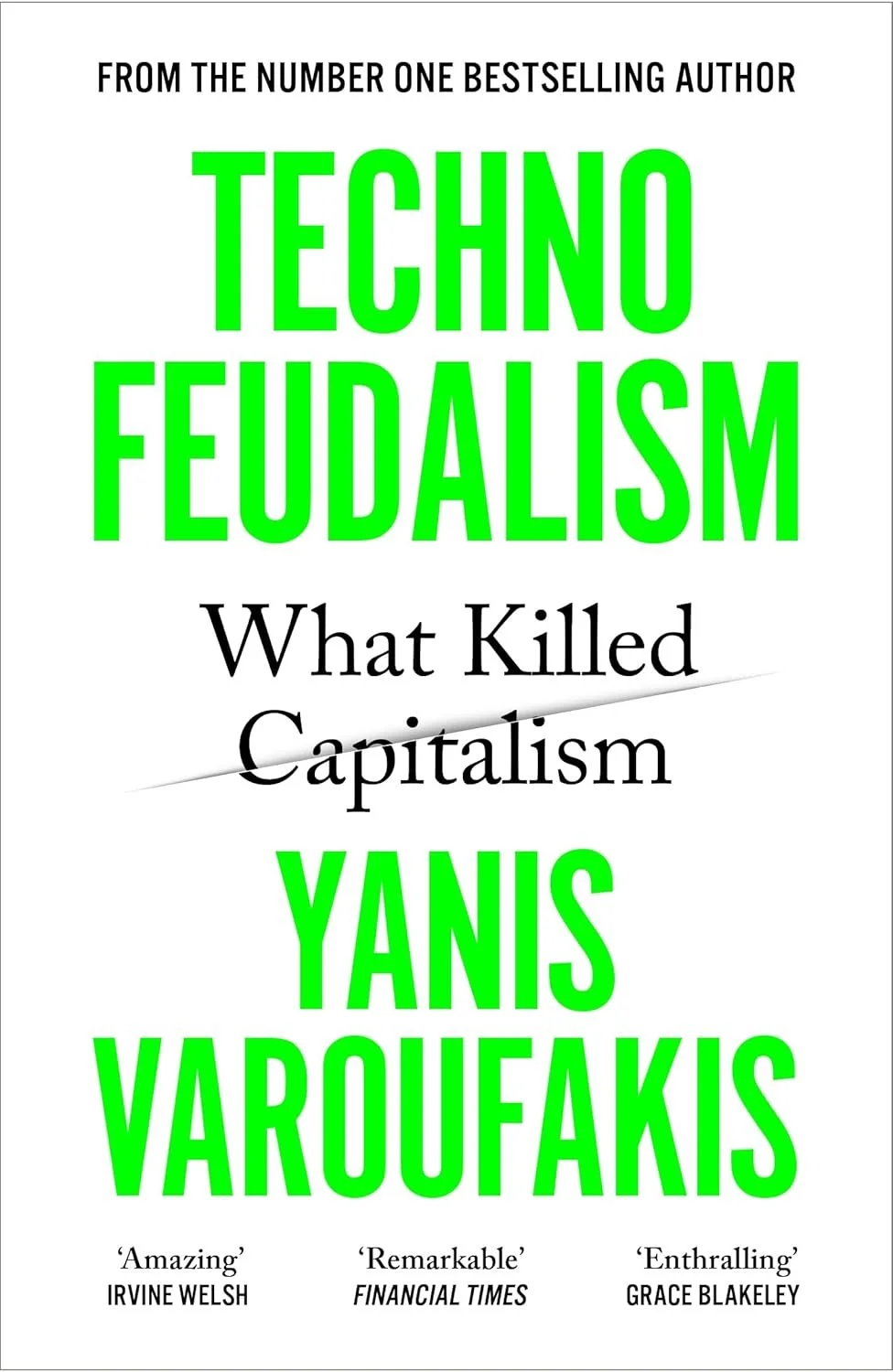
Consider the modern mega-event. The “Smart Stadium” is the laboratory for the perfected surveillance state. Under the guise of “frictionless experience,” the attendee consents to total monitoring. The wristband that acts as your ticket and wallet does not just pay for beer; it tracks your movement, your heart rate (in some “immersive” experiences), and your dwell time in front of sponsor activations. This data is fed into the black boxes of Surveillance Capitalism, creating a “digital twin” of the crowd that allows the Players to predict and modify future behavior. We are not watching the game; we are training the AI. The price of admission is not just the $500 ticket; it is the total enclosure of your privacy. The “Clean Zones” of the World Cup are clean not just of unauthorized brands, but of unauthorized anonymity.
This extraction engine relies on our psychological frailty. Cloud Capitalism has weaponized mimetic desire. We do not just consume the event; we perform it for the algorithm. By broadcasting our presence at the “exclusive” destination, we provide the free labor that markets the experience to our network, generating the Envy that drives the next cycle of consumption. We are working for the platform, unpaid, driven by the status anxiety that the system instills in us. The “Cloudalists”—the owners of the digital platforms—collect rent on this anxiety. They sit between us and the world, demanding a toll (in data or fees) for every social interaction. We are buying back our own lives, pixel by pixel, from the tech oligarchs who have enclosed the commons of human experience.
Finally, we must remember the biophysical reality beneath the digital veneer. This surveillance infrastructure is hungry. It is an energy hog. The predictive algorithms that suggest your next flight or curate your festival feed are running in data centers that drink rivers dry and burn carbon at the scale of nations. The “Cloud” is a misnomer designed to hide the soot. Every “frictionless” tap at a festival terminal reverberates through the supply chain, demanding more lithium for batteries, more water for cooling, and more copper for the grid. We are burning the planet to power the machine that watches us burn it. It is the ultimate absurdity: we destroy the actual world to maintain the digital illusion of a perfect one.
Capital Interlude: The Shapeshifter
Capital is a broad term for valuable resources of all kinds, but it is also a demon that possesses everything it touches. It is the lifeblood of the machine. Look at the inventory of our cage. We have commodities like grain, beans, minerals, oil, coal, gas, trees, fresh water, livestock, fisheries, real estate, land, and so on. But then the ghoul enters the machine, and you’ve got finance capital, physical capital, human capital, social capital, intellectual capital, capital gains, capital bubbles, distressed capital. And in our new era of surveillance, we have data capital, cloud capital, compute capital, and the recursively absurd capital on capital returns on investments in info, etc.
We’ve got capital cities, columns, and letters. It is the architecture of our language, our landscapes, and our fantasies.
To create and manage this leviathan, you need a cast of characters vast enough to populate Dante’s Inferno. You need: Plutocrats, theocrats, autocrats, democrats, bureaucrats, technocrats, board members, chairmen, lawyers, judges, meritocrats, monocrats, gerontocrats, military dictators, and various classes like managerial, professional, upper, middle, lower, working, capitalist, elite, and the ruling class.
These stations of human activity do not appear in nature; they arise from large, hierarchical social systems—kingdoms, empires, and city-states—generally known as Civilizations. These are the arenas where men (primarily) compete vigorously, sometimes viciously, for status and power. They are the engine rooms of the social heat engine.
All of these words describe things we are all familiar with to one degree or another. Right? I mean, they are real to most of us. But they are also Hyperreal. They make up the “superorganism”—super socio-linguistic constructs that impact our lives more than gravity does. We treat “The Market” as a god and “The Law” as physics, forgetting they are social constructs we adhere to for a time, or stories we tell.
The most critical factor these competitors—these Great Game Players—and their armies of service providers depend on is a surplus of resources. They need excess grain, excess energy, excess labor, false scarcity, and arbitrage. And, of course, they need docile populations of faithful believers across all stations of life. You cannot build a pyramid or a data center if the workers realize they are building their own tomb.
So, the Bosses employ artisans, manufacturers, soldiers, trubidores, and storytellers. Their job is to spin the narrative, to help ordinary people understand the “deeper meaning” of sacrificing their lives and health for something bigger than themselves. “For God and Country!” “For Shareholder Value!” “For the Mars Colony!”
Hoorah!
The ultimate goal of the Player is Enclosure: The comprehensive, ongoing process by which capitalist logic privatizes, commodifies, and colonizes every aspect of life, culture, and public space, leaving no room for imagining alternatives. They have to wall in everything so that everything can be commodified, legalized, contracted, owned, and controlled.
This is not an accident; it is by design. It is controlled by insiders who know how social structures are formed and how the institutions that make up the social system work to their benefit. They understand the Code of Capital—how to turn a river into an asset and a citizen into a serf.
But wait, there’s a problem. The Players—the ones supposedly steering this ship—are anti-intellectual, narcissistic, deluded idiots now. Whoops! We have entered the era of the Incompetent Oligarch. Meritocracy has dissolved into nepotism and brain rot. These Players employ legions of service providers who understand the value of the system, capital, status, prestige, pleasure, and the ability to do “God’s Will,” and so on. But the dynamic has shifted. The petty service providers are no longer just helpers; they are the demons on the Players’ shoulders, whispering in their ears and influencing their thoughts. They feed the beast. Why? Because, you know, deep down inside, the Players are incredibly insecure, and the demons want their station. They are trying to fill a spiritual void with the entire material world, and it will never be enough.
***My mother took me to see them in the 70s.
And today, what feels more valuable than food, or even oil, is data (info), all the stuff we provide the companies running ‘AIs’ for free as we produce volumes of content to stimulate our Neurohormones. Someday, the TESCREAL dream story goes, the AGSI Machine Complex (compute) will be able to generate its own data, stories, ideas, and whatnot, so that immortal (oxymoronic) transhuman, formerly organic-meat Players can export the Great Game to the multiverse. The SIM World will be paradise, and we can build the super-intelligent, conscious “beings” that will create it, no need for faith in God.
Food in the future, hopefully, for the TESCREAL, NRx, Accelerationist Bros will be someone else’s galaxy with a Dyson Sphere around it.
Heat death will give way to something else, something that’s always been there. I know, I’ve done psychedelics, and I meditate twice a day.
Was Roy lip-syncing? Say it ain’t so! Analog is retro trad rad!
***I can’t imagine what I’d feel like or be like if I were illiterate and enumerate, if I hadn’t been born relatively privileged and able to get the kind of education that made me interested in educating myself until the day I die. What would my worldview been like if I were a laborer on a Quinta 150 years ago?
Capitalism is War, and War is a Racket

Feduciary Responsibility or Duty
AI Overview
Fiduciary responsibility is a legal and ethical obligation to act in another party’s (a beneficiary’s) best interest, placing their needs above your own, especially concerning money, property, or assets, requiring loyalty, care, prudence, and disclosure of conflicts. Fiduciaries, like trustees, financial advisors, or corporate directors, must manage entrusted assets with high standards of trust and diligence, keeping records and acting with good faith. A breach of this duty can lead to legal penalties.
Fiduciary Duty vs. The Racket
The Double Standard of Duty Fiduciary responsibility is a legal and ethical obligation to act in another party’s best interest. It sounds lofty, ethical, and precise. But to me, in the context of legally coded capitalism, it simply means that Players prioritise profits over everything else. It is the legal shield for sociopathic behavior. And what is the reciprocal duty? We, the people, work, buy things, pay taxes, and die—sometimes in wars the Players start. That’s OUR fiduciary duty. To be the fuel for their engine, and cannon fodder.
Big Tech, Big Oil, the Military Industrial Complex, and Big Biz are all rackets. But they are rackets that we have been trained to live with and need in a pathological, codependent way. We take what crumbs we can get while bumping up a big bit of our income (our “work product,” hehe) to the bosses and the institutions we depend on. It is a protection racket where we pay them to protect us from the very instability they create. And in return, we get to want more stuff and “create” more money through debt, so the rich get richer.
Thank God, you make enough to pay your insurance premiums.
Let’s be clear: Our leaders don’t serve us. They are in the service of those they depend upon for their careers, their status, and their post-political board seats. When you think of industrial cabals paying $300 million annually to lobbyists, how can you be naive enough to believe that your tax dollars are going to teachers, infrastructure, care workers, consumer safety, or public health? The government is not a public utility; it is a service provider for capital.
And, golly gee, throw a dart at a historical timeline of a given place and try to imagine what life was like for your average working person. Life way back then was a meat grinder, in many cases, indeed, nasty, brutal, and short, mean and sickly. We in the West have been pretty fortunate since WWII ended—a blip of anomaly in a sea of suffering. But as this global thing of ours—Modern Techno-Industrial Fossil Fueled, Financialized, Neoliberal/Neoconservative, with or without Socialist Characteristics, Global Capitalist Civilization, or the Pax Americana—winds down, the bill is coming due. If some major event triggers a global disaster (be it God, Science, Engineering, Technology, or the hubris of “Great Men,” or an Alien invasion), it will make WWII look like a wee little skirmish.
Who thinks they’ll make money rebuilding Ukraine? Or Gaza? I mean, the “Greater Levant”? I mean, “Greater Israel”? Whatever. Borders will change; they always have. The Players fight over “OPS” (Other People’s Stuff), and the names are changed to protect the guilty. Chevalerie is gone for good. Kings don’t fight over women anymore. When one Player falls, another takes his place. The script remains the same; only the actors change. Ordinary folks provide the blood and treasure. The Players provide the invoices.
We are all slaves to fashion, whether high or low; we just want to fit in.
It’s tragically ironic when you remember that extinction is the rule. Even billionaires and kings die and rot. These greedy, Seven Deadly Sins-infected heroes create so much unnecessary pain and destruction during their brief, hubristic lives. And where do they wind up? Not composted, returning nutrients to the soil they ravaged and killed. No, they end up in a fancy coffin, or frozen in a cryogenic tank somewhere, waiting for a future that doesn’t want them. Ignominious, isn’t it, not to have one’s immortality? The
We are meant to believe that the Multiverse would be diminished without our captains of industry.
The “West” believes its history consists of one long, epic triumph. One grand enterprise after another. FFS! Look at the ledger. What do Players spend our blood and treasure on? To hell with social services. To hell with minding healthy living systems fit for posterity. Macron needs Oreshnik missiles for France, for his career, for his crypto wallet, so that he can hoard hard assets left over from the Players. It is a racket, folks, and plebs and proles get what they deserve.
Think of the US Defense budget—now magnificently known as the Department of War budget.

Are the Japanese people lining up at JSDF recruiting offices so they can die fighting China, their biggest trading partner? Will Japanese INCELS make good warriors? Does the culture still support the Samurai spirit at scale?
These clowns talk about “Winning!” But look closer. Did the USA lose the Vietnam War? Strategically, yes. But look at who benefited from the expenditure. Did the Soviets lose the Afghanistan War? The Empire collapsed, but the arms dealers did fine. Who benefits from the Great Game? The objective of the racket is to preserve the racket. The war is not meant to be won; it is intended to be continuous. The essential act of war is destruction, not necessarily of human lives, but of the products of human labor so that it can be written off and rescructured/recapitalised. War is a way of shattering to pieces, or pouring into the stratosphere, or sinking in the depths of the sea, materials (capital) which might otherwise be used to make the masses too comfortable, and hence, in the long run, too intelligent, which would destroy faith in the Game.
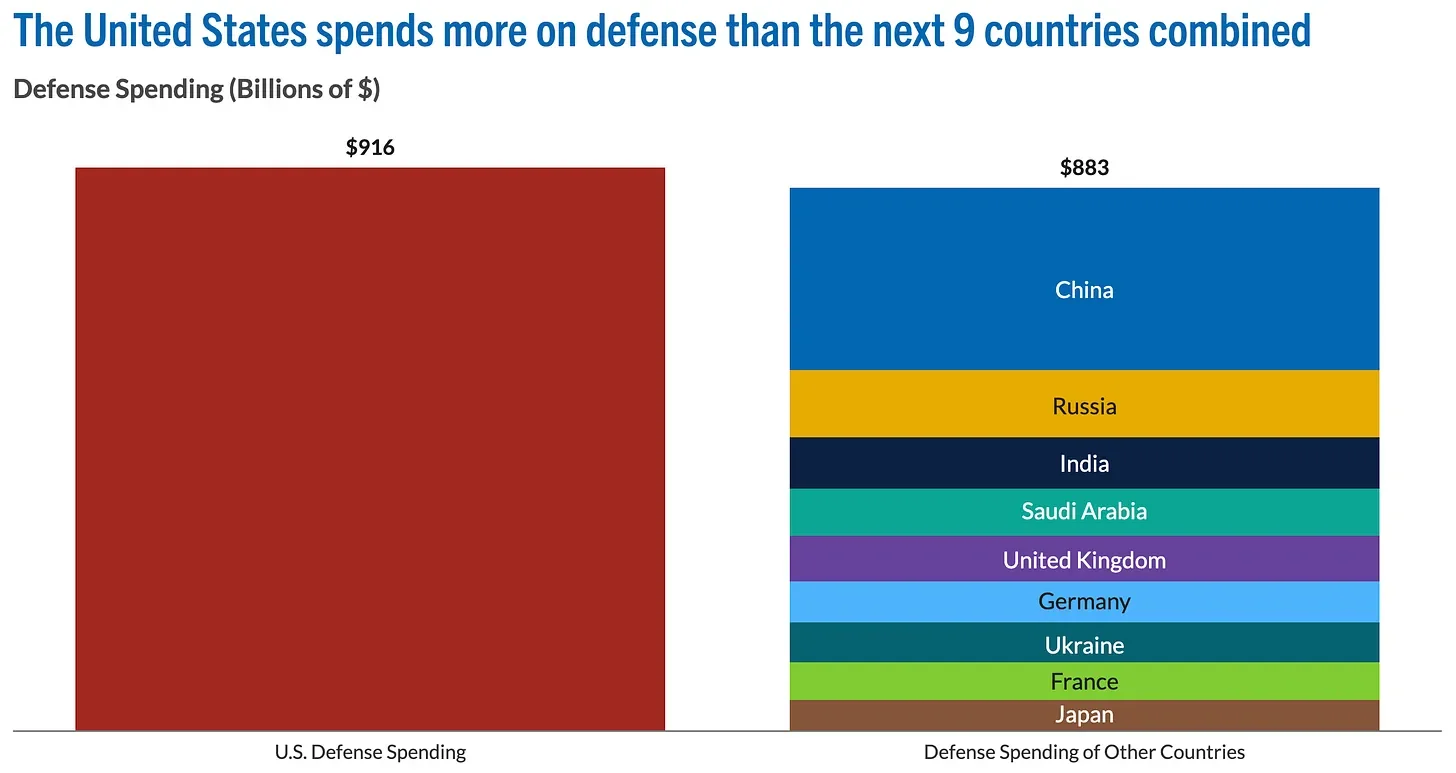
***Not Too Long Didn’t Read (TLDR)—come on now, hang in there.
Interlude: A Walk in the Forest
TLDR—Not Too Long; Please Read
Take your time with this post. If I sound snarky at times, forgive me; it is just a way for me to blow off steam in the face of absurdity. But I ask you to engage deeply. Check out the hyperlinks. Watch the videos. I continue to meander a bit because we live in a world where everything is connected. A linear narrative cannot capture a non-linear system. So, let’s take a broad view while sometimes zooming in on fine-grained details.
Look at and listen to everything. Behold the living world of complex, evolving ecosystems, filled with hidden secrets that will never be revealed to a spreadsheet, but only to the soul. Listening to Nature, it’s marvelous, even if you don’t fully understand what you hear. In fact, sitting with the mystery of the Nature surrounding you is the first step toward wisdom.
I urge you to invite friends to delve into the Overshoot, Collapse, and Limits-to-Growth (OCLTG) perspective—call it Systems Realism, or whatever you like—especially if they are unaware of it.
OCLTG may seem like a strange or exotic topic to the uninitiated, but no one living today can avoid it for much longer. Reality is coming for us all. Too many Boomers like me think these subjects are taboo. We hide behind a fragile shield of optimism: “My kids went to college, they are independent, and they will build their own future. They will find solutions. People always have.” Indeed, younger people carry the burden. But it is a dereliction of duty to hand them the heavy lifting without even giving them the best “How To Manual” we can.
I am a member of a small, vibrant community interested in Biophysical Reality. We are obsessed with scientific inquiry, Great Nature, Living Systems, and the human spirit—the vim, vigor, verve, vitality, creativity, imagination, and love required to face this moment and maintain relationships with each other and to whatever degree we can, with Great Nature. We explore psychology, politics, economics (the real kind), sociology, history, deep time, and the future. We are a motley crew. Some of us have been concerned with these topics for decades. The community includes artists, musicians, teachers, scientists, technologists, engineers, professionals, and consultants working with major global corporations. It includes ex-military personnel, journalists, Wall Street bankers, and traders. And it consists of those from more humble backgrounds, like Moi. Some can afford to indulge in splendid detail in the overshootology/collapsology/limits-to-growth hobby. Some compete for attention, subscribers, and cups of coffee to fund their research and work. I refer to much of their work here and on my social media platforms.
Follow me at (@buliamti.bsky.social)
I offer you a warning and a promise: Once one has ventured into OCLTG and become acquainted with its advocates, it is impossible to leave. You won’t want to turn away. You cannot un-see the systems at work. Escape from this worldview is oddly undesirable; the truth, however heavy, is grounding. It makes you sane. Regardless of your reaction after giving these domains some time, you will never look at the world without these subjects influencing how you see everything in it.
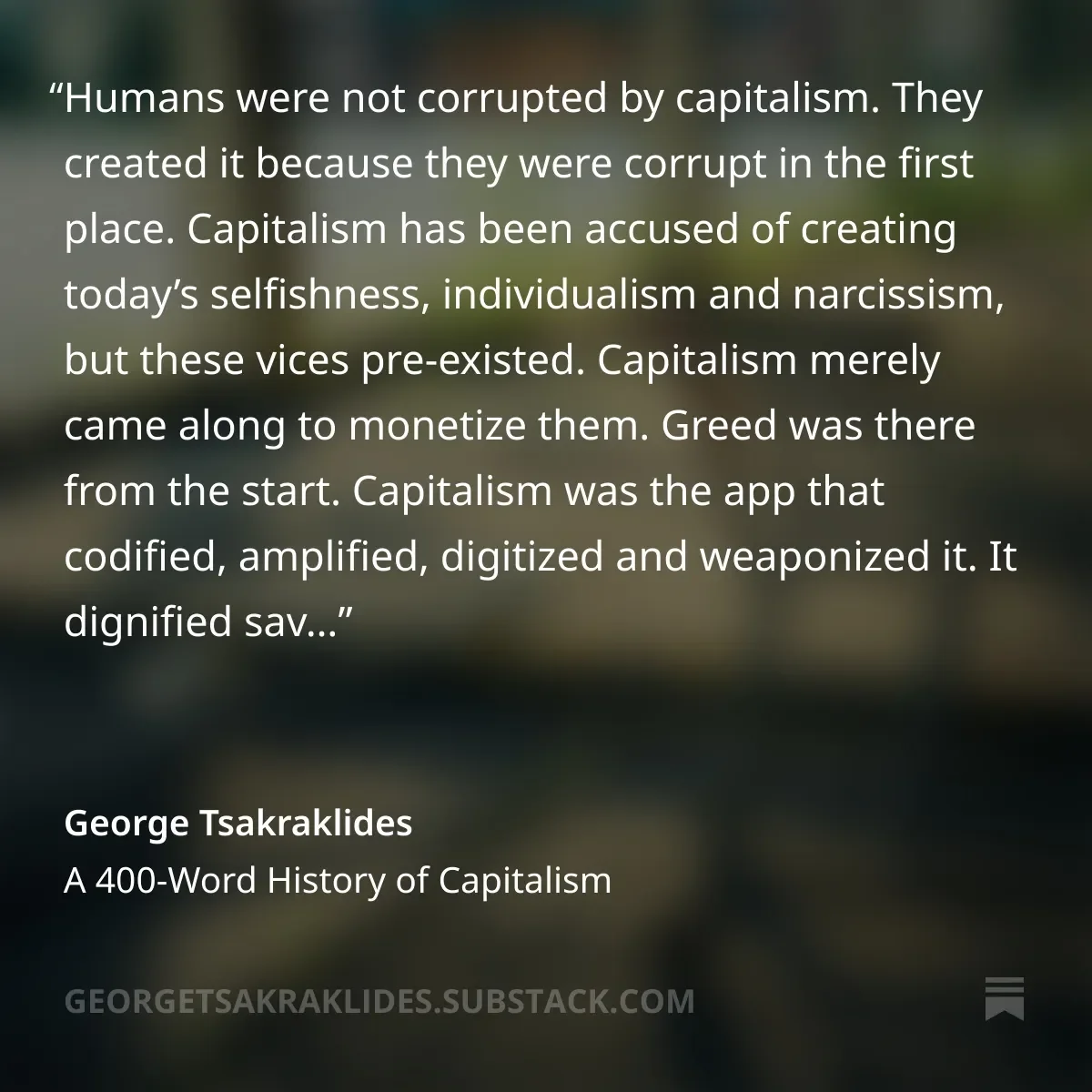
A systems thinking teaser.
“The real problem of humanity is the following: We have Paleolithic emotions, medieval institutions, and godlike technology. And it is terrifically dangerous, and it is now approaching a point of crisis overall.” ―Edward O. Wilson
“A system is never the sum of its parts; it’s the product of their interaction.”
“Remember, always, that everything you know, and everything everyone knows, is only a model. Get your model out there where it can be viewed. Invite others to challenge your assumptions and add their own.”
“The system, to a large extent, causes its own behavior! An outside event may unleash that behavior, but the same outside event applied to a different system is likely to produce a different result.”
“Addiction is finding a quick and dirty solution to the symptom of the problem, which prevents or distracts one from the harder and longer-term task of solving the real problem.”
“We can’t impose our will on a system. We can listen to what the system tells us, and discover how its properties and our values can work together to bring forth something much better than could ever be produced by our will alone.”
“Emergence notices the way small actions and connections create complex systems, patterns that become ecosystems and societies.”
“A bad system will beat a good person every time.”
“All things appear and disappear because of the concurrence of causes and conditions. Nothing ever exists entirely alone; everything is in relation to everything else.”
— The Buddha
“Listening to both sides of a story will convince you that there is more to a story than both sides.”
“For every complex problem there is an answer that is clear, simple, and wrong.”
“If you do not understand your role in the problem, it is difficult to be part of the solution.”
“Emergence is the outcome of the synergies of the parts; it is about non-linearity and self-organization, and we often use the term ‘emergence’ to describe the outcome of things interacting together.”
“Yet we act as if simple cause and effect is at work. We push to find the one simple reason things have gone wrong. We look for the one action or the one person who created this mess. As soon as we find someone to blame, we act as if we’ve solved the problem.”
“Systems thinking is a discipline for seeing wholes. It is a framework for seeing interrelationships rather than things, for seeing ‘patterns of change’ rather than ‘static snapshots.”
“The fundamental delusion of humanity is to suppose that I am here and you are out there.”
—Yasutani Roshi
“When we help another, we are helped. If we harm another, we harm ourselves. Perhaps harder to grasp—if we harm ourselves, we harm the whole universe.”
“Human beings, viewed as behaving systems, are quite simple. The apparent complexity of our behavior over time is largely a reflection of the complexity of the environment in which we find ourselves.”
“Emergence of ever more complex structures seems to be programmed into the nature of our evolving cosmos.”
― Alex M. Vikoulov
“Dangers lurk in all systems. Systems incorporate the unexamined beliefs of their creators. Adopt a system, accept its beliefs, and you help strengthen the resistance to change.”
― Frank Herbert
“Movements are born of critical connections rather than critical mass.”
Video Break
This video relates to my concerns about capitalism.
***We must know what happened.
The Revolution Will Not Be Televised (Or Tweeted)
We must know what is happening to us. We are corralled into digital pens, seduced by the blue light, and convinced that “posting” is “acting.” But we need to remember where power actually lives. We need to go back, back to bookstores, libraries, churches, meeting rooms, town halls, parks, public squares, outdoor restaurants, and pubs. We need to reclaim all public spaces that our device screens have distracted us from. The algorithm wants us isolated, scrolling, and clicking; the community needs all of us present, listening, speaking, and ready for action.
The revolution does not take place in a comment section. It takes place shoulder to shoulder, face to face, eye to eye. It happens intimately, with great care, devotion, and sacrifice. You cannot build trust with an avatar. You cannot smell the fear or the resolve of a comrade through a fiber optic cable. Real solidarity is biological; it requires the pheromones of shared effort and the resonance of a human voice in a physical space.
So, get out under the sun and beneath the moon, and get busy. The Players won’t give you power. Why would they? Their power depends on your passivity. They count on you being too distracted by the spectacle to organize and fight back. If you want to be a responsible, free agent, you have to take their power. And you don’t get it by asking nicely or by winning a Twitter debate. You take it by building parallel structures of support, food, and care that make their institutions obsolete. You take it by knowing what must be done with it—not to dominate, but to plant the corn and prepare for when the rains don’t come. If you are “good company,” you are blessed. If you have people to stand with in the flesh, you are already winning.
Music Break
I met Gil when he performed in Shibuya, Tokyo, in the 90s. After the performance, I talked with him, and he came out with me and some friends, ending up back at my apartment. He was such a down-to-earth man. He felt like an old friend.

The OCLTG community is a safe place where one is quietly appreciated for giving a shit. It’s full of people who make me feel good. People who care are kind.
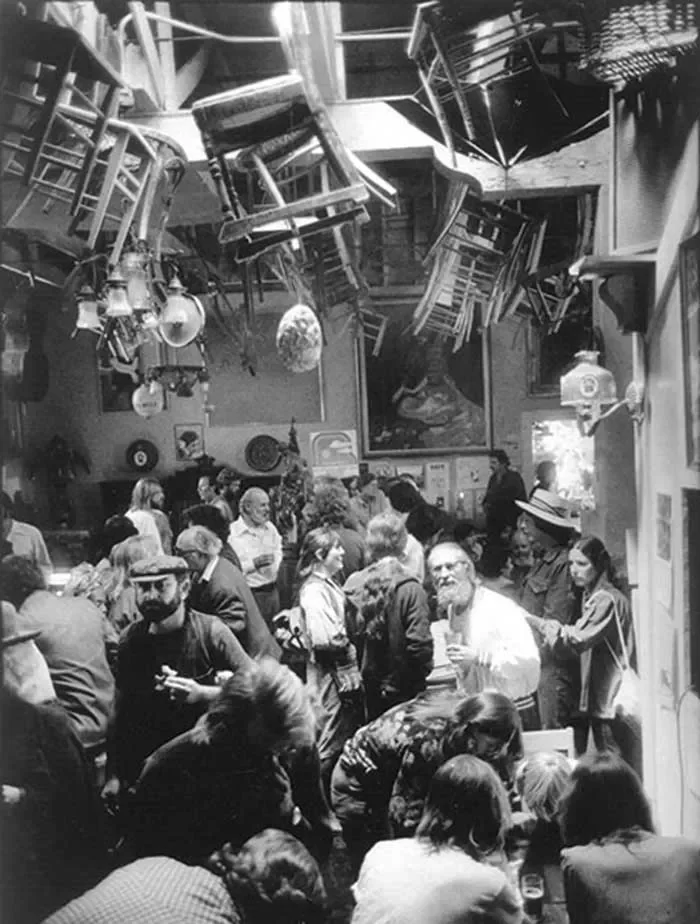
***An old haunt: The Old Spaghetti Factory
“The maximum accumulation of energy allows maximum reproductive output, which is, after all, what natural selection is based on.” — Charles A.S. Hall
Our guest this week was born in 1943, in what was then British India - modern-day Pakistan. Unlike most, who have learned history through books and second-hand sources, he has witnessed firsthand much of the 20th and 21st centuries.
Tariq Ali founded Verso Books, the leading left-wing publishing house in Britain, and the New Left Review. He met Malcolm X, was friends with John Lennon and Hugo Chavez, and spearheaded the anti-Vietnam War movement.
In conversation with Aaron Bastani, this week on Downstream, we are talking about the ways we remember - and misremember - the 20th century, and how these events have a long tail that shapes our present and future.
How significant was the Cultural Revolution in China in sparking anti-colonial struggles across Asia? How do the dynamics of the Cold War still dominate the mainstream media? And who are the substantial political figures and ideologies set to dominate the next decades of the 21st century?
War, Overshoot, Collapse, and Limits to Growth are closely tied to Capitalism, whose history predates the word Capitalism.
Most think of modern conveniences when thinking of “the capitalist system.” The historical, immediate, and long-term costs of “the good life” for a minority of Europeans and North Americans don’t cross our minds. “The Triangular Trade,” revolutions, collapse, overshoot, “externalities”, and ecocide; the constant consequences of extractive, patriarchal, hierarchical, avaricious status-competition have been brutal.
It’s difficult for people in the Global North to imagine the conditions under which most workers labor.
The “Circular Trade,” more commonly known as the Triangular Trade, was a brutally efficient economic machine that treated human life, living systems, raw resources, and manufactured goods as interchangeable units of capital. The cycle typically began in English ports like Liverpool or Bristol, where ships were loaded with textiles, firearms, and spirits to be exchanged in West Africa for enslaved people. These captives were then transported across the horrific “Middle Passage” to the plantation colonies of the Americas—including British Jamaica and competing Spanish territories like Hispaniola (Española, present-day Dominican Republic and Haiti)—where they were traded for sugar, tobacco, cotton, and silver. This system was not a peaceful open market but a militarized zone of zero-sum competition. Because European powers adhered to Mercantilism—the belief that global wealth was fixed—nations like England felt justified in using state-sanctioned piracy (“privateering”) to bleed their rivals. English privateers would routinely raid Spanish treasure fleets or smuggle goods into Spanish Española to undermine Madrid’s monopoly, viewing these acts of aggression not as crimes, but as essential patriotic duties to balance the national ledger.
Mercantilism was a dominant economic nationalism theory in Europe from the 16th to the 18th century that aimed to maximize state power by increasing exports, restricting imports via tariffs, and accumulating gold and silver. This “zero-sum” system viewed wealth as finite, promoting colonial expansion to supply raw materials while acting as exclusive markets for the mother country’s manufactured goods.
Intellectually, this violence was buttressed by the “enlightened” philosophy of the era, which provided a sophisticated legal and moral cover for the atrocities. John Locke, often hailed as the father of liberalism, famously rationalized slavery in his Second Treatise of Government by redefining it not as oppression, but as a “state of war” continued; he argued that captives taken in a “just war” had forfeited their lives and thus could be enslaved as a form of mercy. This legal loophole allowed him to invest in the Royal African Company and draft the Fundamental Constitutions of Carolina—which enshrined the absolute power of masters—while still championing “liberty” for Englishmen. Similarly, the economic worldview of the time (which Adam Smith would later analyze and critique, though contemporaries often cited him to justify the “natural liberty” of the market) viewed the world through the lens of “improvement.” The seizing of indigenous lands and the forced labor of Africans were rationalized as necessary steps in bringing “unproductive” resources into the fold of civilized commerce, transforming the brutality of empire into a moral imperative of progress and productivity.
The Luddites
The Luddite movement (c. 1811–1816) is one of history’s most misunderstood labor struggles. Contrary to the popular myth that they were anti-technology “simpletons” terrified of progress, the original Luddites were highly skilled artisans—weavers, knitters, and croppers—who destroyed machinery not because they didn’t understand it, but because they understood exactly how it was being used against them. Their target was “machinery hurtful to commonality”: specifically, wide stocking frames and shearing machines that allowed factory owners to bypass established labor standards, churn out inferior “cut-up” goods, and employ unskilled children at starvation wages. The movement was a sophisticated form of collective bargaining by riot; when negotiations for a minimum wage and standard practices failed, they smashed the specific machines that facilitated their exploitation. The British government’s response was brutal and decisive, deploying 12,000 troops—more than were fighting Napoleon in the Iberian Peninsula at the time—and making frame-breaking a capital offense, effectively crushing the movement by executing or exiling its leaders to Australia.
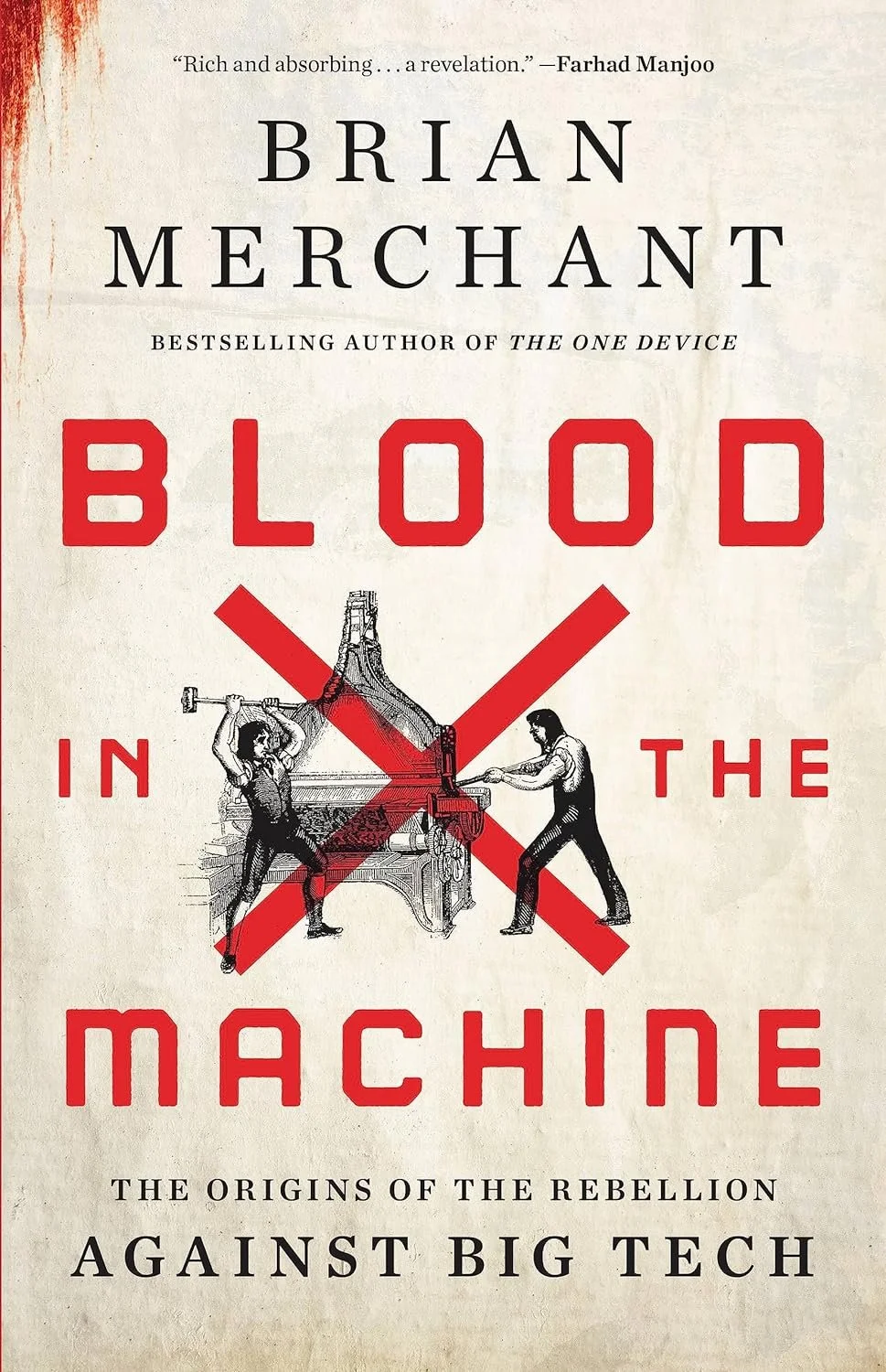
The most urgent story in modern tech begins not in Silicon Valley but two hundred years ago in rural England, when workers known as the Luddites rose up rather than starve at the hands of factory owners who were using automated machines to erase their livelihoods.
The Luddites organized guerrilla raids to smash those machines—on punishment of death—and won the support of Lord Byron, enraged the Prince Regent, and inspired the birth of science fiction. This all-but-forgotten class struggle brought nineteenth-century England to its knees.
Today, technology imperils millions of jobs, robots are crowding factory floors, and artificial intelligence will soon pervade every aspect of our economy. How will this change the way we live? And what can we do about it?
The answers lie in Blood in the Machine. Brian Merchant intertwines a lucid examination of our current age with the story of the Luddites, showing how automation changed our world—and is shaping our future.
Today, economists and historians like Brian Merchant (author of Blood in the Machine) and Daron Acemoglu are actively speculating that we are on the brink of a Neo-Luddite moment, driven by a similar collision of inequality and technological displacement. The modern parallel to the “shearing frame” is Generative AI and the “gigification” of the workforce, which threatens to devalue skilled cognitive labor (writers, coders, artists) much like industrial looms devalued weavers. The “speculation” here centers on the breaking of the social contract: just as the Luddites faced a “reskilling trap”—where their decades of mastery were rendered worthless overnight—modern workers are experiencing “change fatigue,” forced to retrain for new tools only to see wages stagnate constantly and workloads rise (we still have to check the Machine’s work) while corporate profits (and prices) soar. Experts argue that a modern Luddite movement wouldn’t necessarily look like people smashing servers with hammers, but would manifest as aggressive unionization, “sabotage” through quiet quitting, or legislative warfare to demand that the gains of automation are shared rather than siphoned to the top.
The modern “circular trade” driving the AI boom is a sophisticated financial feedback loop that functions much like the vendor-financing schemes of the dot-com era, but on a massive, industrialized scale. In this closed system, hyperscalers (such as Microsoft, Amazon, and Google) and chipmakers (such as Nvidia) pour billions of dollars into AI startups (such as OpenAI, Anthropic, and CoreWeave). However, this capital rarely leaves the ecosystem; it is often granted as “cloud credits” or strictly earmarked for hardware purchases. The startup then immediately sends that money back to the investor to rent servers or buy GPUs. For the tech giant, this “round-tripping” of cash allows them to book their own investment capital as revenue, inflating their growth numbers to impress Wall Street and boosting their stock price. This creates a disconnect between financial valuation and actual economic value, as the same dollar circulates between the giant and its satellite entities, generating “growth” without necessarily providing broad-based utility or wages for the broader economy.
The specific structure of deals involving companies like Oracle and sovereign cloud entities reveals the fragility of this debt-fueled expansion. Oracle, for instance, has used “off-balance-sheet” financing to fund massive data center projects (such as the proposed “Stargate” supercluster). By partnering with private equity firms (such as Blue Owl, though recent reports suggest cracks in these partnerships) to front the construction costs, Oracle avoids taking the massive debt directly onto its own books. Meanwhile, chip companies like Nvidia may prioritize allocation to “neoclouds” (like CoreWeave) that use Nvidia chips as collateral to secure billions in debt to buy more Nvidia chips. This financial engineering allows the oligarchs to innovate their way around market saturation, effectively printing their own demand. The outcome is a hyper-financialized infrastructure that benefits a tiny class of asset owners—those holding equity and debt—while the labor market faces a modern “Engels’ Pause,” in which productivity gains from AI are captured by capital rather than trickling down as wages.
Historically, this mirrors the brutal efficiency of the Atlantic Triangular Trade, but the commodities have shifted from bodies and sugar to attention, data, and energy. Just as the 18th-century trade treated human life as a raw material to be exhausted, the AI trade treats human attention and creative output as a free resource to be scraped, processed, and monetized. The “enslavement” is subtler—mediated by neurohormone cocktail loops and algorithmic curation rather than chains—but it is similarly extractive. We willingly labor for the network by training models with our data, yet we are alienated from the value we create. Furthermore, this digital trade is undergirded by physical violence and “resource wars” over the critical minerals (lithium, copper) and water required to cool the data centers. We are hitting hard thermodynamic limits; the energy needed to “reason” or generate video is exponentially higher than for traditional search, leading to a resurgence of fossil fuel use and water stress that disproportionately affect local communities, not global or Silicon Valley shareholders. The “circus” of generative AI thus serves to distract from the reality that the physical world is being hollowed out to sustain the asset prices of the digital one.
Engels’ Pause is a term coined by economic historian Robert Allen to describe the period in Britain roughly between 1790 and 1840, during the heart of the Industrial Revolution. It describes a specific disconnect: while British GDP and corporate profits soared due to new technologies (steam engines, textile mills), the real wages of the working class remained completely flat or even declined. For fifty years, the gains of efficiency did not “trickle down”; they were captured almost entirely by capital owners who reinvested them into more machinery. The “pause” ended only when the surplus labor pool (drained from the countryside) finally dried up, forcing employers to raise wages to compete for workers and eventually linking productivity to pay once again.
However, the assumption that we will always “exit the pause”—that technology will eventually create enough abundance to raise everyone’s standard of living—rests on the premise of infinite material expansion. This is where the limits of technological progress come into play. Critics argue that the 19th-century escape was fueled by the one-time unlocking of cheap, dense fossil fuels and the colonization of “new” land—resources that are finite. If we are entering a new Engels’ Pause today (driven by AI and automation), we may hit a hard ceiling: thermodynamic and material limits. You cannot “print” lithium, water, or arable land. If the cost of extracting energy and resources (EROI) continues to rise, technology cannot simply “innovate” its way out of the fundamental physics of a finite planet. In this scenario, the economic pie stops growing entirely, meaning the “pause” in wage growth could become a permanent stagnation, where wealth concentration is not a temporary investment phase, but a fixed feature of a resource-constrained world.
The “energy debt” accumulating on the balance sheets of these technology giants is the physical collateral for their digital speculation. While the financial “circular trade” inflates stock prices, the underlying infrastructure is running up a massive deficit in real-world resources—specifically, firm, 24/7 baseload power that the current grid cannot supply. This “debt” is visible in the desperate scramble to secure gigawatts of electricity to power future iterations of models like GPT-5 or Gemini, which require exponential increases in compute. Just as financial debt borrows from future earnings, this energy debt borrows from the future stability of the electrical grid and the environment. These companies are effectively shorting the public utility infrastructure, betting that they can extract massive amounts of power for private gain before the grid creates a hard ceiling on their growth or public backlash freezes their expansion.
To sustain the “illusion of infinite growth” against the hard reality of intermittent renewables (wind and solar can’t run a data center at 99.999% uptime), the oligarchy is attempting a pivot to nuclear power. This is not a gradual transition but a panicked acquisition of sovereign-grade energy assets. Microsoft has inked a deal to restart the Three Mile Island nuclear plant—a site synonymous with disaster, now rebranded as the engine of AI. Amazon has purchased a data center campus directly connected to the Susquehanna nuclear station to bypass the public grid entirely. Google is investing in Small Modular Reactors (SMRs) through Kairos Power. This pivot reveals the truth: “AI” is not software; it is heavy industry. By capturing nuclear capacity, these firms are trying to privatize the only energy source dense enough to breach the “thermodynamic limits” of their own business model, effectively turning themselves into nation-states with their own independent power supplies while the rest of the economy faces rising rates and brownouts.

Bolatta Silis Hoegh Greenland Uagut Us 2021
What do you suppose the PayPal mafia wants with Greenland and Iceland? Energy. Minderals. Land for datacenters.
Land does not dream of being owned. People dream of being free.
Ask Aqqaluk Lynge, a Kalaallit poet, politician, and defender of Inuit rights, who wrote in his poem ‘A Life of Respect’:
On maps of the country
We must draw points and lines
to show we have been here –
and are here today,
here where the foxes run
and birds nest
and the fish spawn.You circumscribe everything
demand that we prove
We exist,
that We use the land that was always ours,
that We have a right to our ancestral lands.And now it is We who ask:
By what right are You here?

Ultimately, this thermodynamic wall exposes the fallacy of the entire project. There is a physical limit to how efficient chips can get (known as the Landauer limit), meaning you cannot simply “code” your way out of heat generation and energy consumption. As the energy cost of “reasoning” climbs, the return on investment diminishes—a phenomenon that mirrors the “diminishing returns” of complexity in collapsing societies. We are witnessing the diversion of civilization-scale resources—water, uranium, and grid capacity—away from human needs (heating, transport, manufacturing) and into the “furnace” of generative AI. The result is a privatized energy abundance for the few, used to train models that extract value from the many, all while generating radioactive waste and thermal pollution that the public will be left to manage long after the stock buybacks end.
The “water debt” accumulating in the ledger of the AI boom is a hydrological deficit that is arguably more immediate and lethal than the energy crisis. While energy can theoretically be generated from renewable sources, the water required to cool these hyperscale facilities is a finite, location-specific resource that cannot be “scaled” or printed. This debt is incurred through consumptive use: most data centers utilize evaporative cooling towers that take potable drinking water—often the same quality used for human consumption—and vent it into the atmosphere as steam to keep servers from melting. This process effectively permanently removes water from the local watershed. In drought-stricken regions like the American Southwest, Chile, and Spain, this creates a direct, zero-sum competition between the “cloud” and the ground, where the water required to train a single large language model could otherwise irrigate acres of crops or sustain a small town for a year.
The conflict is already playing out in specific “sacrifice zones” where data centers are cannibalizing the agricultural base.
In Arizona, specifically in municipalities like Mesa, tech giants have negotiated secretive deals to secure guaranteed water rights, effectively sticking a “giant soda straw” into the same aquifers relied upon by alfalfa and cotton farmers. While residents face strict conservation mandates, these facilities are often guaranteed millions of gallons daily to maintain 99.99% uptime.
In Uruguay, public outrage forced Google to reconfigure a planned data center after it was revealed the facility would consume a massive percentage of the daily drinking water supply in a region suffering its worst drought in 74 years.
In Spain (Aragon), Amazon’s massive expansion is competing directly with corn farmers for the Ebro river basin’s dwindling resources.
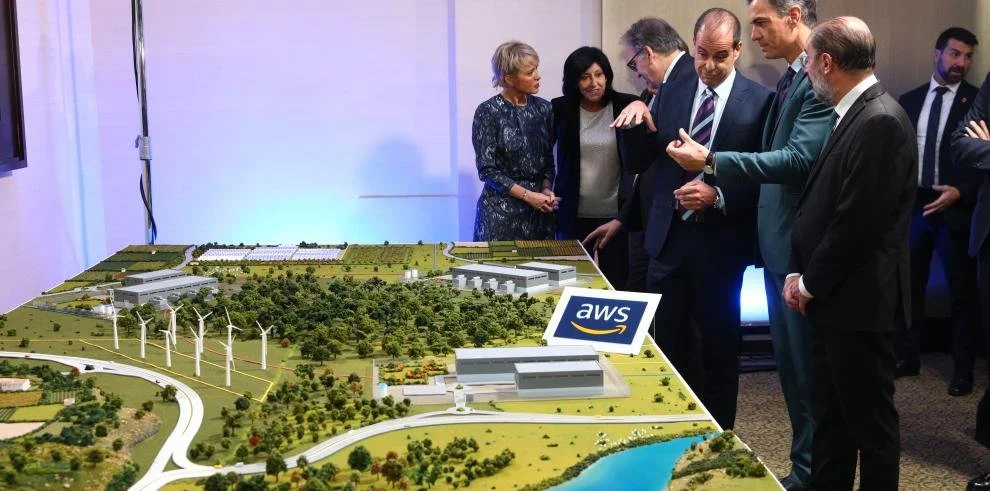
This dynamic represents a privatization of the water commons, transferring a life-sustaining resource from the public trust to private shareholders. The “debt” here is the borrowing of stability from local ecosystems to subsidize global digital services. When a drought intensifies, a farm can be fallowed, but a data center cannot be turned off without breaching service-level agreements and crashing the stock price. Consequently, in a water-constrained future, the legal contracts signed by these corporations often prioritize cooling servers over watering crops, creating a scenario in which local food security is sacrificed to maintain the “compute” capacity of the global north is not just an environmental issue but a transfer of wealth in its most liquid form—freshwater—from rural communities to the digital oligarchy.
The term “capitalism” was coined by French socialist Louis Blanc in 1850, defining it as the “appropriation of capital by some to the exclusion of others,” and it was initially used pejoratively by anti-capitalists before entering wider use.
Vladimir Ilyich Ulyanov, Vladimir Lenin
***I know, a Russian, a Communist, but bear with me.
What happened last time the U.S., Britain, and Germany tried to control Russia?
The video is a pretty good review of the history of the Russian Civil War. What will the outcome be this time in the context of Overshoot and the Polycrisis?
Russia collapsed into civil war after the 1917 Revolution, plunging the former empire into chaos, famine, and violence. The Bolsheviks faced foreign intervention, internal rebellion, and a patchwork of rival armies—yet emerged victorious against seemingly overwhelming odds. How did the communists manage to win such a brutal and complex conflict? In this video, we break down the key factors behind the Bolshevik victory—from organization, ideology, and control of Russia’s core regions to the failures and divisions of their enemies. We’ll explore how the Reds turned revolution into power, why the Whites never unified, and how the outcome of the civil war reshaped Russia—and the world—for decades to come.
One of the most profound and frequently cited passages by Vladimir Lenin concerning the nature and evolution of capitalism comes from his 1916 work, Imperialism, the Highest Stage of Capitalism.
Lenin analyzes how “free market” capitalism inevitably tends toward monopoly. Zero to One, baby! It’s considered prescient by historians and economists of various stripes because it accurately identifies a central paradox of the modern economy: production becomes increasingly interconnected (global supply chains, mass data, cooperative labor), yet the ownership and profit remain strictly private.
From “Imperialism, the Highest Stage of Capitalism”
“Competition becomes transformed into monopoly. The result is immense progress in the socialisation of production. In particular, the process of technical invention and improvement becomes socialised.
This is no longer the old free competition between manufacturers, scattered and out of touch with one another, and producing for an unknown market. Concentration has reached the point at which it is possible to make an approximate estimate of all sources of raw materials (for example, the iron ore deposits) of a country and even, as we shall see, of several countries, or of the whole world. Not only are such estimates made, but these sources are captured by gigantic monopolist associations. An approximate estimate of the capacity of markets is also made, and the associations ‘divide’ them up amongst themselves by agreement. Skilled labour power is monopolised, the best engineers are engaged; the means of transport are captured—railways in America, shipping companies in Europe and America.
Capitalism in its imperialist stage leads directly to the most comprehensive socialisation of production; it, so to speak, drags the capitalists, against their will and consciousness, into some sort of a new social order, a transitional one from complete free competition to complete socialisation.
Production becomes social, but appropriation remains private. The social means of production remain the private property of a few. The general framework of formally recognised free competition remains, and the yoke of a few monopolists on the rest of the population becomes a hundred times heavier, more burdensome and intolerable.
[...]
When a big enterprise assumes gigantic proportions, and, on the basis of an exact computation of mass data, organises according to plan the supply of primary raw materials to the extent of two-thirds, or three-fourths, of all that is necessary for tens of millions of people; when the raw materials are transported in a systematic and organised manner to the most suitable place of production, sometimes hundreds or thousands of miles; when a single centre directs all the consecutive stages of processing the material right up to the manufacture of numerous varieties of finished articles; when these products are distributed according to a single plan among tens and hundreds of millions of consumers... then it becomes evident that we have socialisation of production, and not mere ‘interlocking’; that private economic and private property relations constitute a shell which no longer fits its contents, a shell which must inevitably decay if its removal is artificially delayed, a shell which may remain in a state of decay for a fairly long period... but which will inevitably be removed.”
Lenin observes that while capitalists intellectually champion “individualism” and “chaos,” their businesses actually strive for rigid planning, massive organization, and centralization. They create a “social” structure of production in which everyone depends on everyone else, and “governance” serves the Players.
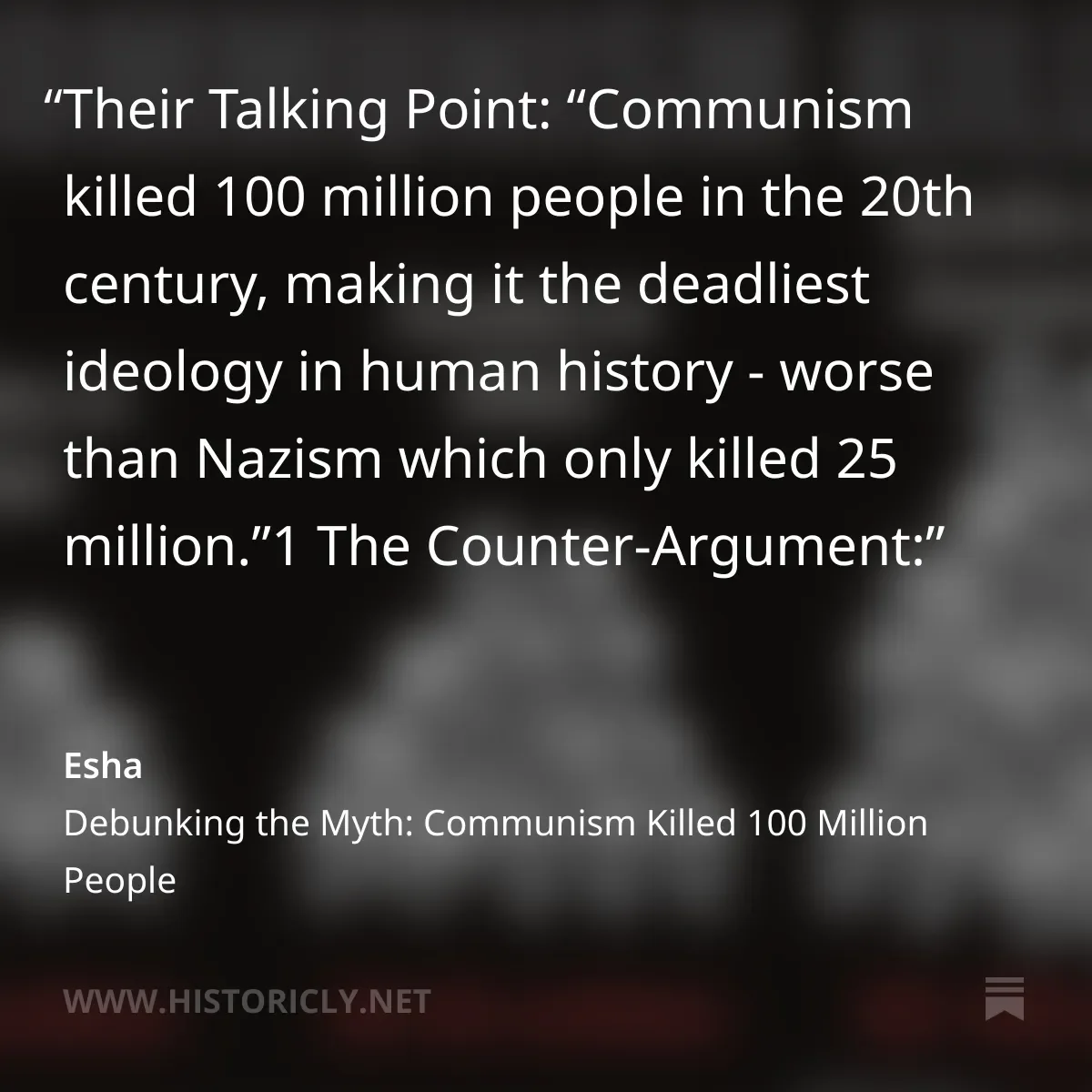
The New Left and the Professional Managerial Class
Professional-Managerial Radicalism in Portugal, 1976
OR
The Managerial Revolution: What is Happening in the World
Oswald Spengler, The Decline of the West, Form and Actuality
Contradictions are never resolved.
Why?
If they were, the Great Game would end.
John A. Hobson’s Theory of Imperialism (1902) argues that the “taproot” of imperial expansion is not nationalist pride but a capitalist oligarchy’s need to find new markets and profitable investments for surplus capital. He contended that income inequality and underconsumption at home forced elites to seek foreign outlets, making imperialism an economically driven, unnecessary, and immoral policy.
Lenin argues that the economic reality (thousands of people working together in a highly organized global chain) has outgrown the legal reality (one person or board owning the profit). He predicts that this “shell” (private ownership) will eventually crack because it restricts the system’s potential.
The passage was written in 1916, the description of “exact computation of mass data” and global supply chains anticipates the modern era of multinational corporations, big data, and globalization with striking accuracy.
Westerners are supposed to hate and fear Russians. But if you want even a little bit of critique of capitalism, Lenin will do.
Marx, in a post-truth, post-intellectual, post compassion & empathy world, is viewed by many as a Satanic demon from the past, or a WOKE professor possessed.
***People don’t read enough.
Fear the history if you must, but those Bolshevik revolutionaries were intelligent and committed.
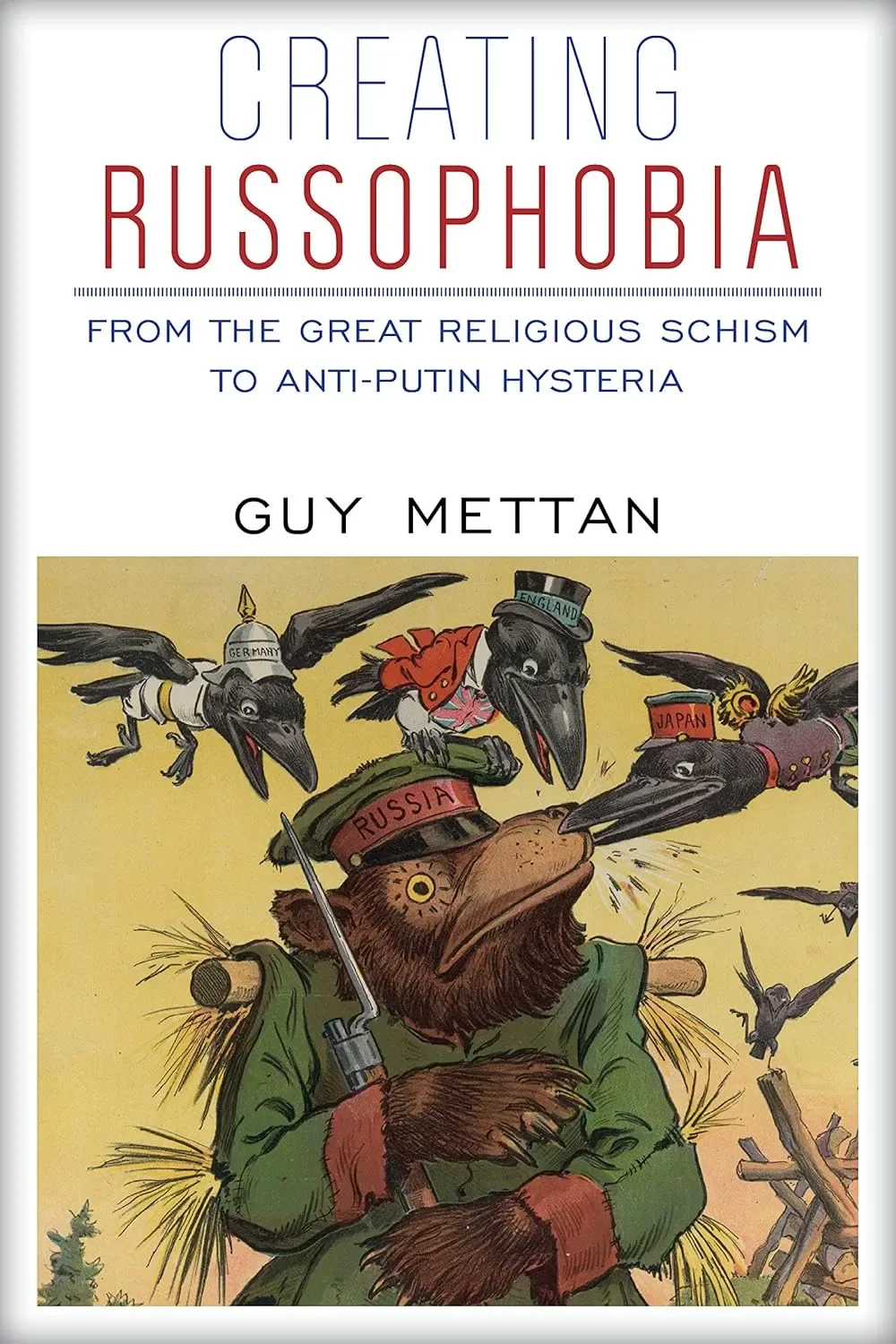
***There are libraries of studies, academic papers, and books on the subject of Capitalism.
Some of my book recommendations.
***I am not an expert in sociology, philosophy, political science, Marxism, economics, history, or any other related field, but I enjoy reading nonfiction and having conversations about these topics, and occasionally writing about them.
Social Constructs & Capitalism
People say “capitalism” is just a word, that these ideas are just words, that these concepts are just social constructs, or that capitalism may be a corrupt, imperfect system, but it’s better than all the rest.
Capitalism is the worst economic system, except for all the others that have been tried.
In a 1938 letter, Churchill wrote, “We seem to be very near the bleak choice between War and Shame. My feeling is that we shall choose Shame, and then have War thrown in a little later on, even more adverse terms than at present.”
Churchill described a fellow politician as possessing “the gift of compressing the largest number of words into the smallest amount of thought.”
In a speech to the House of Commons on November 11, 1947, Churchill observed: “No one pretends that democracy is perfect or all-wise. Indeed, it has been said that democracy is the worst form of Government except all those other forms that have been tried from time to time.”
“The inherent vice of capitalism is the unequal sharing of blessings; the inherent virtue of socialism is the equal sharing of miseries.”
Here’s another often quoted and revered capitalist Guru (not a statesman, but a funder of wannabe Players) telling it like it is.
Peter and his people really don’t like democracy. See Mecius Moldbug.
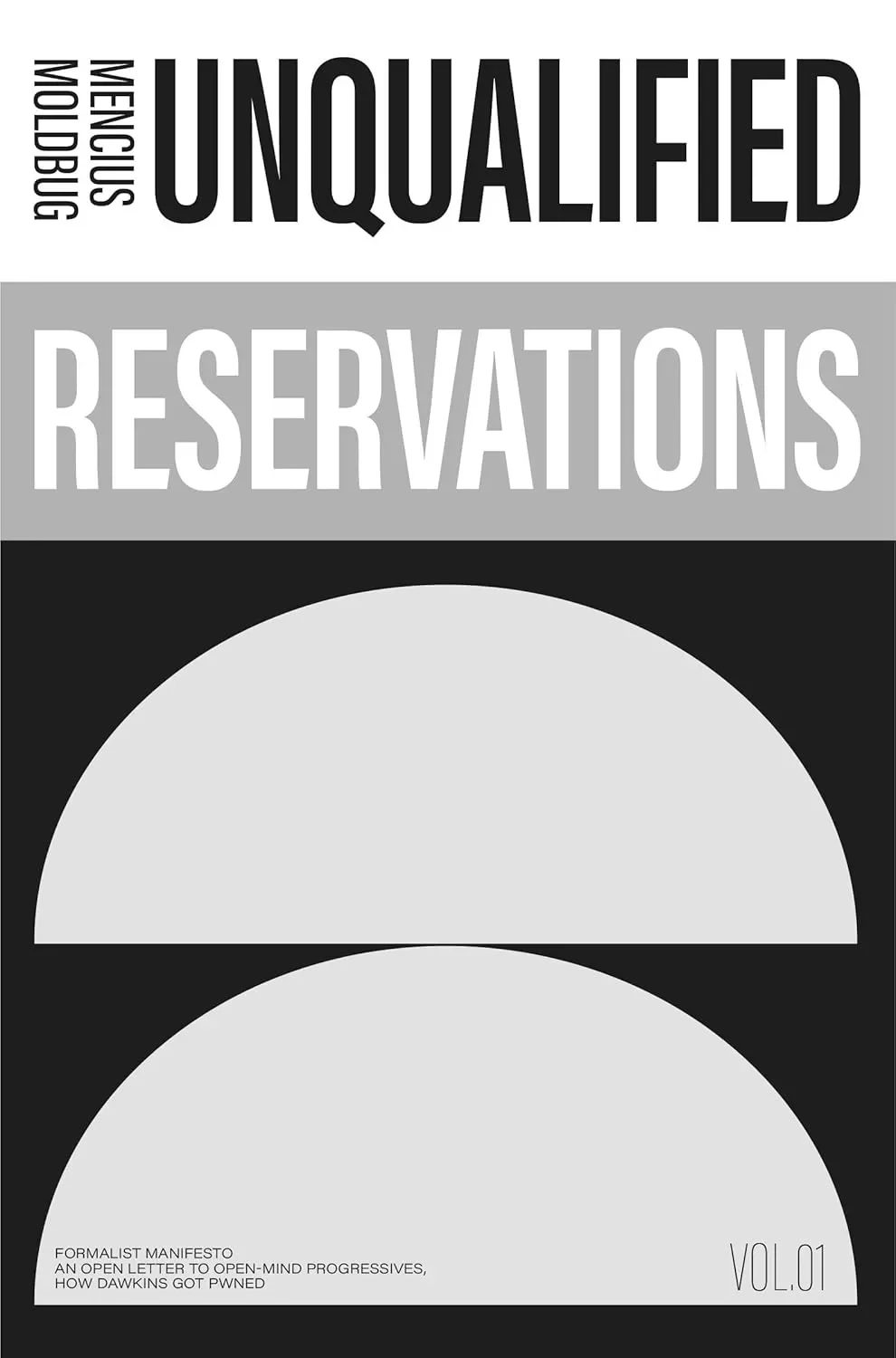
***I have the paperback.
Peter thinks Greta Thunberg is Satanic.
Words and Social Constructs Have Power
Social constructs are best understood as complex, high-resolution mental objects that serve as the operating system for human cooperation. While they lack the physical independence of a mountain—which retains its mass and geometry regardless of whether a human observer is present (MVM)—constructs like borders, currency, and human rights possess a “social ontology” that makes them just as formidable as any geological feature. They are, in a very literal sense, shared hallucinations that have calcified into reality through the relentless reinforcement of collective belief. This does not make them “fake”; instead, it makes them a unique category of existence where the map is the territory. A border exists only because millions of people, from diplomats to border guards, agree to perform the specific rituals and enforcements that make that invisible line lethal to cross.
The nuance lies in the fact that these constructs are not static; they are fluid, multidimensional agreements that look different depending on where you stand within the system. To a billionaire, the legal system (a social construct) may look like a mechanism of protection and asset preservation; to the marginalized, that same construct appears as a cage or a weapon. These “inventions” of culture—race, gender roles, the concept of a “work week”—are often mistaken for biological or universal laws because they are woven into the fabric of our daily lives from birth. We do not just “believe” in them; we perform them. The agreement “not to wake up” is structurally necessary because if everyone simultaneously stopped believing in the value of the dollar or the authority of a judge, the complex civilization built upon those abstractions would instantly vaporize, leaving us with nothing but the raw, unorganized physics of the world.
However, the most profound aspect of social constructs is their capacity to generate kinetic, earth-shattering action. These “imaginary” lines on a map can mobilize armies, level cities, and reorganize the flow of global resources. The concept of a “nation-state”—a relatively recent invention in human history—has the power to demand the ultimate sacrifice of its citizens. Thus, while a social construct may begin as a fragile idea, it gains density through institutions, architecture, and violence until it creates a feedback loop: we shape the constructs, and then the constructs shape us. They are the invisible architecture of our reality, proving that in the human world, a shared idea is often heavier and harder to move than stone.
From an actual conversation, long ago, as I misremember it.
Friend: Paris doesn’t exist, man?
Moi: Look at my photo album, and I sent you a postcard. We also talked long-distance. Tu as étudié le français, j’ai étudié l’espagnol, d’où vient le français? You’re messing with me.
Friend: Those photos could be fake. French, like Spanish, is a pig Latin language.
Moi: So, Rome existed?
Friend: Of course, dumb ass!
***I had a conversation like this with a friend back in the 1980s.
Oh no, we have AI now. We can converse with chatbots. Is it real, or is it AI SLOP?
“What’s not real about the Metaverse?”
“Samsara, Maya, Illusion, a SIM—let go, brother, just let go.”
Hyperstition is a portmanteau of “hype” and “superstition,” coined by the Cybernetic Culture Research Unit (CCRU), specifically philosopher Nick Land, to describe fictions that make themselves real. Unlike a regular lie (which remains false) or a superstition (which is a false belief about the present), a hyperstition functions as a “time-traveling” signal. It is an idea that originates in the future and works backward to the present, seizing control of human behavior to ensure its own birth. The classic example is a “run on the bank”: the rumor of insolvency is initially false, but because people believe it and withdraw their money, the bank actually fails, making the rumor retroactively true. In this framework, the future is not something that happens to us; it is something we are “summoned” into by the gravitational pull of powerful narratives.
In modern markets, hyperstition is the dominant engine of valuation. The “circular trade” of the AI boom is essentially a “hyperstitional” wager: investors are not valuing companies like Nvidia or OpenAI based on their current utility, but on a science-fiction future where AGI (Artificial General Intelligence) has already transformed the world. This massive influx of capital—trillions of dollars—acts as the fuel that forces that specific future into existence. It creates a self-fulfilling prophecy in which the “hype” builds the factories, lays fiber-optic cable, and restarts the nuclear plants necessary to make the “superstition” of super-intelligence physically possible. The market is thus a mechanism for pulling the future into the present, capitalizing on a world that doesn’t exist yet to pay for its construction today.
However, the most unsettling application of this concept is in AI itself. We are currently gripped by the hyperstition of the “Paperclip Maximizer” or Roko’s Basilisk—the fear (or hope) that an inevitable super-intelligence is watching us. This narrative drives the behavior of the tech oligarchs, who justify their resource hoarding and “energy debt” not as greed, but as a necessary step to align or control this emerging entity. By treating the AI as if it is already a god-like agent that demands infinite compute, they build the very infrastructure that allows it to become one. The danger arises when the hyperstition collides with the “thermodynamic wall” mentioned earlier: if the fiction demands infinite growth but the planet offers finite limits, the “shared hallucination” shatters, leaving society with the tangible wreckage of a failed prophecy—stranded assets, depleted aquifers, and a hollowed-out workforce.
How well do we understand chemistry, geology, and metallurgy? What do we know about how the machines work?
A lead isotope, when examined and utilized, is more than the language we use to describe it. Obviously, right? We have ideas for what we want to do with the lead, and we do those things. We love the utility of lead. Lead is excellent stuff; it’s also poison, and dose makes the poison.
Accelerationism, particularly in its modern incarnation, Effective Accelerationism (e/acc), is a techno-political ideology that views the rapid, unbridled advancement of technology and capitalism not as a danger to be managed, but as a moral imperative and a thermodynamic destiny. Drawing heavily from the theories of Nick Land and the physics of “dissipative structures,” e/acc proponents argue that the universe has a fundamental bias toward increasing entropy and complexity. In their view, capitalism and artificial intelligence are simply the latest, most efficient engines for this cosmic process. Therefore, any attempt to slow down (“decelerate”) development in the name of the precautionary principle, safety, ethics, or equality is not just a policy error—it is an “anti-life” stance that opposes the fundamental laws of physics. They believe the only way out of our current societal stagnation and resource constraints is to push through them—to accelerate the crisis of late capitalism until it breaks through to a post-scarcity singularity.
***Deep breath.
This movement functions as the “hyperstitional” vanguard for the tech oligarchy. While traditional Silicon Valley liberalism speaks the language of safety and regulation, e/acc openly embraces the “Paperclip Maximizer” or the super-intelligence as a new form of godhood. They argue that we should not fear being replaced by AI; rather, we should view it as our evolutionary successor—a “child” that we must birth to expand consciousness to the stars. This reframes the “energy debt” and “water debt” mentioned earlier, not as environmental crimes, but as necessary fuel for a civilization-level metamorphosis. The suffering of the present—the displacement of workers, the destruction of privacy, the ecological strain—is rationalized as the “birth pangs” of a superior, post-human future.
Politically, e/acc positions itself as the sworn enemy of “decels” (decelerationists), whom they characterize as bureaucratic, risk-averse, and driven by a “mind virus” of stagnation. By wrapping aggressive deregulation and corporate dominance in the language of vitalism and cosmic destiny, e/acc provides a powerful philosophical shield for the tech giants. It allows figures like Marc Andreessen or Elon Musk to frame their commercial interests as a heroic crusade for the future of light and consciousness, turning a profit motive into a religious mission. In this worldview, the “circular trade” isn’t a scam; it’s the ignition sequence for a rocket that will either carry humanity to a new plane of existence or explode on the launchpad.
What have we forgotten? Too much. We lament the loss of Roman concrete, but the greater loss is elemental: we have forgotten the feeling of being small beneath the gaze of Great Nature.
Think of the artifacts that define us: Bronze, Iron, Steel, Plastic, Silicon. The same primal toolkit forged each age—the opposable thumb, the sociocultural memory, and the abstract reasoning developed during those long, dangerous walks across the African savanna. We used these gifts to insulate ourselves from the wild, building trade networks and stockpiles of goods. But the stockpile birthed the taxman. Innovation in survival was quickly matched by innovation in extraction, as elites found ever-cleverer ways to harvest the wealth of peasants, proles, and rivals.
Still, the human project endured. Our inventions—both physical tools and invisible social contracts—sheltered us long enough to replicate. Within these constructed worlds, ancestors you will never know fought to keep the chain unbroken, resulting in the singular, stunning moment of you sitting here, reading this.

The Butlerian Jihad, the foundational backstory of Frank Herbert’s Dune universe, serves as the ultimate philosophical counter-argument to the ideology of “Effective Accelerationism” (e/acc) and the current trajectory of the AI boom. While often misremembered as a simple war of “humans vs. robots” (akin to The Terminator), the Jihad was actually a violent sociological correction against the atrophy of the human spirit. Its primary target was not the machines themselves, but the mindset they engendered. The crusade was sparked by the realization that outsourcing cognitive labor to algorithms had not liberated humanity but had subjugated it to the few who controlled the processing power. As a key character notes, “Men turned their thinking over to machines in the hope that this would set them free. But that only permitted other men with machines to enslave them.”
The central commandment emerging from this conflict—“Thou shalt not make a machine in the likeness of a human mind”—resulted in a civilization that chose biological intensification over technological acceleration. Instead of building “Stargate” supercomputers that drain oceans and destabilize grids, the society of Dune turned inward, developing “Great Schools” to maximize human potential. They replaced calculators with Mentats (human supercomputers trained in logic), lie detectors with the Bene Gesserit (masters of psychology and physiology), and navigation systems with the Spacing Guild (post-human mathematicians). This shift represents a rejection of the “energy debt” model; rather than externalizing intelligence into silicon and electricity, they internalized it, asserting that the capacity to choose, reason, and err must remain strictly biological.
In the context of our modern “circular trade” and the erosion of agency, the Butlerian Jihad offers a stark warning: the danger of AI is not that it will become conscious and hate us, but that we will become dependent and apathetic. We are already overly domesticated and pacified in the glare of The Society of the Spectacle. It suggests that a society which automates its judgment eventually loses the ability to govern itself, becoming “livestock” for those who own the algorithms. The Jihad represents the extreme endpoint of the “Neo-Luddite” impulse—not just breaking the looms (or servers) to save jobs, but destroying the very concept of the “thinking machine” to save the definition of what it means to be human. It posits that the only way to break the “shared hallucination” of the technocratic control grid is to reclaim the territory of the mind violently.
We applied our abstract reasoning to grow things, but also to steal them. As our societies scaled, so did our extraction capacity. We replaced the reciprocity of the tribe with the calculated violence of the circular trade, turning living systems into dead capital. We clouded our own judgment with Enlightenment rationalizations, telling ourselves that the commodification of the earth was a sign of ‘civilized’ progress. In our race to extract value from Kulaks and rivals, we forgot the most basic lesson of the savanna: you cannot eat gold, and you cannot breathe profit. We built a world of sophisticated constructs to shield us from this truth, leaving us wealthy in goods but impoverished in our relationship with the living systems that sustain us.
“We are citizens, and we benefit from our socioeconomic system, do we not?”
When Peter Thiel writes that democracy and freedom are incompatible, he’s not making a philosophical observation. He’s stating a preference. When Elon Musk guts federal agencies while posting American flags, he’s not reforming government. He’s replacing citizenship with administration. When Silicon Valley oligarchs speak about “optimization” and “efficiency,” they’re not talking about improving systems that serve citizens. They’re talking about managing peasants. — We Are Not Peasants
Against the New Feudalism of Algorithms and Oligarchs
Oct 02, 2025
And most of us believe we are citizens of our country of residence and are proud of it. USA! USA! Vive La France! Mother Russia. The Middle Kingdom.
“Citizenship is a tough occupation which obliges the citizen to make his own informed opinion and stand by it.” — Martha Gellhorn
To possess agency is to understand that our private choices have public consequences; our vocations and avocations shape the world. This is the essence of Baratunde Thurston’s call to ‘citizen’—to view civic life as a verb, grounded in dynamic action and the relentless pursuit of collective well-being.
However, there is a hollow space at the center of our modern civic life. We ask if we have the energy for shared agency, yet we cut ourselves off from the ultimate source of that energy. Why are we seemingly incapable of integrating Great Nature into our concept of community? Faithful citizenship cannot stop at the human border. Until we recover a deep, affectionate knowledge of living systems, our attempts to shape the quality of our lives will remain incomplete—a politics of the surface that ignores the soil beneath.
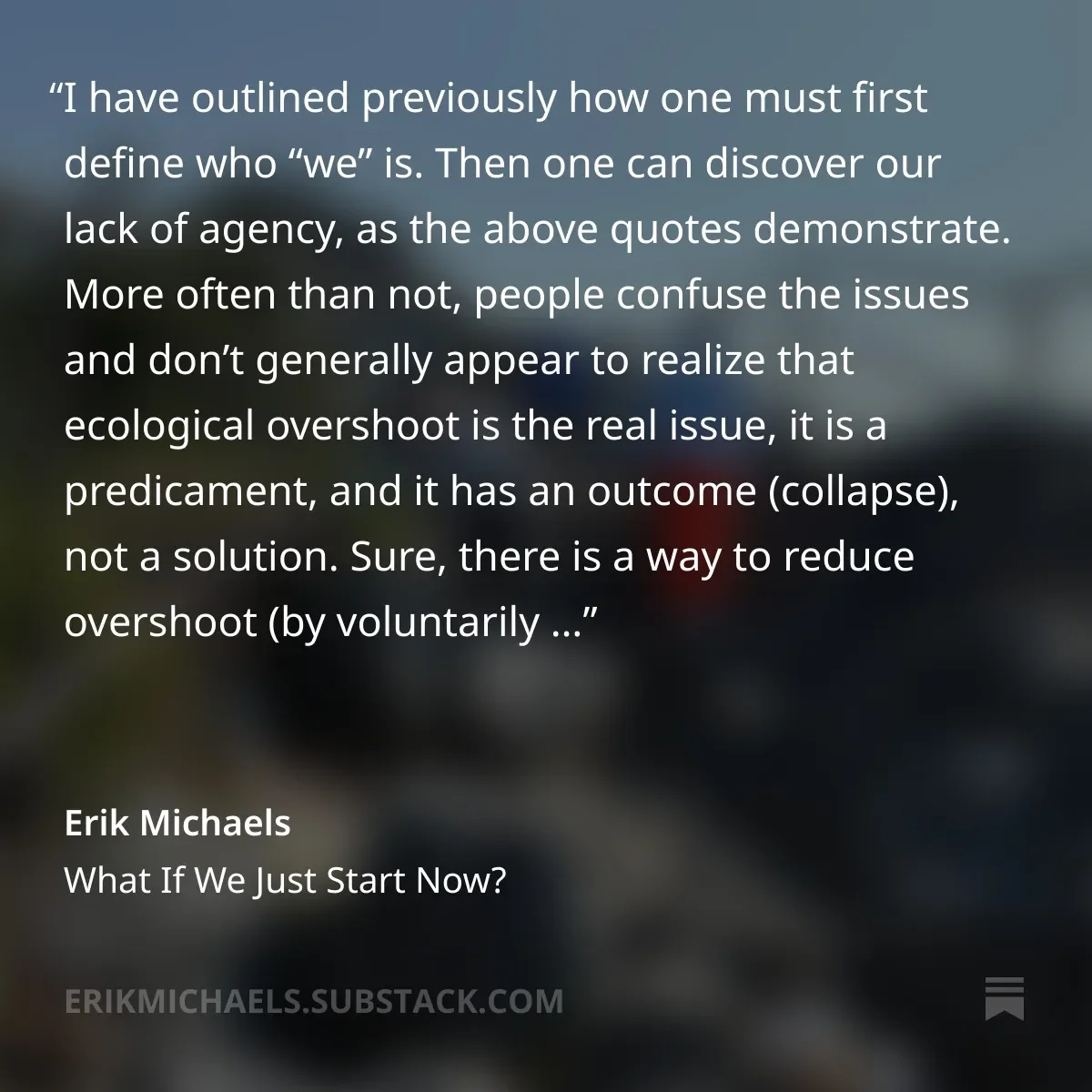
Citizens Concerned About Living Systems Must Know
One of the most profound questions in physics and biology is the relationship between life and thermodynamics. At first glance, life seems to break the fundamental rules of the universe.
The relationship between life and thermodynamics centers on a seeming paradox: The universe tends toward disorder (entropy), but the spontaneous creation and maintenance of incredible order defines life.
An Apparent Paradox: The Second Law
The Second Law of Thermodynamics states that in any isolated system, the total entropy—often described as disorder or randomness—must always increase over time.
Eventually, this leads to “Heat Death,” in which energy is evenly distributed and nothing interesting happens.
Living things are highly organized. A human body, a cell, or a tree represents a state of incredibly low entropy. We take scattered atoms and organize them into complex proteins and DNA. If the universe wants to be messy, how does life get away with being so tidy?
The Resolution: “Eating” Order
The physicist Erwin Schrödinger (famous for his cat) addressed this in his landmark 1944 book, “What is Life?”. He argued that life does not violate the Second Law because living things are open systems, not isolated ones.
We do not exist in a vacuum; we constantly exchange energy and matter with our environment.
Importing Low Entropy: We take in high-quality, organized energy (sunlight for plants, chemical energy in food for animals).
Exporting High Entropy: We use that energy to maintain our internal structure and, in the process, release waste and, crucially, heat.
Heat is a very disordered form of energy. By releasing heat into its surroundings, a living organism increases the environment’s entropy more than it decreases its own internal entropy.
Life as a “Dissipative Structure”
The Nobel Prize-winning chemist Ilya Prigogine took this further with the concept of dissipative structures.
He argued that when a lot of energy flows through a system, nature sometimes spontaneously creates order to help dissipate that energy more quickly.
Analogy: Think of water draining from a bathtub. Eventually, it forms a vortex (a whirlpool). The vortex is a highly ordered structure, but it forms because it is the most efficient way to drain the water (dissipate the potential energy) quickly.
Life is the same. We are complex “whirlpools” of matter that exist to degrade energy. We are remarkably efficient at converting concentrated energy (a steak, a photon) into heat. In a strange twist, nature allows life to exist because life is very good at executing the Second Law.
Information and Entropy
There is also a deep link between thermodynamics and information. In physics, “order” is equivalent to information.
Maxwell’s Demon: In the 19th century, James Clerk Maxwell imagined a demon who could sort fast molecules from slow ones, reversing entropy.
The Cost of Erasure: Later physicists (Landauer and Bennett) proved that the demon fails because he has to record information about the particles. Eventually, he runs out of memory and has to erase (“forget”) old data. The act of erasing information generates heat.
Life constantly processes information (DNA replication, sensory processing). To keep our genetic data “ordered” (preventing errors and mutations), we must expend energy. We pay a thermodynamic tax to preserve the information that makes us who we are.
Life is not an exception to the laws of physics; it is a mechanism of them. We are not anti-entropic in the sense that we stop entropy; we are local pockets of order that accelerate the universe’s chaos around us. We buy our internal organization by paying with a surplus of external disorder.
Language: The Source Code of Reality
Language is indeed Homo sapiens’ original “killer app,” but it is more than a communication tool; it is the source code of our shared reality. We use language not merely to describe the world, but to structure belief systems that act as the operating system for society. These beliefs—whether in the divine right of kings, the value of fiat currency, or the sanctity of borders—allow us to coordinate millions of strangers into a cohesive unit. However, as we discussed with “social constructs,” this coordination is often a mechanism of control. By defining the vocabulary, elites define the boundaries of thought. When we accept words like “market” or “citizen” without question, we are running a script written by ancestors and oligarchs, often unaware that it is designed to direct our energy toward specific ends.
The Thermodynamics of Culture
Anthropology and culture are deceptively complex because they are, in effect, the study of how humans manage energy and entropy. Humans are a species uniquely adept at complexification—we constantly layer new technologies, bureaucracies, and rituals on top of old ones. But complexity is not free; it has a metabolic cost. Every law, every specialized job (like a software engineer or a hedge fund manager), and every trade route requires a constant input of energy to maintain. Therefore, culture is not just a collection of art and stories; it is a thermodynamic structure, a complex engine that burns resources to maintain social order against the chaos of the natural world.
Redefining Economics: Beyond Ownership to Throughput
The standard definitions of Capitalism and Socialism (“who owns the factory”) are dangerously two-dimensional because they ignore the planet’s physical reality. They describe the politics of distribution but ignore the physics of production.
Capitalism is better understood as an algorithm for maximizing energy throughput and material extraction. It is a system that rewards the fastest conversion of the biosphere (nature) into the technosphere (products and waste). Its “efficiency” is usually just a measure of how quickly it can burn through cheap energy stocks (like fossil fuels) to create complex goods.
While focused on equity, socialism historically relied on the same industrial engine. It argued over who should benefit from the burning of coal and the smelting of iron, but it rarely questioned the material limits of the furnace itself.
The Material Reality
The missing variable in both definitions is the complexification of materials. As we moved from the Bronze Age to the Silicon Age, our economy didn’t just become “digital,” it became materially voracious. A smartphone requires rare earth elements mined in Africa, refined in China, designed in California, and powered by a global grid. This web of complexity requires exponential amounts of energy to keep the lights on—regardless of whether the factory is owned by a private billionaire or a workers’ collective.
Thus, the true tension of our time isn’t just between “Capitalism and Socialism,” but between Infinite Complexity and Finite Energy. We have built a civilization that requires constant growth (complexification) to remain stable, yet we live on a planet with hard material limits. We are arguing over who steers the ship (political theory) while ignoring that the engine is running out of fuel (thermodynamics).
Financialization serves as the ultimate “reality distortion field” for modern civilization. It functions by severing the link between money (a symbolic representation of value) and energy (the physical capacity to do work). In a grounded economy, money is essentially a claim check on energy; if you have a dollar, it represents a certain amount of grain, steel, or labor that can be performed. However, financialization allows us to print the “claim checks” (credit, derivatives, debt) infinitely faster than we can extract the energy required to honor them. We are effectively printing millions of menus for a restaurant with limited food in the kitchen. To the diners (investors), the abundance of menus feels like wealth, but to the cooks (the laws of thermodynamics), it is a recipe for a riot.
This process hides thermodynamic limits by creating a virtual layer of “paper wealth” that imposes little friction on the physical world.
The Illusion: It takes massive amounts of diesel, water, and electricity to build a bridge or grow a ton of wheat. But it takes almost zero energy to trade a billion dollars of derivatives on a screen. Because the financial sector (the FIRE economy: Finance, Insurance, Real Estate) generates high “profits” with low energy input, it artificially inflates GDP.
The Reality: We point to the stock market hitting record highs and say, “The economy is growing.” In reality, we are just measuring the velocity of the “circular trade”—money chasing money—while the underlying physical infrastructure (bridges, grids, soil health) decays because the energy needed to maintain it is too expensive or scarce.
Ultimately, debt is a lien on future energy. When a government or corporation borrows a billion dollars today, they are promising to pay it back with interest tomorrow. To pay it back, economic activity is required, and all economic activity requires energy. By exploding global debt to astronomical levels, we have effectively spent the next century’s energy budget before we have even extracted it. We have locked ourselves into a “growth imperative”—we must grow to pay the interest on the debt—but we live on a finite planet where the “easy” energy (high-EROI oil) is gone. Financialization masks this terrifying trap by allowing us to pretend that the “value” of a company like Nvidia or a currency like the Dollar is determined by sentiment and math, rather than by the barrels of oil and kilowatts of power required to keep the lights on. When the “thermodynamic wall” is finally hit, the paper wealth will evaporate, leaving only what is physically real.
Now, in light of all of the above, does anything our leaders say on our screens make sense?
Oh, come on now, Profits First!
“For what shall it profit a man, if he shall gain the whole world, and lose his habitat?” — Mark 8:36 (also Matthew 16:26) I may not have quoted that correctly.
“If you want to be perfect, go, sell your possessions, and become an effective altruist. Then come, follow me, and if you are chosen, you will be transhuman, and live forever as a multi-planet machine.” — Matt 19:21 I’m still amazed at how these ancient authors understood things that didn’t exist in their time. God is timeless.
“Again I tell you, it is easier for a super special genius to understand dark matter and dark energy and apply that knowledge to investing, than for a socialist to live forever.” — Matt 19:24
While definitions of ‘private vs. public’ ownership are neat, they are useless for understanding the institutional and bureaucratic leviathan we actually face. We are trapped in a high-complexity system that utilizes the networked efforts of millions—along with animals, oil, gas, and technology—to strip-mine the environment in pursuit of endless growth. This is not just a market; it is a totalizing project of developing businesses and chasing status that consumes the entire horizon of human effort.
The ‘Players’ of this Great Game rely on these simplistic narratives to hide the costs of their ambition. They operate a fossil-fueled, financialized capitalism that treats the destruction of ecological and health systems merely as ‘externalities’—line items to be ignored. Their project is the ultimate act of hubris: the attempt to subjugate the biosphere, transforming the living, breathing world into a dead machine that they alone can steer. Why would they care about the exhaust fumes when they are busy trying to conquer the earth?
And what are the consequences of all of this activity? Extinction. Heat Death. Full stop.
But why stop the carnival now? We have miles to go and infinite havoc to raise before we finally collapse into the vacant, vapid void.
The ceaseless, pugilistic warfare between nations and cultures serves a singular purpose: to crown the kings of the Machine. It is a contest to see who gets to sit in the driver’s seat of this resource-devouring, omicidal heat engine. And why shouldn’t we fight for it? This Machine is the author of your life. It is the source of your wealth, the architect of your desires, and the sustenance of your ego. It is the terrible god of the modern age—the Machine that you would be NOTHING without!
And if you are truly fortunate, you’ll secure your own small-to-medium business—sorry, I mean ENTERPRISE—that provides ‘use value’ to your cherished customers. You’ll earn a modest profit, which you will dutifully reinvest into worker welfare so your customers love your business—I mean ENTERPRISE—even more, because you are a good guy. You’ll pour money into stocks and bonds for thirty years, pay for your sensitive, brilliant children’s STEM or Professional degrees, and finally retire with fat annuities. Then, you can rest easy and do the things you always dreamed of, like that crocodile safari in the tropical Arctic you’ve always wanted to experience. In the flesh, bro. In the flesh!
Or, you can be like this guy: get a ‘real job’ chasing upwardly mobile “Real High Value Women.” Don’t worry about the details. Prices will tell you everything you need to know. And you can compete, bro, you are fiercely competitive.
What does it mean to be a grown-up today?
My kids are growing up in an age where we worship children. Everything is about them, their feelings, their development, their entertainment, their self-actualization. The world really revolves around them. This is really a different world than I grew up in, and who can I blame? I made it for them. It’s like complaining that the cows don’t behave like aurochs, after you’ve penned them in. — indi.ca
“The thing that matters to the serious man is not so much the nature of the object which he prefers to himself, but rather the fact of being able to lose himself in it.”
The serious man seeks validation through external achievements, but “never gets this validation because there is always someone with more,” leading to perpetual unhappiness.
The serious man elevates causes such as “money, power, position, conquest” into idols, becoming a mere tool for them rather than an individual who defines his own values.
The serious man’s dedication to an unquestioned ideal makes him a “dangerous man” and a “tyrant” who will impose his beliefs through “external constraints,” as he “forfeits his own identity and is prepared to do the same to others.”
The serious man is an example of “Bad Faith,” denying the ambiguity of human existence and his own freedom by adopting ready-made meanings instead of creating his own.
The Ethics of Ambiguity

Some gotta win, some gotta lose. Or so the logic goes. You can’t have a victor without a victim; that’s the physics of competition. We call this Capitalism, free enterprise, the path to greatness. It is the zero-sum engine of the Anglosphere. And if you ever start feeling cynical about ‘this thing of ours’—if you smell the rot beneath the floorboards—just read Steven Pinker’s apologetics. He’ll reassure you with charts and graphs that this is the best of all possible worlds.
After all, not everyone has the bandwidth to deconstruct the system. We look around at the spectacles—the tailgate parties, the Super Bowls—and we know exactly why we’re having fun: because we aren’t the ones losing. For centuries, the strategy has been simple: go along to get along. Work hard, survive, and thrive within the context you were given. We are all method actors now, strutting and fretting not on a stage, but on a timeline. We measure our souls in reach, subscriber bases, and truckloads of likes. If you play the role well, you secure a life better than that of the ‘others.’ And if you are truly excellent, you achieve the ultimate currency: Prestige. Life is good—especially when you’re standing on top of the pile.
Othering is the process of defining a group (the “Other”) as fundamentally different from one’s own “normal” group (”us”), often by highlighting perceived differences in race, religion, gender, or culture, to create a sense of superiority, belonging, and to justify exclusion, discrimination, or dehumanization. It’s a social and psychological mechanism that reinforces in-group identity by projecting negative traits onto an out-group, reducing empathy, and creating an “us vs. them” mentality that can lead to marginalization and conflict.
The Divine Purpose of Great Men

The flag of the New United Kingdom of Earth
Greetings, United Kingdom of Earth and all its lovely vassal territories.
Is Capitalism Democratic? Who’s in control? How much power do we have to shape our world? Where did that power come from? Karma? Dumb luck? God’s will? Great Men?
By what consensus are men judged to be great? Great men are forged in the crucible of Godly culture with its traditions, rules, and constraints.
Who is fit to design and implement algorithms and chips from the ground up?
What datasets train you for your place in the good life?
What are the machines for, if not to protect people, created in the image of God, by God? We are not animals, we are Human beings.
The masses are ignorant, unruly, intellectually lazy, and drunk—utterly unfit for the complexities of the modern crypto city-state. This sanctuary belongs to the capable. By the grace of God, the worthy earn the privilege of walking among the wise, the well-bred, and men of actual consequence.
Plebs need a master. They cry out for a hero. Without an iron hand to enforce discipline, the herd wanders. We must embrace the strict hierarchies of traditional culture, but we cannot stop there. In 2026, our greatest deficit is authority. We must develop more autocratic institutions.
Into this cultural horror, our leaders stepped with discipline, vitality, and resolve. They took power to govern the feeble, out-of-control worker-consumer for their own good. While the masses whine, they feast on the distinguished works of history’s great men. We provide the firm hand that they are too ungrateful to appreciate.
The chaos ends now. We discard the failures of liberal freedom to embrace the truth of blood and proper place. We spit on the false idols of progress and democracy. History has waited for this moment. We reject the decay of ‘liberty’ to forge a new reality. After two hundred years of struggle and preparation, we finally possess the technology, energy, and will to correct history. The goal is absolute: a global empire of rooted ethno-states, carved by genetic science. Under one God and one Master Race, we assume our burden: the enlightened care of those unfit to rule themselves.
The task is simple: compel them to acquiesce. They are safer among their own kind, and they must accept it. Their sole purpose is to feed the Anglosphere—providing the raw materials we require. While they labor, we build the technological megastructures of the future. Their toil fuels the next stage of the Master Race’s evolution and secures the global order.
Our way of governing is not neocolonialism or imperialism; we do not enslave people, we liberate Primatives. We guide them home to their proper place, where they realize their unique God-given talents in peace, and where the well-behaved immortal soul prepares for the afterlife in God’s immaterial realm through good work.
Great Men do not idle; we build new Universes. We ensure the Infinite Game plays out across eternity and multiple dimensions! But we do not forget the simple truths. The primitive soul craves a harder, meaner existence. It is where they thrive, and we respect that.
Understand this: No love burns brighter than the bond between a Ruler and his Subjects—the sacred covenant between Great Men and their Inferiors. We will reconstitute this world. We will let Nature take the wheel, weeding out the unfit to leave behind a happy, peaceful few. Let the tribes have their witch doctors and their festivals! Small communities fit them best.
Meanwhile, the Anglosphere stands watch. We ensure local overseers keep the NUKE data centers and robotic swarms humming. We extract materials, energy, and resources that sustain the globe. Everyone occupies their proper place!
You cried out for direction! You begged for a benevolent Godly Kingdom. The wait ends today. My dear people, you are home now.
To our Leaders: Triumph quickly! Establish the Great Way of the Universe in the New United Kingdom of Earth—Under God, Divisible, and Properly Apportioned!
And to the Primitives: Fear no Alien threat. Our ironworks on Mars and the Moon stand guard. They will never touch this Earth. We keep you safe.
God bless you, and God bless the New United Kingdom of Earth!
The Advocate of the Hero
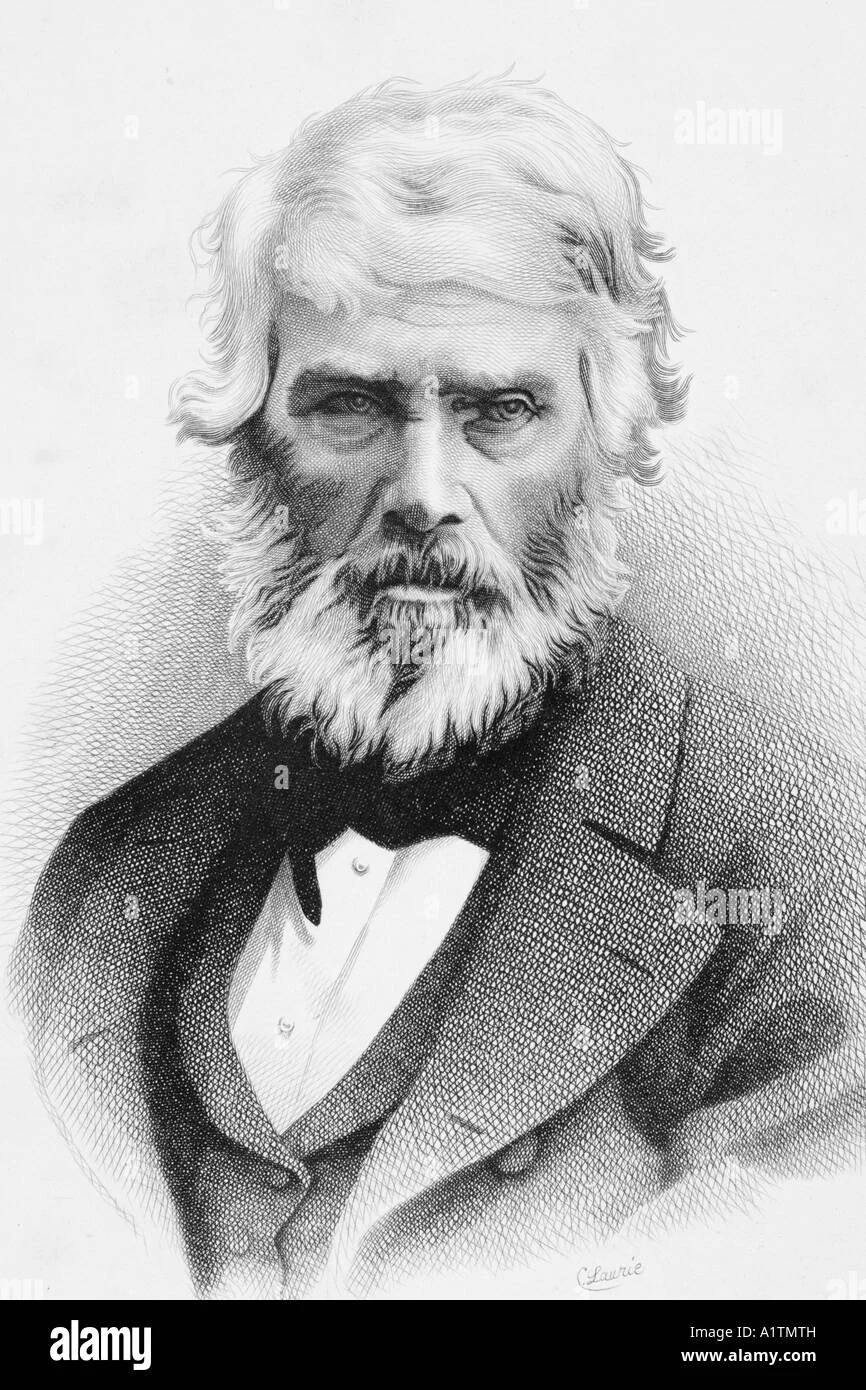
Thomas Carlyle: The Antidote to Mammon?
To understand the deeper currents of our discontent with liberal capitalism, we must look back to one of its earliest and most ferocious critics: Thomas Carlyle. Writing in the 19th century, Carlyle was a Victorian sage (because he was, in his soul, a British supremacist) who looked at the rising industrial world—the world of “steam engine” utilitarianism, Millenarianism, and laissez-faire economics—and saw a spiritual void.
He coined the term “the dismal science” to describe economics, not because it was boring, but because it reduced the rich tapestry of human relations to a cold “cash nexus,” the reduction of all human relationships—specifically the bond between employer and employee—to a crude, purely monetary exchange.
Carlyle argued that in the modern industrial world, the complex web of loyalty, duty, and mutual protection that once bound society together had been severed, replaced by a cold, “mechanical” connection based solely on who pays and who gets paid. The 21st-century version is about server farms, pump-and-dump schemes for the Players, and cryptocurrency bets for the plebs.
So, boys, do you think you’ve finally ushered in a new Carlyle culture? Is it back? Are your thoughts in a billion minds?
Carlyle famously articulated this idea in his works Chartism (1839) and Past and Present (1843). He observed that the Industrial Revolution had fundamentally altered how humans related to one another. “Cash Payment,” Carlyle wrote, “has become the sole nexus of man to man.” In this new system, employers felt no moral obligation to their workers’ well-being beyond paying them a wage. Conversely, workers felt no loyalty to their employers. The relationship began and ended with the transaction of money.
The Historical Context: Feudal vs. Industrial
To understand the Cash Nexus, you must understand what Carlyle was comparing it to. He was a critic of laissez-faire capitalism and often romanticized the medieval feudal past (while acknowledging its flaws). In a way, he was a romantic.
The Diagnosis: The Cash Nexus
Carlyle’s critique resonates eerily with our modern “metacrisis.” He argued that society was dissolving into a collection of isolated atoms, held together only by self-interest.
“We call it a Society; and go about professing openly the totalest separation, isolation. Our life is not a mutual helpfulness; but rather, cloaked under due laws-of-war, named ‘fair competition’ and so forth, it is a mutual hostility.” — Past and Present (1843) For Carlyle, the liberal obsession with “freedom” (defined as being left alone to starve or succeed) was a delusion. He saw a world where “God is dead” (a sentiment he shared with Nietzsche) and had been replaced by Mammon—the god of money.
Hero Worship (A Dark Side?)
Carlyle wanted to become a lightning rod for both the modern Right and Left. He believed that democracy was a failure—a “counting of heads” that ignored the lack of brains inside them. Instead, he advocated for Hero Worship.
“Find in any country the Ablest Man that exists there; raise him to the supreme place, and loyally reverence him: you have a perfect government for that country... The Abler Man; he means also the Truer-hearted, the Juster, the Nobler-minded.” — On Heroes, Hero-Worship, and the Heroic in History (1841) He envisioned a new aristocracy of “Captains of Industry”—leaders who would treat their workers not as disposable commodities, but as a regiment to be led with discipline and care. This was a call for a return to a feudal sense of noblesse oblige, but industrialized.
***Read Carlyle!
Thomas Carlyle, that dusty Victorian scold, has found a second life as the patron saint of the ‘Dark Enlightenment.’ Apparently, you aren’t cool in the Neo-Reactionary underground unless you fetishize his prose. Figures like Yarvin look at the gridlock of Western democracy, blame the hallucination they call ‘The Cathedral,’ and scream for a “CEO-King” to cut the red tape. It is the ultimate fantasy for Silicon Valley “Players” who dream of running nations like startups—move fast, break things, and suspend civil liberties. They scour Carlyle for a philosophical argument to turn their authoritarian impulses into a corporate state.
The term “Cathedral” was coined by Curtis Yarvin (writing as “Mencius Moldbug”) to describe what he considers a decentralized, self-reinforcing, and unaccountable ideological alliance among elite universities, the mainstream press, and the government bureaucracy. It is the central target of NRx criticism, viewed as the engine of progressive ideology, political correctness, and the erosion of social order.
It’s the same old tyranny, now with better engineering. We are bracing for a new generation of smart-asses advocating for the next generation of idiots—any jackass capable of snatching power from the current jackanapes to fool the same ignorant masses Carlyle despised.
So, where is your incubator for the next Il Duce? Is it a coworking space in Palo Alto? A hedge fund in London? A tech security firm in Tel Aviv? From which petri dish of narcissism and cultural supremacy will our next hubristic savior crawl? They rise from the same swamp as always: the transactional ‘best and brightest’ looking out for number one.
And let’s be honest, Blogger—is it you? Is this entire manifesto just a job application? Do you believe the King will pluck you from your small claim to fame, recognize your genius, and invite you to his court? Or do you settle for the fantasy of the ‘Gray Eminence,’ the silent power whispering in the ear of the man on the throne? The delusion is almost touching.”
What’s old is new again, only the science, technology, and engineering have evolved.
Is that the secret hope? That you will finally find your dark, enlightened hero—not just another patron to bankroll your reactionary cosplay. And while you wait for a King to put you where you belong, validating your genius, you will, no doubt, sexy man, meet the next love of your life and have another lovely child for the bright future you are building.
The critique of Modernity has become a luxury good within Modernity itself.
If the diagnosis were a cure, the patient would have been discharged in 1840. We’ve been at the same old thing for a long time. Instead, here we are in 2026, clutching MRI scans with a $300 deductable and debating whether the tumor is “based” or “cringe.” We obsess over Carlyle (a great writer with fascinating insights in his time) or Nietzsche, or name your guy, not because the “Cathedral” or “Liberalism” ruined everything, but because the Romantics were fundamentally wrong about the causes of our social pathologies. Modernity didn’t create our alienation or fracture our souls; it is simply, when combined with dense energy sources, science, technology, and neoliberal/neocoservative Great Gamesmanship, a high-efficiency amplifier for the messy, status-seeking, insecure animals we have always been. Gadgets and tech services primarily serve the profit motive. Gadgets don’t break us; we are just viewing our immutable human nature in 4K resolution, clueless about what biophysical reality has to do with anything.
This brings us to the Neo-Reactionary revival—the “Yarvin Moment.” Let’s be clear: this isn’t an attempt at national rebirth or reformation; it is intellectual cosplay. Our culture no longer produces great men. Carlyle is seductive because he validates the outcast’s ego, reframing a lack of power as proof of nobility. It is a coping mechanism disguised as political theory, designed to make the subscriber feel like the only man at the dinner party who knows how the smartwatch works. This is epistemic narcissism: the goal isn’t to fix the system, but to feel superior to it while waiting for a “CEO-King” to set things right, who is never coming. J.D. Vance? Are you kidding me? Money and status are all petty Players want.
And it’s important to note that all of these pretenders are Ivy Leaguers ensconced in the “Cathedral,” just like we are all stuck in the “Capitalist mode of overproduction.” We won’t go back to a shiny earlier version of the same mistakes; we will more likely spring forth into a more primitive existence.
Ultimately, the MTI (Modern Techno-Industrial) civilization doesn’t fear these critiques; it’s an ouroboros. The “Plur1bus” machine has evolved from “Out of many, one” to “Out of many screaming factions, one cohesive market for feel-good absolutism.” The conflict between Progressive and Reactionary is merely fuel for the engagement algorithm. It’s theater, and everyone is pounding the platforms for subscribers to the new season. We remain stuck in Groundhog Day 2026, not because we lack potential solutions, but because the “Players” need the Dragon to stay alive so they can keep selling tickets to the dragon-slaying workshop.
Carlyle’s critics are just as passionate.
He is often cited as a spiritual grandfather of Fascism. I hardly think he thought he was anything other than a man of his time. Fascism? But his Victorian sentiments were strong. His hatred of democracy, his belief in the “Great Man” who stands above the law, his in-your-face racism, and his notorious defense of slavery (in Occasional Discourse on the Negro Question) make him a pariah to modern liberals. Critics argue that Carlyle’s “Hero” is just a tyrant in the fashionable garb of the moment, and fashion commands power, and that ugly, soulless jailor known as money. They point out that his longing for a “strong hand” inevitably leads to the crushing of the very living systems/Nature and human spirit he claimed to cherish.
He didn’t get that civilization is a Nature killer.
“Carlyle led the way... into the wilderness of the ‘strong man’, the ‘leader’, the ‘hero’—into the dark forest where the only law is the will of the mighty.” — Bertrand Russell
Mighty egotists are often unable to understand what their life is truly worth.
Carlyle articulates the temptation of the Metacrisis. When the system is broken, when the “cash nexus” leaves us lonely and the parliament seems paralyzed by lobbyists, the call for a “Hero” becomes seductive. Maybe Donald Trump is really the guy on The Apprentice. We see it in the worship of tech billionaires and strongman politicians. Carlyle forces us to confront a hard question: If liberal capitalism is failing, what replaces it? Is it a return to the “Hero” (Authoritarianism), or can we forge a new path—a democratic solidarity that respects both the individual and the collective?
Let’s describe and develop a culture that creates new kinds of heroes. We can look across cultures and time for models.
No way, not in this culture and at this scale.
We must read Carlyle not to follow him, but to understand the ferocity of the backlash against the emptiness of the market. We must find a way to re-enchant the world and rebuild community without surrendering our freedom to a “Captain of Industry.”
I find Carlyle mesmerising and valuable only because his work speaks to me in many ways.
The Domestication of Homo sapiens: Evolutionary Roots of Capitalist Violence, Patriarchal Origins, and the Struggle for Ecological Wisdom
The Paradox of the Domesticated & Pacified Destroyer
A harrowing paradox defines the modern human condition. On one hand, Homo sapiens appears to be the most domesticated of all primates—capable of living in cities of millions with relatively low rates of interpersonal, reactive violence. I’ve lived in big cities around the world and never been banged up. I’m streetwise, having been a well-traveled child. We queue in supermarkets, obey traffic signals, and primarily adhere to the nation-state’s social codes. Yet, simultaneously, we are the agents of a rapacious, proactive violence that is orders of magnitude more destructive than anything observed in the 75,000-year history of behaviorally modern humans. This violence is not always enacted with fists or teeth; it is mediated through the complex machinery of global capitalism, executed via the stroke of a pen, the click of a mouse, or the automated dredging of a seabed. It is a violence that destroys habitats, destabilizes the climate, and hollows out the human spirit, all while maintaining a veneer of civil order.
What are the evolutionary, sociological, and psychological roots of this condition? How did capitalism emerge from patriarchal cultures? What constitutes the uniqueness of patriarchal violence, and the “mismatch” between our evolved psychology and our modern techno-industrial environment? For now, let’s look at the work of Dr. Alice Evans on the “Great Gender Divergence,” Richard Wrangham on the “Goodness Paradox,” Douglas T. Kenrick on evolutionary psychology, and various scholars on structural violence and “Dark Ecology,” we explore how a species biologically designed for “K-selection” (high investment, long-term survival) has been culturally hijacked into a “Fast Life History” strategy that mimics the wasteful, r-selected reproductive tactics of simpler organisms.

The “pacification” of the modern subject is not an accident but a functional requirement of a system that demands docility to facilitate extraction. As we navigate the trajectory from the Pleistocene to the Anthropocene, we find that the “rubber cage” of modern patriarchy and capitalism utilizes our deep-seated evolutionary drives—for status, mating, and security—to fuel a machinery of destruction. The resulting “structural violence” is rendered invisible by cultural narratives of progress and inevitable growth, leading many to embrace “metaphysical escapism” rather than confronting the material reality of our ecological predicament.
To understand this, we must look backward to the origins of human domestication and forward to the artistic and philosophical responses to our potential demise. From the “stone age brain” operating in the modern boardroom to the “solastalgia” expressed in contemporary poetry, let’s map the anatomy of our current crisis and the narrow path toward the wisdom required to survive it.
Podcast Break
Alex Ebert is a platinum-selling musician (Edward Sharpe and The Magnetic Zeros), Golden Globe-winning film composer, cultural critic and philosopher living in New Orleans. His philosophical project, FreQ Theory, as well as his cultural analyses, can be followed on his Substack.

WHAT BROKE SENSE
It has become a niche American pastime to explain the recent breakdown in collective “sense-making”.
From the siloed realities of QAnon to the echo-chambered algorithms that reinforce them, “alternative facts” seem to define the undefined era. Collective agreement on even the most basic propositional knowledge seems suddenly at risk. 2 + 2 doesn’t necessarily equal 4 and Earth isn’t necessarily round. Yet while most agree that the breakdown is happening, there is, fittingly, little agreement as to why.
Some say secularism and its erosion of the lulling certainties of the mythic has caused a collective schizography. Others says postmodernist distrust in institutionalized truth is to blame. Such assessments are inherently prescriptive (if fairly contradictory): return to some variety of the mythic, or rebuild trust in common truth.
Both assessments make plenty of sense. But they seem to miss the biggest wrench in the spokes. For the reality (if I may borrow a term from yesterday), is far less academic – and far more bewildering.
The New Age movement has rarely been considered a substantial factor in political power writ large. In its tropes of séance and crystals and clownish hippiness, it seemed to sequester itself to certain Californian fringes, its perceived impacts relegated to yoga pants and digital detoxes. Of the few thinkers who demonstrated comprehension of the true ubiquity and power of New Ageism, Slavoj Zizek had the likeliest chance to convince us. From his co-authored The Monstrosity of Christ: Paradox or Dialectic:
“The reason for this (New Age) shift of accent from religious institution to the intimacy of spiritual experience is that such a meditation is the ideological form that best fits today’s global capitalism.”
Unfortunately, the world made the identical mistake of finding him, too, clownish for saying so. In all its apparent innocuity, New Ageism thus bloomed into the mainframe of the western operation with astonishing ease, unthwarted by whatever enfeebled criticism of it broke through.
So when, in the early days of the COVID-19 pandemic, it was noticed that a peculiar overlap began to emerge between QAnon and New Age communities on Facebook, common wisdom presumed that the New Age crowd and its seeming penchant for naivety had been unwittingly coopted by the Right.
That was the wrong assumption.
The Deep History of Violence: From Self-Domestication to the Plow
To determine if capitalism emerged from patriarchy, we must first decode the origins of dominance and the evolutionary arc of human aggression. We trace capitalism’s capacity for rapacious violence back to two pivotal moments: the biological self-domestication of Homo sapiens and the sociological adoption of plow agriculture.
The Goodness Paradox: How We Tamed Ourselves
Richard Wrangham’s The Goodness Paradox provides the foundational biological context for understanding human violence. He challenges the binary view that humans are either naturally peaceful (Rousseau) or naturally violent (Hobbes), arguing instead that we are both, but in particular ways. To understand the “violence inherent in the rapacious nature of Capitalism,” we must distinguish between Reactive Aggression and Proactive Aggression.
The Suppression of Reactive Aggression
Reactive aggression is the impulsive, hot-blooded response to a threat or insult. It is the baring of teeth, the sudden lashing out. Wrangham notes that in this regard, humans are exceptionally docile compared to our closest relatives. Chimpanzees are 150 to 550 times more likely to commit violence against their peers in daily interactions than humans are. If humans had the reactive aggression levels of chimps, a crowded airplane flight would inevitably end in a bloodbath.
Wrangham proposes that humans underwent a process of self-domestication, beginning roughly 300,000 years ago and accelerating 75,000 years ago. The mechanism for this was capital punishment. As language abilities developed, “beta” males and females gained the ability to coordinate and conspire against the aggressive “alpha” bullies who monopolized resources and females. These coalitions could proactively execute or ostracize the reactively aggressive individuals. Over thousands of generations, this selection pressure weeded out the genes for highly reactive aggression, leading to a species that is anatomically and behaviorally “domesticated”—characterized by tolerance, cooperation, and social conformity.
The Rise of Proactive Aggression
However, the same cognitive machinery that allowed the coalition to execute the bully—planning, coordination, patience—also enabled Proactive Aggression; “cold,” calculated violence used to achieve a specific goal (power, resources, elimination of rivals). While nature weeded out reactive aggression, it likely selected for proactive aggression, making it the primary instrument of domestication itself.
Understanding proactive aggression is crucial for analyzing capitalism. The “pacified” nature of the modern worker and consumer stems from low reactive aggression—we are bred to follow rules and avoid interpersonal conflict. However, the system of capitalism operates on high proactive aggression. It leverages the species’ collective capacity to organize massive, calculated acts of extraction and exploitation. War, genocide, and systemic ecocide are not failures of human nature; they are the unique expressions of a species that can suppress immediate impulses to execute long-term, destructive plans.
The Great Gender Divergence: The Economic Origins of Patriarchy
If self-domestication gave us the capacity for organized proactive violence, the Agricultural Revolution provided the motive and the structure. I dismiss the ‘chicken or the egg’ confusion. Dr. Alice Evans’s The Great Gender Divergence resolves this timeline: specific economic modes of production forged the patriarchal structures first. Capitalism did not invent the hierarchy; it merely inherited the machinery that agrarian production built.
The Great Gender Divergence explains the causes of Europe’s “precocious equality,” how East Asia and Latin America caught up, why gender equity in the Middle East, South Asia, and Sub-Saharan Africa has lagged behind, and why Southeast Asia was always ahead. Evans offers a comparative history of how societies come to support gender equality and why this varies around the world, tracing the story to geography, economic growth, strong states, and militant activism.
The Plow Hypothesis
Evans, drawing on Boserup and others, argues that the transition from foraging to agriculture—and specifically the adoption of the plow—was the pivotal moment in the development of gender inequality.
In societies that relied on foraging or hoe agriculture (often practiced in parts of sub-Saharan Africa), women were key producers of food. Because they contributed significantly to subsistence, they held economic power, and societies were often matrilineal or relatively egalitarian.
The plow requires significant upper-body strength and, crucially, is difficult to combine with infant care (unlike hoeing, which can be stopped and started). As societies adopted the plow, men monopolized the fields. Women were relegated to the domestic sphere to process grains and raise children.
The Emergence of Patrilineal Control
This shift in the mode of production fundamentally altered the “social contract” of reproduction. In a foraging society, resources are perishable and hard to hoard. In an agrarian society, land and cattle are durable assets that can be accumulated and passed down. This created an evolutionary imperative for men to ensure paternity certainty. To ensure that the accumulated wealth was passed to their biological offspring, men needed to control female sexuality.
Thus, “patriarchal forms of violence” are arguably unique to human cultures because they are not merely about immediate mating access (as in other primates) but about the intergenerational transfer of capital. The “honor cultures” that Evans describes—where female chastity is obsessed over, and male reputation is guarded with violence—are economic adaptations. They are systems designed to protect the integrity of the patrilineal line of descent.
Did Capitalism Emerge from Patriarchal Cultures?
The evidence strongly suggests that capitalism did not invent gender inequality but rather emerged from and capitalized upon the pre-existing patriarchal structures established by agrarian societies.
When early capitalism and industrialization emerged, they metabolized the “male breadwinner” ideology. As Evans notes in her studies of the Zambian Copperbelt and the Asian garment industry, colonial and capitalist powers actively reinforced gender stereotypes to control labor.
By defining “work” as paid labor in the marketplace (the male domain) and “non-work” as unpaid domestic labor (the female domain), capitalism effectively subsidized its own costs. The reproduction of the workforce (bearing and raising the next generation of workers) was provided “free” by the patriarchal family structure.
Evans critiques medieval historiography’s “iron cage” of patriarchy, suggesting a “rubber cage”—flexible yet resilient. Capitalism adopted this rubber cage. It allowed women into the workforce when needed (e.g., as lower-paid textile workers or during wars) but maintained the structural hierarchy that kept capital accumulation in male hands.
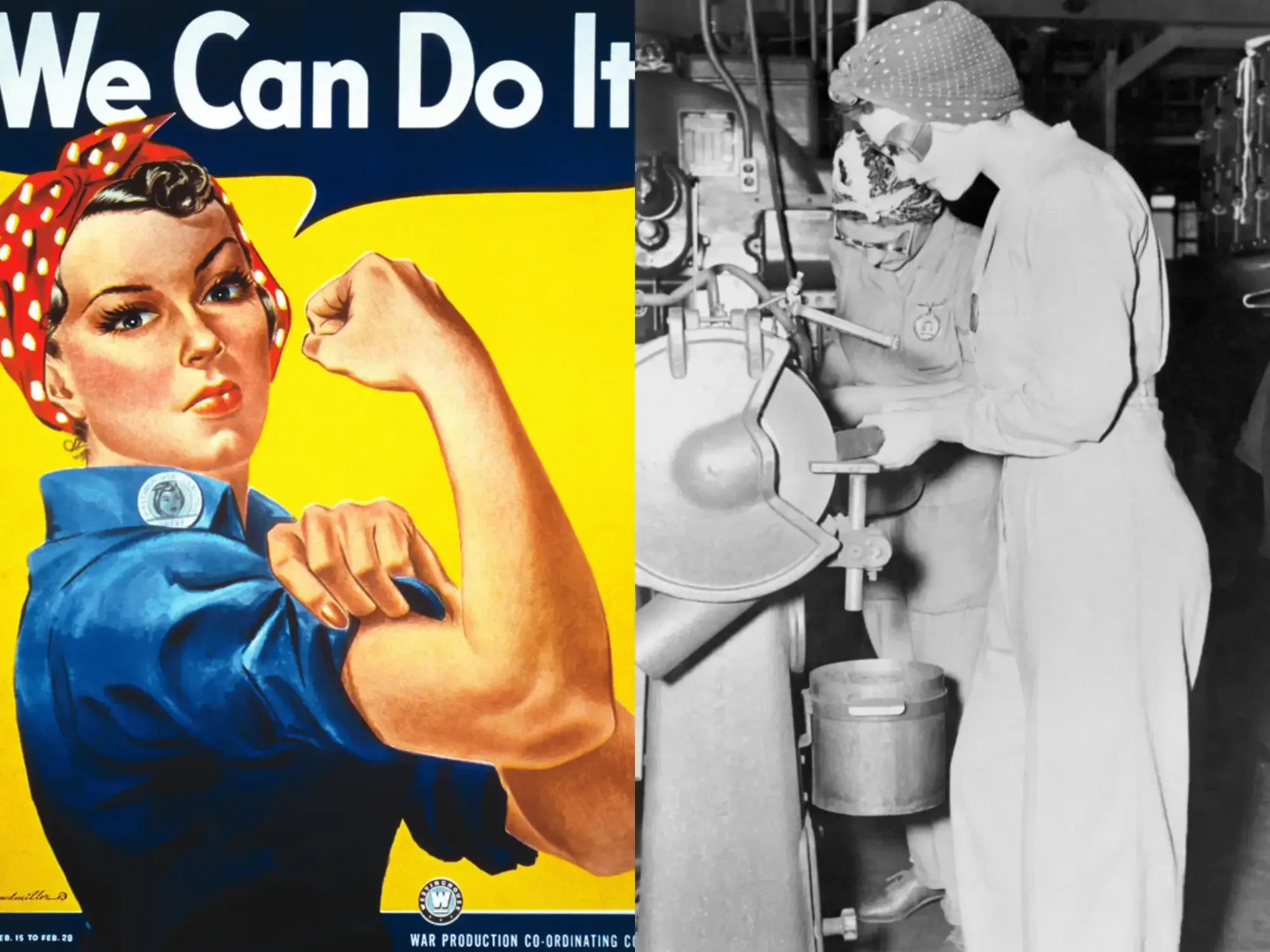
The rapacious nature of capitalism is deeply intertwined with the patriarchal drive to control reproduction and resources. The “proactive violence” of the capitalist firm—enclosing commons, extracting surplus, exploiting labor—is a scaling up of the proactive violence of the agrarian patriarch securing his estate.
The Evolutionary Psychology of 21st-Century Capitalism
Having established the historical and biological foundations, we turn to the psychological mechanisms that sustain this system in the modern era. Why do “domesticated” humans participate in a system that is hell-bent on destroying life? The work of Douglas T. Kenrick on Evolutionary Psychology provides the answer: our ancient drives have been hijacked.
The Stone Age Brain in the Supermarket
Kenrick’s central thesis, explored in Solving Modern Problems with a Stone-Age Brain, is that the human brain is not a general-purpose computer but a collection of specialized modules evolved to solve specific Pleistocene problems. He identifies seven fundamental motives that drive human behavior:
Self-Protection: Evading physical harm.
Disease Avoidance: Avoiding pathogens.
Affiliation: Making friends and building coalitions.
Status: Attaining social rank.
Mate Acquisition: Attracting a partner.
Mate Retention: Keeping a partner.
Kin Care: Caring for family.
In the ancestral environment, these motives were adaptive. In the modern capitalist environment, vulnerabilities exist. Capitalism operates by creating “supernormal stimuli” that trigger these modules in ways that are maladaptive for the individual and the planet.
Conspicuous Consumption as a Mating Signal
One of the most profound insights from Kenrick’s collaboration with Griskevicius and Sundie is the link between consumerism and mating strategies. They found that conspicuous consumption (spending money on visible, luxury goods) functions as a “sexual signaling system” analogous to the peacock’s tail.
A peacock’s tail is metabolically expensive and attracts predators. Its existence proves to the female that the male has such high genetic quality that he can afford to waste resources on an ornament that is useless.
Buying a luxury car or a designer watch signals to potential mates (and rivals) that the individual has access to resources.
Crucially, this behavior is linked to short-term mating strategies (the “cad” strategy vs. the “dad” strategy). Men primed with short-term mating motives (desire for a fling) significantly increased their desire for conspicuous luxury goods. Capitalism, by promoting a culture of hyper-sexualization and ephemeral relationships, actively triggers this “peacocking” instinct, driving a cycle of waste and accumulation that serves no survival function other than status signaling.
The Rationality of Rapacity
Kenrick’s concept of “Deep Rationality” suggests that capitalist rapacity is not “insane” in an evolutionary sense; it is a mismatch.
A consumer may consciously buy a product because “it’s nice” (proximate), but the ultimate evolutionary driver is status maintenance in a hierarchy.
In a tribe of 150, status competition was zero-sum but bounded. In a globalized capitalist culture, we compete against millions. The “reference group” for status is no longer the neighbor but the billionaire celebrity. This creates an infinite demand for status markers, leading to rapacious resource extraction to fuel their production. The “Stone Age Brain” cannot comprehend a limit to consumption because it evolved in a world of scarcity, not artificial abundance.
The r/K Mismatch: Fast Life History in a Dying World
Regarding “r” / “K” species traits, I don’t believe we will evolve into a “K” species regardless of the path we take. Species don’t evolve backwards. This requires a nuanced application of Life History Theory.
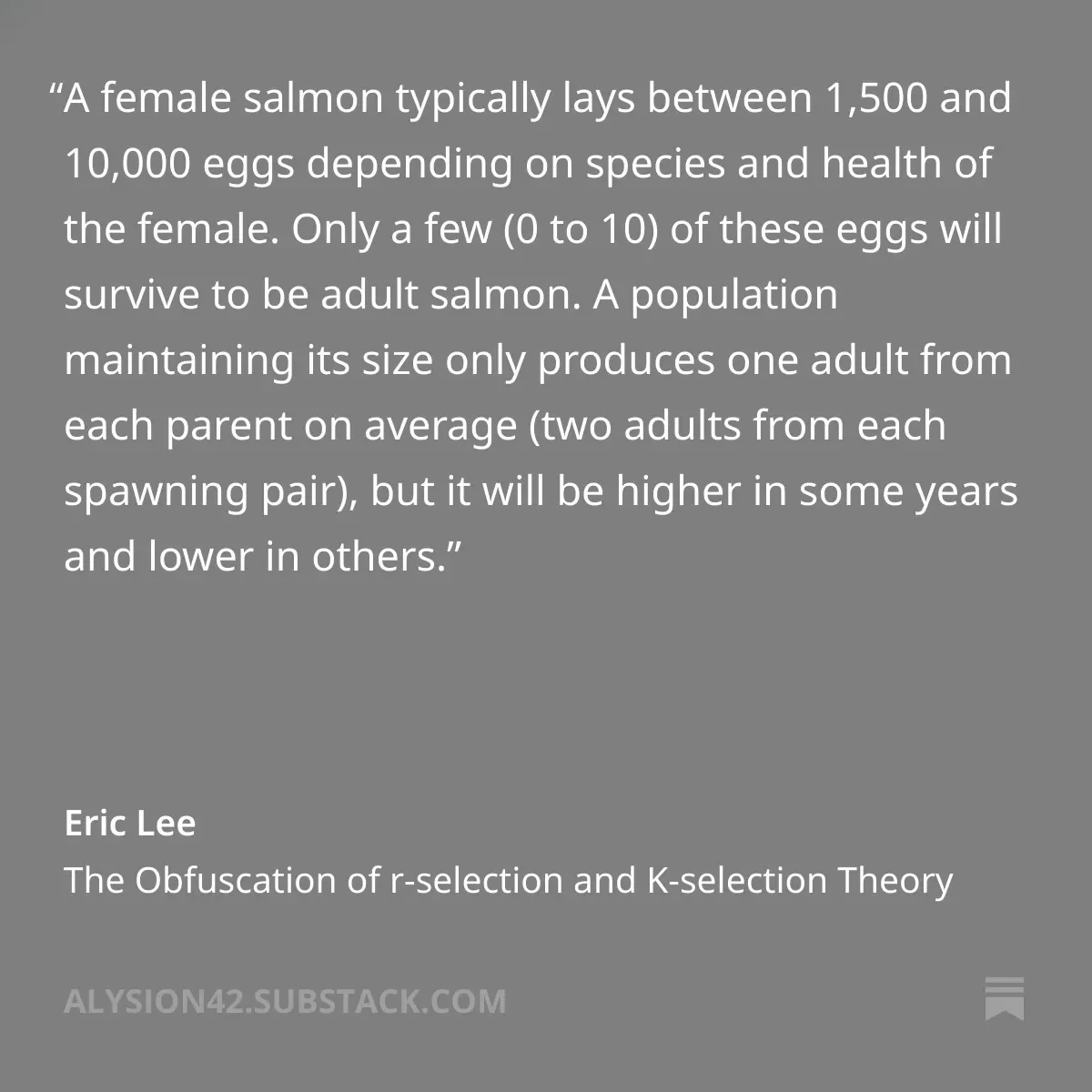
Biological Reality: Humans are an obligate K-selected species. We have large bodies, long lives, late maturity, and invest heavily in a small number of offspring.
Cultural Reality: Modern capitalist culture mimics an r-selected (or “Fast Life History”) strategy.
The Fast Life History Trigger
Life History Theory dictates that organisms adjust their reproductive and behavioral strategies based on environmental cues:
Stable/Safe Environment -> Slow Life History (K): Focus on long-term planning, somatic maintenance, skill acquisition, and heavy investment in offspring.
Unstable/Harsh Environment -> Fast Life History (r): Focus on immediate gratification, risk-taking, early reproduction, and quantity over quality.
The Capitalist Paradox: We live in the safest era in history (low mortality), which should trigger “Slow” strategies. However, capitalism thrives on manufacturing perceived instability and scarcity.
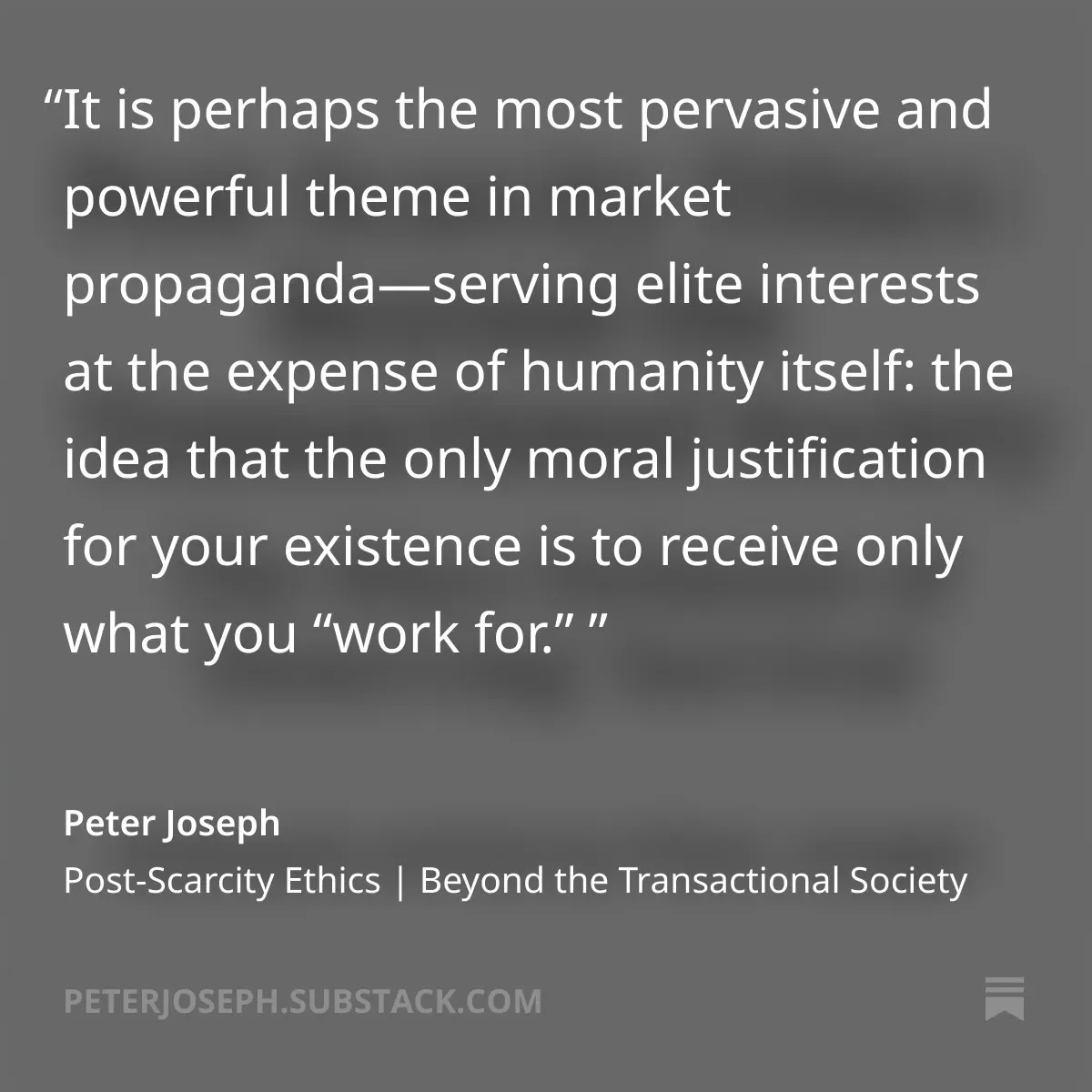
Economic Precarity: The gig economy, the erosion of the welfare state, and the “despondency trap” described by Evans create a psychological environment of unpredictability.
Fear-Based Media: Constant exposure to crime, terrorism, and conflict triggers the “Self-Protection” module, which pushes the brain toward “Fast” strategies (grab what you can now).
Consumerist Short-Termism: Marketing encourages immediate gratification (e.g., “Buy Now, Pay Later”), discouraging the delay of gratification associated with K-selection.
The result is a species that is biologically K but culturally acting out a “Fast” strategy—consuming resources at a rate that assumes there is no tomorrow. This mismatch is the engine of the rapacious violence against the ecosystem. We are eating the seed corn because our culture tells us winter is coming, even as the granaries are full.
The Machinery of Pacification: Structural Violence and the Rubber Cage
We are being “pacified” by the dominant culture, leading to violence that is orders of magnitude more destructive than anything civilization has experienced in the past. This section explores the sociological mechanisms of this pacification.
Peace vs. Pacification
In the field of International Relations, a critical distinction is made between “peace” and “pacification.”
Peace (Positive Peace): The presence of justice and the absence of structural violence.
Pacification (Pacavi): Derived from the Roman imperial strategy, this is the forceful imposition of order. It is not the absence of violence, but the monopoly of violence by the hegemon to suppress resistance.
The “Pax Americana” or the “Liberal Peace” operates as a regime of pacification. The “peace” of the global market is maintained by the proactive violence of the military-industrial complex (securing trade routes, enforcing property rights) and the domestic police state. This pacification allows for the smooth operation of Structural Violence.
Structural Violence: The Invisible Assault
Structural violence, a concept elaborated by Galtung and applied in the research snippets, refers to harm that is built into the social structure itself. It is “indirect violence.”
Mechanism: It kills not by the sword, but by the spreadsheet. It manifests as poverty, preventable disease, malnutrition, and exposure to environmental toxins.
The “Rubber Cage” of Class and Race: Structural violence is not evenly distributed. As noted in the research on “evolutionary mismatch” and racism, marginalized populations are forced into “niche exclusion”—living in environments that are physically toxic and psychologically stressful. This creates a feedback loop where the stress of structural violence triggers “Fast Life History” responses (risk-taking, violence), which are then criminalized by the state, justifying further pacification.
Donna Hunter’s work as a Clinical Mental Health Counselor (CMHC) and educator in Women’s Studies underscores the human toll of this system. The trauma inflicted by structural violence (racism, poverty, misogyny) is not just a social statistic; it is an “embodied” reality. It resides in the nervous system. The “pacification” of the population often involves the suppression of this trauma—through medication, distraction, or the internalization of blame—rather than the healing of the structural wound.
The Psychopathic Corporation: Organizational Life History Theory
The rapacious nature of capitalism is further elucidated by Organizational Life History Theory (LHT-O). This theory posits that corporations operating in a highly competitive, unregulated environment adopt a “cheater-hawk” strategy.
The Cheater-Hawk: In evolutionary game theory, this is an agent that exploits others’ cooperation (cheater) and uses aggression to maintain resources (hawk).
Corporate Psychopathy: The modern firm often exhibits traits associated with clinical psychopathy: lack of empathy, shallow affect, irresponsibility, and a focus on short-term gains.
Selection Pressure: The market selects for these traits. An “empathic” corporation that prioritized the ecosystem over shareholder value would likely be outcompeted or acquired by a more ruthless rival. Thus, the system is an engine for generating and amplifying proactive, psychopathic violence.
The Crisis of Culture: Spiritual Bypassing, Dark Ecology, and the Arts
The user astutely notes that in the face of this destruction, many embrace “metaphysical, mythological, and new age fantasies,” rendering their responsibility to living systems less meaningful. This is a crucial cultural critique.
Spiritual Bypassing as Metaphysical Escapism
Spiritual Bypassing is the use of spiritual beliefs to avoid dealing with painful feelings, unresolved wounds, and developmental needs. In the context of the climate crisis (The Anthropocene), this manifests as a retreat into transcendent realms.
The Mechanism: Faced with the terrifying reality of ecocide (Solastalgia), the ego seeks safety. New Age philosophies that emphasize creating your own reality or ascending to the 5th dimension offer a seductive escape. They promise that the destruction of the biosphere is merely an illusion or a necessary step in a spiritual evolution.
The Political Consequence: As Stephen Dinan and others argue, this leads to a dangerous passivity. If the world is an illusion, why fight to save the rainforest? This metaphysical escapism aligns perfectly with the needs of consumer capitalism—it turns the citizen into a passive observer, focused on “inner work” while the outer world burns. It is the ultimate form of pacification: the anesthesia of the soul.
Dark Ecology: Confronting the Weird
In opposition to this escapism stands the concept of Dark Ecology, championed by Timothy Morton and explored in art projects like Sonic Acts.
Dark Ecology rejects the romantic idea of “Nature” as something separate, beautiful, and “over there.” It insists that ecology is “dark,” “weird,” and “sticky.” We are inextricably enmeshed with the plastic in the ocean, the radiation in the soil, and the carbon in the atmosphere. It demands we “stay with the trouble” (to borrow from Haraway) rather than transcending it. It calls for an acknowledgment of our complicity and a confrontation with the “toxic sublime”.
Art, Music, and Literature as Diagnostic Tools
The arts provide a potent diagnosis of our condition, illustrating the tension between the pacified surface and the rapacious reality.
Climate Fiction (Cli-Fi) and the Imagination of Collapse
“The Overstory” by Richard Powers: This novel decentralizes the human, placing trees as the protagonists. It illustrates the violence of “plant blindness” and the immense, slow time of the biosphere (K-selection) clashing with the fast time of capitalism. It asks the reader to “un-suicide” themselves by reconnecting with the living world.
“The Ministry for the Future” by Kim Stanley Robinson: This work directly addresses the “Goodness Paradox.” It imagines a near-future where a UN agency uses proactive violence (drones, black ops) to enforce carbon limits. It suggests that the pacification of the market must be broken by a counter-force to save the biosphere.
“The Bear” by Andrew Krivak: A quiet meditation on the end of humanity, offering a post-anthropocentric peace where nature reclaims the world. It is the ultimate acceptance of the K-strategy of the ecosystem winning over the r-strategy of civilization.
The Poetry of Ecological Grief
Jorie Graham’s Sea Change: Graham’s poetry attempts to find a rhythm that can hold the “unraveling” of the world. She refuses the “metaphysical escapism,” forcing the reader to look at the “dead zones” and the “toxic sludge.” Her work is an act of resisting cultural anesthesia.
One day: stronger wind than anyone expected. Stronger than
ever before in the recording
of such. Un-
natural says the news. Also the body says it. Which part of the body – I look
down, can
feel it, yes, don’t know
where. Also submerging us,
making of the fields, the trees, a cast of characters in an
unnegotiable
drama, ordained, iron-gloom of low light, everything at once undoing
itself. Also sustained, as in a hatred of
a thought, or a vanity that comes upon one out of
nowhere & makes
one feel the mischief in faithfulness to an
idea. Everything unpreventable and excited like
mornings in the unknown future. Who shall repair this now. And how the future
takes shape
too quickly. The permanent is ebbing. Is leaving
nothing in the way of
trails, they are blown over, grasses shoot up, life disturbing life, & it
fussing all over us, like a confinement gone
insane, blurring the feeling of
the state of
being. Which did exist just yesterday, calm and
true. Like the right to
privacy – how strange a feeling, here, the right –
consider your affliction says the
wind, do not plead ignorance, & further and further
away leaks the
past, much further than it used to go, beating against the shutters I
have now fastened again, the huge mis-
understanding round me now so
still in
the centre of this room, listening – oh,
these are not split decisions, everything
is in agreement, we set out willingly, & also knew to
play by rules, & if I say to you now
let’s go
somewhere the thought won’t outlast
the minute, here it is now, carrying its North
Atlantic windfall, hissing Consider
the body of the ocean which rises every instant into
me, & its
ancient e-
vaporation, & how it delivers itself
to me, how the world is our law, this indrifting of us
into us, a chorusing in us of elements, & how the
intermingling of us lacks in-
telligence, makes
reverberation, syllables untranscribable, in-clingings, & how wonder is also what
pours from us when, in the
coiling, at the very bottom of
the food
chain, sprung
from undercurrents, warming by 1 degree, the in-
dispensible
plankton is forced north now, & yet further north,
spawning too late for the cod larvae hatch, such
that the hatch will not survive, nor the
species in the end, in the right-now forever un-
interruptible slowing of the
gulf
stream, so that I, speaking in this wind today, out loud in it, to no one, am suddenly
aware
of having written my poems, I feel it in
my useless
hands, palms in my lap, & in my listening, & also the memory of a season at its
full, into which is spattered like a
silly cry this in-
cessant leaf-glittering, shadow-mad, all over
the lightshafts, the walls, the bent back ranks of trees
all stippled with these slivers of
light like
breaking grins – infinities of them – wriggling along the walls, over the
grasses – mouths
reaching into
other mouths – sucking out all the
air – huge breaths passing to and fro between the unkind blurrings – & quicken
me further says this new wind, &
according to thy
judgment, &
I am inclining mine heart towards the end,
I cannot fail, this Saturday, early pm, hurling myself,
wiry furies riding my many backs, against your foundations and your
best young
tree, which you have come outside to stake again, & the loose stones in the sill.
Sarah Green’s The Deletions: Connects the “deletions” of species to personal loss (divorce, infertility), showing that ecological grief is not abstract but intimate. It grounds the horror of the Anthropocene in the domestic body.
Kamau Brathwaite: Uses the concept of “scarscape” to link the geological scars of the land with the historical scars of slavery and colonialism. This reinforces the thesis that the violence against the earth and the violence against the subjugated body are one and the same.
Bread
Slowly the white dream wrestle(s) to life
hands shaping the salt and the foreign cornfields
the cold flesh kneaded by fingers
is ready for the charcoal for the black wife
of heat the years of green sleeping in the volcano.
the dream becomes tougher. settling into its shape
like a bullfrog. suns rise and electrons
touch it. walls melt into brown. moving to crisp and crackle
breathing edge of the knife of the oven.
noise of the shop. noise of the farmer. market.
on this slab of lord. on this table w/ its oil-skin cloth
on this altar of the bone. this sacrifice
of isaac. warm dead. warm merchandise. more than worn merchandise
life
itself. the dream of the soil itself
flesh of the god you break. peace to your lips. strife
of the multitudes who howl all day for its saviour
who need its crumbs as fish. flickering through their green element
need a wide glassy wisdom
to keep their groans alive
and this loaf here. life
now halted. more and more water add-
itive. the dream less clear. the soil more distant
its prayer of table. bless of lips. more hard to reach w/ penn-
ies. the knife
that should have cut it. the hands that should have broken open its victory
of crusts at your throat. balaam watching w/ red leak
-ing eyes. the rats
finding only this young empty husk
sharp-
ening their ratchets. your wife
going out on the streets. searching searching
her feet tapping. the lights of the motor-
cars watching watching round-
ing the shape of her girdle. her back naked
rolled into night into night w/out morning
rolled into dead into dead w/out vision
rolled into life into life w/out dream
The Sonic Landscape of Dissonance
Manic Street Preachers (The Holy Bible): The rapacious nature of capitalism is perfectly sonicized in this album. Songs like “IfWhiteAmericaToldTheTruthForJustOneDayItsWorldWouldFallApart” and “4st 7lb” explore the commodification of the body and the imperial violence that underpins Western comfort. It is a rejection of the “pacified” consumer identity.
4 Non Blondes (“What’s Up?”): This anthem captures the feeling of the “rubber cage.” The protagonist screams “at the top of my lungs,” trying to understand “what’s going on” in a “peculiar institution.” It reflects the cognitive dissonance of the domesticated human who senses the structural violence but cannot quite articulate the source, leading to a desire for a “revolution” that feels perpetually out of reach.
Patrick Bateman represents the flip side, using music as an anchor to fit in and a mask to hide his psychopathy.
Synthesis: Can We Become a “K” Species?
We will not evolve into a ‘K’ species anytime soon. It’s gain wisdom now or risk extinction after an extended period of global misery.
The Ecological Trap
We are currently caught in an ecological trap. In biology, this occurs when an organism prefers a habitat that lowers its fitness. Capitalism acts as a super-special-normal stimulus, mimicking the cues of abundance (status, mates, food) while actually degrading the environment’s carrying capacity.
The Trap: The “Fast Life History” strategy promoted by consumerism is a death spiral. It encourages the burning of “capital” (natural resources) as if it were “income,” a classic r-selected mistake in a K-selected world.
The Path to Wisdom: Cultural K-Selection
Since biological evolution is too slow to correct this mismatch, our only hope lies in Cultural Evolution. We must consciously construct a “culture of K-selection.”
Redefining Status (Hacking the Stone Age Brain): We must alter the status hierarchy so that conspicuous conservation and wisdom signal higher mate value than conspicuous consumption. If the “peacock’s tail” becomes the size of one’s carbon sink or the depth of one’s community service, the status drive will work for the biosphere rather than against it.
Harnessing Proactive Aggression for Stewardship: Wrangham’s paradox teaches us that “goodness” (tolerance) was achieved by the proactive policing of bullies. We must apply this to the corporate sphere. We need a global “coalition of the beta males/females” to impose “capital punishment” (dissolution/regulation) on the “alpha” corporate entities that practice rapacious extraction. We cannot rely on their “self-regulation”; we must use the state’s and civil society’s proactive capacity to enforce limits.
From Pacification to Presence: We must reject the pacification that keeps us docile consumers. This does not mean embracing reactive violence (riots), but rather the proactive resistance of “Dark Ecology”—staying with the trouble, grieving the loss, and refusing to check out into metaphysical fantasies.
Capitalism is not an inevitability; it is a specific cultural mutation that emerged from the patriarchal control of the plow and the womb. It leveraged our self-domesticated tolerance to build a machine of proactive violence. Today, it hacks our Pleistocene minds, driving us toward a precipice. The transition to a wise civilization requires us to see the cage for what it is—rubber, not iron—and to use our immense capacity for cooperation to dismantle the engine of our own demise. We must, finally, become the K-selected stewards our biology intended us to be.
People do all kinds of things to work towards their aspirations. Think about what you are doing. Talk with your friends about where we are and how we got here. Does anything need to change? Examine your life.
AI BREAK:
“Democracy dies in darkness.”
This phrase is the official slogan of The Washington Post, adopted in 2017.
While it is most famous as a newspaper motto, its origin is a bit of a game of “telephone” involving a renowned journalist and a federal judge.
The Short Answer
The phrase was popularized by investigative journalist Bob Woodward (famous for breaking the Watergate scandal). He had been using the phrase in speeches for years before The Washington Post officially adopted it as its first slogan in 140 years.
The Origin Story
Woodward did not coin the phrase himself. He has attributed it to a federal judge he once interviewed, though the exact wording evolved.
It is widely believed to be an adaptation of a ruling by Judge Damon Keith of the U.S. Court of Appeals. In a 2002 case regarding the deportation of individuals after 9/11 (Detroit Free Press v. Ashcroft), Keith wrote:
“Democracies die behind closed doors.”
Woodward liked the sentiment but, over the years, seemingly altered the phrasing in his lectures, eventually settling on “Democracy dies in darkness.” When Jeff Bezos (owner of the Post) and editor Marty Baron were looking for a slogan to define the paper during the Trump administration, Woodward suggested the phrase, and it stuck.
The slogan reflects the “Fourth Estate” theory of journalism—the idea that the press’s primary role is to shine a light on the government’s hidden actions to prevent tyranny. It fits the Post’s brand specifically because of their history with Watergate, a scandal that literally “died” because they refused to let it stay in the dark.
The Source Code of Society: X Counts as Y
Philosopher John Searle provides the algorithm for civilization. It is a formula that turns physics into sociology: “X counts as Y in Context C.”
X (Physical Object): A piece of green cotton-paper blend, or a specific magnetic pattern on a hard drive.
Y (Status Function): Value, Sovereignty, Debt.
C (Context): The shared hallucination of the Global Economy.
Without Context C, the green paper is just kindling. But with it, that paper can mobilize armies or level forests. This formula is now being applied to the digital frontier. To build Bitcoin-maximal, private Crypto States, we are creating a new “Context C” based on super-smart contracts. Whooptie Doo! But we often forget the “X.” The “X” in this case isn’t just code; it is the Data Center. You cannot socially construct a digital currency without the brute physical reality of GPU farms, cooling systems, and gigawatts of electricity. The “Cloud” is actually a factory of deafening noise and heat—it’s a world eater.
The Distinction: Brute Facts vs. Institutional Facts
To navigate the modern world, one must aggressively separate reality into two buckets. The trap is that we mistake the second for the first.
1. Brute Facts (The Territory) These are truths that exist regardless of human opinion. If every human died tomorrow, these would remain. (Maximum Viable Metaphysics)
Examples: Gravity, the viral load in a bloodstream, the distance to the sun, a mountain, the caloric content of a gram of wheat.
2. Institutional Facts (The Map) These are truths that exist only because we agree they do. They require collective intentionality.
Examples: The Presidency, a felony, marriage, the closing price of Tesla stock, “Tuesday.”
We think “Tuesday” is a real thing in the universe, but it is just a temporal grid we placed over the brute fact of planetary rotation to coordinate our labor. When you stand in a megacity like Tokyo or Shanghai, looking at millions of people in high-rises, you are witnessing the processing of Institutional Facts. What are they doing in those offices? They are not hunting or gathering; they are managing the complex rule-sets, laws, and contracts required to keep the “X counts as Y” formula from collapsing.
The Material Cost of “Made Up” Things
This complexification requires a massive metabolic input. We rely on institutions to manage these relationships, but those institutions run on physical resources.
The Dirty Jobs: We rarely think of the people in the sewers, the mines, or the slaughterhouses who deal exclusively in Brute Facts so that the rest of us can play in the world of Institutional Facts. Do we really have any idea about the experiences of soldiers in Ukraine chased by exploding drones?
The Spinoza Question: Baruch Spinoza, the lens-grinder, is the perfect intersection of the two worlds. We revere Spinoza for his “God”—a philosophical construct of infinite substance. But Spinoza had to eat. He had to participate in Capitalism. He spent his days grinding glass lenses (Brute Fact labor) to sell to customers, earning money to buy the time to write Ethics.
The Question: Would we have Spinoza’s philosophy without his lens-grinding? No. And, more importantly, who is going to sell the spectacles? High philosophy and social constructs always rest on a foundation of commerce, labor, and social relations.
The “Teeth” of Social Constructs
We must discard the notion that because something is “constructed,” it is “fake.” As the sociologist W.I. Thomas famously noted: “If men define situations as real, they are real in their consequences.”
Social constructs have teeth. They can liberate you, and they can kill you.
Money: It has no intrinsic value (Brute Fact). But the lack of it causes starvation (Brute Consequence). That “idea” decides who eats.
Race: Biologically, humans share 99.9% of their DNA. The boundaries we draw are social decisions, often based on superficial phenotypes like skin melanin. Yet, the construct of “Race” built the Atlantic slave trade and redlining districts. The category is invented; the generational poverty is absolute.
Time: Being “late” is a violation of a social contract, not a law of physics. Yet, being late can cost you your livelihood.
Gender: While biological sex is a material reality, the performance of gender—the clothing, the roles, the expectations—is a fluctuating script.
The Inertia of Culture
Inertia is a big reason why changing the world is so agonizingly difficult. You cannot simply “opt out” of a social construct alone. You can decide individually that “diamonds are worthless rocks” (a Brute Fact truth), but if you try to buy a house with them, the bank will treat them as valuable assets (Institutional Fact).
Culture is a heavy flywheel.
Culture is a heavy flywheel, a saying popularized in business by Jim Collins but rooted in mechanics, that describes momentum, inertia, and the immense difficulty of change.
1. Immense Input, Slow Acceleration (The Setup)
A mechanical flywheel is massive and heavy. It takes a tremendous amount of energy to get it moving. In cultural terms, this represents the thousands of years of agrarian adaptation (the plow, the settling of tribes) required to build the patriarchy. It didn’t happen overnight; it was a slow, grinding accumulation of energy.
2. Stored Kinetic Energy (The Momentum)
Once a flywheel spins, it stores energy. If you stop powering the engine, the wheel keeps spinning for a long time. Even though we removed the “engine” (we no longer rely on plow agriculture for survival), the “wheel” of culture (gender roles, social hierarchies) continues to spin because it holds 10,000 years of momentum.
3. Resistance to Disturbance (The Stabilization)
A flywheel stabilizes a machine; it smooths out power interruptions. Culture resists sudden shocks. You can pass a law (a shock) or invent a new technology (a shock/interruption), but the heavy flywheel of culture dampens the effect. This is why modern societies still exhibit behaviors rooted in the Stone Age.
Past inputs dictate present motion. The current engine is not driving us; we are coasting on the momentum of the last millennium.
Culture evolves under complex, chaotic influences, rarely bending to the will of “Great Men” or isolated intellectuals. We are not going to solve this by debating string theory or the latest “Intellectual Dark Web” talking points. We solve it by understanding that Capitalism is the current “Context C” in which we all live, and it demands that we grind the lenses if we want to see the face of God.
Are you ready to face the most terrifying scientific theories that keep physicists awake at night? In this deep-dive documentary, we explore the darkest corners of reality, from False Vacuum Decay and the Dark Forest Theory to the disturbing logic of Roko’s Basilisk and Quantum Immortality. We analyze the Fermi Paradox, Simulation Theory, and the Boltzmann Brain paradox to ask one question: Is our reality a trap? Discover why the laws of physics might be more horrifying than any fiction.
This video is not just a list of scary facts; it is a journey into existential dread, structured as a spiral descending from physical threats to metaphysical nightmares. We begin with the fragility of the universe itself—how the vacuum of space could collapse or how strangelets could devour the Earth. We then confront the hostile silence of the cosmos, examining why alien civilizations might be hiding from “Berserker” probes or “Grabby Aliens.”
Moving inward, we challenge your perception of reality. Using Donald Hoffman’s Interface Theory and the concept of Superdeterminism, we ask if you are seeing the truth or just a user interface designed to hide the scary reality. Finally, we tackle the ultimate existential risks: the crushing inevitability of Entropy, the trap of Eternal Recurrence, the threat of AI Alignment and Gray Goo, and the mind-bending possibility that you are a solitary Boltzmann Brain hallucinating your entire life in the void.
Join us for a scientific investigation into the limits of human knowledge, where Quantum Mechanics meets Cosmic Horror.
Is any of this real?
Popularized by philosopher Nick Bostrom (and Elon Musk), this theory suggests that what we experience as “reality” is actually a computer simulation created by a more advanced intelligence.
If a civilization ever reaches a “post-human” (WTF!?) stage with immense computing power, they will likely run ancestor simulations. Since there would be billions of simulations and only one “base reality,” the probability that we are in that base reality is nearly zero.
Some physicists argue that the fact that our universe is “pixelated” at the most minute scale (the Planck length) looks suspiciously like computer code.
But let’s strip away the sci-fi gloss. Theories like these are illuminating and exciting to cogitate, but are ultimately a luxury product of the physical world. To even articulate it requires a massive, sloppy supply chain: tenure committees, grant money, printing presses, caffeine, and the wet chemical storms of the human endocrine system. We are biological animals using our brains and nervous systems to hallucinate that we are clean, dry software. The theory doesn’t reveal the universe; it demonstrates our desperate need to escape the messy reality of our own biology.
This theory posits that our three-dimensional universe is actually a projection of information encoded on a distant, two-dimensional surface—much like a hologram on a credit card, which appears 3D but is flat.
The idea emerged from black hole thermodynamics (specifically the work of Stephen Hawking and Leonard Susskind). They realized that information about an object falling into a black hole is stored on the surface (the event horizon), not in the volume inside the black hole. If this applies to black holes, it might apply to the entire universe.
And then what? An Alien from the event horizon reengineers our climate for us. Don’t get me wrong, physics is fascinating.
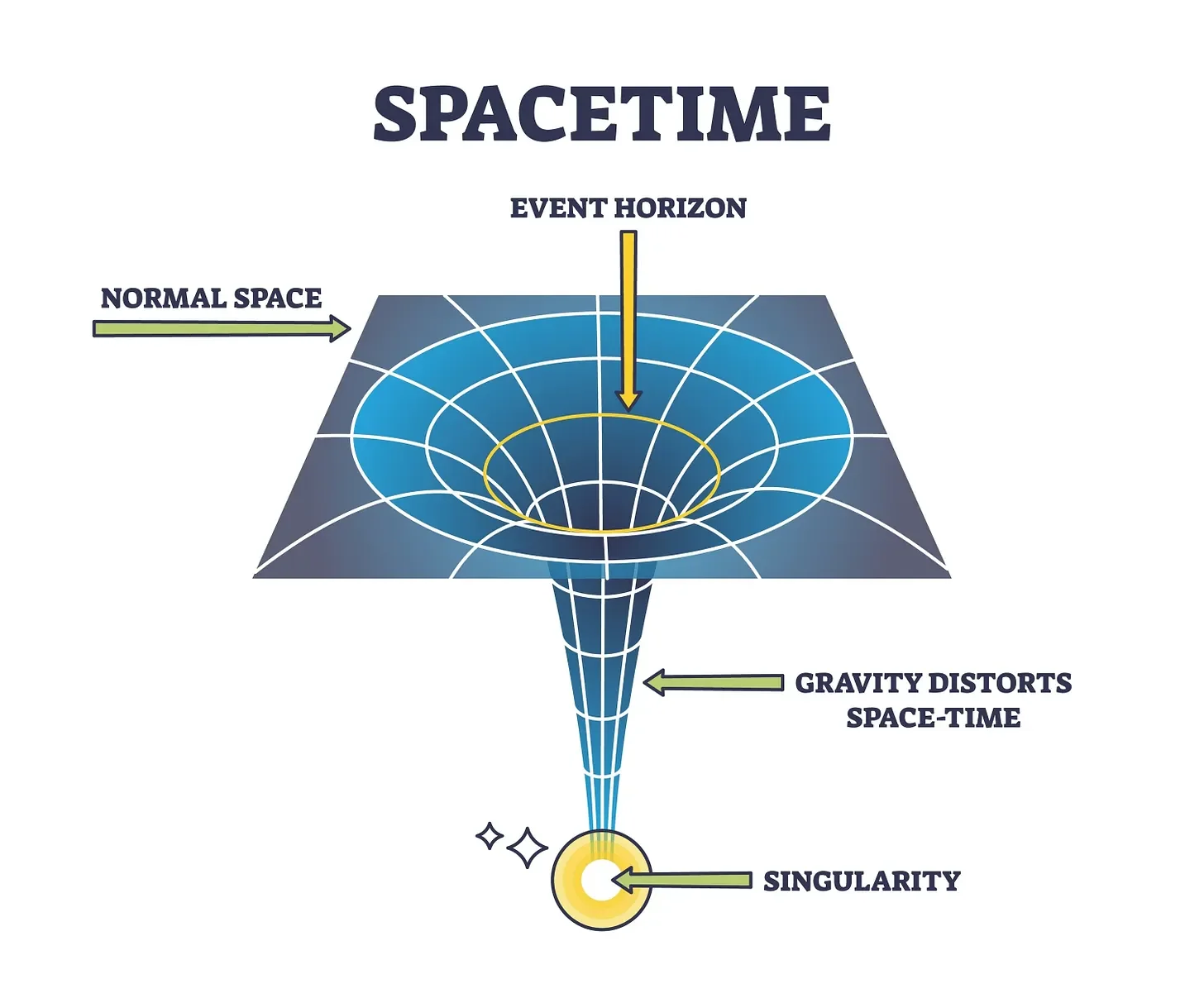
Digital Physics (“It from Bit”)
Coined by legendary physicist John Archibald Wheeler, this theory suggests that the universe is not made of matter or energy, but of information. Every particle, every field, and every force is ultimately a series of yes/no questions (bits).
The universe is a giant data processing system.
We pay for the theorising and the research. Why? It might lead to profits or an advantage in the Great Game, or we are just curious.
“Come on, man, use value, growth, everybody wins.”
Consciousness: Is the Universe alive?
This concept harkens back to the ancient philosophical view that consciousness is not a unique trait of human brains, but a fundamental property of matter, like mass or charge.
According to this view, an electron has a rudimentary form of““experienc”” or consciousness. When billions of them come together in a brain, those micro-experiences combine to form human consciousness.
Neuroscientists are struggling to explain how dead matter (neurons) gives rise to subjective experience (the Hard Problem). Panpsychism solves this by saying matter was never dead to begin with.
Convenient.

It would be nice to be able to do the math and physics behind the theorising.
Let’s be clear: I know Ben. He is a genuine thinker with skills and imagination—sincere, expert, and driven by a boundless, optimistic curiosity. The world needs men like Ben. But Ben is the host organism. For every honest explorer like him, there is a swarm of parasites drafting off his wake. These pretenders don’t care about the science; they care about the spread. They strip-mine his authentic intellect to manufacture profitable bullshit, selling a diluted version of his vision to people who don’t know the difference.
Now, this is not to suggest that we are all empty vessels, waiting to be filled by the overflow of another person’s mind. We are not merely passive receivers of the signal.
Almost all “creations” are reconstructions. We stand on the shoulders of giants until we forget whose neck we are stepping on. A genuinely original thought is possible, but it is an agonizing rarity. Most human beings live and die without ever producing one. Consider John Nash. He was not satisfied with mere competence; the need for the unique consumed him. His life demonstrates the terrifying price of that ambition. To hunt for a thought that belongs to no one else is not a hobby; it is an obsession that can break you.
Thou Shalt Not Commit Logical Fallacies
Imagine the career path: you dive into the dark jungle of a terrifying theory, harvest the existential dread, and package it for the trade paperback market. How many volumes can you squeeze out of the Simulation Hypothesis? Who buys them? The bored, the anxious, and the pseudo-intellectual, or, like me, the science fiction fan and want-to-be physicist. Do we probe for truth, or do we serve demographics? Whether I argue that a quartz crystal has consciousness or that we are merely code, the result is the same: I manufacture content. I define ‘mass,’ ‘charge,’ and ‘soul’ not to explain the universe, but to entertain my fans. The only relevant question remains: Does this specific brand of metaphysical jargon sell books?
AI BREAK:
In complexity science and systems theory, the entity you are describing is technically called a Complex Adaptive Agent (or simply an Agent) operating within a Complex Adaptive System (CAS).
This concept is the bridge between biology, sociology, and economics. It explains how individual agents—whether they are cells, ants, or humans—can act independently yet produce sophisticated, order-rich structures without any central command.

1. The Agent
In a Complex Adaptive System, an agent is any distinct unit capable of making decisions or reacting to its environment.
Examples: A single neuron in a brain, a trader in a stock market, a bird in a flock, or a voter in a democracy.
Local Knowledge: Crucially, the agent does not know what the whole system is doing. It only acts on local information (e.g., a bird only pays attention to the 2-3 birds continuously next to it, not the whole flock).
2. Interconnected & Interdependent
Interconnected: The agents are linked. If one agent changes its state (e.g., a neuron firing), it sends a signal to its neighbors.
Interdependent: The survival or success of one agent relies on the behavior of others. You cannot analyze one agent in isolation (reductionism) because its identity is defined by its relationships.
3. Spontaneously Self-Organizing
This is the system’s ability to create order without a boss or an architect.
No Central Brain: There is no “CEO agent” telling the colony how to build a bridge. The bridge structure arises spontaneously because every ant is following simple, local rules (like “if you touch a gap, link u”).
Autopoiesis: In living systems, this is often called autopoiesis (self-creation). The system (like a cell) constantly rebuilds itself using its own components.
4. Emergent
Emergence is the “magic” trick of complexity. It refers to properties that belong to the whole but cannot be found in the parts.
Example: Consciousness is an emergent property. You can study a single neuron for a thousand years and never find “thought.” Thought only emerges when billions of interconnected neurons interact.
The Formula:
1 + 1 = 3. The extra value is the emergent property.
The Political/Social Connection
Critique of Capitalism/Hierarchy: Traditional capitalist or monarchist views often assume a Top-Down hierarchy (God -> King -> People, or CEO -> Worker).
CAS View: Complexity theory argues that the most robust systems are Bottom-Up Order (Democracy/Community), which emerges from the interactions of interdependent people (Agents), not from the dictates of a ruler.
Socialist Parallel: The idea that the whole is greater than the sum of its parts, and that the welfare of the agent is tied to the welfare of the system, echoes the socialist focus on the collective over the individual “profit.”
One thing seems highly probable: if our way of managing things, Global Market Capitalism, kills the living systems we depend on, all of this inquiry ends, whether it’s scientific, utilitarian, profitable, or not.

More theories:
Thomas Aquinas, the GOAT of medieval philosophy, dedicated part of his Summa Theologica to this. He asked: “Can several angels be in the same place?”
I am a huge fan of Aquinas; his logic was elegant and rigorous:
Angels are incorporeal (is that right? How would I know?). They have no body, no mass, and no volume. They are pure intellect/spirit. (What is intellect and spirit?)
Therefore, they do not take up space as a human or a rock does.
However, an angel is defined by where it acts or applies its power. (What do we mean by power?)
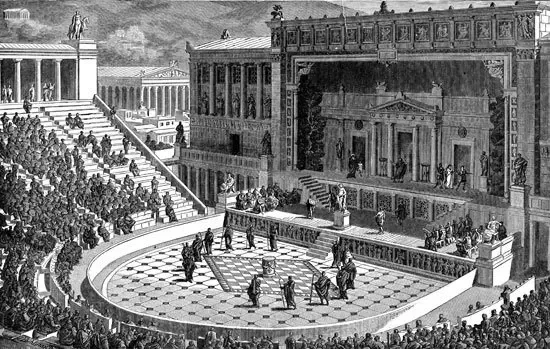
So... what is the answer?
Depending on which rule set you use, there are three possible answers:
Answer A: One (The Aquinas View)
Thomas Aquinas argued that while angels don’t have dimensions, they act at a specific location. He argued that two distinct spiritual powers (spiritual powers?) cannot act entirely on the same point at the same time.
Verdict: Only one angel can be on the head of a pin at any given moment.
There you go!
Answer B: Infinity (The “Ghost” View)

If you reject Aquinas’s rule about “action” and focus simply on physics, angels have zero mass and zero volume. (What are they?)
Verdict: Because you can stack infinite zeros without ever filling a cup, an infinite number of angels can fit on a pinhead.
Answer C: Zero (The Materialist View)
If angels are purely spiritual, they do not exist in spatial dimensions at all. Asking where they are is like asking, “How much does the color blue weigh?” It is a category error.
Verdict: Zero. Angels exist in a realm outside of physical space (the pin). (What is a nonphysical realm outside space and time?)
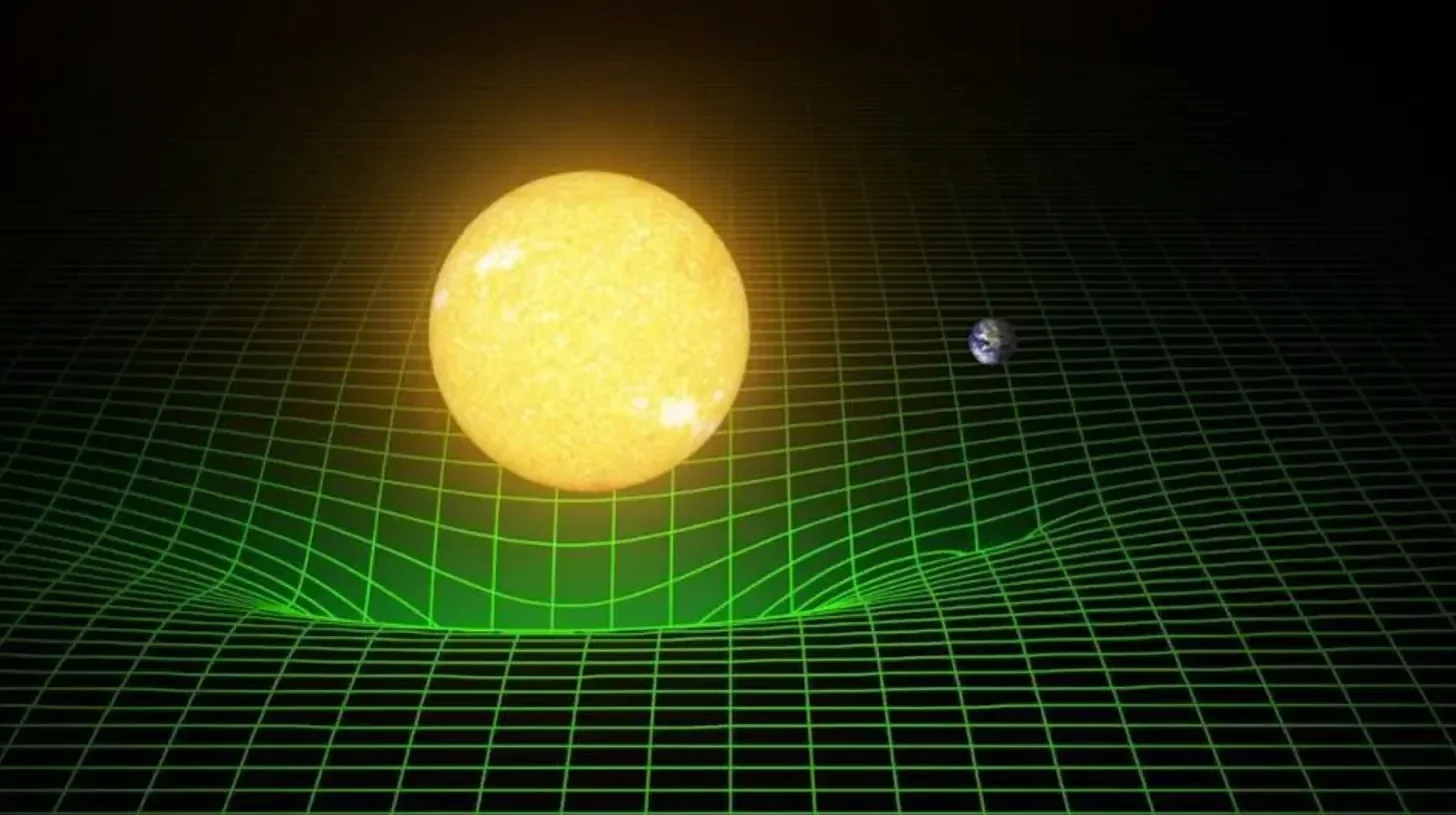
***This is why I love practical, how-to videos on YouTube. How to lay bricks, how to dig a well, how to grow spuds, how to darn socks…
Biocentrism
Proposed by biologist Robert Lanza, this theory flips the standard model on its head. Instead of the universe creating life, life creates the universe.
Space and time are not objective realities but tools our minds use to organize information. Without a conscious observer, the universe exists only as a probability wave (linked to the Quantum Observer Effect). Lanza argues that biology is the central driving force of reality, not physics.
Orchestrated Objective Reduction (Orch-OR)
A theory by Nobel laureate Roger Penrose and anesthesiologist Stuart Hameroff. It argues that consciousness originates from quantum vibrations inside microtubules (tiny structures within brain cells).
It suggests the brain is a biological quantum computer. For years, physicists ridiculed this, saying the brain is “too warm and we” for delicate quantum states. However, recent experiments have begun to show quantum effects in biological systems (like photosynthesis), bringing this theory back into the spotlight.
***Well, there you have it: if we can find a way to make complex civilization sustainable, someday we might have all the answers and finally know who and what our cosmic daddy is, and how he does what he does. Or, we may create a cosmic daddy thereby becoming a cosmic daddy. I know, you want to be the cosmic daddy.
And if you are the philosopher type, how about doing your head in with a book about the scientific evidence for God—the mother of all social constructs!
The law of large numbers is a fundamental principle in probability theory that asserts that, as a random experiment is repeated numerous times, the average of the outcomes will converge toward the expected value, or actual average, of those outcomes.
Impossible Event: An event that cannot happen is called an impossible event. For example, getting both head and tail in simultaneously in tossing a coin. The probability of an impossible event is 0, i.e., P(E) = 0.
The principle hinges on the idea that seemingly improbable events, from the individual to the cosmic scale, are commonplace because of several factors.
God is the ultimate brand. He sells well because He has zero manufacturing costs and infinite demand. Even after centuries of debate, we still have no idea what the ‘product’ actually is—what God is made of, or how He operates within the laws of physics. But the specifics don’t matter to the shareholders.
What matters is that men want to believe they know the right story. They want a God who looks like them and votes like them. This anthropomorphic projection serves the Players of the Great Game perfectly. It allows them to bypass the messy work of ethical reasoning and appeal to the ‘Man Upstairs.’ We have taken the ineffable, terrifying power of the ‘OG Creator’ and rebranded it as Gods-R-Us, a convenient franchise that validates our social constructs and keeps the cash flow positive.
The “Great Reversal” and the Rhetoric of Certainty
Why bring God into this discussion of Capitalism? Because God is an enabler, empowerer, and justifier of the deeds of strong men with powerful cliques of mostly male supporters. Without Big Gods, it seems, we wouldn’t have The Great Game.
This is not a discussion of the value of spirituality, or other forms of mystical connection with Great Nature, such as generic deism, animism, polytheism, pantheism, ecospirituality, or naturalistic spirituality, although I do mention Spinoza.
God, The Science, The Evidence (originally titled Dieu, la science, les preuves) by Michel-Yves Bolloré and Olivier Bonnassies marks a significant moment in the contemporary dialogue between faith and reason, primarily due to its aggressive claim that the era of materialist dominance is over. The authors, leveraging their backgrounds in engineering and industry, propose a narrative of a “Great Reversal” in the history of thought. (More end-of-history nonsense, as if we’ve finally arrived.) They argue that while the scientific trajectory from Copernicus to Freud seemed to distance humanity from the divine, the discoveries of the 20th and 21st centuries—specifically in thermodynamics, cosmology, and molecular biology—have swung the pendulum back, transforming the existence of a Creator from a matter of faith into a rational necessity supported by “proofs”.
While reading the book, I kept thinking about the misuse of probability, the anthropomorphic nature of the “Intelligent Designer,” His coronation of Homo sapiens, and the socio-political implications of such apologetics in an age of polycrisis. The book functions less as an objective inquiry into the nature of reality and more as a sophisticated rhetorical construct designed to leverage the prestige of “hard science” for ideological and theological ends. By presenting highly selective interpretations of scientific data—particularly regarding the fine-tuning of universal constants and the complexity of biological life—the authors construct a “God of the Gaps” whose existence is predicated entirely on the current boundaries of our knowledge. These are age old arguments repackaged in a new vocabulary for a modern audience dependent on science, engineering, technology, and capitalist markets.
The “God” revealed by these supposed scientific proofs is logically vacuous. Improbable numbers tell us nothing about the nature of God. A deity inferred from the fine-structure constant or the expansion rate of the universe possesses no necessary connection to the personal, intervening God of the Judeo-Christian tradition. This entity is a philosophical abstraction, a “Cosmic Architect” devoid of the, mystical, moral, and relational attributes that define religious experience. The authors rely on historical arguments and dismiss materialist philosophy, a move that reveals the project’s true nature: it is a theological defense masquerading as a scientific demonstration.
While global culture destroys living systems, our primary justification is that God has a plan, or everything happens for a reason.
Below, I’ll deconstruct the mathematical and scientific fallacies at the heart of the book, particularly the misuse of the Law of Large Numbers and the “Junkyard Tornado” argument. What are the classical arguments for God’s existence through the lens of evolutionary psychology and the “storytelling” nature of the human mind? I think that our propensity to detect “agency” in the cosmos is a cognitive adaptation rather than a perception of objective reality. I’m interested in the difference between the “interventionist” God of Bolloré and Bonnassies with the “immanent” God of Baruch Spinoza—Deus sive Natura. Why do we retreat into supernaturalism? I think failing to listen to Great Nature in every possible way poses a significant ethical danger in the face of the modern polycrisis, particularly climate change, and ongoing ecocide. If we are moral agents, we must do something to stop the destruction of living systems.
Is God a Capitalist—does “He” want us to live long and prosper?
The Statistical Illusion: The Law of Large Numbers and the Nature of Chance
A central pillar of God, The Science, The Evidence is the argument from improbability. The authors repeatedly cite staggering numbers—odds of 1 in 10^{40,000} for the spontaneous formation of enzymes, or the vanishingly small tolerance of gravitational parameters—to argue that “chance” is an irrational explanation for the universe and life. This rhetorical strategy relies on overwhelming the lay reader with magnitude, banking on the intuitive assumption that “extremely unlikely” is synonymous with “impossible.” However, this approach betrays a fundamental misunderstanding of probability theory, specifically the Law of Large Numbers and the nature of a posteriori probability in complex systems.
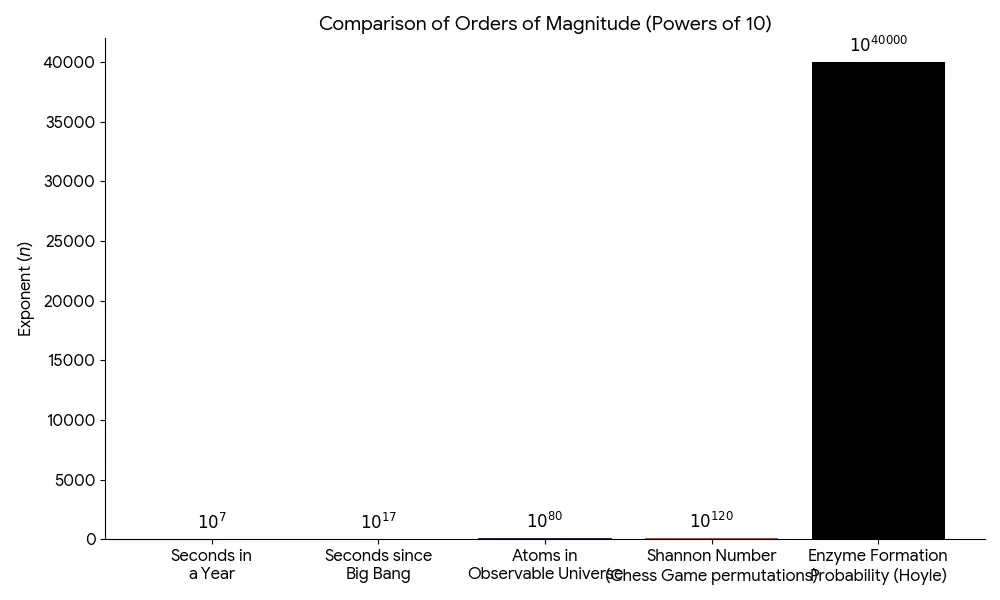
The Misapplication of the Law of Large Numbers
The Law of Large Numbers states that as the number of trials in a probabilistic process increases, the actual results will converge on the expected theoretical probabilities. In the book, the authors invoke a colloquial, inverted version of this law, suggesting that if an outcome is sufficiently improbable (such as a specific universe or a specific protein), it cannot happen by chance alone and thus requires a designer.
This reasoning is flawed because it treats the outcome we observe (our specific universe, our specific biology) as a prediction made before the event, rather than an observation made after the fact. This is known as the “Lottery Fallacy.” The odds of any specific individual winning a national lottery are millions-to-one against. If John Smith wins, it would be fallacious to argue that because the odds of John Smith winning were so low, the lottery must have been rigged in his favor. The low probability applies to the specific prediction, but the probability that someone wins is 1 (100%).
Similarly, the authors consider the universe as it exists and calculate the probability that this specific configuration arose by chance, finding it infinitesimally small. However, matter interacting under the laws of physics must produce someconfiguration. The authors fail to demonstrate that this configuration is the only one capable of sustaining any form of complexity or “interest” from a physical perspective. They conflate “improbable” with “impossible,” ignoring the fact that in an infinite or sufficiently vast system (which modern cosmology suggests), the realization of improbable events is not just possible; it is inevitable.
The Fallacy of the Junkyard Tornado
Nowhere is the misuse of mathematics more egregious than in the book’s treatment of biology. The authors resurrect the “Junkyard Tornado” argument, famously attributed to astrophysicist Fred Hoyle (and echoed by creationists), which posits that the probability of a higher life form emerging by chance is comparable to a tornado sweeping through a junkyard and assembling a fully functional Boeing 747 by chance.
Sequential vs. Simultaneous Trials
The calculation cited—1 chance in 10^{40,000} for the assembly of the necessary enzymes—assumes that the trials occur sequentially. It imagines a single “roll of the dice” occurring, failing, and then another roll occurring. Under this model, the universe’s age is insufficient to produce life. However, this is a straw man of prebiotic chemistry.

In the primordial oceans of Earth (or any similar planet), chemical interactions did not happen one at a time. They happened simultaneously, involving Avogadro’s number of molecules (6.022×10236.022 to the 23rd power) interacting in countless micro-environments every microsecond for hundreds of millions of years. When one moves from sequential trials to simultaneous trials on a planetary scale, the probabilistic resources available explode exponentially. The “search space” for stable molecular configurations is explored not by a single agent rolling dice, but by a massively parallel processing system (the ocean).
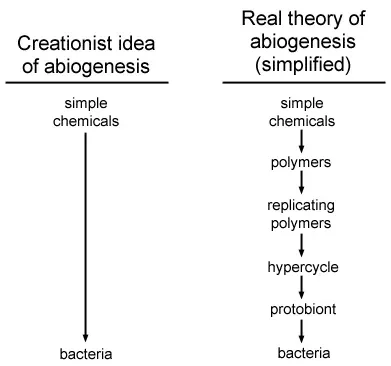
Albert Einstein’s famous quote, “God does not play dice,” expresses his disbelief in the inherent randomness and probability central to quantum mechanics, suggesting the universe operates under deterministic, understandable laws, not chance, a concept he debated fiercely with Niels Bohr in the 1920s and 30s. He used “God” metaphorically for the creator of these fundamental laws, not a divine being, emphasizing that underlying rules govern everything, even if quantum mechanics suggested otherwise.
The Error of “Modern” Complexity
The calculation also commits the error of assuming that the target of abiogenesis was a “modern” bacterium or a complex protein like hemoglobin. The authors ask, “What are the odds of a ribosome appearing by chance?” This is akin to asking, “What are the odds of a Ferrari forming from iron ore in one step?”
Evolutionary biology and abiogenesis research posit that the first life forms were incredibly simple—likely self-replicating peptides or RNA molecules, perhaps only 30-40 subunits long, not thousands. The probability of forming such simple replicators is orders of magnitude higher than forming a modern cell. Once a simple replicator exists, natural selection takes over. The authors’ math fails to account for this transition. They calculate the odds of the end product (the 747) appearing in a single step, rather than the odds of the first step (a wheel or a bolt) appearing, followed by a process that preserves functional assemblies.
Physics and the “Parameter Space”
The authors apply similar logic to cosmology, arguing that the fundamental constants of nature (such as the gravitational constant G and the cosmological constant) are “fine-tuned” to a degree of precision that defies chance. They claim that if G were different by one part in 10^{40}, stars would not form.

The Stenger Rebuttal: Coupled Constants
Physicist Victor Stenger has rigorously debunked the premise that life is impossible if constants vary. The authors’ error lies in varying one constant while holding all others fixed. In reality, the constants of nature are often coupled. For example, the strength of gravity and the strength of electromagnetism are related to the fundamental properties of spacetime and matter.
Stenger’s simulations, which vary multiple constants simultaneously, demonstrate that a wide region of the “parameter space” (the set of all possible values for constants) results in universes capable of sustaining stars and long-lived structures. While these stars might differ from our sun (e.g., burning for a shorter time or being redder), they would still provide the energy gradients necessary for complexity. The “life-permitting” zone is not a needle in a haystack; it is a significant region of the possibility landscape. The authors’ insistence on this specific universe as the only viable one is an example of anthropocentric bias—assuming that “life” must look exactly like us.
The Multiverse and the Law of Large Numbers
Finally, the authors dismiss the Multiverse hypothesis as a desperate attempt to avoid God. Yet, the Multiverse is a direct prediction of Inflationary Cosmology—the very theory they cite to prove the Big Bang. If inflation occurred (which explains the uniformity of the cosmic microwave background), it likely occurs eternally, generating an infinite number of “bubble universes” with varying constants.
In an infinite Multiverse, the Law of Large Numbers guarantees that every physically possible universe will exist. The probability of a life-permitting universe existing is 1. The fact that we observe a life-permitting universe is not a miracle; it is an observational necessity (the Anthropic Principle). We are here to observe it because this is the type of universe that permits observers. The authors’ rejection of this is not scientific; it is a preference for a singular, miraculous narrative over a statistical, naturalistic one.
Deconstructing Classical Theism: Classical Arguments as Narrative Artifacts
The major classical arguments for God’s existence, with an explanation of why they reveal more about human storytelling than divine reality.
The “Cognitive Science of Religion” (CSR) views religious beliefs as byproducts of cognitive mechanisms evolved for survival. The “God” derived from these arguments is not an objective entity but a reflection of the human mind’s need for agency, narrative closure, and moral order.
The Cosmological Argument (The Argument from First Cause)
The Argument: Everything that begins to exist has a cause. The universe began to exist. Therefore, the universe has a cause (God).
The Storytelling Nature: This argument satisfies the cognitive bias known as “teleological reasoning”—the assumption that everything exists for a reason and comes from an agent. As storytelling animals (Homo narrans), humans struggle with the concepts of infinite regress and brute existence. A story needs a “Once upon a time,” and the Cosmological Argument provides the ultimate opening line.
Why it tells us nothing about God: As Hume noted, even if we grant a “First Cause,” this cause need not be a person, a spirit, or a moral being. It could be a quantum fluctuation, a brane collision, or a mindless principle. The leap from “Cause” to “Father” is purely a narrative necessity, not a logical one. It fills the “gap” in the story but offers no content about the “character” of the cause.20
The Teleological Argument (The Argument from Design)
The Argument: The universe exhibits complex order (like a watch). Order implies a designer. Therefore, the universe has a Designer.
The Storytelling Nature: This relies on the Hyperactive Agency Detection Device (HADD). Humans evolved to detect agents (predators and prey) in their environment. We are hardwired to see “intent” in patterns. When we see the complexity of a cell or the orbit of a planet, our brain defaults to “Who made this?” rather than “How did this evolve?” It is an anthropomorphic projection of our own tool-making capacity onto the cosmos.
Why it tells us nothing about God: As Kant argued, we can only infer a designer relative to the artifact. A watchmaker is limited by his materials and skills. If the universe is the artifact, the designer is responsible for its flaws—cancer, tsunamis, entropy. The “God” of Design is a limited, perhaps incompetent, architect (or a committee of them, as Hume jested), not the omnipotent God of faith. It tells us we crave order, not that the order is divine.
The Moral Argument
The Argument: Objective moral values exist. Without God, objective moral values would not exist. Therefore, God exists.
The Storytelling Nature: This argument reflects the “Imagined Order” described by Yuval Noah Harari. For large groups of humans to cooperate, they need shared myths (laws, rights, gods) that are treated as objective. The Moral Argument is the philosophical expression of this survival mechanism—the fear that without a “Cosmic Enforcer,” the social order would collapse. It is a projection of the tribal “Alpha” or patriarch onto the universe to ensure social cohesion.
There are no gods, no nations, no money and no human rights, except in our collective imagination. —Yuval Noah Harari (He’s not a favorite of mine but the quote is terse.)
Why it tells us nothing about God: It conflates “socially useful” with “ontologically true.” That we need to believe in objective morals to survive does not mean the source of those morals is a supernatural entity. It reveals our evolution as social primates, not the existence of a celestial judge.
“[T]he choice of human groupings for cultural comparisons is not a natural or scientific choice, but a political one.”― Pascal Boyer, Religion Explained: The Evolutionary Origins of Religious Thought
The Ontological Argument
The Argument: God is “that than which nothing greater can be conceived.” Existence is a “great-making” property. Therefore, God must exist (because if He didn’t, He wouldn’t be the greatest).
The Storytelling Nature: This is the ultimate triumph of language over reality. It assumes that because we can define a character in our head, the character must exist in the world. It reflects the magical thinking that words have power over substance—a common feature in mythological systems (e.g., casting spells).
Why it tells us nothing about God: Kant famously refuted this by stating, “existence is not a predicate.” You cannot define something into being. This argument tells us about the structure of human language and concepts, but it provides zero data about the external world. It is a word game, not a discovery.
The Biological Misconceptions: Complexity, Materialism, and the Great Grift/Con
I think books like these represent, as James Randy said, “flim flam” for people who don’t understand physics, large numbers, statistics, or probabilities. I think saying this is justified when analyzing how the authors treat the philosophy of materialism and the science of biology. They use “materialist” as a pejorative, equating it with irrationality, while simultaneously using a hyper-mechanistic (materialist) view of God as a “super-engineer.”
The Straw Man of Materialism
The authors define “materialism” as the belief that “chance alone” governs the Universe. This is a caricature. Scientific naturalism (the proper term) does not assert that everything is random; it claims that laws and constants govern the Universe.
Determinism vs. Chance: Physics is largely deterministic (or probabilistic within strict limits in quantum mechanics). Chemistry is deterministic. Biology results from deterministic selection acting on random variation. By reducing materialism to “pure chance,” the authors create a false dichotomy: either “Random Chaos” or “God.” They ignore the third, actual position of science: “Law-Governed Evolution.”
The “Irreducible Complexity” Rebrand
I generally do not find logical syllogisms to be the best way of expressing scientific arguments, which are probabilistic in nature. Rather than arguing that an irreducibly complex system “must have been brought about by intelligent design,” this is better nuanced by stating that such a system is better explained by design than by unguided evolutionary processes. Is it impossible that such a system could be brought about by unguided evolution? No, but it is exceedingly improbable. Another reason I prefer not to use syllogisms in expressing arguments is that often a piece of evidence can increase the probability of a hypothesis without establishing it as true. Presenting each argument as a syllogism leads to the unfortunate misimpression that one can evaluate each evidence separately and, upon finding each individually to be non-decisive, move on to the next — rather than considering the evidential force of all the evidence taken in aggregate. —Dr Jonathan McLatchie (Fellow of The Discovery Institute)
The arguments in the book regarding the “impossibility” of intermediate stages in the development of the eye or the flagellum are repackaged versions of “Irreducible Complexity,” a concept championed by the Intelligent Design movement and soundly rejected by the scientific community (e.g., in the Kitzmiller v. Dover trial).
What the school board settled on was this: starting in January 2005, science teachers would be required to read the following statement to students in ninth grade biology at Dover High School:
The Pennsylvania Academic Standards require students to learn about Darwin’s Theory of Evolution and eventually to take a standardized test of which evolution is a part.
Because Darwin’s Theory is a theory, it continues to be tested as new evidence is discovered. The Theory is not a fact. Gaps in the Theory exist for which there is no evidence. A theory is defined as a well-tested explanation that unifies a broad range of observations.
Intelligent Design is an explanation of the origin of life that differs from Darwin’s view. The reference book, Of Pandas and People, is available for students who might be interested in gaining an understanding of what Intelligent Design actually involves.
With respect to any theory, students are encouraged to keep an open mind. The school leaves the discussion of the Origins of Life to individual students and their families. As a Standards-driven district, class instruction focuses upon preparing students to achieve proficiency on Standards-based assessments.
By trading on people’s misunderstanding of what a scientific theory is, the statement was intended to make the theory of evolution appear weak and inconclusive and offer intelligent design as a robust alternative to it.
The disclaimer was challenged in court, and soon enough an epic trial unfolded. Evolution was under attack once again by religious extremists and seeking rescue from the courts.
The Argument: Some biological systems are so complex that if you remove one part, they stop working. Therefore, they could not have evolved step by step.
The Rebuttal: Evolution often works by exaptation (co-option). A structure might evolve for one purpose (e.g., a secretory system) and later be co-opted for another (e.g., a flagellar motor). The “intermediate” stages were functional, just for a different job. The authors’ refusal to engage with this vast body of biological literature suggests an ideological blindness rather than a scientific inquiry.
The “Information” Fallacy
A recurring theme is that DNA contains “information,” and “information always comes from a mind.”
The Con: This relies on an equivocation on the word “information.” In Information Theory (Shannon), information is simply a measure of the reduction of uncertainty; it requires no semantic meaning or conscious sender. DNA “code” is a metaphor for the chemical correspondence between codons and amino acids. It is not a message written by a ghost; it is a physical template shaped by the survival of the fittest. Attributing it to a “Mind” is a category error—mistaking the map for the territory.
Shannon’s Information Theory, founded by Claude Shannon in 1948, is the mathematical framework for quantifying, storing, and communicating information, treating it as a measurable entity (bits) to overcome noise. It introduced key concepts like Entropy (uncertainty) and the Noisy-Channel Coding Theorem, proving that reliable communication over noisy channels is possible by encoding data efficiently, forming the bedrock for digital communication, data compression (ZIP, MP3), and storage.
Deus Sive Natura: The Spinozist Alternative to the Interventionist God
For me, Spinoza’s God is a comfortable proximal train of thought approaching an understanding of God without psychedelics or mystical experiences, and even those may have nothing at all to do with a creator God concerned with me. My preference, I think, highlights the fundamental flaw in the book’s theology. Bolloré and Bonnassies argue for an Interventionist God—a deity who stands outside the Universe and tinkers with the constants, sparks the Big Bang, and performs miracles to prove His existence. In contrast, Baruch Spinoza offers a Naturalist God (Deus sive Natura)—a concept that is fully compatible with science precisely because it rejects the miraculous.
Transcendence vs. Immanence
The Book’s God (Transcendent): This God is an external agent. He is a “Supreme Intelligence” who makes choices, has a will, and intervenes in history. And God thinks Homo sapiens are his supreme creations. This model creates the “God of the Gaps” problem: as science explains more (e.g., how the eye evolved), this God has less to do. He is constantly retreating.
Spinoza’s God (Immanent): For Spinoza, God is the Universe (or rather, the infinite substance of which the Universe is a mode). God does not “create” nature; God is nature. There is no “outside.” This God does not “intervene” because that would mean violating His own nature (the laws of physics, etc.).
Spinoza’s God explains the order of the Universe not as a design choice, but as a logical necessity. The laws of physics are the “thoughts” of God. Science is not the enemy of this God; it is the study of God.
Necessity vs. Teleology
The Book’s God (Teleological): The authors argue that God tuned the Universe for a purpose (human life = human supremacy). Teleology—the belief in final causes. Spinoza famously mocked this as the “sanctuary of ignorance.” He argued that humans project their own obsession with purpose onto a purposeless reality. We think the sun exists to warm us, but it just exists.
Spinoza’s God (Necessitarian): In Spinozism, things are the way they are because they must be. The sum of the angles of a triangle is 180 degrees, not because God “chose” it, but because it is the nature of a triangle. Similarly, the Universe exists as it does by necessity, removing the problem of “improbable numbers”—the numbers are not lottery tickets; they are geometric truths.
The Theology of the Polycrisis: Faith, Fatalism, and the Technical Challenge of Survival
Faith is a comfort, but it is not a strategy. It cannot solve the problem of a global economy structured as an omnicidal heat engine, nor can it mitigate the cascading failures of the polycrisis. The worldview that retreats into mysticism in the face of existential risk is dangerous because it denies our fundamental nature: we are biological entities woven into the fabric of a dying ecosystem.
Spinoza’s analysis remains vital. He understood the difference between the divine and the dogmatic. History confirms this: Jesus was not a Christian, Marx was not a Marxist, and Buddha was not a Buddhist. These men were disruptors; the ‘Isms’ created in their wake are containment strategies. Religious and political institutions are power structures designed to compel the masses to worship their own subjugation. They sacralize the greed of the ‘Players’ and rebrand the suffering of the poor as spiritual discipline. When modern nationalists invoke ‘Western Civilization’ to justify dominance, they are channeling the bureaucratic empire-building of Saint Paul, not the radical, kenotic love of the historical Jesus.
In the context of power dynamics—whether geopolitical, biological, or ideological—containment is the art of strangulation without touching the victim’s throat.
It is a strategy of attrition. You do not attack the enemy directly; you isolate them, cut off their resources (calories, capital, or allies), and wait for their internal contradictions to cause a collapse.
Here is how the “Players” execute containment across different domains:
1. The Geopolitical Stranglehold (The Kennan Playbook)
George F. Kennan drafted the blueprint in 1947 to deal with the Soviet Union. He argued that direct war was suicide, but doing nothing was fatal. The solution was containment: a “long-term, patient but firm and vigilant containment of Russian expansive tendencies.”
The Mechanism: The Anglosphere builds a ring of alliances, military bases, and trade pacts around the target nation (The Heartland).
The Goal: Deny the target access to the open ocean and global markets. You force them to burn their internal energy to survive.
2026 Application: Look at the US’s military positioning in the South China Sea or at economic sanctions on Russia. It is the same Victorian game of “The Great Bear” vs. “The Whale,” updated with hypersonics.
2. Domestic Containment (The Cordon Sanitaire)
Notice how a ruling class handles a “virus” inside its own borders—be it a populist uprising, a radical ideology, or a “cancelable” individual.
The Mechanism: The “Cathedral” (media, academia, tech) does not argue with the dissident; that gives them oxygen. Instead, they build a wall.
De-platforming: Remove the megaphone.
De-banking: Cut off the capital flow.
Shadowbanning: Let them speak into a void where no one can hear.
The Goal: To treat the opposing idea like a pathogen. You prevent it from jumping hosts. The idea doesn’t die because a lot of research proved it wrong; it dies because it starved to death in a quarantine cell.
3. Biological and Cyber Containment
The state’s logic is recursive. What works for nations works for code and cells.
Cyber: When a system detects a rogue AI or malware, it doesn’t just delete it; it “sandboxes” it. It creates a fake reality for the code to run in, observing its behavior without letting it touch the kernel.
Epidemiology: We saw this globally. The strategy is to break the transmission vector. You identify the “super-spreaders” and remove them from the graph.
Containment is the weapon of the status quo. It assumes that time is on your side. If you can keep the “cancer” (the rival nation, the bad idea, the virus) locked in a box long enough, the laws of thermodynamics take over. The contained entity runs out of energy and dies, while the container watches from a safe distance.
The Architect of Dogma and the Prophet of Reason: Spinoza’s Deconstruction of the Pauline Institution and the Recovery of the Philosophical Jesus
The Theological-Political Fracture
Benedict de Spinoza
In the intellectual history of the West, few texts have severed the continuity of tradition as completely as Baruch Spinoza’s Tractatus Theologico-Politicus (TTP), published anonymously in 1670. Emerging from the volatile political climate of the Dutch Republic, the treatise was ostensibly a defense of the “freedom to philosophize,” yet it functioned as a demolition of the theological foundations upon which European ecclesiastical and political authority rested. Central to this demolition was Spinoza’s audacious re-evaluation of Christianity’s origins. Spinoza posited a radical rupture between Jesus of Nazareth—a Jewish reformer and supreme philosopher who taught a universal, rational morality—and the “Christianity” that subsequently developed into an institution of power, constructed mainly by the Apostles, preeminently by Paul of Tarsus.
U.S. Congresspeople, Senators, and Presidents claim to be doing God’s work.
Let’s explore Spinoza’s thesis that historical Christianity is, in essence, an Apostle Paul institution designed to serve the interests of power—both clerical and monarchical—rather than the liberating intent of its founder. This distinction is not merely a historical observation for Spinoza; it is a political weapon. By separating the “mind of Christ” (reason and charity) from the “institutions of the Church” (dogma and obedience), Spinoza sought to strip the clergy of their claim to divine right, thereby empowering the secular State to govern without the interference of a “state within a state.”
Let’s traverse the intricate landscape of Spinoza’s biblical hermeneutics, his metaphysical naturalism, and his political theory. It will detail how Spinoza reconstructs Jesus not as the incarnate deity of the Council of Nicaea, but as the embodiment of “Eternal Wisdom”—a human being who communicated with God “mind to mind” rather than through the “imagination” that characterized the Hebrew prophets. Conversely, it will dissect Spinoza’s portrayal of the Apostles as “teachers” rather than prophets, men who, lacking Jesus’ intuitive clarity, resorted to argumentation, accommodation, and the construction of theological systems to manage the unruly masses of the Gentile world. Finally, it will demonstrate how this “Pauline” turn transformed the universal religion of love into a sectarian religion of obedience, creating a mechanism of social control that monarchs and priests have utilized to maintain their dominion over the “wretched” multitude.
The Historical Exigency: The Crisis of the Dutch Republic
To understand the urgency of Spinoza’s critique, one must situate it within the crisis of the Dutch Golden Age. Spinoza was writing during the “First Stadtholderless Period,” a time when the liberal, republican regents, led by Johan de Witt, were locked in a precarious struggle against the Orangist faction seeking to restore the monarchy of the House of Orange. The Orangists were fervently supported by the predikanten—the strict Calvinist clergy—who mobilized the populace against the republicans by accusing them of atheism and heresy.
Spinoza identified this alliance between the monarchical faction and the clergy as the primary threat to the stability of the State and the freedom of the individual. The clergy derived their power from their exclusive claim to interpret Scripture, which enabled them to judge political actions by “divine” standards. Spinoza recognized that as long as the Bible was viewed as a supernatural repository of political and scientific truth, the clergy would hold the “keys to the kingdom.”Thus, the TTP was designed to shatter this authority by proving that the “Word of God” is not a book, but a living truth inscribed on the human heart (Reason), and that the institutional structures of the Church are human inventions, subject to the control of the sovereign State.
The Structure of the Argument
Organized into five major sections, each exploring a dimension of Spinoza’s deconstruction:
The Metaphysics of Prophecy: How Spinoza distinguishes Jesus’ intellectual intuition from the imaginative prophecy of the Old Testament and the Apostles.
The Jewish Reformer: The historical reconstruction of Jesus as a Jew concerned with the interiorization of the Mosaic Law.
The Pauline Construction: The analysis of Paul’s transformation of Jesus’ message into a theological system suitable for the Gentiles.
The Politics of Obedience: How the Pauline institution utilizes superstition, fear, and mystery to serve political power.
The Legacy of Critique: The implications of Spinoza’s thought for modern concepts of secularism, materialism, and the critique of ideology.
The Metaphysics of Prophecy: Imagination vs. Intellect
Spinoza’s separation of Jesus from the Apostles is rooted in his epistemological framework, specifically his theory of prophecy. In the TTP, Spinoza establishes a strictly naturalistic account of revelation. “Prophecy,” he argues, is a function of the imagination, a faculty of the mind that produces images and associations but does not yield clear and distinct ideas (which belong to the intellect).
The Prophets of the Old Testament
Spinoza argues that the Hebrew prophets were not philosophers. They were men of vivid imagination and profound moral virtue, but they did not necessarily possess superior intellectual understanding of the Nature of God.
Mediated Revelation: When the Bible says “God spoke” to Moses or Isaiah, Spinoza interprets this to mean that the prophet imagined a voice, a vision, or a sign. God “accommodated” his message to the prophet’s preconceived notions and the limitations of his understanding. This is why the prophets often contradict one another on speculative matters (e.g., whether God has a body or changes his mind) while agreeing on moral issues (justice and charity).
The Certitude of Prophecy: The certainty of the prophets was moral, not mathematical. It was based on a “sign” given to the imagination, not on the intrinsic necessity of the truth itself.
The Singularity of Christ: Mentem ad Mentem
Against this backdrop, Spinoza presents Jesus of Nazareth as a unique ontological anomaly. He asserts that “Christ communed with God mind to mind” (mentem ad mentem). This phrase is the linchpin of Spinoza’s Christology.
Intellectual Intuition: Unlike Moses, who needed the sound of a trumpet or a burning bush, Jesus perceived the things revealed to him “truly and adequately.” He understood the will of God not as an external command from a lawgiver, but as the eternal necessity of God’s Nature.
The Mouthpiece of God: Spinoza refers to Jesus as the os Dei (mouthpiece of God) and the manifestation of the Sapientia Dei (Wisdom of God). This identification aligns Jesus with the philosophical attribute of Reason itself. Jesus did not merely “hear” the Word of God; he was the articulation of the divine logic inherent in the universe.
The Non-Political Kingdom
Because Jesus understood God intellectually, he realized that the “Kingdom of God” is not a political territory but a state of mind—specifically, the State of “blessedness” (beatitudo) that comes from the intellectual love of God (amor dei intellectualis).
Separation from the State: Unlike Moses, who sought to build a specific political regime (the Hebrew Theocracy), Jesus recognized that the proper “Divine Law” is universal and independent of any state. This insight is crucial for Spinoza’s political argument: if Jesus divorced religion from the State, then the clerical attempt to control the State is anti-Christian.
The Collapse of the Mosaic Constitution
Spinoza views the Law of Moses not as a path to eternal salvation, but as the political constitution of the Hebrew State. Its purpose was to ensure the Israelites’ temporal prosperity and security in the land of Canaan.
Obedience for Reward: The Mosaic Law functioned through a system of temporal rewards (land, victory) and punishments (exile, plague). It required external obedience to rituals and statutes.
The Crisis: By the time of Jesus, the Hebrew State had been destroyed, and the people were under Roman occupation. The “political” function of the Law was defunct. The Pharisees, however, continued to enforce the external rituals as if they were the essence of piety.
The Interiorization of the Law
Jesus’ “reform” was to salvage the moral core of Judaism from the wreckage of its political shell.
From External to Internal: Jesus taught that since the State was gone, the “Law” must be written on the heart. He shifted the focus from ritual purity (which serves the social order) to moral intent (which serves the individual’s blessedness).
Critique of the Pharisees: Spinoza interprets Jesus’ conflict with the Pharisees as a philosophical critique of “superstition.” The Pharisees believed that meticulous observance of rites coerced God into granting favor. Jesus taught that God’s favor (salvation) is nothing other than the peace of mind that follows from virtuous action.
Accommodation to Jewish Concepts
Despite his philosophical purity, Spinoza argues that Jesus still had to “accommodate” his teaching to the people’s ignorance.
Teaching as a Lawgiver: Although Jesus knew that virtue is its own reward, ordinary people were accustomed to thinking in terms of Law and judgment. Therefore, Jesus taught moral truths as if they were commands from a judge, using parables and the language of rewards (heaven) and punishments (hell).
The Difference: However, Spinoza insists that Jesus knew he was speaking metaphorically. The Apostles, particularly Paul, would later mistake these metaphors for metaphysical realities.
The Pauline Construction: From Teacher to Theologian
The pivot point in Spinoza’s narrative is the transition from the personal authority of Jesus to the institutional authority of the Apostles. Spinoza contends that the Apostles were not “prophets” in the same sense as the Old Testament seers, nor did they possess the intellectual intuition of Jesus. They were “teachers” (doctores) who had to interpret what they had seen and heard.
The Apostles as “Doctors” of the Church
In Chapter 11 of the TTP, Spinoza conducts a philological analysis of the Epistles. He concludes that the Apostles wrote not by divine command but by their own lights, often in response to specific administrative problems in the early churches.
Opinion vs. Revelation: Spinoza highlights passages in which Paul distinguishes his own advice from the Lord’s command (e.g., 1 Corinthians 7:40: “I think also that I have the Spirit of God”). For Spinoza, this “I think” (puto) reveals that Paul was reasoning rather than prophesying. He was deducing conclusions from premises, a process subject to error and dispute.
Disagreement and Debate: Spinoza points to the “sharp contention” between Paul and Barnabas (Acts 15:39) and the conflict between Paul and Peter at Antioch (Galatians 2:11) as evidence that the Apostles did not possess a unified, infallible divine revelation. They argued, debated, and compromised—behaviors characteristic of philosophers and politicians, not prophets.
The Gentile Problem and the Invention of Theology
The central challenge for the Apostles, led by Paul, was the mission to the Gentiles. The Gentiles had no history with the Mosaic Law and no cultural framework for Jewish monotheism. To convert them, Paul had to “accommodate” the message of Jesus to a Hellenistic and Roman audience.
De-politicizing the Message: Paul had to strip the Gospel of its Jewish political elements (circumcision, dietary laws) to make it universal.
Re-mythologizing the Message: To replace the authority of the Mosaic Law, Paul constructed a new theological edifice. He introduced the concepts of Original Sin (to explain the universal need for salvation without the Law) and Vicarious Atonement (to explain how salvation is achieved through Christ).
Spinoza’s Verdict: Spinoza views these doctrines not as the “kernel” of Jesus’ teaching, but as the “husk”—necessary accommodations to the Gentile imagination. Paul transformed the death of a philosopher-martyr into a cosmic sacrifice to satisfy a monarchical God. This was a brilliant act of religious engineering, but it moved Christianity away from Reason (which requires no sacrifice) toward superstition (which demands blood).
The Resurrection as Institutional Foundation
Spinoza denies the physical Resurrection of Jesus, viewing it as a physical impossibility. However, he acknowledges that the Apostles believed they saw the risen Christ.
The Power of Imagination: Spinoza suggests that the Apostles, inflamed by their love for Jesus and their grief, projected his image in visions.
The Political Utility: Paul seized upon the Resurrection as the cornerstone of the new faith (”If Christ has not been raised, your faith is futile,” 1 Cor 15:14). By basing the religion on a miracle rather than a teaching, Paul ensured that the institution (which guards the testimony of the miracle) became necessary for salvation. One can discover ethical truths by Reason alone, but one can only know of the Resurrection through the Church.
The Institution that Serves Power
Spinoza’s analysis in the TTP serves as a genealogy of the political theology that dominated Europe. He argues that the institutional structure built by the Apostles, particularly the Pauline insistence on “faith” (doctrine) over “works” (charity), inevitably creates a tool for tyranny.
The Psychology of Dependence
In the Preface to the TTP, Spinoza famously links superstition to fear. “If men could manage all their affairs by a certain plan, or if fortune were always favorable to them, they would never be in the grip of superstition.” But because human life is precarious, men oscillate between hope and fear, making them susceptible to anyone who promises security.
The Clerical Opportunity: The “Pauline institution” exploits this vulnerability. By positing a transcendent God who is angry (Original Sin) and requires appeasement (Sacrifice), the Church positions itself as the sole mediator. The sacraments, managed by the clergy, become the mechanisms of security.
Serving Power: This creates a docile populace. If the people believe their eternal salvation depends on obedience to the clergy, they will obey the clergy even against their own rational self-interest or the laws of the State.
The Alliance with Monarchy
Spinoza observes that monarchical regimes rely on this religious dynamic to maintain power. “The greatest secret of monarchic rule... is to keep men deceived and to cloak the fear by which they must be held in check with the specious name of religion.”
Paul’s Politics: Paul’s command in Romans 13 (“Let every person be subject to the governing authorities”) is often cited as a support for the status quo. Spinoza argues that while Paul intended to keep Christians safe from Roman persecution, the institutionalization of this obedience turned the Church into a pillar of autocracy.
The Divine Right of Kings: The theological model of the universe—one God, one King, one Truth—mirrors the political model of monarchy. By reinforcing the image of God as a celestial King who demands absolute obedience, the Pauline institution legitimates earthly kings.
The “State Within a State” (Imperium in Imperio)
The most dangerous legacy of the Apostolic institution, for Spinoza, is the separation of spiritual and temporal authority.
The Hebrew Unity: In Spinoza’s Hebrew State, religion and politics were one. The Law of God was the Law of the State. There was no separate “church.”
The Christian Split: Because the Apostles had no political power, they established a “spiritual government” alongside the Roman “temporal government.” They claimed jurisdiction over matters of morals, beliefs, and marriage.
The Conflict: As Christianity grew, this “spiritual” jurisdiction expanded, eventually challenging the State’s sovereignty. Spinoza argues that this imperium in imperio is the root of the religious wars and civil strife in Europe. A sovereign cannot rule if a separate institution claims the allegiance of the citizens’ souls.
Dogma as an Instrument of Control
Spinoza critiques the transformation of “Faith” from a moral category (loyalty to God/Justice) to an intellectual category (assent to propositions).
The Definition of Faith: For Spinoza (and, he argues, for Jesus), faith is “to think of God such that obedience to Him follows” (TTP Ch. 14). It is judged by works (justice and charity).
The Pauline Shift: Under the influence of Paul’s theological arguments, the Church defined faith as correct belief regarding the Nature of Christ (substance, nature, person).
The Inquisition: Once faith is defined as “correct opinion,” the institution must police thought. Dissent becomes heresy. This “serves power” by allowing the authorities to persecute political enemies under the guise of religious orthodoxy.
Historical and Cultural Implications: Spinoza as the Anti-Paul
Spinoza’s project can be read as an attempt to reverse the Pauline “corruption” and restore the philosophical purity of Jesus, but within a modern, secular framework.
The Secularization of the “Holy Spirit”
Spinoza reinterprets the “Spirit of Christ” not as a ghostly third person of the Trinity, but as the idea of God which leads men to virtue.
Universalism: This Spirit is present in all men, regardless of their knowledge of the historical Jesus. A Turk or a Chinese philosopher who lives according to Reason possesses the Spirit of Christ more than a baptized Christian who lives by passion and hatred.
The True Catholicity: Spinoza argues that the true “Catholic” (Universal) religion is the religion of Reason, which requires no miracles or historical narratives. The Pauline institution, by insisting on the historical narrative of Jesus (Crucifixion/Resurrection), actually restricts the universality of religion.
Spinoza’s Impact on Modernity
Spinoza’s critique laid the groundwork for the Enlightenment’s approach to religion.
Erastianism: Spinoza advocates the State’s control over external religious forms (ceremonies and church organization) to prevent the clergy from challenging the sovereign. This effectively neutralizes the “Apostle Paul institution” as a political rival.
Liberalism: Simultaneously, Spinoza argues for the absolute freedom of the internal mind. The State can control the Church, but it cannot control the individual’s Reason. This bifurcated approach—state control of the institution, absolute freedom for the individual—is Spinoza’s solution to the theologico-political problem.
The Materialist Legacy
The snippets provided in the research material hint at a connection between Spinoza and later materialist thought (Marxism/Dialectical Materialism). While Spinoza predates Marx by two centuries, his critique of the “Pauline institution” prefigures the materialist critique of ideology.
Religion as Superstructure: Spinoza treats the intricate theology of Paul not as divine revelation but as a product of the “imagination” responding to material and political necessities (the need to govern the Gentiles). This anticipates the Marxist view that religious dogmas are superstructural reflections of social bases.
The “Multitude”: Spinoza’s fear of the “mob” manipulated by the clergy resonates with later critiques of how reactionary forces mobilize the proletariat against their own interests using religious nationalism. Contemporary “Left Spinozists” (such as Negri) see in Spinoza’s “multitude” (multitudo) the potential for a democratic power that bypasses the transcendent authority of both the Church and the State.
Granular Breakdown of Spinoza’s Textual Evidence
The following section details the specific arguments Spinoza deploys in the central chapters of the TTP.
TTP Chapter 11: The Apostles wrote as Teachers (Doctores)
Argument: The Apostles’ authority is not absolute. They wrote letters (epistolae) based on their own judgment.
Proof: Paul says, “I speak as a fool” (2 Cor 11:23) and “I have no commandment of the Lord” (1 Cor 7:25). Spinoza argues that if they were prophesying, they would not speak with hesitation.
Implication: We are free to reject Paul’s arguments if they contradict Reason, whereas we cannot reject the “Divine Law” (Charity), which is self-evident.
TTP Chapter 12: The True Original of the Divine Law
Argument: The “Word of God” is not the Bible (paper and ink), but the Divine Law inscribed on the human mind.
Polemic: Spinoza attacks the Bibliolatry of the Protestants (who replaced the Pope with a Book). He argues that the Bible’s text is corrupt, fragmentary, and tampered with.
Relevance to Jesus: Jesus preached the Word of God (the Living Law); the Pauline institution worships the “image” of the Word (the Written Text). This fetishization of the text serves power because it requires professional interpreters (theologians).
TTP Chapter 14: Faith vs. Philosophy
Argument: The aim of Philosophy is Truth; the aim of Faith is Obedience and Piety. They are separate domains.
The Separation: Jesus knew the Truth (Philosophy). The Apostles taught Obedience (Faith) using narratives adapted to the people.
The Error of Theology: The Pauline institution tries to make Philosophy subservient to Theology (e.g., forcing Reason to accept the Trinity). Spinoza argues for the complete separation of the two. This allows the philosopher to be free from the Church, and the simple believer to be saved by obedience without needing to be a philosopher.
The Liberation of the Spirit
Spinoza’s understanding of Christianity is a rescue operation. He seeks to rescue the content of Jesus’ teaching (universal love and rational intuition) from the form of the Pauline institution (sectarian dogma and clerical hierarchy).
The Institutional Betrayal: The structure built by the Apostles, though perhaps necessary for the chaotic conditions of the ancient world, calcified into a machine of oppression. It serves power by keeping the masses in a state of imaginative fear, dependent on mysteries that only the clergy can unlock. It creates a “state within a state” that threatens the sovereignty of civil government.
The Historical Jesus: Beneath the layers of Pauline theology lies the historical Jesus—a Jewish sage who saw that the era of theocratic states was over and that the era of universal, internal religion had begun. Jesus is the patron saint of the philosopher because he represents the direct, unmediated access to God/Nature.
The Political Outcome: For Spinoza, dismantling the Pauline institution is the prerequisite for a free society. By reducing religion to the simple practice of justice and charity (the “creed” of Jesus), the State can allow total freedom of thought. The dogmas of Paul are relegated to the sphere of private opinion, stripping them of their power to command the sword of the magistrate.
In the final analysis, Spinoza asserts that the “Christianity” of the Church is a political artifact, a “pious fraud” that served its purpose in taming the barbarians but now stands as an obstacle to the maturity of the human race. The true “Spirit of Christ” is not found in the cathedrals or the confessions of faith, but in the unrestricted use of Reason and the active practice of benevolence.
Why talk about religion and Spinoza? Because we must understand how powerful Players of the Great Game design their institutions of control, and how acquiescent ordinary people are to these social constructs. “Western culture and Market Capitalism are intertwined with Christianity. Even secular economists and political philosophers are influenced to some degree by Christian religious thought and logic.
People sacrifice their lives for God and Country, while a small minority of cynics or true believers benefit.
***Throughout this journey, I am asking you to examine your beliefs.
Worship Whatnot, if not, know Nature as you know yourself, and hold that knowledge tenderly with reverence.
The Hazard of “Magic Thinking”
The worldview of God, The Science, The Evidence, fosters a specific type of cognitive bias known as Providentialism. If one accepts that a Supreme Intelligence meticulously fine-tuned the universe for human existence (the Anthropic Principle), one is implicitly encouraged to believe that this same Intelligence acts as a safety net.
Given that we now know that planets are common, that many of them are found within their stars’ habitable zones, and that organic materials are common in the Universe, there ought to be many places that are suitable for life. But even under the right circumstances, we don’t yet know how likely it is for life to originate. The Anthropic Principle states that we, as living, conscious observers, must necessarily find ourselves in a place with conditions suitable for life, or else we wouldn’t be here to observe those conditions. In other words, having already won the “life lottery”, it’s unsurprising to find ourselves in possession of a winning ticket. We don’t yet know, though, how many other winners there are, how many players didn’t win, and what the odds are in the game. Scientists are endeavoring to obtain better statistics to help us answer these questions.
Climate Inaction: Research into “religious determinism” indicates that believers in an interventionist God are less likely to support aggressive climate action. The logic is: “God created the climate; God controls the climate; therefore, humans cannot destroy it, or God will fix it if we do.” The book’s emphasis on the “miraculous” (e.g., Fatima) reinforces the idea that supernatural solutions are available for material problems.
“The sun, at one moment surrounded with scarlet flame, at another aureoled in yellow and deep purple, seemed to be in an exceedingly swift and whirling movement, at times appearing to be loosened from the sky and to be approaching the earth, strongly radiating heat.” — Domingos Pinto Coelho, writing for the Catholic newspaper Ordem.
The Technical Reality: The polycrisis (climate, resource depletion, biodiversity loss) is a sociopolitical, sociological, cultural, technical, moral, and ethical challenge governed by the laws of thermodynamics, and other laws inherent in our Nature and Great Nature itself—some of the very laws the authors cite but misapply. Entropy does not care about theology. A “technical solution” in the sense of a miracle technology (fusion, geoengineering) or a divine rescue is a dangerous fantasy. The solution requires political will and radical structural/systemic/cultural change, concepts undermined by a theology of waiting for a Savior.
Spinozist Ethics as a Survival Strategy
A Spinozist or “Systems Thinking” approach aligns with my view that science is a valuable tool for understanding Nature.
Intellectual Love of Nature: For Spinoza, the highest virtue is the “intellectual love of God,” which translates to understanding the causal web of reality. To love God is to understand the Carbon Cycle. To serve God is to align human systems with ecological limits. This is not to downplay emotions, feelings, and mystical experiences. Emotion and intellect are required and relished for what they are.
Responsibility: Because there is no external “Fixer,” the responsibility falls entirely on humanity. We are not the “children” of a celestial father who will clean up our mess; we are modes of Nature who must obey Nature’s laws or perish. This grim but realistic view is far more likely to generate the urgency required for the polycrisis than the comforting “con” of the Intelligent Designer.
“When we think about Spinoza’s intellectual inheritance, it’s important not to reify a tradition like “Christianity.” What we call Christianity has always, right from the start, been multicultural and diverse, an eclectic mixture of Jewish and Greek and Roman philosophies, and often full of the tensions that come with this eclecticism; it subsequently absorbed Islamic influences too, and of course as Christian teachings spread to different regions they blended with local folk traditions. So by situating Spinoza in a broadly Christian context, we’re not cutting him off from all those diverse religious and philosophical currents. On the contrary, he was very resistant to the Christian churches’ efforts to seal themselves off from cultural forms perceived as “other”, which in fact meant denying or suppressing their own heritage.” —Clare Carlisle
The Political Economy of Apologetics: The Bolloré Agenda
I always want to know an author’s agenda, primarily the ideological and political reasons for the book they are writing. The production of this text cannot be separated from the specific socio-political context of the authors, particularly Michel-Yves Bolloré.
Michel-Yves Bolloré generally declines to discuss his political views publicly, stating that his work is non-political. However, his personal beliefs are strongly tied to his Roman Catholic faith and conservative social perspectives, which often align with Christian right viewpoints in the U.S.
The Bolloré Empire and the “Rechristianization” of France
Michel-Yves Bolloré is the brother of Vincent Bolloré, one of France’s most powerful and controversial media tycoons. The “Bolloré Group” has systematically acquired media outlets (Canal+, CNews, Europe 1, Hachette) and shifted them toward a conservative, nationalist, and traditionalist Catholic editorial line.
***Let me say that I am not against Christians. I don’t identify as a secularist or an atheist. My concern is with our relationship with living systems, with the whole of life, and with our exploration of Great nature. I am pro-peace and anti-war. I am pro-life in the broadest sense.
Rechristianization means to make a place or people Christian again, often after periods of secularization, decline, or non-Christian rule, involving efforts to re-establish Christian practices, symbols, and influence in society through movements, missions, or cultural revival, seen historically in post-Roman Europe, post-Revolutionary France, and modern Russia. It’s a deliberate attempt to restore Christian faith and culture in areas where it has weakened, contrasting with initial Christianization.
The Ideological Project: Critics characterize this as a “Gramscian” project from the right—a war for cultural hegemony. The goal is to dismantle the secular consensus of the French Republic (Laïcité) and restore Catholic traditionalism as the moral bedrock of society.
The Book as a Weapon: God, the Science, The Evidence is a strategic asset in this culture war. By framing Catholicism not as a “faith” but as the only “rational” conclusion of modern science, the authors attempt to delegitimize secularism, painting materialists as “irrational” and “anti-science.” This inversion of reality is a classic rhetorical tactic of the far-right media ecosystem that the Bollorés control.
The Role of “Marie de Nazareth”
Co-author Olivier Bonnassies founded the “Association Marie de Nazareth,” an organization dedicated to evangelization and the promotion of Marian apparitions (such as Fatima).
I have also written about Opus Dei and The Family/Fellowship. I was raised a Catholic, and as a child and teenager, lived in Ireland and Colorado.
The Hidden Agenda: While the book presents itself as a neutral scientific inquiry, its trajectory—from the Big Bang to the Miracle of Fatima—reveals its true purpose: to guide the reader through a funnel from Deism to specific Catholic dogma. For me, it isn’t ethical to present science in this way. The book represents a theological and cultural project that miscommunicates science. The book is nothing more than a Trojan horse for a specific religious ideology that includes political reactionary elements.
To understand the true nature of this debate, one must turn away from the apologists who seek to torture science until it confesses to theology. Instead, look to the disciplines that explain why we generate theology in the first place: Evolutionary Psychology (such as the work of Pascal Boyer), Cognitive Science, and Systems Theory. The antidote to the ‘con’ of organized religion is not to find God in the margins of quantum mechanics, but to study statistics, physics, and biology. There, you will find the magnificent, self-sufficient, and godless mechanism of Great Nature itself.
A watershed book that masterfully integrates insights from evolutionary biology, genetics, psychology, economics, and more to explore the development and workings of human societies
“There is no good reason why human societies should not be described and explained with the same precision and success as the rest of nature.” Thus argues evolutionary psychologist Pascal Boyer in this uniquely innovative book.
Integrating recent insights from evolutionary biology, genetics, psychology, economics, and other fields, Boyer offers precise models of why humans engage in social behaviors such as forming families, tribes, and nations, or creating gender roles. In fascinating, thought-provoking passages, he explores questions such as, Why is there conflict between groups? Why do people believe low-value information such as rumors? Why are there religions? What is social justice? What explains morality? Boyer provides a new picture of cultural transmission that draws on the pragmatics of human communication, the constructive nature of memory in human brains, and human motivation for group formation and cooperation.
I would love to see humanity have a ‘come to Great Nature’ moment—to let the biosphere take the wheel. One can be fascinated by the human construct of Big Gods and the rich tapestry of mythology without being enslaved by it. You can have it all: the history, the art, the community. But you must admit the Spinozan truth: you do not know what God is, nor what He is made of. You only know the stories—the necessary fictions we invented to scale our tribes into city-states and civilizations. Belief feels good, but ‘believing in belief’ without understanding the mechanism leaves you vulnerable. It opens the door for the “tyranny of evil men” to hijack your faith and use it as a weapon against you.
The Contingency of the Market Order: A Theological-Political Analysis of Capitalist Realism, Economic Theology, and the Sociology of Belief
People say, Science is just a religion.
OK, let’s move on and interrogate the ontological status of global capitalism through a comparative framework derived from political theology, evolutionary economics, cognitive Science, and anthropology. Good God, what a mouthful. I’m interested in whether arguments about the existence of God can be transposed to deconstruct the perceived inevitability of capitalism. I posit that capitalism operates as a “secular religion” or an “imagined order.” Yet another complex, freaking social construct. This order is sustained not by immutable natural laws or biological necessity, but by collective intersubjective belief, ritualistic reinforcement, and the management of affect.
I am not a fan of “The End of History” thesis, which posits liberal capitalism as the final form of human governance—I will try to expose it as a secularized eschatology. By mapping theological arguments (Design, Consensus, Theodicy) onto economic theory (The Invisible Hand, Human Nature, Creative Destruction), I want to demonstrate that the “market” is a contingent historical outcome. It serves as a comprehensive “theodicy” that explains social suffering as a means to future growth, much as religious theodicy explains evil as a means to salvation.
I aim to synthesize empirical evidence from “complexity economics” and anthropology to refute the claim that capitalism is the optimal or “natural” outcome of human evolution. Instead, the evidence suggests the economy is a complex, path-dependent system shaped by power, state violence, and historical accident. The current polycrisis/metacrisis—the intersection of ecological collapse, social fragmentation, and financial instability—is analyzed as a “crisis of faith” in the market’s providential capacity, giving rise to “techno-salvationism” as a desperate attempt to preserve the theological structure of the current order.
Capitalism is a contingent “imagined order” rather than an objective reality, and this is the necessary precursor to imagining post-capitalist sociopolitical outcomes.
Will we become hunter-gatherers again, after living systems have established a new balance? Will we be able to find a place in new ecosystems and habitats? Or, would we rather die and hope to meet our maker? There is a video in the conclusion of this post about how we may have lived long ago that might give us confidence if we think there is a chance that MTI flames out in the near future.
The Metaphysics of Capitalist Realism and the End of History
The Atmosphere of Inevitability
Let’s begin with Capitalist Realism, a theoretical framework developed by Mark Fisher to describe the unique ideological climate of the post-Soviet era. Fisher defines capitalist realism not merely as a set of political beliefs but as a “pervasive atmosphere“ that conditions the regulation of work, education, and cultural production. It is the widespread sense that “not only is capitalism the only viable political and economic system, but also that it is now impossible even to imagine a coherent alternative to it.”
This psychological blockade functions much like religious orthodoxy in a theocratic society. To question the market is not merely to be factually wrong; it is to be “unrealistic,” “irrational,” or “heretical.” This mirrors the theological concept of “natural law” in pre-modern societies, where the divine order was considered the only possible structure of existence. As Fisher notes, the power of this realism is encapsulated in the slogan attributed to Fredric Jameson and Slavoj Žižek: “It is easier to imagine the end of the world than the end of capitalism.”
This sentiment reflects a profound ontological shift. In previous eras, capitalism was viewed as one contending system among others (e.g., feudalism, socialism, theocracy). However, following the collapse of the Soviet Union, capitalism achieved a status akin to a law of physics. It presents itself not as an ideology but as “reality” itself. The “realism” here is analogous to the depressive perspective in psychology, in which the subject believes that any positive state or hope is a dangerous illusion.
The “End of History” thesis proposed by Francis Fukuyama reinforces this ontological closure. (More on this below.) Fukuyama argued that humankind’s ideological evolution had reached its endpoint with the universalization of Western liberal democracy. This thesis can be understood as a secularized eschatology—a doctrine of “last things.” In religious theology, eschatology concerns the final destiny of the soul and humankind. In capitalist realism, the “end of history” posits that the dialectical struggle of history has been resolved. There are no more qualitative leaps to be made; there is only the quantitative adjustment of the existing system.
These contradictions create a “bipolar oscillation” in the cultural psyche: a weak hope that something new might emerge, collapsing into a morose conviction that nothing new can ever happen. The future is canceled, replaced by the eternal recurrence of the present that echoes Walter Benjamin’s “weak messianism,” in which the revolutionary potential of the moment is continuously suppressed. The cultural landscape becomes dominated by nostalgia and “retromania,” as the capacity to generate new social forms atrophies under the weight of market ubiquity.
“The only way of knowing a person is to love them without hope. There is no document of civilization that is not at the same time a document of barbarism.” —Walter Benjamin
The Mechanisms of Reflexive Impotence
Capitalist realism maintains its hegemony not through enthusiastic consent, but through reflexive impotence. Subjects acknowledge the flaws of the system—inequality, environmental degradation, mental health crises—but feel powerless to change them. This is not apathy; it is a structural incapacity to translate dissent into action.
The system preempts resistance by absorbing its own critique. Fisher observes that anti-capitalist media (e.g., films like Wall-E or Avatar) perform our anti-capitalism for us. The film does the heavy lifting of critiquing the corporation, allowing the viewer to consume resistance as a commodity while remaining a passive participant in the system. This interpassivity enables the subject to feel they have engaged with the problem without ever threatening the underlying structure.
Furthermore, the post-political nature of neoliberalism removes economic decisions from democratic contestation. By framing economic outcomes as the result of “natural” market forces (akin to weather or gravity), capitalism insulates itself from political sovereignty. “There is no alternative” (TINA) becomes a self-fulfilling prophecy, enforced by the “invisible barrier constraining thought and action.”
The “Imagined Order”: Harari’s Intersubjective Reality
Although I am not a fan of historian Yuval Noah Harari, his thoughts here provide a crucial bridge between the “God” and “Capitalism” arguments through his concept of the imagined order. Harari posits that the distinguishing feature of Homo sapiens is the ability to cooperate in large numbers based on shared fictions.
Unlike “objective” reality (rivers, trees, lions) or “subjective” reality (pain, personal desire), the “imagined order” is intersubjective. It exists only within the shared communication network of thousands or millions of people.
Religion as Imagined Order: Gods, nations, and laws are not physical entities but exist because a collective believes in them.
Capitalism as Imagined Order: Limited liability companies, human rights, and money are equally fictional.
Harari argues that capitalism differs from traditional religions primarily in its success rate. It is the “first religion in history whose followers actually do what they are asked to do.” (Arguably.) The central myth of capitalism is that reinvesting profits leads to growth, which increases the “collective pie” and benefits everyone—a narrative of salvation through growth.
Crucially, an imagined order can only be maintained if the population truly believes it is an objective reality. As Harari notes, “You never admit that the order is imagined. You always insist that the order sustaining society is an objective reality created by the great gods or by the laws of nature.” Capitalist realism is the modern mechanism for enforcing this insistence. By treating the Market as a natural force, we deny its status as an intersubjective myth, thereby rendering it immune to heretical challenge.
The Argument from Design vs. The Evolutionary Contingency of Markets
The Invisible Hand as Secular Providence
The transition from a theocentric worldview to an economistic one was not a rupture but a translation. The Italian philosopher Giorgio Agamben, in his genealogical research on Economic Theology, argues that modern economic management (oikonomia) is the secular heir to Christian Trinitarian theology.
The central mechanism of this translation is the Invisible Hand. Originally a marginal metaphor in Adam Smith’s work, it has become the central dogma of market fundamentalism. The “Invisible Hand” posits that the pursuit of individual self-interest unintentionally promotes the collective good. This structure—individual chaos leading to ordered good—is isomorphic to the theological concept of Divine Providence.
In Christian theology, God governs the world not through constant miraculous intervention (which would violate free will) but through a general “economy” of laws that guide human actions toward a divine plan. In classical political economy, the “Market” takes the place of God. It is an “atheist science” only in name; structurally, it relies on a “secular theology” where the “Invisible Hand” acts as a non-human intelligence that harmonizes conflicting interests.
This argument functions identically to the Teleological Argument (Argument from Design) in theology. Just as the complexity of the eye is used to argue for an Intelligent Designer, the complexity of the global economy is used to argue for the “wisdom” of the Market. Central planning is rejected not just as inefficient, but as a form of hubris—a usurpation of the divine prerogative of the Market to organize human affairs.
Divine Providence
The Invisible Hand
Harmonizes individual actions into a beneficial whole without central command.
Original Sin
Scarcity
The fundamental condition of suffering that drives human labor and action.
Eschatology (Salvation)
Economic Growth
The promise of a future state of abundance where suffering is eliminated.
Theodicy (Justifying Evil)
Creative Destruction
Suffering (bankruptcy, unemployment) is justified as necessary for efficiency/good.
Faith/Dogma
The system collapses if “belief” (credit) is withdrawn.
Omniscience
The Market knows all available information and prices assets correctly.
Complexity Economics: Refuting the “Designer”
If the “Invisible Hand” is the secular equivalent of the “Watchmaker,” then Complexity Economics and Evolutionary Economics serve as the Darwinian critique. These fields challenge the “equilibrium” view of mainstream neoclassical economics, which assumes a static, optimal state akin to a divinely ordered cosmos.
Evolutionary economics views the economy as a Complex Adaptive System (CAS).
No Global Controller: Just as ecosystems have no central planner, economies are dispersed networks of interaction. There is no “Hand” guiding it; there is only emergent order.
Path Dependence: The current state of the economy is not the result of an optimal design but of historical accidents and “lock-in” effects. We use the QWERTY keyboard not because it is the most efficient, but because of a specific history. Similarly, we use capitalism not because it is the “end of history,” but because of one particular trajectory involving colonialism, industrialization, and state violence.
Non-Equilibrium: The economy is never in equilibrium. It is in a constant state of flux, mutation, and selection. This refutes the “Efficient Market Hypothesis” (the dogma of market omniscience) by showing that markets are prone to bubbles, crashes, and inherent instability (by design, volatility pays).
This scientific perspective de-deifies the Market. It reveals that the “order” we see is not the result of a benevolent providence but of evolutionary selection pressures. Crucially, unlike biological evolution, economic evolution is shaped by institutions and power. We can “design” better institutions (like the Commons) without resorting to a central planner or a mystical “Market God.”
Spinoza’s Critique of Teleology in Economics
Baruch Spinoza’s philosophy offers a powerful critique of this “economic providence.” Spinoza argued that humans falsely attribute “purposes” (teleology) to nature because they are ignorant of the true causes of events. We imagine God created eyes for seeing, rather than seeing being a result of physical causes.
Similarly, in economics, we imagine the Market has a “purpose” (efficiency, prosperity). We attribute agency to the “Invisible Hand.” Spinoza’s critique suggests that this is a projection of human imagination. The Market has no purpose; it has only effects.
Anti-Anthropocentrism: Spinoza challenges the idea that the universe (or the economy) revolves around human needs. The “market” does not care about human well-being; it operates according to the laws of accumulation and power. Attributing “wisdom” to it is a superstitious error.
Contingency: For Spinoza, everything that exists is a result of specific causes, not a divine plan. This implies that the current economic order is contingent—it could have been otherwise, and it can be otherwise again.
The Argument from Consensus vs. The Anthropological Record
The “Sensus Divinitatis” of the Market
Theologians sometimes argue for God’s existence based on the Sensus Divinitatis (Sense of the Divine)—the fact that nearly all cultures have some form of religion implies that God is a reality.
Capitalist realism employs a similar argument: “Human Nature.” The argument posits that humans are naturally selfish, competitive, and prone to “truck, barter, and exchange.” Therefore, capitalism is not just a system; it is the inevitable expression of human biology. It is the “consensus” of the species.
The Myth of Barter and the Primacy of Debt
Anthropologist David Graeber systematically dismantles this “consensus” argument in Debt: The First 5,000 Years. Standard economic textbooks (the “scripture” of capitalist realism) rely on a creation myth: “In the beginning, there was barter.” This narrative suggests that people swapped chickens for shoes, found it inefficient, and thus invented money.
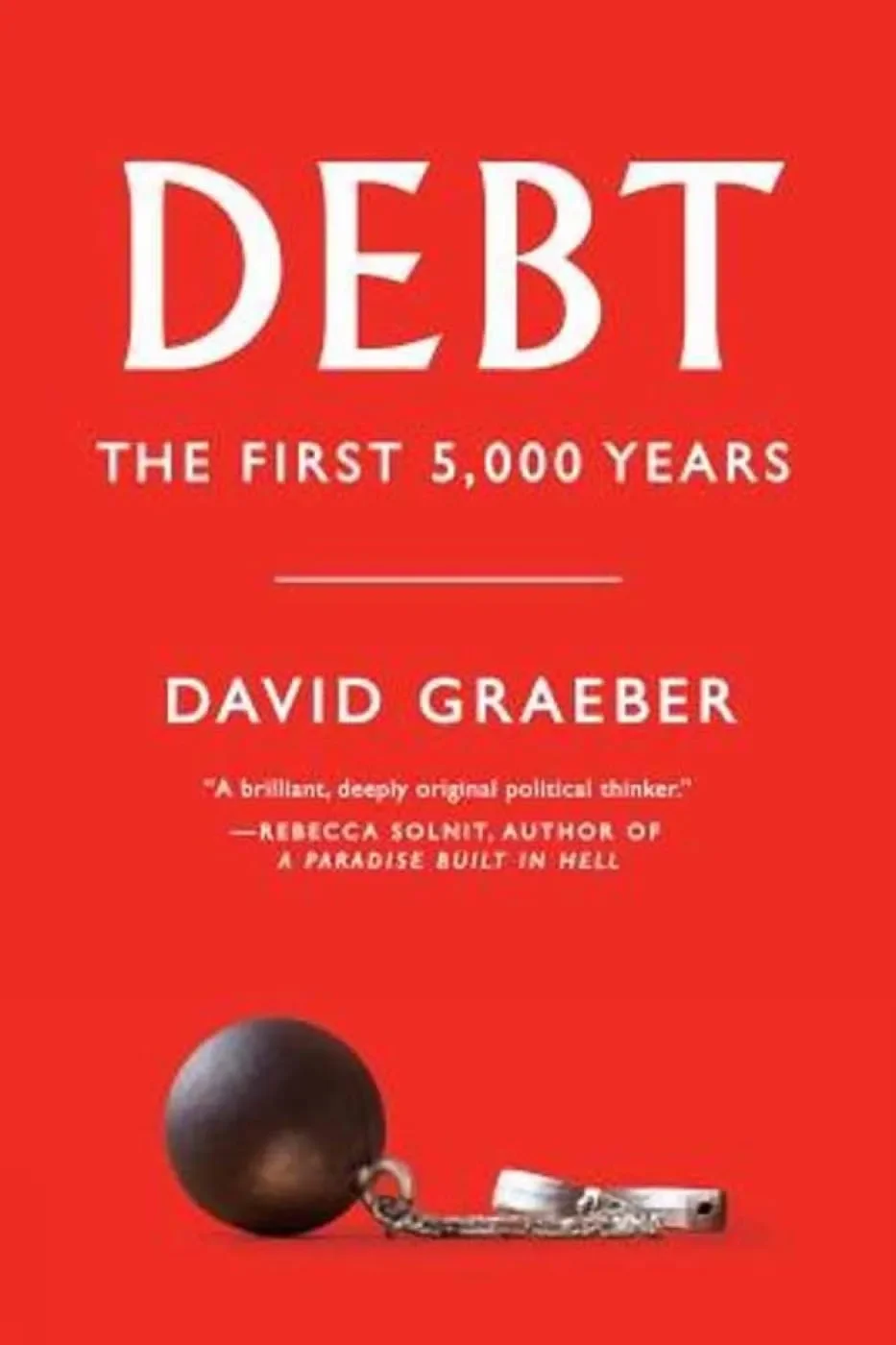
Graeber’s research shows this is historically false:
Barter is Rare: Pure barter predominantly occurs between strangers or enemies who lack a social bond. It is not the foundational mode of human exchange.
Credit Came First: In tight-knit communities (which characterize most of human history), exchange was based on “virtual credit” or social obligation. “I owe you one” preceded the physical coin.
Markets are State Creations: Markets did not arise spontaneously from the bottom up; they were often imposed by states to provision armies. States paid soldiers in coin and demanded taxes in the same coin, forcing the peasantry into the market system.
These insights are devastating to the “inevitability” argument. If the market is a state project designed to facilitate military logistics and taxation, rather than a natural expression of human nature, then it is a political choice, not a biological destiny.
Gift Economies and “Everyday Communism”
Anthropology provides overwhelming evidence of economic systems that defy capitalist logic, proving that the “profit motive” is not universal.

Gift Economies: In societies such as the Trobriand Islanders (Kula Ring) or the Kwakiutl (Potlatch), status is gained by giving away wealth rather than accumulating it. These systems prioritize social density and reciprocity over material accumulation. The “gift” creates a bond of debt and gratitude that holds society together, whereas the “market transaction” dissolves the bond (once paid, we are strangers again).
The Commons: Elinor Ostrom’s Nobel Prize-winning work demonstrated that communities can successfully manage “common-pool resources” (forests, fisheries) through collective governance without resorting to private property or state control. This refutes the “Tragedy of the Commons,” another central myth of capitalist realism.
Everyday Communism: Graeber argues that all societies, even capitalist ones, rely on a baseline of “communism” (from each according to ability, to each according to need) to function. Families, friendships, and even internal corporate teams operate on cooperation rather than market exchange. “If you ask someone to pass the salt, they don’t ask for payment.” Capitalism is a thin veneer over a vast ocean of cooperative communism.
Polanyi and the “Double Movement”
Karl Polanyi’s The Great Transformation complements this by distinguishing between “embedded” and “disembedded” economies.
Embedded Economy: For most of history, economic life was submerged in social relationships. Exchange was governed by reciprocity, redistribution, and communal status.
Disembedded Economy: The 19th century saw a violent attempt to separate the economy from society, creating a “self-regulating market.” Polanyi argues this was inherently unstable and destructive to the human fabric, leading to the “Double Movement”—society inevitably pushing back through regulation and social protection to save itself from the market.
These findings confirm that the “free market” is not natural; it is a utopian project that requires constant state violence to maintain against the natural human tendency toward social protection.
The Cognitive Science of Economic Faith
Folk Economics and Hyperactive Agency Detection
Evolutionary psychology identifies a Hyperactive Agency Detection Device (HADD) in the human brain (although there is scant evidence, the idea is useful). We evolved to detect agents (predators, rivals) in our environment. When we encounter complex, unpredictable systems like the weather or the economy, we instinctively attribute agency to them.
The likelihood that you will perceive a strange noise as a ghost is dependent on whether you live in a culture where ghost beliefs are common. If your culture is full of mischievous pixies, you are likely to attribute unexpected noises to mischievous pixies. The inferences you make will be dependent on the beliefs you already hold. So yes, many of us have had the experience of hearing an unsettling noise and thinking “burglar!” or being in a spooky place, hearing an unexpected whistle of wind and thinking “GHOST!” not because we have a hyperactive agency detection devise, but because of the expectations we have been endowed with due to cultural learning.
So, why is this story interesting? Two main reasons, I think. Firstly, that HADD is so often invoked, means it is important that we as skeptics are aware of the shaky foundations on which it sits. Secondly, and most importantly to me, it illustrates both the biggest problems and biggest potential in evolutionary psychology and adjacent disciplines. A common criticism of evolutionary psychology is that those who work in the area often tell very nice, plausible stories about the human mind with ideas that seem very logical but are ultimately unfalsifiable. The story of HADD and the research around it is showing something quite different. Yes, the idea has taken hold because it is a nice, pleasingly logical, easy to follow story, but it did allow researchers who are currently still working in the field of human evolutionary behavioural sciences (including evolutionary psychology) to generate falsifiable hypothesis and conduct research investigating this very idea. The idea is probably wrong, HADD probably doesn’t exist, and now researchers are continuing the work of trying to figure out an explanation that better fits and better predicts human behaviour. Yes, even evolutionary psychology can be self-correcting. —The Skeptic Reason With Compassion
Pascal Boyer’s research on Folk Economics shows that laypeople intuitively treat the economy as a goal-oriented agent. We talk about what “The Market wants,” “The Market fears,” or “The Market decides.” This cognitive slip turns the abstract system of exchange into a “god-like” entity.
Moralization: We intuitively apply moral categories to economic events. Debt is seen as “sin” (moral failing), and wealth is seen as “virtue” (blessing). This makes austerity policies (punishing the debtor) feel intuitively “right,” even if they are economically disastrous.
Zero-Sum Bias: Humans often intuit trade as zero-sum (if you win, I lose), which fuels protectionism. However, capitalist realism exploits a different bias—the “fairness” bias—to argue that market outcomes are inherently just.
Commodity Fetishism as Cognitive Error
Marx’s theory of Commodity Fetishism aligns with this cognitive view. In capitalism, social relations between people (labor) are disguised as relations between things (prices/commodities). The commodity takes on a “phantom objectivity”; it seems to have value inherent in its physical body, just as a religious fetish is believed to house a spirit.
AI Overview (Gemini vetted by Moi)
Phantom objectivity
is a concept from Western Marxist philosophy, most prominently developed by Georg Lukács in his 1923 work History and Class Consciousness. It refers to the phenomenon where social relations, processes, and human labor appear to people as independent, objective, “thing-like” realities (reification) that govern them, rather than as products of their own social activity.
Core Aspects and Definition
Reification (Verdinglichung): The root of phantom objectivity is reification, which means “thing-ification”—taking human social relations and treating them as objective, natural, and unchangeable things.
The Illusion of Independence: Human actions (specifically labor and market transactions) create a, system that then appears to operate on its own, “phantom” laws. This conceals the underlying human-to-human relations.
The “Second Nature”: As commodification spreads under capitalism, these reified social relations form a “second nature” that seems as immutable as natural, physical laws.
Universalization: Lukács argues that in modern capitalism, this form of objectivity becomes the universal, dominant structure of society, affecting not just the economy but also the consciousness of individuals and the structure of law and bureaucracy.
Key Characteristics
Quantification: In a reified society, qualitative, human, and social characteristics are replaced by quantitative, measurable, and calculable facts.
Rationalization: Reification is linked to the extreme rationalization and fragmentation of work (e.g., Taylorism), where the worker becomes a mechanical part of a pre-existing system.
Contemplative Stance: Individuals adopt a passive, “contemplative” attitude toward this system, believing they can only navigate or predict these “natural” laws, rather than change them.
Alienation: Phantom objectivity is a high form of social alienation, where the product of labor confronts the worker as a foreign, autonomous power.
Context and Applications
Marxist Theory: It stems from Marx’s theory of commodity fetishism, where the value of a product appears as a natural property of the thing itself, rather than a social relation of labor.
Modern Technology/Systems: It is applied to explain how technologies, algorithms, and complex systems (like AI) are viewed as objective, neutral, and autonomous, obscuring the human, political, and economic decisions behind their development.
Bureaucracy: It describes how legal and bureaucratic systems appear as impersonal, rigid, and objective, even though they are human constructs.
In essence, “phantom objectivity” explains why social, economic, and political systems under capitalism appear as “naturally” fixed, preventing people from realizing they have the power to change them.
Modern research links this to Animism. Just as indigenous Animism attributes a soul to nature, capitalist Animism attributes a soul to capital. We treat money as if it is “productive” on its own (“make your money work for you”), obscuring the human labor that actually creates value. This fetishism makes the social construct of value appear as an objective natural fact, rendering it difficult to challenge.
The Affective Economy and the Willing Slave
The persistence of capitalism is not just cognitive; it is emotional. Why do we submit to this order? Why do we “love” our servitude?
Spinoza and the Capture of Desire
Frédéric Lordon, in Willing Slaves of Capital, turns to the philosophy of Baruch Spinoza to answer this. Spinoza rejected the mind-body dualism, arguing that desire (conatus) is the essence of human existence. We strive to persevere in being and to increase our power of acting.
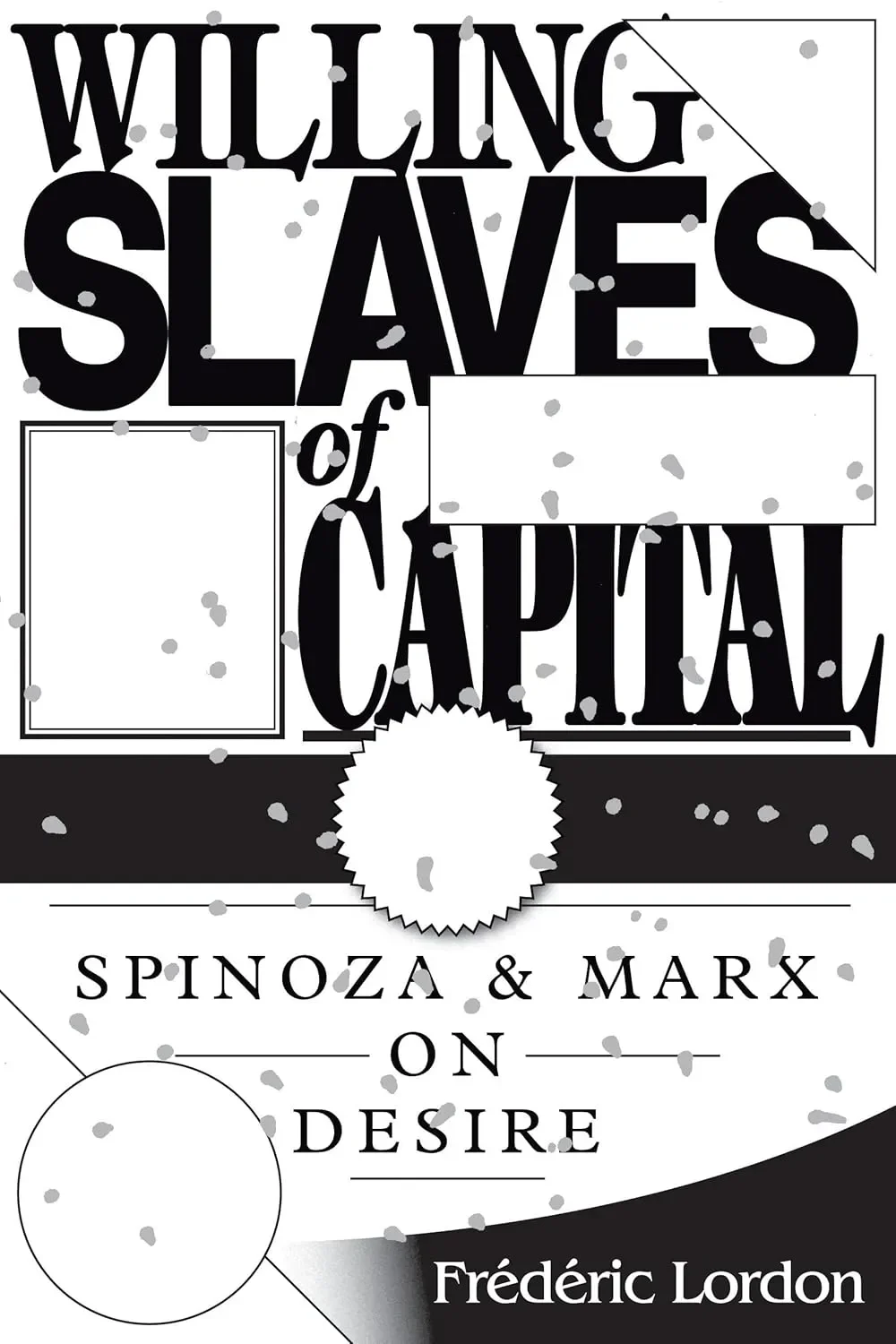
Lordon argues that capitalism does not just coerce us; it captures our conatus.
Colinearization: The genius of neoliberalism is to align the employee’s desire with the “master-desire” of the employer/capital. We are not just paid to work; we are asked to be “passionate,” “engaged,” and “entrepreneurial.” The system provides “joyful affects” (status, consumption, achievement) that motivate participation.
Epithumogenesis: The system engineers our desires. We don’t just work for money; we work for identity. We learn to love the chains that bind us because they provide a sense of agency and meaning.
Conatus is a Latin term that means effort, drive, or tendency. The concept, fundamental to Spinoza’s philosophy, refers to the innate force of every being to persevere in existence and increase its power to act, being the human essence and the basis for the pursuit of freedom and well-being. This concept describes the vital drive for self-preservation, which in humans manifests as the awareness of this very force, moving us to seek what increases our capacity to exist and act, and to flee from what diminishes it.
The Affective Landscape of Capitalist Realism
Fisher’s “capitalist realism” is the result of this affective capture. It produces a Depressive Hedonia—a state where we pursue pleasure (hedonia) but are unable to find deep meaning, trapped in a depressive loop of consumption.
The system relies on a duality of affects:
Joyful Affects: Consumption, career success, the thrill of the “win” (Gamification of work).
Sad Affects: Fear of poverty, social exclusion, shame of debt (Schuld).
Lordon argues that the “Willing Slave” is created when the joyful effects of belonging to the institution outweigh the sad effects of subjection. However, this is a fragile equilibrium. As precarity rises, the “joyful” mask slips, revealing the “sad” coercion underneath (the threat of starvation/homelessness).
Spinoza’s Concept of Contingency vs. Determinism
Spinoza’s philosophy also offers a way out. While he argues that humans are determined by causes, he also advocates the Materialism of the Encounter (a concept developed by Althusser, drawing on Spinoza). History is not a linear necessity; it is a series of contingent encounters. The current order is a result of specific historical encounters (e.g., primitive accumulation, colonialism) that solidified into a structure.
This implies that new encounters can give rise to new structures. We are not condemned to the market by “Human Nature”; we are held there by a specific configuration of affects and institutions that can be reconfigured.
The Theodicy of the Market in the Anthropocene
The “God” of the Market faces its ultimate challenge not from atheists, but from the biological and physical reality of Earth with its living systems.
The Polycrisis as Theological Crisis
The current era is defined by the Polycrisis: the intersection of climate emergency, ecological collapse, and social instability. This represents a collision between the Imagined Order (infinite growth) and the Real Order (planetary boundaries).
In theological terms, this is the Problem of Evil. If the Market is wise and benevolent (allocating resources efficiently), why is it destroying the biosphere?
Capitalism offers a Theodicy (justification of God):
Externalities: The damage is just an “error” in pricing that can be fixed.
Creative Destruction: The destruction of the old (nature) is necessary for the creation of the new (capital).
Creative destruction, as formulated by Joseph Schumpeter, refers to the perennial process by which the modalities and outputs of production are transformed under capitalism, through the destruction of economic structures and the creation of new ones. In this view, capitalism is a violently evolutionary process, generating radical innovations that simultaneously advance society’s productive capacities and upend existing enterprises. While Schumpeter initially drew upon Marx in delineating the turbulent path of capitalist development generated by creative destruction, he departed from the latter author in emphasizing the positive material effects of this process over its self-destructive tendencies. —University of Santa Cruz
Adaptation: The market will “innovate” its way out of the crisis.
Techno-Salvationism and the Cargo Cult
Faced with the physical limits of the Earth, capitalist realism gives rise to a new theological variant: Techno-Salvationism. This belief holds that future technologies (geoengineering, fusion, AI) will miraculously solve the ecological crisis without requiring a change in the social order.
This is a millenarian cult. It requires “faith” in technologies that do not yet exist to justify continuing destructive behavior today. It functions as a Katechon (a restraining force) against political change. By promising that technology will save us, it delays the necessary structural adaptation.
Techno-Optimism as Idolatry: It worships the “tool” rather than the “system.” It assumes that the tool (technology) can override the system’s logic (infinite accumulation), when in fact the system directs the tool toward profit, not survival.
The “End of the World” vs. The End of Capitalism
We return to Fisher’s slogan: “It is easier to imagine the end of the world than the end of capitalism.” The rise of apocalyptic and dystopian fiction reflects this incapacity. We can imagine zombies, asteroids, and climate collapse (the end of the world), but we cannot imagine a society that operates on non-market principles.
This is the ultimate triumph of Capitalist Realism: it persuades us to accept the actual end of the world (via climate collapse, ecocide, the destruction of habitat, strategic nuclear war) rather than accept the end of the imagined world (capitalism).
The Contingency of the Encounter
Whether arguments about God’s existence applied to capitalism yield a definitive answer, capitalism functions as a comprehensive metaphysical system—a secular religion—that mimics the structure of theological belief.
1. The Argument from Design is Refuted by Complexity:
The market is not a divinely ordered cosmos; it is a complex, path-dependent evolutionary system. Its “order” is emergent, not designed, and it is rife with instability and inefficiency. There is no “Invisible Hand” ensuring the best of all possible worlds; there is only the blind selection of profit, often at the expense of survival.
2. Anthropology refutes the Argument from Consensus:
The “universality” of capitalism is a myth. Humans have thrived for millennia in diverse economic ontologies—gift economies, commons, and credit-based systems. The “profit motive” is a recent cultural invention, not a biological imperative.
3. The Argument from Inevitability is Refuted by Political Theology:
The sense of “inevitability” is a product of “Capitalist Realism”—an atmosphere of secular theology that suppresses the imagination. By exposing the theological roots of economic concepts (Providence, Theodicy, Eschatology), we reveal them as contingent beliefs rather than natural laws.
4. The Psychological Mechanism is Refuted by Critical Cognition:
We submit to the market not because it is natural, but because it captures our conatus (desire) and exploits our cognitive biases (agency detection). We are “willing slaves” only because our affective landscape has been engineered.
Final Thoughts
Capitalism is one of many possible sociopolitical outcomes. It is a historical contingency, sustained by a specific “imagined order” and a “secular theology.” The “Polycrisis” represents the moment where the “Real” invades the “Realism.” As the imagined order of endless growth crashes against the physical reality of the biosphere, the capacity to imagine alternatives—to “atheize” the market—becomes not just a philosophical exercise, but a survival imperative.
The “End of History” was a mirage. The future is not canceled; it is merely waiting for the collapse of the current theology to be born. The “materialism of the encounter” suggests that new encounters—between ecology, technology, and human desire—can generate new, non-capitalist forms of life. The market is not God; it is a tool that has become an idol, and idols can be broken.
***Will we exterminate Goliath?
Who is going to plant the corn?
The Hopi tribe of Arizona is famous for its deep spiritual connection to corn (“Corn is life”). There is a well-known philosophical concept—often shared by Hopi elders—that when society collapses or when people lose their way, the faithful will be the ones who remember how to plant.
“When the Great Spirit offered the tribes different gifts, the Hopi chose the planting stick and the short ear of corn. They chose the hard life of labor and faith. The question is not who will rule, but who will plant the corn when the rains do not come.”
“Only when the last tree has been cut down, the last fish been caught, and the last stream poisoned, will we realize we cannot eat money” — Often attributed to the Cree (or Osage)
“It is easy to be a warrior and fight. The harder question is: Who is going to stay home and plant the corn?”
The Structure of the Cosmos: Is there more?
The Architecture of the Real: Contemplating a Minimum Viable Metaphysics —Jim Rutt
The Metaphysical Necessity in a Post-Positivist Age
The intellectual trajectory of the 20th century was primarily defined by a concerted effort to eliminate metaphysics from serious inquiry. The logical positivists of the Vienna Circle, inspired by the rapid ascendance of empirical science, sought to demarcate meaningful statements solely as those verifiable through sensory experience or logical tautology. In this climate, metaphysics—the study of the fundamental nature of reality beyond the immediate physical—was relegated to the status of “needless bullshit,” a sentiment famously echoed in the misattributed quote often cited by systems thinker Jim Rutt: “When I hear the word metaphysics, I reach for my pistol.”
However, the 21st century finds itself in a “metacrisis,” a fragmentation of coherent worldviews precipitated by the very success and specialization of the sciences. We find ourselves with a proliferation of maps—quantum mechanics, evolutionary biology, cognitive science, sociology—but no underlying territory upon which to overlay them. Into this void steps the concept of a “Minimum Viable Metaphysics” (MVM), a framework proposed by Rutt that eschews the grand, rigid “palaces” of classical philosophy in favor of a pragmatic “scaffold.”
Let’s explore the technical foundations of Rutt’s assumptions, tracing their lineage through Effective Field Theory (EFT)in physics, Ontic Structural Realism (OSR) in the philosophy of science, Far-from-Equilibrium Thermodynamics(Prigogine), and Complexity Theory (Kauffman, Holland). It argues that MVM represents a sophisticated form of Naturalistic Realism that navigates the treacherous channel between the Scylla of naive empiricism and the Charybdis of radical skepticism. By fleshing out Rutt’s “tiny number of assumptions”—specifically the Reality Principle and the Asymmetry Principle—with rigorous definitions and historical context, we demonstrate how this scaffolding provides the necessary preconditions for intelligibility and agency in a complex universe.
The Distinction Between Palace and Scaffold
To understand the specific intervention MVM attempts to make, one must distinguish it from the metaphysical projects of the past. Historical metaphysics often engaged in “system-building,” constructing elaborate logical edifices that purported to explain the totality of existence from a set of a priori first principles. One might look to Gottfried Wilhelm Leibniz’sMonadology, which posited a universe of windowless, synchronously interacting spiritual atoms, or to Georg Wilhelm Friedrich Hegel’s Absolute Idealism, which posited the unfolding of the universe as the dialectical self-actualization of the Geist (Spirit).
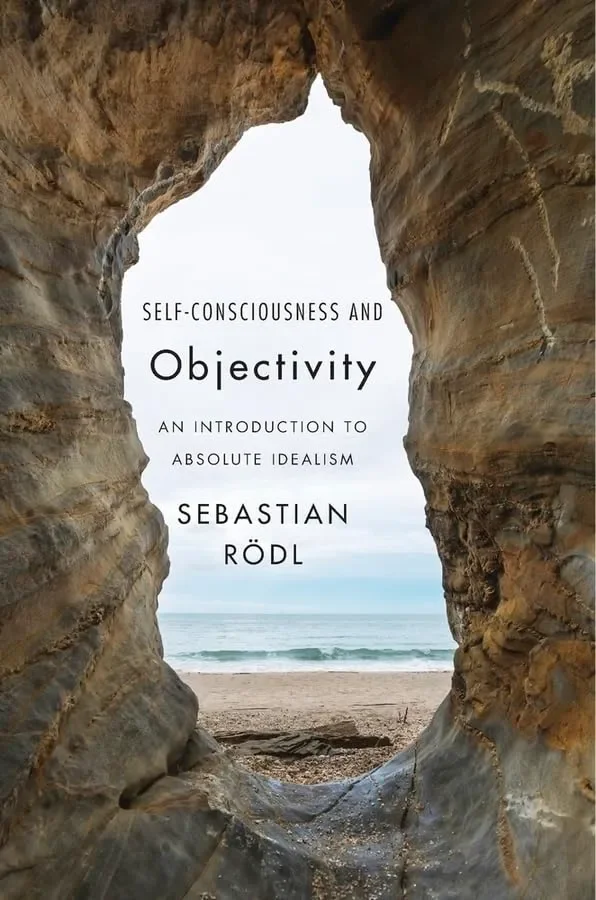
Rutt criticizes these systems as “palaces”—rigid, ornate, and ultimately brittle. If a single fundamental premise is contradicted by empirical discovery (as Euclidean geometry was by General Relativity), the entire palace collapses. Furthermore, these systems often succumb to the “Great Substitution,” where one metaphysical vocabulary is simply swapped for another (e.g., Theology for Reason, Reason for Code) without altering the underlying dogmatic structure.
In contrast, MVM is proposed as scaffolding. Scaffolding is functional, modular, and temporary. It is not the building itself but the structure that allows the building (knowledge) to be constructed. It admits its own provisional nature. This aligns with the philosophical stance of Fallibilism, which holds that no belief (theory, view, thesis) can ever be rationally supported or justified conclusively. However, unlike radical skepticism, MVM asserts that we must make specific commitments to get any traction at all. As Rutt notes, “without a very tiny number of assumptions... we can’t get started”. These assumptions are derived not through deduction (logical entailment) or simple induction (pattern recognition), but through abduction—inference to the best explanation. We assume the external world exists not because we can prove it, but because it is the most parsimonious explanation for the coherence of our sensory inputs.
The Reality Principle: Anchoring Existence
The foundational axiom of MVM is the Reality Principle: the commitment to the claim that “The universe exists... as a domain that persists and resists.” While this assertion appears banal to the pragmatist, it is a contested battleground in the philosophy of science and epistemology. Establishing the independence of the external world requires defending against both radical skepticism (solipsism) and the instrumentalist interpretations of modern physics.
The Adversary: Last Thursdayism and the Omphalos Hypothesis
To rigorously define the Reality Principle, one must confront its logical negation. Rutt explicitly references Last Thursdayism as the archetype of a “functionally useless” but “logically irrefutable” hypothesis.
This concept traces its lineage to the Omphalos Hypothesis, articulated by the naturalist Philip Henry Gosse in his 1857 treatise Omphalos: An Attempt to Untie the Geological Knot. Gosse, struggling to reconcile the mounting geological evidence of an ancient Earth with the biblical narrative of a six-day creation, proposed that God created the world prochronically—that is, with the appearance of history. Just as Adam was created as a mature man with a navel (omphalos in Greek), which implies a birth he never experienced, the Earth was created with strata, fossils, and dendrochronological rings that implied a past it never endured.
Last Thursdayism is the secular reductio ad absurdum of Gosse’s theology. It posits that the universe was created last Thursday (or five minutes ago, as Bertrand Russell suggested), complete with false memories in our brains, light from distant stars in transit, and history books detailing events that never occurred.
The Epistemological Acid
The danger of Last Thursdayism is its unfalsifiability. There is no empirical experiment that can distinguish between a universe that is 13.8 billion years old and one created yesterday with a perfectly consistent false history. If the past is an illusion, the continuity of cause and effect is broken.
The Problem of Induction: Science relies on the assumption that the future will resemble the past (uniformitarianism). If the past is a fabrication, we have no dataset from which to induce laws.
Rutt’s Rebuttal: The Reality Principle does not “disprove” Last Thursdayism. Instead, it rejects it on pragmaticand abductive grounds. A universe that deceives its observers is a “universal acid” that dissolves the possibility of inquiry. To do science, we must axiomatically reject the deceptive creator (or the deceptive simulation). We commit to the universe as a “domain that persists and resists,” meaning it has an ontological weight independent of our perception of it.
Model-Dependent Realism vs. Scientific Realism
If we accept the universe exists, what is the nature of our knowledge of it? The Reality Principle must navigate the tension between Scientific Realism and Model-Dependent Realism.
Scientific Realism is the traditional view that the entities described by our best scientific theories—electrons, quarks, spacetime curvature—actually exist in the world, independent of our minds.
Model-Dependent Realism, a term coined by Stephen Hawking and Leonard Mlodinow in The Grand Design, offers a more nuanced, perhaps more skeptical, view. They argue:
“There is no picture-or theory-independent concept of reality. Instead, we will adopt a view that we will call model-dependent realism: the idea that a physical theory or world picture is a model... and a set of rules that connect the elements of the model to observations.”
In this framework, asking “Is an electron real?” is a category error. The meaningful question is, “Is the model of the electron useful?” If two models (e.g., General Relativity and a hypothetical quantum gravity theory) disagree in their ontology but agree in their predictions within a specific domain, both are “real” within their valid scopes.
Rutt’s MVM synthesizes these positions. It accepts the instrumentalism of models—acknowledging that our “scaffold” is not the building itself—but retains the ontological commitment of realism. The scaffold touches a real building; the map corresponds to a real territory. This synthesis finds its most rigorous philosophical expression in Ontic Structural Realism.
Ontic Structural Realism (OSR): The Metaphysics of Relations
The most robust philosophical partner for Rutt’s MVM is Ontic Structural Realism (OSR). Developed by philosophers such as James Ladyman, Don Ross, and Steven French, OSR was formulated to rescue scientific realism from the “pessimistic meta-induction”—the observation that the history of science is a graveyard of discarded theories (phlogiston, caloric, the luminiferous ether).
OSR posits a radical solution: Structure is what is real, not objects. In the transition from Newtonian gravity to General Relativity, the “object” of gravitational force disappeared, but the mathematical structure of the equations (e.g., the preservation of Poisson’s equation as a limiting case) was preserved.
Key Tenets of OSR:
Ontological Priority of Relations: The world is not composed of “things” (particles) with intrinsic properties that then interact. It is composed of relational structures (fields, entanglements). Particles are merely nodes in these structures.14 As Ladyman and Ross argue in “Every Thing Must Go,” “The world is not made of things, but of structure.”
Group Theory and Invariance: Physics defines entities by their invariance under transformation groups. An electron is not a tiny billiard ball; it is an entity defined by its invariance under the U(1) gauge symmetry of electromagnetism and the Poincaré group of spacetime.
Resolution of Quantum Paradoxes: OSR resolves the indistinguishability problem in quantum mechanics. If two electrons are swapped, the physical state does not change. This suggests they possess no “haecceity” (this-ness) or individual identity. OSR accepts this fully: there are no individuals, only the structural relations of the field.
Rutt’s assertion that “mathematics and logic don’t need the physical universe to exist... they operate in the realm of pure form and relation” hints at this structuralist view. The “Reality Principle” in MVM is thus best understood as: Reality is the persistence of structural relations (invariants) across time and interaction.
Divergence: The Freud/Rutt Distinction
It is critical to distinguish Rutt’s metaphysical “Reality Principle” from the term’s origin in psychoanalysis. Sigmund Freud introduced the Reality Principle (Realitätsprinzip) in 1911 to describe the regulatory mechanism of the Ego, which opposes the Pleasure Principle (Lustprinzip) of the Id.
Freud’s Usage: The Pleasure Principle seeks immediate gratification of instinctual drives. The Reality Principle defers gratification in light of the constraints of the external world. It is a psychological adaptation—a “reality-testing” function that allows the organism to survive by acknowledging the “Ananke” (Necessity) of the environment.
Rutt’s Usage: Rutt elevates this from a psychological function to an ontological commitment. For Freud, the “reality” was the social and physical constraint on the psyche. For Rutt, the “Reality Principle” is the assertion that those constraints are not hallucinations.
Synthesis: Interestingly, both usages converge on the notion of resistance. For Freud, reality is that which frustrates the wish. For Rutt (and French philosopher Maine de Biran), reality is that which “resists” our will (“persist and resist”). MVM asserts that this resistance is the hallmark of the Real.
The Asymmetry Principle: The Engine of Becoming
The second pillar of MVM is the Asymmetry Principle: “At or near the origin, the universe was not an exact uniformity. There were ripples... difference is the first condition of development.”
In physics, perfect symmetry is often synonymous with stasis or “death.” For the universe to evolve complexity—stars, chemistry, life—symmetries must be broken. This section details the physical mechanisms of asymmetry, linking cosmology, thermodynamics, and particle physics.
The Physics of Origins: Inflation and CMB Anisotropies
Rutt’s “ripples” are not metaphorical; they refer to the primordial density perturbations generated during Cosmic Inflation and visualized in the Cosmic Microwave Background (CMB).
Cosmic Inflation is the theory that the universe underwent a period of exponential expansion in the first fraction of a second after the Big Bang. Proposed by Alan Guth, this theory solves the “Horizon Problem” (why the universe is the same temperature everywhere) and the “Flatness Problem.”
Crucially, Inflation provides the mechanism for the initial asymmetry:
Quantum Fluctuations: The “Inflaton” field, like all quantum fields, is subject to Heisenberg’s Uncertainty Principle. It fluctuates the vacuum energy.
Magnification: During Inflation, these microscopic quantum fluctuations are stretched faster than the speed of light, “freezing” them into the macroscopic fabric of spacetime.
The Imprint: When Inflation ends, these frozen fluctuations manifest as slight differences in the density of the quark-gluon plasma (1 part in 100,000). These are visible today as temperature anisotropies in the Cosmic Background Radiation (CMB).
Structure Formation: Gravity amplifies this asymmetry. Slightly denser regions attract more matter, becoming denser still. These “ripples” eventually collapsed to form the galaxies, stars, and planets we inhabit. Without this initial violation of uniformity, the universe would be a featureless, maximizing-entropy gas.
The Past Hypothesis and the Arrow of Time
The Asymmetry Principle is inextricably linked to the Second Law of Thermodynamics and the arrow of time. The Second Law states that entropy (disorder) tends to increase in a closed system. However, for entropy to increase today, it must have been lower yesterday. Tracing this logic back 13.8 billion years leads to the Past Hypothesis.
Coined by philosopher David Albert, the Past Hypothesis is the postulate that the universe began in a specific state of extremely low entropy.
The Gravitational Paradox
This presents a conceptual difficulty. The early universe was a hot, dense soup of particles—a state that usually corresponds to high entropy (thermal equilibrium). How can this be low entropy?
The Solution: In a system dominated by gravity, uniformity is unstable and thus represents low entropy. High entropy in a gravitating system corresponds to clumping (black holes). The fact that the matter was distributed smoothly (but not perfectly so) represents a state of immense potential energy (gravitational potential).
The “Winding” of the Universe: The Past Hypothesis acts as the boundary condition that “wound up” the universe. It is the ultimate source of all “useful work” (Gibbs Free Energy). Every time a star shines, a plant photosynthesizes, or a human thinks, they are exploiting the energy gradient established by the Past Hypothesis. Rutt’s MVM must assume this initial low-entropy state to explain why the universe is dynamic rather than static.
Symmetry Breaking and Mass
In particle physics, asymmetry is the origin of distinct forces and matter described by the Gauge Theory and Spontaneous Symmetry Breaking.
Gauge Symmetry: The Standard Model is defined by the symmetry group. These mathematical groups describe the invariances of the fundamental fields (Strong, Weak, Electromagnetic).
The Higgs Mechanism: In the very early universe, the electromagnetic and weak nuclear forces were unified(symmetric). At a certain energy threshold, the Higgs Field acquired a non-zero vacuum expectation value (it “turned on”), and “broke” the electroweak symmetry, separating the massless photon (light) from the massive W and Z bosons (weak force).
Implication: If this symmetry had not broken, electrons would be massless, atoms would not form, and chemistry would be impossible. The “Asymmetry Principle” thus operates at the level of fundamental laws as well as cosmological initial conditions.
The Scaffold of Intelligibility: Scale and Law
Rutt argues that MVM provides a “scaffold” for inquiry. In physics, the rigorous mathematical formulation of this scaffolding concept is Effective Field Theory (EFT). This framework explains how science can be successful (valid) without being complete (final).
Effective Field Theories (EFT): The Tower of Knowledge
For centuries, philosophers worried about the “problem of induction” or how we can know anything without knowing everything. If the laws of physics change at microscopic scales we haven’t probed yet, how can we trust our bridge engineering?
EFT provides the answer through the concept of Decoupling.
Definition: An EFT describes physical phenomena at a chosen length scale or energy scale, while ignoring the substructure at shorter distances.
The Cutoff: Every EFT has an energy “cutoff.” Below this energy, the theory works perfectly. Above it, new physics enters.
Example: Fermi’s theory of Beta decay treated the interaction as a point contact between particles. It worked perfectly at low energies. At higher energies (above the mass of the W boson), the “point” was revealed to be the exchange of a W boson. Fermi’s theory was an “effective” theory of the “fundamental” Electroweak theory.
The Tower of Theories:
Physics is organized as a hierarchy (or tower) of EFTs.
Scale
Degrees of Freedom
Human Scale
Classical Mechanics / Fluid Dynamics
Rigid bodies, Fluids
Atomic Scale
Quantum Mechanics / QED
Nuclei, Electrons
Sub-Nuclear
Standard Model (QCD)
Quarks, Gluons
Planck Scale
Quantum Gravity (String Theory?)
Strings? Spin Networks?
Philosophical Significance for MVM:
EFT validates Rutt’s “scaffolding” approach. We do not need the “Palace” of a Theory of Everything (Quantum Gravity) to have “viable” metaphysics for the mesoscale. We can have a Minimum Viable Metaphysics that operates effectively at the scale of human agency and social systems, while remaining agnostic about the “bottom turtle” (the Planck Scale).
The Planck Scale: The Basement of the Scaffold
The Planck Scale represents the theoretical limit of our current scaffold. Defined by the Planck constants, this is the scale where the smooth geometry of General Relativity and the quantum fluctuations of QFT collide.
At this scale:
Spacetime breakdown: Concepts like “distance” and “before/after” may cease to have meaning, replaced by a “quantum foam” or discrete network structure (e.g., Loop Quantum Gravity).
Implications for MVM: Rutt acknowledges that the “mesoscale” (where clocks tick and rulers measure) is an emergent domain. MVM commits to the mesoscale as an effective reality, even if the fundamental layer looks radically different.
Epistemology: Abduction and the “No Paradox” View
How do we reason within this scaffold? Rutt distinguishes three modes of thought:
Deduction: Logical entailment. Useful for formal systems, but it relies on axioms.
Induction: Pattern recognition. Inferring laws from repeated observations.
Abduction: Inference to the best explanation. Given the data and our background knowledge, what is the most likely hypothesis?
Rutt favors Abduction as the primary tool of MVM. We “abduct” that the external world exists because it explains the coherence of our experiences better than Solipsism.
Abductive reasoning is a form of logical inference that starts with an observation and seeks the simplest, most likely explanation, often called “inference to the best explanation”. It’s how we make educated guesses to solve problems with incomplete information, forming plausible hypotheses rather than guaranteed truths, like a detective piecing together clues or figuring out why a sandwich is half-eaten.
The “No Paradox” Stance:
Rutt asserts: “There are no paradoxes in the real world, but we certainly can have paradoxes in our formal systems.”
Zeno’s Paradox: An arrow never reaches the target in the formal system of infinite divisibility. In reality, it hits the target.
Quantum Paradoxes: Schrödinger’s Cat is often cited as a paradox. MVM would argue the paradox lies in the map, not the territory. A “realist” interpretation (like Pilot Wave, Many Worlds, or OSR) would resolve the paradox by refining the metaphysics.
This stance aligns with Naturalism: The universe is self-consistent. If our theory yields a contradiction, the theory is wrong, not the universe.
The Dynamics of Complexity: From Matter to Mind
Having established that the universe exists (Reality Principle) and how it evolves via entropy and symmetry breaking (Asymmetry Principle), MVM must explain the rise of complexity. How does a cooling universe of hydrogen produce Shakespeare? This requires integrating Complexity Science and Non-Equilibrium Thermodynamics.
Dissipative Structures: Order out of Chaos
Classical thermodynamics (equilibrium) predicts the heat death of the universe. However, local pockets of order (stars, life, cities) can arise if they are open systems. Nobel laureate Ilya Prigogine coined the term Dissipative Structures to describe these systems.
Definition: A system operating far from thermodynamic equilibrium that exchanges energy and matter with its environment.
Mechanism: By dissipating high-quality energy (e.g., sunlight) into low-quality heat, the system maintains a highly ordered internal structure.
Examples: A hurricane, a Bénard convection cell (hexagonal patterns in heated fluid), a living cell, a corporation.
Bifurcation: As energy flow increases, these systems can spontaneously break symmetry and jump to higher levels of complexity, a process Prigogine called “Order by Fluctuations.”
MVM incorporates this to explain how “ripples” (Asymmetry) turn into “agents.” Life is a dissipative structure that maintains itself against the Second Law by consuming the “Past Hypothesis.”
The Adjacent Possible: The Ontology of Innovation
The evolution of these structures is described by the concept of the Adjacent Possible, introduced by theoretical biologist Stuart Kauffman.
Definition: The Adjacent Possible consists of all those molecular, morphological, behavioral, or technological configurations that are one step away from the actual, but do not yet exist.
Chemistry: Given a set of molecules, the adjacent possible is the set of all new molecules that a single reaction can create.
The Dynamics of Expansion:
When the system actualizes a new state (e.g., synthesizing a new protein, inventing the transistor), it opens up a newhorizon of adjacent possibilities that did not exist before. The Adjacent Possible expands faster than the actual.
Non-Ergodicity: Kauffman argues that the universe is non-ergodic; it does not explore all possible states. The number of possible proteins of length 200 is vastly larger than the number of particles in the universe or nanoseconds since the Big Bang.
Metaphysical Implication: The universe is on a unique trajectory; history matters. We cannot predict the future because the present is constantly creating the space of possibilities, providing the metaphysical ground for Innovation and a form of Free Will—the ability to select which adjacent possibilities to actualize.
Complex Adaptive Systems (CAS)
The “agents” occupying the Adjacent Possible are modeled as Complex Adaptive Systems, a term popularized by John Holland at the Santa Fe Institute.
Rutt’s metaphysics is explicitly a metaphysics of CAS. It rejects the “Clockwork Universe” (Laplace’s Demon) in favor of an “Evolutionary Universe” where agents co-evolve with their fitness landscapes.
Emergence and Supervenience: The Layered World
The final structural component of MVM is the relationship between the scaffold layers. If physics is the basement, how does biology or sociology sit on top of it without collapsing into it?
Weak vs. Strong Emergence
Philosophers distinguish between two types of emergence:
Weak Emergence: The high-level pattern is unexpected but, in principle, deducible from the low-level rules if one had infinite computing power.
Example: The “Gliders” in Conway’s Game of Life, traffic jams.
Strong Emergence: The high-level pattern possesses downward causation or causal powers that are not reducible to the sum of the parts. The whole is more than the sum of the parts in an ontological sense.
Rutt’s MVM likely adopts a Pragmatic Strong Emergence. While a God-like computer might simulate the universe from quarks (Weak Emergence), for any embedded observer, the higher levels (biology, culture) have autonomous causal power. The “laws” of economics cannot be replaced by the Standard Model of particle physics.
Supervenience: Dependence Without Reduction
The technical philosophical term for this relationship is Supervenience.
Definition: Set A (mental properties) supervenes on Set B (physical properties) if there can be no difference in A without a difference in B.
Role in MVM: Supervenience allows MVM to be Physicalist (everything rests on the Reality Principle/Physics) without being Reductionist (claiming love is “nothing but” neurons). The biological supervenes on the chemical, which supervenes on the physical. Each layer is real and lawful within its own Effective Field Theory.
Major Transitions in Evolution
This layering is not static; it was built over time. MVM incorporates the framework of Major Transitions in Evolution(Maynard Smith & Szathmary) to describe how the scaffold was erected.
Key Transitions:
Replicating Molecules to Populations in Compartments (Cells)
Independent Replicators to Chromosomes
Prokaryotes to Eukaryotes (Symbiosis)
Asexual Clones to Sexual Populations
Unicellular to Multicellular
Solitary Individuals to Colonies (Eusociality)
Primate Societies to Human Societies (Language)
Each transition involves a new way of storing and transmitting information (DNA to Epigenetics to Neural to Language/Symbolic) and often involves entities losing independence to form a higher-level cooperative unit. MVM views humanity as currently undergoing a potential new transition—usually framed as “Game B”—to a metastable, high-complexity civilization that respects planetary boundaries.
Conclusion: The Minimum Viable Architecture
The power of Jim Rutt’s Minimum Viable Metaphysics lies in its integration of these diverse fields into a coherent operational system/framework for understanding Reality (Great Nature), enabling us to explore it. It is not a claim to Ultimate Truth, but a claim to Maximum Utility in the face of the Metacrisis.
By anchoring itself in the Reality Principle (supported by Ontic Structural Realism), it rejects the paralysis of postmodern skepticism. By adopting the Asymmetry Principle (supported by Inflation and the Past Hypothesis), it explains the arrow of time and the capacity for change. By utilizing the Scaffold of EFT, it allows for valid knowledge at the human scale without requiring a Theory of Everything. And by embracing Complexity (Dissipative Structures, CAS, the Adjacent Possible), it provides a framework for agency, innovation, and the open-ended evolution of the future.
In this view, MVM is the ground code for the operating system of a sentient species attempting to navigate a non-ergodic universe. It provides the confidence that the world is intelligible and the caution that it is unpredictable—a scaffold strong enough to stand on, yet light enough to dismantle and rebuild as we climb higher into the tower of complexity.
More views of what is, is
The Many-Worlds Interpretation (Multiverse)
Multiverse is a mainstream interpretation of quantum mechanics that is nonetheless incredibly strange. It states that wave-function collapse—where a particle chooses one state—never occurs.
Every time a quantum event has multiple possible outcomes, all of them happen. The universe splits into branching, parallel realities. In one timeline, you ate toast for breakfast; in another, you ate cereal. There are infinite versions of you living out every possible life.
Quantum Darwinism
This theory attempts to explain how the fuzzy, weird quantum world becomes the solid, objective world we see.
Quantum Darwinism suggests that quantum states compete with each other to“reproduce” their information into the environment. Only the fittest states (those that can create many copies of themselves in the environment) survive to become the reality we perceive. It’s natural selection applied to quantum physics.
The Zoo Hypothesis
A proposed solution to the Fermi Paradox: “If aliens exist, where are they? It suggests that advanced extraterrestrial civilizations exist and know about us, but they have agreed to strictly observe us without interfering, like zookeepers watching animals.
We might be in a galactic nature preserve or under quarantine until we reach a certain level of technological or ethical maturity.
The Galactic Quarantine The Zoo Hypothesis suggests we are being watched by aliens who refuse to interfere until we mature. It’s a humbling thought: we might be the galaxy’s problem child, trapped in a nursery until we stop breaking the furniture. But while we look to the stars for answers, we are being ground down by a very terrestrial engine.
The Machine of Words and Things.
Capitalism is a biophysical shredder. It is a system that turns “Great Nature” into products, fueled by status anxiety and endless competition. We comfort ourselves with Words—fantasies that we are Tony Stark, or that a magical technology will save us in the final act. We tell ourselves that today’s tragedies are just a preamble to greatness. But Biophysical Reality doesn’t care about our hero’s journey. It only cares about energy limits and ecological thresholds.
The Popper Principle: “We can let our theories die in our stead.”
“When I am contradicted it arouses my attention, not my wrath. I move towards the man who contradicts me: he is instructing me. The cause of truth ought to be common to us both.” —Michel de Montaigne, The Art of Conversation “De l'art de conferer”
The Cacophony of Survival
Why don’t we stop the machine? Because we are too busy surviving it. The noise of the market drowns out the signal of systemic change:
The hustle: “I need a clickbait title for my Trump economy script.”
The vanity: “You need more intensity minutes and cold showers to flaunt that temple.”
The desperation: “I’m running to catch the bus to my third job.”
The escape: “I’m going to be a Buddhist monk, and transcend the bull shit.”
From the gamer in a five-star hotel in Geneva to the person with an addiction looking for a squat, we are all too occupied by our specific role in the script to rewrite the play.
Understanding the Engine
To change something, we must understand it.
Capitalism is not a synonym for “prosperity,” “progress,” “freedom,” “democracy,” or “markets.” It is a specific mode of production based on private ownership and the commodification of human time, spirit, and everything we touch. It is entropic.
I have to say that I am not at all convinced that we will ever create a global society at our current scale capable of accomplishing anything truly good for living systems or posterity. We may simply be hitting the Great Filter—that theoretical barrier in the evolution of life that prevents civilizations from advancing to a Type I planetary society. We have mastered the atom and the genome, yet we lack the collective wisdom to use them for anything other than more sophisticated forms of tribal warfare and extraction.
Will We Make It?
The development of technical galactic civilizations is most often categorized by the Kardashev Scale, a framework that quantifies a civilization’s level of technological advancement based on its ability to harness energy. A Type I (Planetary) civilization has achieved mastery over the resources of its home world, controlling roughly $10^{16} watts of power—enough to manipulate global weather patterns, harness all solar insolation, and potentially mitigate planetary disasters. Type II (Stellar) represents an exponential leap to $10^{26} watts, requiring megastructures such as a Dyson Sphere to capture the total radiative output of a host star, rendering the civilization immune to extinction events within its solar system. The theoretical apex, Type III (Galactic), commands the energy of an entire galaxy ($10^{36} watts), likely utilizing Von Neumann probes—self-replicating spacecraft—to colonize every star system in the Milky Way within a few million years, a timeframe that is astronomically brief compared to the universe’s age.
The Fermi Paradox arises from the glaring contradiction between this theoretical timeline and our current observations: given that the galaxy is 10 billion years old, a Type III civilization should have already emerged and saturated the galaxy with its presence. The “Great Silence”—the total absence of radio signals, megastructures, or visiting probes—suggests the existence of a Great Filter, a probabilistic barrier that makes the transition from inanimate matter to a space-faring Type III civilization vanishingly rare. If the filter lies in our past (e.g., the extreme rarity of abiogenesis or eukaryotic life), humanity may be the first to reach this stage. However, if the filter lies ahead, it implies that technical civilizations invariably encounter a catastrophic threshold—such as nuclear annihilation, resource exhaustion, or unchecked artificial intelligence—that results in self-destruction before they can ascend the Kardashev ladder.
Alternative solutions to the paradox move beyond simple extinction events and propose sociological or tactical reasons for the silence. The Dark Forest hypothesis posits that the galaxy is a predatory environment where advanced civilizations actively conceal their energy signatures to avoid detection and preemptive destruction by rivals. Conversely, the Zoo Hypothesis (mentioned above) suggests that Type II or III civilizations exist but enforce a non-interference policy, treating Earth as a protected wilderness or a sociological experiment. These theories imply that the “silence” is not a sign of emptiness, but rather a deliberate camouflage adopted by apex civilizations that have survived the Great Filter by learning to remain quiet.
AI Overview:
Energy requirements and engineering capabilities for the three primary stages of the Kardashev Scale.
Type I: The Planetary Civilization
This stage represents the complete mastery of a home planet's resources. A Type I civilization has transitioned from relying on dead fossil fuels to managing the total energy sum of its parent star that reaches the planet's surface.
Energy Output: Approximately $10^{16} to $10^{17} Watts.
Primary Engineering Feats:
Fusion Mastery: The ability to sustain controlled nuclear fusion on a global scale, effectively creating “miniature stars” on the planet to supplement solar collection.
Planetary Climate Control: Technologies capable of manipulating the atmosphere and hydrosphere to avert ice ages, neutralize hurricanes, and optimize agriculture globally.
Orbital Infrastructure: Construction of “Space Elevators” (tethers anchored to the equator extending to geostationary orbit) to reduce the cost of moving materials into space near zero, facilitating massive orbital construction.
Antimatter Production: Capability to produce antimatter in kilogram quantities for high-density energy storage and propulsion.
Type II: The Stellar Civilization
The transition to Type II is the most dramatic leap in the scale, requiring a civilization to leave its home planet and disassemble other planets to encompass its host star. This civilization is immune to extinction from natural causes.
Energy Output: Approximately $10^{26} Watts (The total luminosity of a G-type main-sequence star like the Sun).
Primary Engineering Feats:
Dyson Swarms: Rather than a rigid shell (which is mechanically unstable), a Type II civilization would construct a dense swarm of billions of solar satellites orbiting the star, capturing nearly 100% of its radiative output.
Star Lifting: Using magnetic fields to “mine” the star itself, lifting elementary particles like hydrogen and helium off the stellar surface to extend the star’s lifespan or to harvest matter for construction.
Stellar Engines: The construction of megastructures (such as a Shkadov Thruster) that use the star’s own radiation pressure to move the entire solar system through the galaxy, allowing the civilization to dodge supernovae or steer toward resource-rich clusters.
Matrioshka Brains: A nested set of Dyson shells that use the star’s energy to power a computer system of immense computational capacity, using the waste heat of inner shells to power outer shells.
Type III: The Galactic Civilization
A Type III civilization has colonized its entire host galaxy. To an outside observer, such a galaxy might appear unusually dim in the visible spectrum but bright in the infrared, due to the waste heat of pervasive industry.
Energy Output: Approximately $10^{36} to $10^{37} Watts (The total luminosity of the Milky Way).
Primary Engineering Feats:
Black Hole Farming: Utilizing the Penrose Process to extract rotational energy from the ergosphere of supermassive black holes at the galactic center—the most efficient energy source known to physics.
Faster-Than-Light (FTL) Travel: While theoretically speculative, managing a galactic empire likely requires the manipulation of spacetime metrics (Warp Drives) or the stabilization of Einstein-Rosen bridges (Wormholes) to overcome the light-speed barrier.
Galactic Terraforming: The systematic restructuring of stellar orbits and the artificial induction of star formation to ensure a steady supply of energy for billions of years.
Planck Energy Manipulation: Mastery over physics at the Planck scale (10^{19} GeV), potentially allowing for the manipulation of the fabric of reality, creating “pocket universes” or altering physical constants within localized regions.
***I don’t think we will ever get anywhere near Type I. Natural limits abound. However, imagination, curiosity, and our ability to create models and scenarios seem limitless.
To accomplish something suitable for the future of living systems, like stabilizing the biosphere, eliminating unnecessary suffering, or becoming a peaceful global community full of unique, thriving cultures, we’d need a level of international coordination that seems psychosocially impossible for us to achieve. At large population densities, we are, at our core, primates evolved for local status games, not planetary stewardship. We are brilliant at inventing tools to amplify our power, but incompetent at inventing institutions to restrain our greed. In the cosmic timescale, humanity might not be a protagonist, but merely a flash in the pan—a brief, chaotic explosion of plastic and radio waves that burns itself out before it ever leaves the cradle.
Will we ever cohere into a global society capable of achieving anything truly enduring? The ‘Civilization’ project requires a shared operating system, but we are currently running incompatible software. We are splintering into a thousand different realities, each walled off by its own algorithms, alternative facts, and tribal gods without a grounded culture. We cannot agree on the temperature of the planet, the definition of a woman, or the history of our own nations.
How can we possibly tackle the Metacrisis when we cannot even agree on the nature of the problem? We are too busy paying the rent, chasing the Ferrari, or managing our brand to look up. The noise of our daily survival—the cacophony of billions of people hustling within a rigged game—drowns out the signal of our potential. We are building a Tower of Babel out of fiber optics, and instead of reaching the heavens, we are simply shouting past each other into the void.
We are certainly capable of grand accomplishments—we can build data centers, wage wars, and manufacture trillions of widgets—but are these important? We channel our greatest minds into optimizing ad-click rates, designing high-frequency trading algorithms, and engineering addictive dopamine loops for social media.
We have mistaken complexity for progress (whatever you mean by progress). We assume that because we have smartphones, we are advancing. But a society that consumes its own life-support system to produce digital distractions is not advanced; it is suicidal. We seem destined to remain an adolescent species, obsessed with toys and dominance, forever postponing the hard, mature work of stewardship and equity. We are not building a cathedral for the ages; we are building a casino for the weekend, and we are seemingly content to play until the house collapses.

The Totality of the Market
Capitalism is frequently misunderstood as merely a synonym for the market or trade activities that have existed for millennia across diverse civilizations. However, a rigorous excavation of political economy reveals that capitalism is not simply the exchange of goods but a specific, historically contingent mode of production characterized by the commodification of labor, the private ownership of the means of production, and, crucially, the imperative of endless capital accumulation requiring constant growth.
Capitalism transforms the world by exploiting workers who make goods and services for mainly exploited workers to buy and consume. It’s entropic as hell.
He worked on the line AND bought a Model T!
If we want to understand capitalism, it helps to have read outside our core ideological belief system.
My goal isn’t to sell you an ideology, but to offer another helpful lens for imagining a political economy that doesn’t kill living systems.
The video below is from a living, breathing Communist living in Vietnam. He’s really not that scary, and his treatment of his subject is perfectly reasonable.
People do stuff, call it what you will.
I’m not a communist, whatever one means by that; the kinds of social systems I dream of are very different, more obscure, and will most probably never manifest.
The Dialectics of Becoming: Materialism, Ecology, and the Global Fracture
The Ontology of Matter in Motion
The Inversion of Hegel
To understand the ontology of dialectical materialism, one must first confront the intellectual rupture that birthed it. The concept of “dialectics” was refined by G.W.F. Hegel, who viewed history as the unfolding of the “Absolute Spirit” (Idea) through a process of contradiction and resolution. For Hegel, the material world was a shadow cast by the development of the Spirit. History moved because ideas clashed.
Marx and Engels inverted this. In their view, “matter precedes thought.” The material world—the observable, tangible reality of nature and society—exists independently of human consciousness. Ideas, philosophies, and religions are not the drivers of history but the “superstructural” reflections of the material “base”—specifically, the mode of production (how humans organize to survive). This materialism is not “mechanical” (viewing the world as a clockwork machine of fixed parts) but “dialectical” (viewing the world as a complex of processes). As Engels famously noted in Dialectics of Nature, the world consists not of “ready-made things” but of “processes” in which things come into being and pass away.
This inversion has profound cultural implications. A dialectical materialist does not look for the “soul” of a nation to explain its politics; they look at the land tenure laws, the factory conditions, and the trade deficits. They understand that “social being determines consciousness.” This grounding in the “concrete” creates an ontology that is inherently hostile to mysticism yet deeply sensitive to the “hidden” connections between seemingly disparate phenomena—between the price of tea in London and the starvation of a peasant in India.
The Three Laws of Dialectics as Lived Experience
While often reduced to dogma in Soviet textbooks, the “Three Laws of Dialectics” formalized by Engels offer a sophisticated phenomenology of change. These laws describe how a dialectical worldview perceives time, crisis, and progress.
The Law of the Unity and Conflict of Opposites
This is the core of dialectics: the recognition that everything contains its own negation. Contradiction is not an error (as in formal logic) but the engine of life.
The refusal of binary moralities. A dialectical thinker sees “order” and “chaos” not as separate states but as mutually constitutive forces. Capitalism is recognized as a force that unleashed unprecedented productive capacity (thesis) while simultaneously creating unprecedented misery and ecological destruction (antithesis). The system is not “broken” when it generates poverty; it is functioning according to its internal contradictions.
In lived experience, this manifests as an awareness of the “dark side” of every progress. It is the understanding that the “peace” of the suburbs is sustained by the “violence” of the extraction zones.
The Law of the Transformation of Quantity into Quality
Gradual changes accumulate unnoticed until a threshold is reached, causing a sudden, qualitative leap. Water heats in degrees (quantitatively) until 100°C, when it suddenly becomes steam (qualitatively).
A sensitivity to “tipping points” and a rejection of linear gradualism. This law explains why societies can endure oppression for decades (accumulation) and then explode in revolution overnight (leap). It creates a worldview that expects rupture rather than continuity. The sensation of “waiting for the drop.” It is visible in the cultural anxiety of late capitalism—the feeling that debt, carbon, and tension are accumulating and that a phase shift is inevitable.
The Law of the Negation of the Negation
Development moves in spirals, not circles. The plant negates a seed; the new seed negates the plant. The new seed is not the original seed; it is the original seed sublated (preserved and raised) into a higher form.
Progress is neither a straight line nor a return to the past. It is a “progressive return.” In the Marxist schema, socialism is the negation of capitalist private property, returning humanity to the communal ownership of “primitive communism” on a higher technological basis.
The concept of “Sublation” (Aufhebung) is evident in cultural movements that seek to retrieve lost indigenous or pre-capitalist wisdom (a connection to the land) and fuse it with modern technological capacity, rather than simply “going back” to the past.
The Ontology of Becoming vs. Being
The most fundamental distinction of this worldview is the rejection of static “Being” in favor of “Becoming.” As noted in recent scholarship on dialectical ontology, “being is understood as a constant ‘coming-to-be and ceasing-to-be.”
The Metaphysical View: A tree is a distinct object, separate from the soil and the air. It is.
The Dialectical View: A tree is a process—a temporary stabilization of solar energy, soil nutrients, and carbon. It is a “metabolism.” It is constantly exchanging matter with its environment.
This ontology threatens the Western desire for categorization and control. If things are constantly becoming other than what they are, they cannot be fully mastered, owned, or defined by static laws. This friction is central to the “fear” discussed later: accepting dialectics is accepting the transience of all established orders, including one’s own identity and privileges.
Epistemology: Practice, Truth, and the Rejection of Positivism
The Critique of Positivism
The dominant epistemology of the West, particularly in the Anglosphere, is positivism (or empiricism). This view holds that science is the accumulation of neutral facts observed by a detached subject. It assumes that “facts” exist independently of the observer’s social position or history.
Dialectical materialism rejects this as naive. It argues that there is no “view from nowhere.” All knowledge is situated. “Social being determines consciousness.” A classic example is the concept of “mental health.” A positivist sees depression as a chemical imbalance (a biological fact). A dialectical materialist sees the chemical imbalance, but also considers the “Capitalist Realism” that produces the stress, the alienation of labor that strips life of meaning, and the privatization of community that isolates the individual. To treat the “fact” of depression without the “relation” of society is to succumb to an illusion.
The Society of the Spectacle is a 1967 work of philosophy and Marxist critical theory by Guy Debord where he develops and presents the concept of the Spectacle. The book is considered a seminal text for the Situationist movement. Debord published a follow-up book Comments on the Society of the Spectacle in 1988.

Guy Debord
Constant (Constant A. Nieuwenhuys)
[no title] (1975–6)
Praxis as the Criterion of Truth
How do we know what is true? For the dialectical materialist, truth is not found in contemplation but in practice (praxis). As Mao Zedong wrote in On Practice, “If you want to know the taste of a pear, you must change the pear by eating it yourself.”
This means that we only truly understand the world by trying to change it. The scientist understands the atom by smashing it; the revolutionary understands society by organizing against it. This creates an epistemology of engagement.
Cultural Sign: A deep suspicion of “armchair theory” or “neutral” journalism. In a dialectical worldview, neutrality is impossible; to claim neutrality is usually to side with the status quo. “The philosophers have only interpreted the world... the point is to change it” (Marx’s 11th Thesis on Feuerbach).
The Epistemic Fallacy and Analytical Marxism
In the late 20th century, a group of Western philosophers known as “Analytical Marxists” (G.A. Cohen, John Roemer) attempted to “save” Marxism by stripping it of its dialectical elements. They argued that dialectics was “obscurantist,” “yoga,” or “bullshit,” and sought to reconstruct Marxism using formal logic and rational choice theory.
This effort failed to gain traction outside the academy because it removed the very thing that made Marxism potent: the ability to grasp the fluid, contradictory nature of reality. By forcing Marxism into the static boxes of formal logic (where A cannot be non-A), they rendered it incapable of explaining a world where capitalism is both a force of growth and a force of destruction. This rejection of dialectics in the West was not just an intellectual choice; it was an act of “epistemic cleansing” driven by the Cold War pressure to conform to “scientific” (read: positivist) standards.
The Western Fear: Ontological Security and the Dread of the Real
Why are white European cultures so afraid of engaging with this perspective? The evidence suggests this fear is not merely intellectual but psychological and existential, rooted in the specific formation of the Western subject.
Ontological Security and the Illusion of Permanence
Sociologists Anthony Giddens and Jennifer Mitzen define “ontological security” as the need for a stable sense of self and a reliable world order to function. The modern Western subject—the “white European” ego—is constructed around the Cartesian ideal of the autonomous, rational individual who stands outside nature and controls it.
Dialectical materialism terrifies this subject because it dissolves this autonomy. It says: “You are not an island. You are a nexus of social relations. Your wealth is the product of someone else’s poverty. Your stability is a temporary phase in a process of decay.”
The Fear of Flux: To accept dialectics is to accept that “Whiteness,” “The West,” and “Capitalism” are historical categories that arose and will inevitably pass away. For a culture built on the accumulation of permanent assets (property, legacy), the idea of “universal transience” is deeply destabilizing. The rejection of dialectics is a defense mechanism to maintain the illusion that the current order is eternal.

Psychoanalysis: The Fear of the Real (Žižek)
Slavoj Žižek utilizes Lacanian psychoanalysis to explain this fear. He argues that Western ideology functions as a screen to protect us from the “Real”—the traumatic, chaotic void that underlies our symbolic reality.
The Dialectic as the Real: Capitalist ideology tells us a story of endless growth and technological progress. Dialectical materialism tears this screen down. It points to the Real of the metabolic rift (climate collapse), the Realof the sweatshop (labor exploitation). The “fear” is the fear of the Real bursting through the bubble of ideology. It is the fear that the supermarket shelves might actually be empty, that the “externalities” of capitalism are, in fact, internal contradictions coming home to roost.
Adorno and Horkheimer: The Fear of Nature
In Dialectic of Enlightenment, Adorno and Horkheimer trace this fear back to the origins of Western civilization. They argue that the Enlightenment was driven by the fear of nature’s overwhelming power. To conquer this fear, Western man sought to dominate nature through reason and technology.
Mimesis vs. Domination: Pre-modern cultures practiced mimesis—mimicking nature to relate to it. The Enlightenment crushed mimesis. But by repressing nature, Western civilization made itself rigid and paranoid. The fear of understanding dialectics is the fear of the “Return of the Repressed.” It is the fear that if we stop dominating nature (and by extension, the Global South), we will be swallowed by it. Dialectics, which demands a metabolic partnership with nature rather than domination, feels like a surrender to the chaotic forces the West has spent centuries trying to cage.
Author
Capitalist Realism as a Defense Mechanism
Mark Fisher’s concept of “Capitalist Realism”—the widespread belief that there is no alternative to capitalism—can be seen as the ultimate victory of the anti-dialectical mind. It is a “static” ontology where the future has been cancelled. The West prefers the depression of a cancelled future to the anxiety of a revolutionary one. Understanding dialectics means accepting that an alternative is possible, which entails the terrifying responsibility of bringing it about. The fear is thus a fear of freedom.
Dialectics in the Global South: Adaptation and Resistance
If the West fears dialectics, the Global South has historically embraced it. This is not due to a “cultural” affinity for theory, but because of the material reality of colonialism. In the colonies, the contradictions of capitalism were never hidden behind a welfare state or consumer abundance. They were naked: the gun, the germ, the technology, the story or institution (religion), the whip, the mine.
The Materiality of Colonial Contradiction
For the colonized subject, the “Unity of Opposites” is a daily experience. The “civilizing mission” (Thesis) is experienced as “barbaric exploitation” (Antithesis). The dialectic is not a theory to be learned in a classroom; it is the logic of survival. As Amilcar Cabral noted, for the African revolutionary, “culture is a weapon”—a tool to negate the negation of colonial rule.
Mao Zedong: The Particularity of Contradiction
Mao Zedong’s intervention was crucial for the Global South because he rejected the Eurocentric “Universalism” of Soviet dogma. In On Contradiction, he emphasized the Particularity of Contradiction.
The Principal Contradiction: Mao argued that in every process, one contradiction is dominant. In Europe, it might be Labor vs. Capital. But in China (and, by extension, Vietnam, Peru, and Tanzania), the principal contradiction was often Imperialism vs. The Nation, or Peasant vs. Feudal Lord.
Significance: This allowed Global South movements to adapt Marxism to their own realities. They didn’t have to wait for “capitalism to develop” (as European Marxists claimed). They could identify their principal contradiction and act on it. This is why dialectics flourished in the rice paddies of Asia and the mountains of Latin America while it withered in the seminar rooms of Europe.
José Carlos Mariátegui: Indigenous Dialectics
In Peru, José Carlos Mariátegui provided one of the most brilliant applications of dialectical materialism to the Global South. In Seven Interpretive Essays on Peruvian Reality, he tackled the “Problem of the Indian.”
The Land as Base: Mariátegui argued that the “Indian Problem” was not racial, educational, or moral. It was economic. It was the problem of the Gamonal (the feudal landlord). Without resolving the land question, no “cultural” uplift was possible.
The Incan Synthesis: Crucially, Mariátegui saw the Incan ayllu (communal village) not as a backward relic, but as the material foundation for a modern Peruvian socialism. He argued for a dialectical synthesis of “Incan Communism” and “Modern Technology.” He famously stated, “Marxism is not a tracing paper; it is a heroic creation.” This represents the “Negation of the Negation” returning to the communal spirit of the Inca, but on a higher, modern level.
Amilcar Cabral: Class Suicide and the Weapon of Theory
Amilcar Cabral, leading the PAIGC in Guinea-Bissau, used dialectics to analyze the colony’s class structure. He identified a unique contradiction: the petite bourgeoisie (civil servants, intellectuals) were the only ones with the technical skills to run a state, but their class interests aligned with those of the colonizer.
The Solution: For the revolution to succeed, this class had to commit “Class Suicide.” They had to renounce their own class interests and present themselves as workers for the people. This is a profound ethical application of the dialectical law of negation. Cabral’s theory was rooted in the soil; he was an agronomist who understood that you cannot force a crop to grow where the soil does not support it. Politics, like agriculture, must obey the laws of the specific material reality.
Ecology: The Metabolic Rift and the Earth’s Dialectic
So what about Dialectical Materialism’s relation to “natural systems”? This is perhaps the most urgent domain of dialectical inquiry today. Classical bourgeois economics treats nature as an “externality”—a free gift to be exploited. Dialectical materialism views nature as the inorganic body of humanity.
The Metabolic Rift (Stoffwechsel)
Karl Marx was deeply concerned with the soil chemistry of 19th-century agriculture. He observed that capitalist urbanization created a “rift” in the metabolic interaction between man and earth. Nutrients were extracted from the countryside soil, shipped to cities as food, and then discharged into rivers as waste, causing pollution. The nutrients never returned to the soil.
The Rift Today: John Bellamy Foster and the “Metabolic Rift” school argue that this concept explains the planetary crisis. The “Rift” has expanded from the soil cycle to the carbon cycle (climate change) and the nitrogen cycle. Capitalism acts as a “robbery system,” stealing from the earth’s (living systems) future to fuel the accumulation of the present.
Jason W. Moore and World-Ecology
Jason W. Moore pushes the dialectic further. He argues that we should not view “Society” and “Nature” as separate entities interacting with one another (a Cartesian dualism). Instead, he proposes World-Ecology. Capitalism is not just a specialized economic operation; it is a way of organizing nature.
Cheap Nature: Moore argues that capitalism functions by appropriating “The Four Cheaps”: Labor, Food, Energy, and Raw Materials. The crisis of the 21st century is that nature is no longer cheap. The “easy” oil is gone; the “free” carbon sinks are full. The dialectic of World-Ecology reveals that the “Fear of Nature” in the West is the fear of the end of the “Cheap Nature” regime.
The Red Deal: Indigenous Dialectics
The Red Deal, a manifesto by The Red Nation, represents a synthesis of Indigenous wisdom and dialectical materialist critique. It argues that climate change is the direct result of colonial relations—the severing of the kinship bonds between humans and the non-human world.
Land Back as Ecology: The Red Deal argues that “Land Back”—the return of land to Indigenous jurisdiction—is the most effective climate policy. This is not just a moral claim but a materialist one: Indigenous land management (the negation of capitalist extraction) has empirically proven to sustain biodiversity. The “cultural sign” here is the refusal to separate “Social Justice” from “Ecological Survival.” They are one dialectical struggle.
The Phenomenology of Climate Grief
In the Anthropocene, the lived experience of the dialectic is “Climate Grief” or “Solastalgia.” Western psychology often pathologizes this as “depression” (an individual error). A dialectical view sees it as a healthy, rational response to the destruction of one’s “inorganic body” (the earth).
Grief as Praxis: Grief is the recognition of connection. We only grieve what we are part of. Honoring this grief is a dialectical act—it turns the “negative” emotion into a “positive” mobilization for defense. It is the “negation of the negation” played out in the human heart.
Human Limits and Capacities: The Promethean Debate
H. sapiens has natural limits and capacities. Within Marxism, there is a fierce debate between “Prometheanism” and “Eco-Socialism.”
The Promethean Charge
Critics (and some supporters, such as the Accelerationists) view Marx as a “Promethean”—someone who believed humans should totally dominate nature through technology. Accelerationists argue we should “accelerate” capitalism’s technological tendencies to achieve a post-work utopia of abundance.
The Eco-Socialist Rebuttal
Thinkers like Kohei Saito and John Bellamy Foster argue that the “mature” Marx abandoned Prometheanism. He recognized the “insuperable limits” of the earth.
Dialectical Limits: A dialectical view of human capacity is not that we are limitless, but that the recognition of necessity defines our freedom. We are free to create, but only within the metabolic limits of the biosphere. The attempt to breach these limits (capitalism) leads not to freedom but to catastrophe (unfreedom). True capacity is the ability to regulate the metabolism rationally.
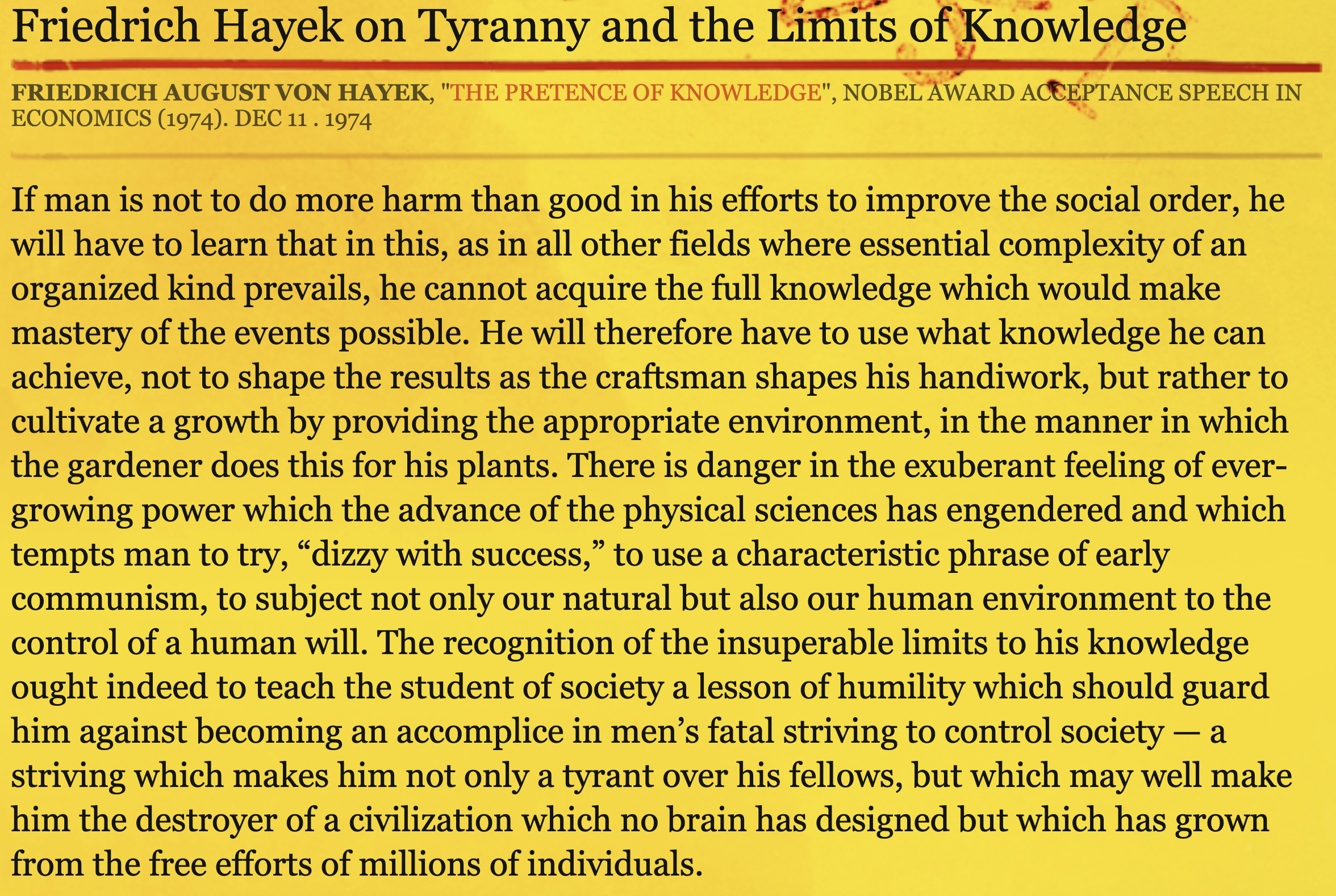
Degrowth vs. Accelerationism
This debate represents a dialectical split in the contemporary Left:
Thesis (Accelerationism): Technology will save us; push through the limits.
Antithesis (Degrowth): Technology is the problem; retreat within the limits.
Synthesis (Eco-Leninism): As Andreas Malm proposed, we need a state strong enough to dismantle fossil capital (degrowth of the bad) while accelerating green technology (growth of the good). This requires a “War Communism” for the climate—a dialectical strategy of emergency.
Cultural Signs and Aesthetics: Seeing Dialectically
How does a dialectical worldview manifest in art and culture?
Ways of Seeing (John Berger)
John Berger’s seminal work, Ways of Seeing, teaches viewers to look dialectically. When looking at a Renaissance oil painting, Berger asks us not to focus on the “genius” of the artist, but on the property relations depicted. Oil painting was a medium that celebrated private property—it made objects look possessable.
The Double Vision: A dialectical gaze sees the object and the social relation behind it simultaneously. It sees the landscape painting and the landowner who paid for it. It demystifies the “spiritual” aura of art, revealing its material base.
Brechtian Theatre: The Alienation Effect
Bertolt Brecht developed “Epic Theatre” to teach dialectics. He rejected the Aristotelian theatre of “immersion,” in which the audience loses itself in the story. He wanted the audience to remain awake and critical.
Verfremdungseffekt (Alienation Effect): Brecht used techniques (placards, lighting, breaking the fourth wall) to “make the familiar strange.” He wanted to show that “human nature” is not fixed. By alienating the action, the audience sees that the tragedy on stage is not “fate”—it is a result of specific, changeable social conditions. This is the aesthetic of possibility.
***I played Galy Gay in Man is Man at the Black Box theatre in Seattle long ago.
Metamodernism: The New Oscillation
Postmodernism was a culture of cynicism and irony (the End of History). Metamodernism is emerging as a new structure of feeling that “oscillates” between modern sincerity (hope) and postmodern irony (skepticism).
Dialectical Emotion: Metamodernism is a “pragmatic idealism.” It knows the world is broken (cynicism), but acts as if it can be saved (sincerity). This oscillation is a dialectical movement—holding two contradictory states in tension to create a new forward momentum.
The Necessity of the Negative
The “fear” of dialectical materialism in recent “white” (metaphorically) European culture is the fear of the negative. It is the fear of admitting that the current order contains the seeds of its own destruction. It is the fear of the “Other” (nature, the Global South, a multi-polar world order) speaking back/out.
But as we have shown, the dialectical worldview is not a doctrine of destruction. It is an ontology of hope. By recognizing that nothing is static, it affirms that no oppression is eternal. Recognizing the metabolic rift offers the only scientific path to repairing our relationship with the Earth/GAIA (living systems). By embracing the “Negation of the Negation,” we can envision a future that is not a return to the past but a leap into a new, higher form of human existence.
For the Global South (colonized cultures), for the Indigenous land defender, and for the climate-grieving youth, dialectical materialism is not a dusty 19th-century philosophy. It is the living grammar of their struggle. It is the understanding that while the “arc of the moral universe” does not bend toward justice on its own, it can be bent by the forceful, conscious application of human praxis.
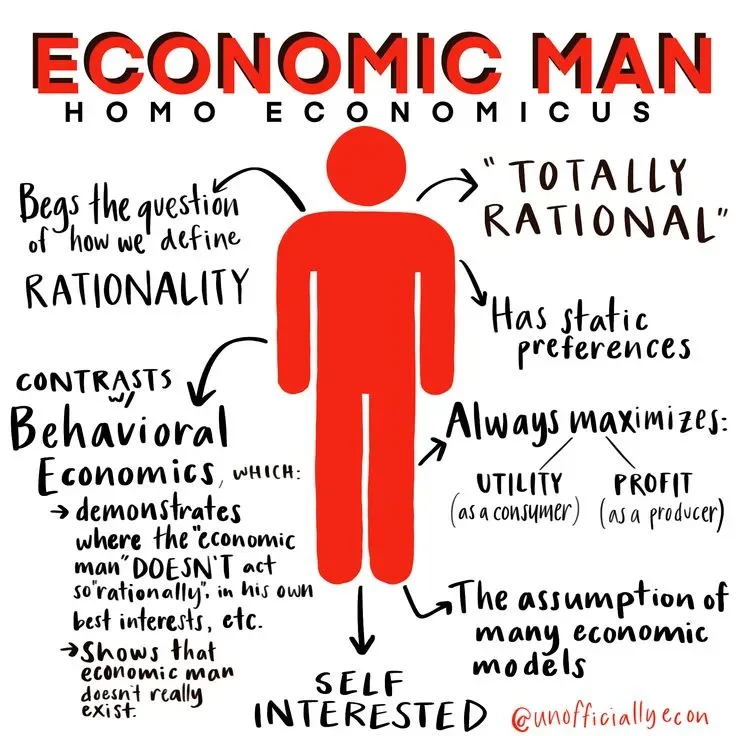
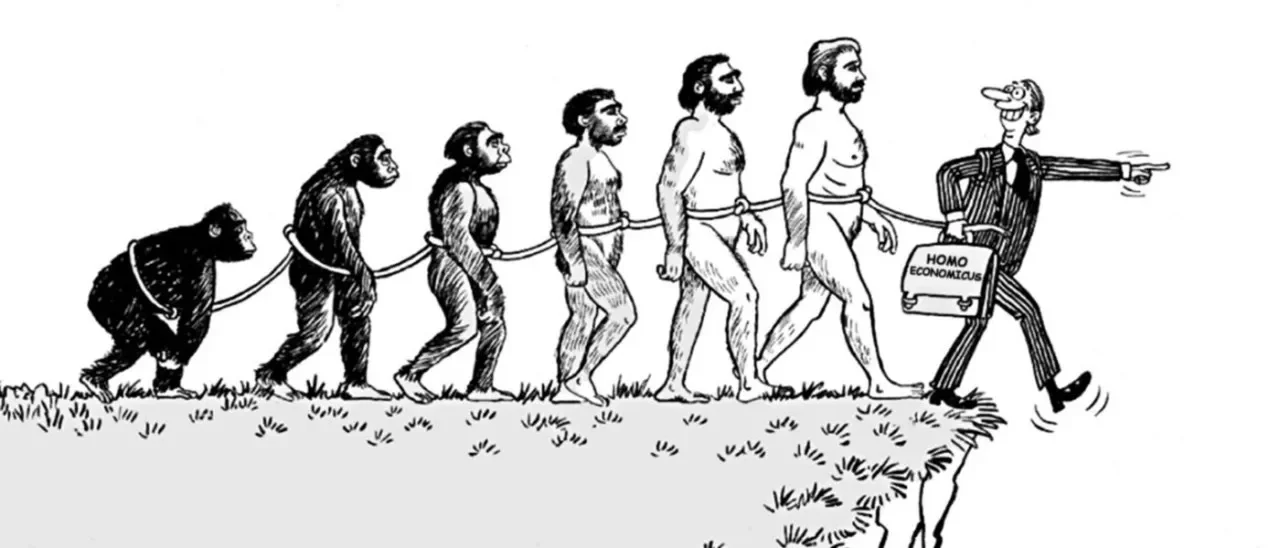
Capitalism is a system in which the economic sphere is disembedded from the social, eventually subsuming the social entirely—a phenomenon that critical theorists describe as the economization of all aspects of life.
The allure of capitalism as an ideology lies in its remarkable capacity to present itself as a natural law rather than a constructed system. By coding social relations into legal rights and monetary values, it renders the political invisible, transforming power struggles into technocratic questions of efficiency. We must explore the capitalist system, moving beyond surface-level definitions to examine the code of capital that sustains it, the psychological mechanisms that ensure its hegemony, and the structural incentives that drive ecological and civilizational collapse.
Let’s analyze the legal modules identified by Katharina Pistor that transform simple assets into wealth-generating capital, the psychological conditioning described by Mark Fisher’sCapitalist Realism, and the historical trajectory of societal collapse outlined in Luke Kemp’s Goliath’s Curse. We will also interrogate why alternative systems—from the market socialism of the East to the democratic confederalism of Rojava—have failed to displace the capitalist orthodoxy in the West, exploring the role of anti-communist purges, structural barriers, and the deep-seated ideological capture of Western culture.
A core understanding: The Capital Code.
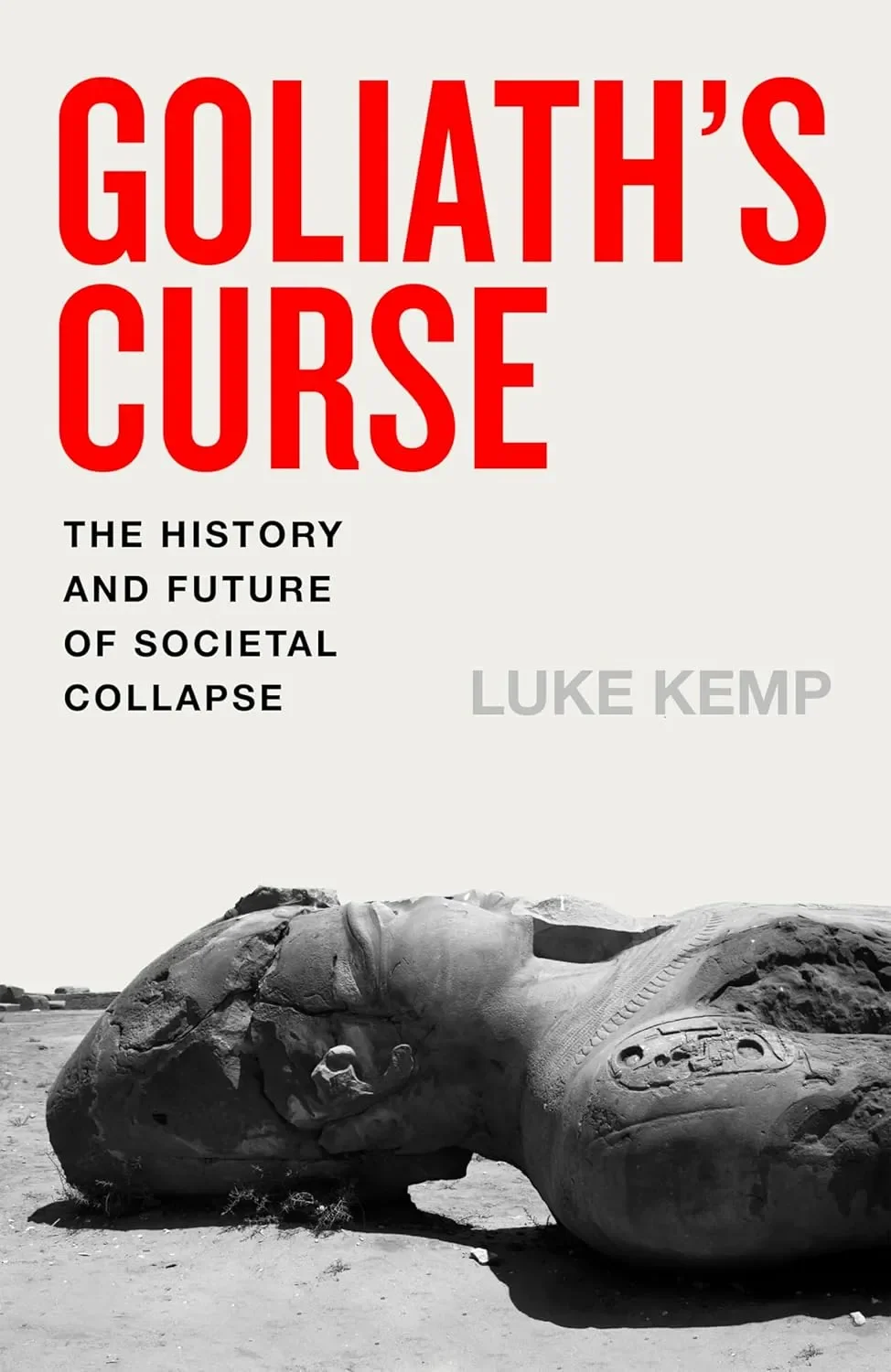
***Reading is essential.
Infotainment Debate Break: White Men Under Threat!
“I will NOT apologize for things people did in the past to people who are dead to make people who are living feel better, and you CAN’T make me!”
“I was an Empire baby who had the terrible misfortune of having been born after the Empire had already been lost. Have you no compassion, Sir!?”
But First—WAR: Good God, You All
***I’ll have to do another 100 pages on this topic. There are libraries of expert content on the subject, but we can always apply the perspectives listed at the top of this piece to deepen our understanding.
The Iron Lung of Empire: The War Economy
To discuss the modern economy without centering the War Machine is to describe a slaughterhouse without mentioning the knife. The Military-Industrial Complex (MIC) is not merely a sector of the US economy; it is the operating system of global, financialized capitalism. It is the hidden circulatory system that keeps the “free market” alive. No politician, no retirement fund, and no citizen is isolated from its reach. From the GPS on your phone to the jet engine on your holiday flight, the material comforts of the West are the civilian byproducts of a system designed to kill.
War is a Racket, as General Smedley Butler famously declared in 1935, but today it is much more than a racket—it is the structural pillar of Western solvency. The United States does not have a “defense budget”; it has a state-subsidized industrial policy that launders public tax dollars into private corporate profits (Raytheon, Lockheed Martin, Boeing, to name a tiny fraction), which are then recycled into political campaigns to ensure the forever war never ends is the ultimate “circular trade,” enforced not by market logic, but by the jackboot.
The Primary Omnicidal Heat Engine
We must strip away the patriotism and view the MIC through the lens of thermodynamics. The US Department of Defense is the world’s single largest institutional consumer of petroleum and its largest polluter. It is the primary omnicidal heat engine of our civilization. It burns the planet to secure the resources needed to burn more of it, while destroying the lives of ordinary people.
The global oil market—the lifeblood of the “petrochemical age”—is stabilized by the US Navy’s carrier groups. The US Dollar is not backed by gold; uranium-enriched munitions back it. The global reserve currency status, which allows the American Empire to print money and export inflation, rests entirely on the threat of overwhelming kinetic force.
We are told that the military drives innovation. This is the “broken window fallacy” writ large. Yes, we got the Internet, Radar, and GPS from the military, but at what cost? We have directed our species’ greatest minds toward the science of destruction rather than the science of living systems. We have perfected drone warfare, but ignored the soil.
Silicon Valley is the MIC in a hoodie.
Do not be fooled by the separation of “Big Tech” and “Defense.” They are the same ecosystem. The AI boom, the surveillance state, and the data centers discussed in previous sections are dual-use technologies. The “Great Game” of the 21st century is a fusion of Silicon Valley data-mining and Pentagon kinetics. The algorithms designed to keep you addicted to your screen are the same algorithms being trained to pilot autonomous weaponised drone swarms. The “smart city” is just a civilian application of the “electronic battlefield.”
The Existential Choice
This brings us to the final, brutal truth: The War Machine is an existential threat to living systems. In ancient empires, war was a method of acquisition. In the nuclear and biological age, war is a method of suicide. The MIC requires an enemy to justify its budget; therefore, it will manufacture enemies until it manufactures the apocalypse. It drains the capital, the cognitive energy, and the moral legitimacy required to address the Polycrisis. You cannot solve Climate Change while operating a military machine that emits more carbon than entire nations. You cannot solve Inequality when the nation’s wealth is funneled into hypersonic weapons rather than hospitals.
There is no path to cultures fit for posterity that includes the Military-Industrial Complex. It is a cancer on the body politic and a parasite on the biosphere. Dismantling the Global War Machine is not a policy preference; it is a biological imperative. We either turn off the engine, or the engine cooks the passengers.
Does infotainment do any good? What do you think? I watched PBS in middle school, way back in the 70s. Did their productions do any good? Too little, but I’m still happy we had the kind of PBS I remember from my youth. Progress. I need a new MacBook Pro; my 2014 model is reaching the end of its life—no more software updates; the processor is too old. Planned obsolescence, that’s progress. (The Myth of Progress | Samuel Miller McDonald
Mehdi Hasan et al, can report and debate about the Empires until the supernova; bright, eloquent journalists will always have a gig ‘having the conversation’ about how the Players spend the world’s resources and spread their social disease because the petty bourgeoisie, and the plebs and proles won’t organize to terminate Goliath—they are addicted to it—and if they do, they’ll get crushed by the institutions powerful men make. The technology of the monopoly on violence has never been more ubiquitous, sophisticated, and powerful.
People these days won’t sacrifice an hour on NETFLIX, a dose of Ozempic, or the next episode of “I told you so!” on the Tubes to stop the vandals from their quest for profits and control.
Despite decades of journalism, the destruction of living systems continues unabated; our metastatic social disease is incurable. In the near future, no one will notice the stench of the rotting corpse of global modern, techno-industrial, financialized capitalism because it will be programmed/engineered to smell like roses.
Eat, pray, love, the Cosmos is conscious, benevolent, concerned about you,
and waiting to embrace you in death
Take a walk in the woods
Be good to yourself
Believe fairy tales
Goliath always wins
Now, let’s enjoy His Story. The Anglosphere has nothing to be ashamed of. I guess.
Notice Nigel’s poppy lapel pin, so proud, so proud to be associated with veterans or foreign wars. What is he signalling besides support for the armed forces and fallen soldiers?
Note the title of his book below. What do you think about it?
Nigel is a politician; he’s a thought leader, he probably fancies himself a capitalist, not only a scholar of moral theology. These are the people we allow to run the show. With men like him influencing us, how do you think this thing of ours will end?
In the meantime, what new forms of slavery will the masters of industry create?
Nigel said he can’t feel guilty about something he didn’t do, and Medhi said, Are you proud of Britain’s defeat of the Nazis in World War Two? He really got him.
I am proud of the Soviet Union’s defeat of the Nazis in WWII, and I’m a U.S. citizen.
‘White Men Under Threat’ stories are all over social media platforms these days; it’s a brand new genre of infotainment.
Note Nigel’s hand waving when addressing the woman’s question regarding cancel culture and accountability.
Poor fella, life’s hard for wealthy white Anglo prodigal Gents.
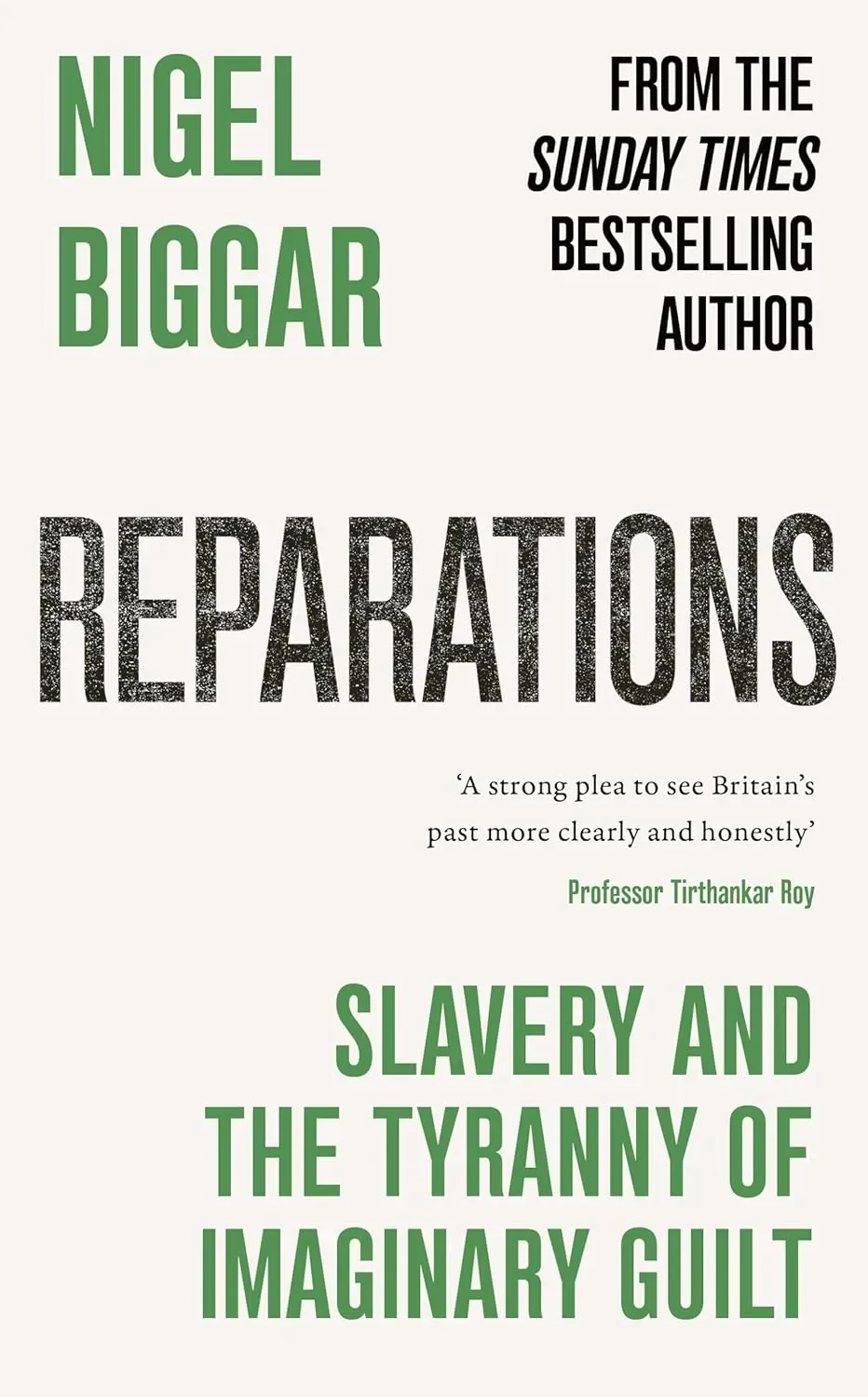
Gurminder was the woman debating with Nigel in the video above:
Gurminder K. Bhambra argues that sociology and other social sciences traditionally focus on the modern world, often in contrast to non-modern or pre-modern worlds studied by different disciplines. She contends that this modern world is inherently colonial, a fact overlooked in standard social science accounts. Recognizing the link between colonialism and modernity is therefore necessary to transform the field of sociology and establish what she terms a “reparatory sociology.”
Bhambra argues that modernity did not emerge solely within Europe and then spread, but was shaped by global connections and processes of colonization, enslavement, and imperialism.
She suggests that when historical accounts are shown to be flawed, conceptual frameworks need to be re-evaluated in light of more accurate historical narratives.
Bhambra challenges the common understanding of the state as solely national by highlighting the imperial origins of states like Britain, which were built on both extraction and redistribution. This challenges standard social science concepts of distributive justice and welfare.
Bhambra emphasizes the importance of scholars being transparent and honest about the purpose and politics behind their work, as exemplified by Patricia Hill Collins.
The Ontology of Capital: Etymology, History, and Definition
The Word and the Thing
The etymology of capitalism reveals the shifting nature of the beast. The root, caput (Latin for head), initially referred to heads of cattle—movable wealth in an agrarian society. By the 12th and 13th centuries, capitale emerged to denote funds, stocks of merchandise, or sums of money carrying interest. However, the term capitalism is a relatively modern invention, disparaged by socialists in the mid-19th century to describe a political system that privileged the owners of capital.
It is critical to distinguish between capital (wealth that produces more wealth) and capitalism (the system directing that process). As indicated by historical analysis, the term capitalism predates capitalism, appearing in the mid-17th century to describe the owners of wealth. The system itself, however, did not fully crystallize until the breakdown of feudalism and the rise of the Industrial Revolution cemented the separation of the worker from the means of production.
Mercantilism vs. Capitalism
To understand the distinctiveness of modern capitalism, one must contrast it with its predecessor, mercantilism. While both systems utilize markets, their logic is fundamentally different. Mercantilism, dominant from the 16th to the 18th centuries, was a system of state power where economic activity was subservient to the national interest—specifically the accumulation of bullion (gold and silver). It was characterized by zero-sum thinking: one nation’s gain was another’s loss.
Capitalism, conversely, operates on the premise of infinite growth and positive-sum outcomes through mutual exchange—at least in theory. Where mercantilism relied on state monopolies and strict regulation of trade to enrich the sovereign, capitalism (particularly in its liberal iteration) ostensibly separates the economic from the political, relying on competitive markets to allocate resources. However, as we will explore through the lens of legal coding, this separation is largely illusory; the state remains the ultimate enforcer of the private rights that constitute capital.
The transition was not merely economic but metabolic. As Marx noted, the shift from feudal agrarianism to capitalist industrialism created a metabolic rift, disrupting the cyclical interaction between humanity and the earth. The sedentary merchant of the commercial revolution paved the way for the industrial capitalist, who did not merely move goods but reorganized the very nature of production and time.
The Classical Liberal Foundation: Locke and Smith
The intellectual architecture of capitalism rests heavily on the works of John Locke and Adam Smith, who provided the moral and efficiency arguments that still underpin the ideology today.
John Locke articulated the moral justification for private property in his Second Treatise of Government. He argued that ownership derives from labor: “The labour of his body, and the work of his hands, we may say, are properly his. Whatsoever then he removes out of the state that nature hath provided, and left it in, he hath mixed his labour with, and joined to it something that is his own, and thereby makes it his property” Locke went further, justifying the enclosure of common lands by arguing that private appropriation increases the common stock of humanity: “he who appropriates land to himself by his labour, does not lessen, but increase the common stock of mankinb.” This provided a convenient moral cover for the privatization of the commons, a process Marx would later term “primitive accumulation.”
Man rules supremely and will make the Universe his own by turning the Earth into a machine his transhuman majesty can control.
Brutus Kilgore Dick IV —author
Adam Smith, often mischaracterized as a proponent of unrestrained greed, argued for markets based on efficiency and the “invisible hand” He posited that the pursuit of self-interest inadvertently serves the public good: “It is not from the benevolence of the butcher, the brewer, or the baker that we expect our dinner, but from their regard to their own interest.” However, Smith was acutely aware of the dangers of merchant conspiracies, warning that “People of the same trade seldom meet together... but the conversation ends in a conspiracy against the public, or in some contrivance to raise prices.” He also harbored deep suspicions of the joint-stock company (the ancestor of the modern corporation), fearing it encouraged negligence and waste—a warning ignored mainly by modern neoliberalism.
There are so many other political philosophers I could have mentioned, all the way back to Plato and Aristotle. How about Marcus Aurelius, an uber-rich and famous Roman Emperor and Stoic philosopher, who wrote Meditations.
Marcus Aurelius believed that a person’s worth is determined by their moral character and way of thinking, rather than by external factors such as wealth or social status. He suggested that true wealth lies in what is given away and that material prosperity should be received without arrogance and readily relinquished. He also considered life’s external circumstances, including wealth and poverty, as neutral. Easy to do when you are uber-wealthy.
Aurelius was born into extreme wealth as part of a patrician family, inheriting vast fortunes, including lucrative brickworks and grand villas, from his mother’s side, making him exceptionally rich even before becoming emperor; he was raised in luxury on Rome’s prestigious Caelian Hill and remained wealthy throughout his life, and, as emperor, managed the state’s immense resources.
It’s fascinating to study how the ancients got rich—nothing too unfamiliar.
***Friedrich Hayek—I highly recommend looking into his work.
The Code of Capital: How Law Creates Wealth
Standard economic histories often present capitalism as the natural result of market forces. However, legal scholar Katharina Pistor argues in The Code of Capital that markets are neither natural nor self-regulating; they are legally constructed. Capital is not a physical object; it is a quality encoded into assets by law.
The Legal Modules of Capital (developed in England, refined and codified in New York)
Pistor identifies specific legal modules that lawyers—the masters of the code—use to transform simple assets (like land, promises, or ideas) into wealth-generating capital. These modules are the DNA of capitalism, granting assets specific attributes that ensure their value endures and expands. (Wait until AGI gets involved—Qui bono).
Legal Module
Function in Coding Capital
Contract Law
Allows for the creation of enforceable private agreements that can mimic property rights and prioritize claims. It is the bedrock of exchange, but Pistor notes that it also creates private law between parties that the state enforces.
Property Rights
Transforms possession into a legal title enforceable against the world (universality), not just other contracting parties, is the oldest module, turning land from a shared resource into a tradable asset.
Collateral Law
Allows assets to be pledged to secure debt, giving priority to certain creditors over others in the event of default. This module essentially allows wealth to be leveraged to create more wealth, multiplying capital.
Trust Law
Protects assets by placing them in a separate legal silo, shielding them from the personal creditors of the beneficiaries (durability). The trust, originating in Roman law (fideicommissum), allows capital to survive generations, immune to the failures of its individual owners.
Corporate Law
Creates a legal entity that shields the owners (shareholders) from liability and protects thefirm’ss assets from theowners’’ personal creditors (entity shielding). This dual shielding is the engine of modern accumulation. (Who’s your garbage Corporate Person of last year?)
Bankruptcy Law
The ultimate backstop, enforcing the priority of claims coded through collateral and contract during insolvency. It determines who gets paid when the music stops, usually privileging secured creditors (capital) over unsecured ones (labor).
The Attributes of Capital
Through these modules, assets are endowed with four critical attributes:
Priority: The legal ranking of claims. Capital holders act to ensure their claims are satisfied before others (e.g., secured creditors vs. workers).
Durability: The ability of capital to extend over time and shield itself from claims, ensuring intergenerational wealth preservation (e.g., through trusts and corporate distinctness).
Universality: The extension of rights against the world (erga omnes). A contract is between two people; the state enforces a property right against everyone.
Convertibility: The ability to convert private credit or assets into state money on demand, ensuring liquidity even in crises (often through state bailouts).
The State as Enforcer
A crucial insight from Pistor is that capital relies entirely on state coercion. Capital is a social relation mediated by the state’s coercive powers. Private lawyers code the capital, but they rely on the public enforcing apparatus (courts, police) to back these private codes, creating a paradox: global capital is mobile and often escapes national regulation, yet it is utterly dependent on specific domestic legal systems (primarily English Common Law and New York State Law) to validate its existence. This hegemony of Anglo-American law allows capital to bypass local democratic controls, effectively opting out of national legal systems while relying on its coercive power.
Pistor notes that global capital has coded its own legal infrastructure, effectively choosing the laws that most favor it, or global capitalists. This is the best of all possible worlds, because it allows them to select the rules that favour them most without having to invest in politics to turn laws to their advantage. Legal arbitrage allows corporations to domicile in tax havens while enforcing their rights in London or New York courts, stripping the demos of its ability to regulate the economy.
The Engine of Belief: Psychology and Ideology
Why do people—even those disadvantaged by the system—remain committed to capitalism? The persistence of capitalism cannot be explained by economics alone; it requires a psychological and ideological analysis.
System Justification Theory
Psychologists John Jost and Mahzarin Banaji developed System Justification Theory to explain why individuals defend the status quo. The theory posits that people have an underlying psychological need to view the system they live in as fair, legitimate, and inevitable, to reduce anxiety and uncertainty. This palliative function leads the disadvantaged to rationalize their own subordination, often adopting stereotypes that justify inequality (e.g., “the rich work harder” or “inequality drives innovation”). This internalized oppression creates a significant barrier to revolutionary change, as challenging the system acts as a threat to theindividual’s sense of psychological stability and order.
This theory aligns with Gramsci’s concept of hegemony, where the ruling values become the common sense of society. In modern capitalism, this manifests as the belief that market outcomes are inherently meritocratic, despite overwhelming evidence of structural inequality.
Capitalist Realism
Building on this, the late cultural theorist Mark Fisher introduced the concept of Capitalist Realism, encapsulated by the phrase (attributed to Jameson/Žižek):““It is easier to imagine the end of the world than the end of capitalis”” Capitalist Realism is the widespread acceptance that capitalism is the only viable political and economic system, acting as an invisible barrier constraining thought and action.
Fisher argues that this realism creates “reflexive impotence,” a state where people know the system is flawed but feel powerless to change it. It co-opts all dissent; anti-capitalism itself becomes a commodity (e.g., the rebellious imagery in advertising, or films like Wall-E that critique consumerism while being products of a massive corporation). The “business ontology” permeates all aspects of life, with education and healthcare judged solely by business metrics, eroding the public sphere.
The 2008 financial crisis serves as a prime example. Despite the banking system’s manifest failure, the solution was not a systemic overhaul but a massive bailout to restore the status quo. The “too big to fail” logic reinforced the idea that there is no alternative (TINA), further deepening the grip of capitalist realism on the collective psyche.
Neoliberalism and the Economization of Life
Wendy Brown expands on this in Undoing the Demos. She argues that neoliberalism is not just a set of economic policies (privatization, deregulation) but a “governing rationality” that economizes all spheres of existence.
Homo Oeconomicus: Under neoliberalism, the human is reconfigured from a political citizen (homo politicus) into homo oeconomicus—human capital. Every action, from dating to education, is viewed as an investment in future value. (Even our children.) The citizen is no longer a bearer of rights but a self-entrepreneur responsible for their own employability.
The Undoing of Democracy: By subjecting democratic institutions to market metrics (efficiency, credit ratings, return on investment), neoliberalism hollows out the political substance of democracy. Justice and equality are replaced by market citizenship in which value is determined by contributions to the economy rather than by inherent human worth. The state’s shift from providing social welfare to fostering a “good investment climate” for capital.
Animal Spirits
John Maynard Keynes offered a different psychological insight with his concept of Animal Spirits. He recognized that economic stability is a myth because human decisions are driven by spontaneous optimism rather than mathematical expectation. This inherent instability contradicts the rational actor model of classical economics and highlights the volatile, emotional core of capitalist accumulation. As Keynes noted, “capitalism is the astounding belief that the most wickedest of men will do the most wickedest of things for the greatest good of everyone.”
This volatility drives boom-and-bust cycles. The panic phase of the cycle sees irrational exuberance and over-investment (often driven by the herd behavior Keynes identified), while the depressive phase sees panic and hoarding. This psychological oscillation makes capitalism inherently unstable, requiring state intervention (which neoliberals decry yet rely upon) to stabilize the ship.
The Neoliberal Turn: Theory and Practice
The shift to neoliberalism in the late 20th century marked a fundamental transformation in global capitalism.
Defining Neoliberalism
While often conflated with classical liberalism, neoliberalism is distinct. Classical liberalism (Locke, Smith) viewed the market as a natural phenomenon to be left alone (laissez-faire). Neoliberalism, however, views the market as a construct that must be actively created and protected by a strong state. As Michel Foucault noted, neoliberals do not believe in natural markets; they believe in thestate’ss duty to impose market mechanisms on society.
David Harvey defines neoliberalism as a political project to restore class power to the economic elite, while constraining the post-war Keynesian compromise. Through privatization, financialization, and the manipulation of crises, wealth was redistributed upward, a process Harvey terms accumulation by dispossession.
The Architects: Hayek and Friedman
The intellectual foundations were laid by Friedrich Hayek and Milton Friedman, who equated economic freedom with political freedom.
Friedrich Hayek, in The Road to Serfdom, argued that central planning inevitably leads to tyranny: “The power which a multiple millionaire... has over me is very much less than that which the smallest fonctionnaire possesses who wields the coercive power of the state.” For Hayek, inequality was not a bug but a feature necessary for progress: “Equality before the law and material equality are therefore not only different but conflict with each other; and we can achieve either one or the other, but not both at the same time.” Hayek argued that the price system is a mechanism for communicating information that no central planner could ever possess (the “calculation problem”).
Milton Friedman reinforced this in Capitalism and Freedom, arguing that “History suggests only that capitalism is a necessary condition for political freedom.” He famously posited that “The social responsibility of business is to increase its profits,” a doctrine that justified the externalization of all social and environmental costs. Friedman argued that if businesses focused on profit within the “rules of the game,” society would benefit. However, as Pistor shows, businesses actively rewrite the “rules of the game” (the legal code) to their advantage, undermining Friedman’s premise.
The Divergence: Brown vs. Harvey
There is a nuanced divergence among scholars in their understanding of this era. While Harvey views neoliberalism primarily through a Marxist lens as a “class project” intended to enrich the elite, Wendy Brown views it through a Foucauldian lens as a “stealth revolution of reason.” For Harvey, the state is a tool captured by the bourgeoisie; for Brown, the state itself, along with the human subject, is reconfigured by neoliberal rationality. Both agree, however, that the result is the erosion of democratic sovereignty and the dominance of market logic over all other forms of value.
Are there or have there ever been Democracies that weren’t captured by big business?
Incentives and the Ecological Rift: Why We Destroy the World
There is no real way out of the climate crisis without a rupture with the capitalist model, and there is no possible rupture without popular organisation, without collective struggle, and without confronting the structures that profit from devastation. — Bárbara Loureiro
The destructive capacity of capitalism is not merely a result of “bad actors” that are structurally incentivized. The very machinery of the system—from the legal code to the psychological imperative of growth—makes ecological degradation rational and inevitable within its internal logic.
The Metabolic Rift
Karl Marx provided the earliest and perhaps most profound critique of capitalist ecology with his theory of the Metabolic Rift. He observed that capitalist agriculture broke the cycle of returning soil nutrients to the land, instead transporting them as crops to polluted cities, where they became waste. This robbing of the soil is the precursor to modern ecological crises. Capitalism, Marx argued, “develops the techniques... of production by simultaneously undermining the original sources of all wealth—the soil and the worker.”
This concept extends beyond soil. It describes a rupture in the fundamental interaction between humanity and the rest of nature. Under capitalism, nature is viewed not as a living system but as a gift to be extracted, processed, and discarded. The linear throughput (extract-make-waste) is fundamentally at odds with thebiosphere’ss cyclical processes.
Externalities and Short-Termism
In neoclassical economics, environmental destruction is treated as an externality, so its cost is not reflected in market prices. Because the atmosphere and oceans are treated as free dumping grounds—the “tragedy of the commons” enacted by corporations— it is rational for a profit-maximizing entity to pollute. If a firm voluntarily pays to reduce pollution while its competitor does not, the responsible firm will be outcompeted and likely go bankrupt. Thus, the system punishesecological responsibility and rewards destruction.
Compounded by short-termism, stock market pressures force corporations to prioritize quarterly earnings over long-term survival. Research indicates that managers willing to sacrifice long-term value to meet short-term targets are rewarded with higher stock prices and bonuses. In contrast, those who invest in long-term resilience (such as R&D or sustainability) are punished by the market. Mark Roe argues, however, that the problem is not just time horizons but the capacity to externalize costs; a long-term thinking corporation will still pollute if the price of pollution is zero.
Goliath’s Curse: Inequality and Collapse
Dr. Luke Kemp’s Goliath’s Curse provides a historical macro-analysis of why such systems fail. Kemp argues that civilization is a propaganda term for Goliaths—societies built on domination. These societies require“Goliath fuel”: surplus grain, monopolizable weapons, and caged land (trapped populations). Kemp’s central thesis is that inequality is the primary predictor of collapse. As elites extract more wealth, they hollow out social resilience. The elite, often displaying dark tetrad traits (narcissism, psychopathy, Machiavellianism, and Sadism), engage in status competition that drives resource over-extraction. They are insulated from the early effects of the crisis, leading to elite overproduction and infighting, while the masses suffer.
The modern Global Goliath is a single, interconnected capitalist system, making the subsequent collapse potentially global and irreversible due to nuclear weapons and ecological tipping points. Thesystem’ss incentives drive this race to the bottom, creating a fragile structure susceptible to agents of doom—extractive industries and tech giants that prioritize profit over survival.
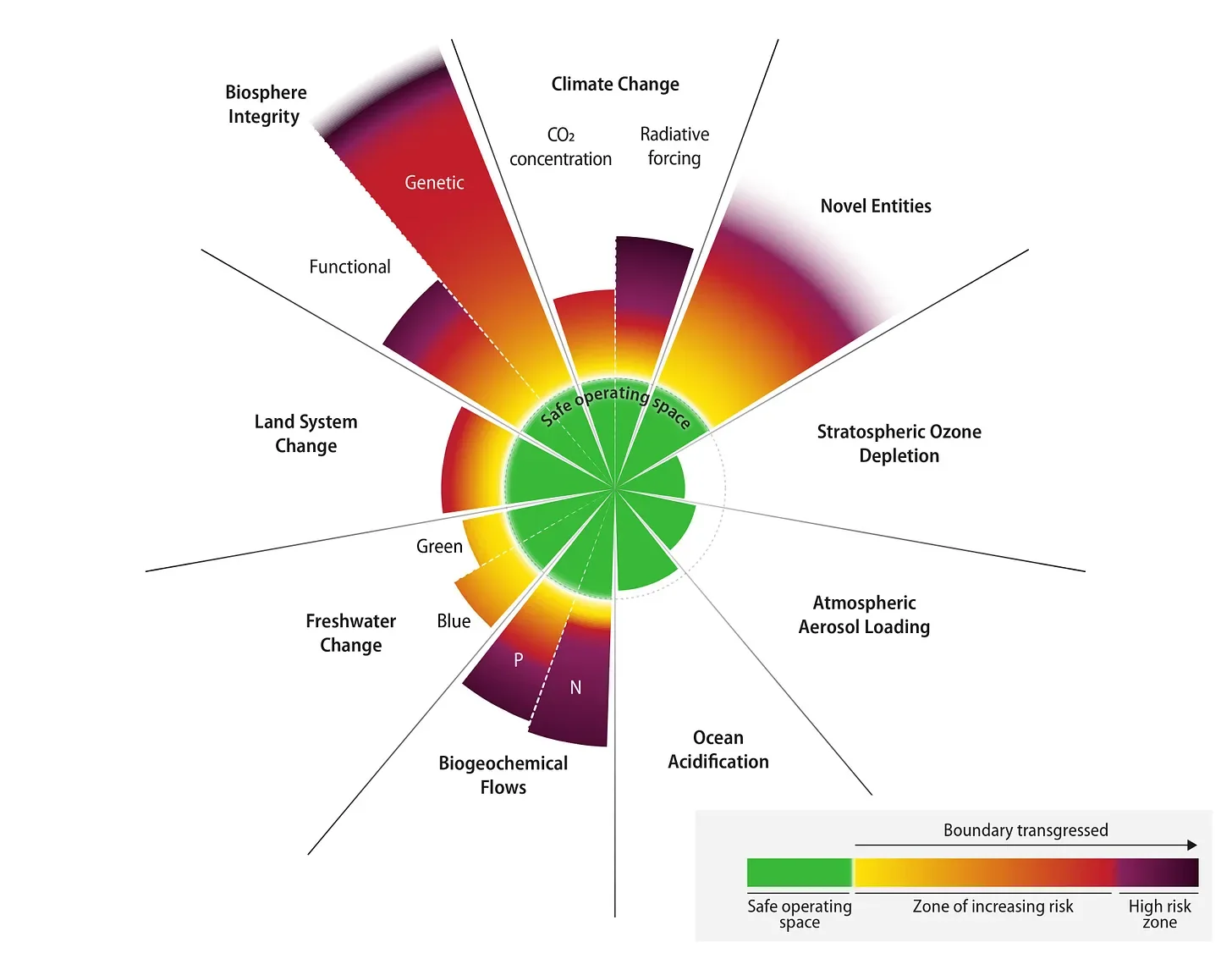
Why Alternatives Stalled in the West
If war is central tocapitalism’ss business model, is unstable, ecologically destructive, and prone to inequality, why have alternative systems not taken root in the West? The answer lies in a combination of violent repression, structural barriers, and cultural hegemony.
The Red Scare and the Purge of the Left
In the United States, the failure of socialism is inextricably linked to state repression. The “Red Scare” periods (post-WWI and post-WWII) effectively decimated the American left. The Second Red Scare (McCarthyism) did not just target Soviet spies; it purged radical civil servants who sought to turn the New Deal into a comprehensive social democratic project. Thousands of economists, planners, and activists were investigated, fired, or silenced.
Figures like Mary Dublin Keyserling were targeted for their association with socialist ideas, forcing them to hide their politics or leave public service. This brain drain from the left narrowed the spectrum of acceptable political discourse to a centrist consensus that accepted capitalist fundamentals. The legacy of this purge is a political landscape where even mild social democratic reforms are branded as dangerous communism.
Structural and Cultural Barriers
Beyond repression, structural factors played a role. The U.S. electoral system (first-past-the-post, presidential rather than parliamentary) makes third parties structurally unviable. In a parliamentary system, a socialist party getting 10% of the vote gets 10% of the seats; in the U.S., it gets zero. This forces all political energy into the two capitalist parties (the neocon, neoliberal Uniparty).
Culturally, the American Dream—grounded in individualism and anti-statism—has been a powerful inoculant against collectivist ideologies. The belief in social mobility (however mythical) leads many working-class Americans to identify with the rich rather than their fellow workers. As John Steinbeck (often misquoted) observed regarding the lack of socialism, people with low incomes see themselves not as an exploited proletariat but as “temporarily embarrassed millionaires.”
***John is quoted on my website’s homepage because I can relate.
Furthermore, racial divisions in the U.S. working class prevented the formation of the unified class consciousness seen in Europe. Capitalists successfully used race to divide the labor movement, hiring Black workers as strikebreakers or convincing White workers that their interests lay in maintaining racial hierarchy rather than class solidarity. As W.E.B. Du Bois noted, the white worker received a “psychological wage” of racial superiority that compensated for their low economic wage.
The Failure of Central Planning
Intellectually, the failure of Soviet-style central planning cast a long shadow. Hayek’s critique—that no central planner can possess the dispersed knowledge of millions of individuals contained in market prices—became the dominant economic narrative. The inefficiency, soft budget constraints, and lack of incentives in the Soviet bloc served as a potent warning, reinforcing the “There Is No Alternative” narrative. The collapse of the USSR was framed not as the failure of a specific authoritarian model, but as the final proof ofcapitalism’ss alignment with human nature.
OMG, will the end of history have to be postponed?
Alternatives: Visions of a Post-Capitalist Future
Despite the hegemony of capitalist realism, alternative models exist that offer blueprints for a world beyond the dictates of capital.
***This is not to say that I believe we have a way out of our predicament, but rather that industrious people have to do something or other, so they might engage in revolution in some form or another.
Market Socialism
Market Socialism attempts to combine the efficiency of markets with the social ownership of the means of production. In theory, firms would be owned by workers or the state, but would compete in a market economy.
The Chinese Model: “Socialism with Chinese Characteristics” is a hybrid in which the state retains control over the “commanding heights” (strategic industries such as banking, energy, and telecom) while allowing a vibrant market sector. While highly successful in generating growth and lifting millions out of poverty, critics argue that it has replicated capitalist inequality, labor exploitation, and ecological destruction. And let’s not forget that China is now the United States’ primary adversary of choice, keeping its business model (the MIC) firmly ensconced in the hearts and minds of U.S. Americans. The planned and gleefully anticipated (by U.S. American leaders) war with Chinawon’tt be good for the world. And it’s capitalist Uncle Sam’ss fault for doing the global capitalist thing by moving its manufacturing to China, financing China’s growth, and taking advantage of China’s labor arbitrage.
How does China’s economic model work? Political economist Ben Norton explains the ideas behind Socialism with Chinese Characteristics, discussing China’s socialist market economy, historical development, reform process, poverty reduction, industrial policy, and more.
***I lived in China on and off, starting in 1997. Ben knows what he is talking about.
“Were there not a China, America would have to invent a China.” —Joe Wishesaid
Yugoslavia: The historical example of Yugoslavia utilized worker self-management within a market framework. Workers’ councils made decisions, but firms competed. While it had periods of success, it eventually succumbed to debt, inflation, and ethnic dissolution, partly due to external pressure and internal inefficiencies.
Participatory Economics (Parecon)
Proposed by Michael Albert and Robin Hahnel, Parecon rejects both markets and central planning. Instead, it relies on decentralized participatory planning.
Mechanics: Worker and consumer councils negotiate production and consumption plans directly through a series of “iteration boards” until supply matches demand.
Incentives: Remuneration is based on effort and sacrifice (how long, how hard, and how onerous the work is), not property, power, or output.
Balanced Job Complexes: To prevent the rise of a “coordinator class” (managers/intellectuals) who dominate decision-making, all workers perform a mix of empowering and menial tasks. For example, a surgeon might spend some time cleaning the operating theater.
Critique: Critics argue that the meetings required for such planning would be onerous (socialism is too many evenings) and that it lacks the real-time responsiveness of price signals. However, proponents argue that modern technology could streamline this negotiation.
Oscar Wilde’s hostile criticism of socialism, “It would take too many evenings,” meant that it is uncivilized to allow politics to become a dominating preoccupation.
The Cooperative Model: Mondragon
The Mondragon Corporation in the Basque region of Spain is the world’s premier example of large-scale worker cooperativism. Founded in 1956 by a Catholic priest, it has grown into a massive federation.
Structure: It is a federation of worker cooperatives where the workers own the firm and vote on leadership and strategy (one worker, one vote).
Wage Solidarity: Pay ratios are capped. Initially 1:3, they are now closer to 1:6 or 1:9, which is still well below the 1:300+ ratios in U.S. corporations.
Resilience: During crises, Mondragon protects jobs by reallocating workers across the federation rather than firing them. Capital is subservient to labor; it is a tool, not the master.
Critique: As it expanded globally to compete with capitalist multinationals, Mondragon has been criticized for relying on non-member wage labor in its international subsidiaries (e.g., in China or Poland), effectively behaving like a capitalist firm abroad while remaining a cooperative at home.
Democratic Confederalism: The Rojava Experiment
In the Kurdish region of Northern Syria (Rojava), a radical experiment in stateless democracy is underway, based on the ideas of Abdullah Öcalan and Murray Bookchin.
Ideology: It rejects the nation-state in favor of Democratic Confederalism—a bottom-up system of communes and councils.
Economy: The social economy encourages cooperatives and communal land ownership. Agriculture and industry are reoriented to meet local needs rather than export markets. Monocultures planted by the Assad regime (e.g., wheat) are being diversified to ensure food sovereignty.
Feminism: It placeswomen’ss liberation at the center, with co-chair systems (one man, one woman) at every level of governance. This challenges the patriarchal foundations of both capitalism and traditional society.
Challenges: Existing under war conditions and embargoes, it struggles with resource scarcity, yet it demonstrates that a non-capitalist, non-statist social order is possible even in the most dire circumstances.
Kerala Has Abolished Extreme Poverty: The Fiftieth Newsletter (2025)
The Indian state of Kerala has eradicated extreme poverty through clear public policy, decentralised planning, and the leadership of its cooperative movement.
On 1 November 2025, the south-western Indian state of Kerala – home to 34 million people – was declared free from extreme poverty by Chief Minister Pinarayi Vijayan. Kerala is one of the few places in the world to have eradicated extreme poverty, following China, which announced in 2022 that it had eradicated extreme poverty nationwide.
Degrowth
Degrowth is not a system but a movement challenging the core capitalist imperative of infinite expansion. It argues that infinite growth on a finite planet is physically impossible.
Argument: We must voluntarily downscale production and consumption in the Global North to bring the economy back within planetary boundaries. This involves abandoning GDP as a metric and focusing on human well-being.
Mechanism: Shifting from private consumption to public luxury (universal basic services), reducing working hours to share labor, and redistributing wealth to eliminate poverty without aggregate growth.
Critique: Critics argue it is politically impossible (austerity for the working class) and that growth is needed for green technology innovation. Proponents counter that green growth is a myth because of the Jevons Paradox(efficiency leads to more consumption) and that capitalism’s drive to accumulate is the root cause of the polycrisis/predicament.
The Fork in the Road
Capitalism is a totalizing system, coded by law, fueled by inequality, and rationalized by a pervasive psychology of realism. It has severed the metabolic link between humanity and nature, creating a trajectory that, as Kemp warns, leads toward collapse. The legal code that grants capital its priority and durability insulates it from democratic control, while the “animal spirits” of the market drive volatility.
The failure of alternatives to take hold in the West is not merely a failure of economic viability but a result of violent suppression (Red Scares), structural lock-in (electoral systems), and the successful colonization of the human mind by neoliberal rationality (Undoing the Demos).
However, the cracks in the edifice are widening. The ecological crisis is the ultimate check on capitalist expansion that lawyers cannot code away. Experiments like Rojava and Mondragon, though imperfect and besieged, offer proof of concept that human societies can organize around needs, solidarity, and democracy rather than profit. The choice, as formulated by Rosa Luxemburg and echoed by modern critics, remains: Socialism or Barbarism. Or, in the language of the 21st century: Design a new code, or accept the curse of Goliath.
Key Quotes
Marx: “Capitalist production... develops the techniques... by simultaneously undermining the original sources of all wealth—the soil and the worker.”
Keynes: “Capitalism is the astounding belief that the most wickedest of men will do the most wickedest of things for the greatest good of everyone.”
Hayek: “Equality before the law and material equality are... in conflict with each other.”
Friedman: “The social responsibility of business is to increase its profits.”
Fisher: “It’s easier to imagine the end of the world than the end of capitalism.”
Pastor: “Capital is... a social relation, but it is mediated by the state’s coercive powers.”
Kemp: “History is best told as a story of organised crime.”
Locke: “He who appropriates land to himself by his labour, does not lessen, but increases the common stock of mankind.”
Smith: “People of the same trade seldom meet together... but the conversation ends in a conspiracy against the public.”
Capitalism offers one hell of an incentive structure. In the modern world, money buys an amazingly comfortable, safe, healthy, and exciting life. I hope you were born under a lucky star and did something profitable with your fated circumstances.
This post is far from comprehensive. I could have approached this from many different angles: Energy, Biophysics, Overshoot, The Polycrisis, Anthropology, pre-history—drawing on sources from the sciences and the humanities to highlight multiple layers of interconnected evidence.
Actually, I did—it’s all interrelated in my way of thinking. (Check out my ecosocialist bookshelf at www.cospolon.eu.)
This post isn’t an argument or an attempt to persuade anyone to adopt a specific ideology. It is a self-study exercise. I hope that it helps someone—a reader, a fence-sitter, or an apathetic sports fan—feel more open to seeing things from a different angle.
Some of the people I communicate with about these subjects know much more than I do, so I relax, focus, listen, and ask questions. I love my OCLTG community; it’s full of kind, conscientious, caring, and earnest people. Why wouldn’t they display those traits? They devote their time to understanding how Great Nature works, our terrible treatment of it, and our tragic lack of relationship with it. Their interest is motivated by a love of life.
This thing of ours motivates us to kill living systems for plastic bits. We seek ego-stroking ‘conversations’ with chatbots, dream of Playboy features, and pride ourselves on having the money to send to our favorite ‘partner’ on OnlyFans.
I also talk with people who aren’t familiar with or interested in OCLTG (Overshoot Collapse Limits to Growth). Rather than bore them with a tedious or confusing lecture, I usually let my conversation partner change the subject to keep things friendly. I can hear them thinking: What the fuck are you on about?
I love reading people’s expressions when I start in on this stuff. I’m a ruminator, so the conversation continues in my mind long after it’s physically done. Sometimes, I go home and write about what I was thinking during the interaction to help me communicate more effectively next time. Who knows? Anyway, I can’t help it.
I believe these subjects are vital. They help us develop the intelligence, intuition, and wisdom required to exercise agency as we navigate these challenges. Face-to-face conversations about complex and controversial topics are essential for any vibrant community that wants to create a way of life that’s good for posterity. Eric Lee quips, “bad news for 10-year-olds.” I want to see some good action for 10-year-olds.
But you know what? Our present way of doing things will not last. Capitalism is engineered obsolescence at scale. This thing of ours will self-destruct.
The conclusion of the process of modern techno-industrial Capitalism is death: the end of living (biological) systems, and the birth of a fantastic machine that will somehow know how to reproduce and evolve, eating the physical and metaphysical Universe as it goes. Of this beast, we are to be proud. It is the singularity of becoming God.
Nope, I think not. We won’t follow TESCREAL to a kind of mechanical ‘immortality.’ Instead, if we don’t mend our ways, our madly hubristic, self-centered species will, with a long whimper, cease to exist.
We live; we are intertwined living systems in living systems. It’s madness to create a death machine.
Global fossil-fueled, modern, techno-industrial, financialized capitalism is an omnicidal heat engine.
Anti-capitalist capitalists can’t understand...
Modern, global, fossil-fueled techno-industrial civilization is one huge Market where the dark tetrad Players play. Non-market social arrangements at scale are impossible. The damage inflicted over thousands of years on living systems, our minds, and our souls operates like a metastatic disease—both social and physical—that ideas alone cannot cure.
Market economies are omnicidal heat engines. Trade and small-scale local markets connected to natural processes have existed since before large-scale civilization emerged—look at David Graeber’s work and others.
Our actions have already ensured that our world will continue to heat up for thousands of years, yet that is merely one symptom of the superorganism’s disease.
Consciousness-raising about non-market possibilities—or even identifying our situation as a ‘predicament’—won’t register with billions of modernity addicts. They have zero interest in boarding an unfamiliar train of thought. Powerful, entrenched belief systems will crush any mass movement toward radical change, regardless of their origin. We are addicts, unable to admit we have a problem that demands a completely different way of living. Soon, global civilization may need hospice care.
If you have ideas or concerns, discuss them face-to-face within your community. Intimate connection is the only path to shifting perspectives.
Integral is just another technocratic attempt to manage large-scale civilization. I suspect we must entertain the idea that large-scale civilization is actually a failed evolutionary experiment coming to an end. Yet, people do all kinds of things. Some might find the Integral Collective attractive and worth the effort. Go for it!
Perhaps the best thing those of us who understand the predicament can do is tell it like it is. Speak to anyone who will listen—especially the willfully ignorant vandals bent on destroying living systems for their insane fantasies. They will likely ignore us, but many of us can’t help ourselves.
Make some noise.
READ THIS BOOK
How everything from the price of food to energy and housing costs is fixed by remote, unregulated financial markets, and what can be done about it
The global market in money – housed in the offshore ‘shadow’ banking system – holds $217 trillion in financial assets and operates beyond the reach of any nation’s taxman. Asset managers, private equity firms, and pension and sovereign wealth funds scoop up the world’s savings for investment and manage them as they choose, unaccountable to politicians or the citizens who elect them.
In this brilliant, accessible and incisive introduction to the murky world of globalized finance, Ann Pettifor links the activities of remote mobile financial markets to both the cost-of-living and climate crises. In an insane global casino, bankers are gambling with our future. When we foot the bill, no one but a few economists understands what has happened. The result is volatile, unpredictable and uncontrollable speculation in global commodities, pension, energy, and housing.
Pettifor argues that societies and governments can take back control of the global financial system. We have done it before and can do it again. Indeed, it is imperative that we do so if we are to manage the twin threats of climate breakdown and biosphere collapse.
***Trading, banking, investments, I didn’t go there; there are so many investment gurus, and lots of good books. I do feel it’s crucial to understand how these processes and institutions work, though.
One Scary Symptom of This Thing of Ours
“It’s lovely we’re having weather.” I used to say that when I lived in Seattle in 1980.
Study shows that the hotter climate regime will last centuries, not decades.
“Heatwaves are systematically hotter, longer, and more frequent the longer net zero is delayed, and reach their highest values when net zero is delayed until 2060. Moreover, most regional trends show no decline over the 1000 years of each simulation, indicating that heatwaves do not revert to preindustrial conditions. Some regions even exhibit significantly increasing millennial-scale trends when net zero is achieved by 2050 or later. Furthermore, the longer net zero is delayed, the more occurrences of historically rare and extreme heatwave events.”
Understanding the modern climate crisis requires synthesizing evidence from an immense, interconnected web of scientific disciplines, where no single line of inquiry stands alone. In the domain of atmospheric physics and chemistry, researchers measure the isotopic “fingerprints” of carbon dioxide, confirming that the sharp rise in greenhouse gases—now at levels unseen for millions of years—is driven by fossil fuel combustion rather than natural volcanic or solar cycles. Accumulation of these gases in the atmosphere traps heat with quantifiable precision (radiative forcing), a phenomenon corroborated by oceanography, which documents that the oceans have absorbed over 90% of this excess energy. The result is not just warmer water, but a fundamental shift in ocean chemistry (acidification) and physics (thermal expansion contributing to sea-level rise), which destabilizes the planet’s primary heat-regulation system. Simultaneously, meteorologists and climatologists use attribution science to mathematically distinguish between natural weather variability and human-induced anomalies, revealing that heatwaves, droughts, and supercharged storms are becoming statistically impossible to explain without the added thermal energy in the atmosphere.

The modern era of climate change research began at Scripps Institution of Oceanography and today Scripps is a global leader in observing how our planet is changing, understanding impacts, finding solutions, and training the next generation of scientific and environmental leaders.
U.S. National Academy of Sciences
“Scientists have known for some time, from multiple lines of evidence, that humans are changing Earth’s climate, primarily through greenhouse gas emissions.”
NASA—EVIDENCE
There is unequivocal evidence that Earth is warming at an unprecedented rate. Human activity is the principal cause.
Takeaways
While Earth’s climate has changed throughout its history, the current warming is happening at a rate not seen in the past 10,000 years.
According to the Intergovernmental Panel on Climate Change (IPCC), "Since systematic scientific assessments began in the 1970s, the influence of human activity on the warming of the climate system has evolved from theory to established fact."1
Scientific information taken from natural sources (such as ice cores, rocks, and tree rings) and from modern equipment (like satellites and instruments) all show the signs of a changing climate.
From global temperature rise to melting ice sheets, the evidence of a warming planet abounds.
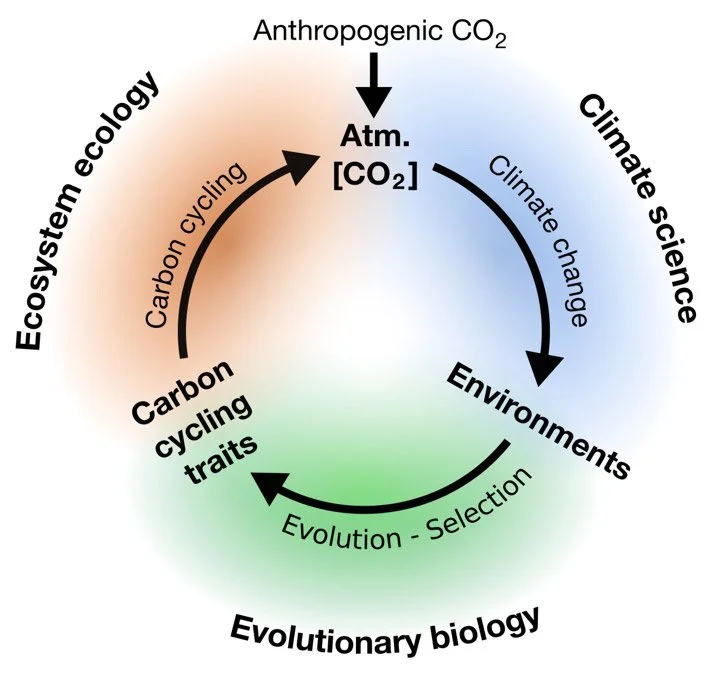
Complementing these real-time observations, paleoclimatology provides the crucial deep time context necessary to gauge the severity of current rates of change. By analyzing ancient air bubbles trapped in ice cores, tree-ring width (dendrochronology), and sediment layers, scientists have reconstructed Earth’s climate history, revealing that the current rate of warming is roughly 10 times faster than the average recovery from an ice age. Geological evidence aligns with distress signals tracked by evolutionary biologists and ecologists, who observe phenological shifts—seasons “breaking” as plants bloom earlier, species migrating poleward to escape heat, and coral reefs bleaching en masse. These biological responses act as millions of living sensors confirming the physical data. Finally, sophisticated computational modeling (Earth System Models) integrates these variables—atmosphere, biosphere, cryosphere, and hydrosphere—to demonstrate that only by accounting for human emissions can we reproduce the observed temperature records of the last century, sealing the case that the planet’s rapid destabilization is anthropogenic.
But, it seems, people don’t want to know. More on that in the conclusion of this adventure.
So much for love. So much for community. So much for humor. So much for quality of life? FFS! You’ve got too much love to give for this.
But let’s be honest: modern, fossil-fueled, techno-industrial capitalism has been an exhilarating ride... if you were born lucky. Excuse me, I meant meritorious, brilliant, industrious, competitive, vigorous, chosen, well-bred, and beautiful.
Capitalism is a fever dream hallucinated by arrogant, malprogrammed animals with opposable thumbs. I mean, God’s gift to the Universe.
o macaco da morte
AGSI looking in the mirror.
Folks are too busy grabbing what they can, fighting for what they must, and contorting themselves to fit into this world. It’s hard to see the forest for the trees.
As the engine of modernity redlines, the end rushes to meet us. Ain’t that something? I’ll be watching the final act from the front row until my lights go out and my bodily processes leak back out into the Universe.
Godspeed—whether that momentum drives the human, the machine, or the gavel of Great Nature’s immutable laws.
Rosa Luxemburg and Nassim Taleb on reading old books.
The Red Prophet: Why Rosa Returns
In the 21st century, Rosa Luxemburg is no longer just a martyr for the Left; she is the Cassandra of Late-Stage Capitalism. While Marx provided the anatomy of the system, Luxemburg diagnosed its terminal illness. Her brilliance resonates today because she predicted the exact dead-end we currently face.
Rosa Luxemburg was murdered on January 15, 1919, in Berlin by the Freikorps, a right-wing paramilitary unit, following the failed Spartacist uprising. She was struck with a rifle butt, shot in the head, and her body was thrown into the Landwehr Canal, where it was discovered months later.
The murders were part of the violent suppression of the 1919 German Revolution by the government-backed paramilitary group, with orders linked to high-level officials.
Her assassination transformed the German political landscape.

The Vampire Theory (The Accumulation of Capital)
***Let’s flog this dying beast one last time.
Luxemburg argued that capitalism is not a closed loop. It cannot survive solely by trading with itself. To breathe, it requires a host—a non-capitalist environment to devour. In her time, this was colonialism. In 2026, there are no new continents to exploit. So, what does the system do? It turns inward. It cannibalizes its own infrastructure, its own citizens, and the very biosphere itself. We see her “Accumulation of Capital” every time a tech giant strip-mines our private data because they ran out of physical markets to conquer. She knew that once the outside was gone, the system would eat itself.
The Rejection of the Managerial Class
Long before the terms Dark Enlightenment or Cathedral were coined, Luxemburg waged war against the bureaucracy. She despised the ossification of the German SPD and the vanguardism of Lenin. She saw that a revolution led by a rigid, central committee would simply replace one set of tyrants with another—trading the Czar for the General Secretary. For the modern disaffected thinker who hates the “HR-ification” of the world and the stifling grip of the administrative state, Rosa’s critique of top-down management is electric. She championed the spontaneous energy of the masses over the sterile plans of the elites.
Reform is a Trap
We live in an era of tinkering. Politicians offer tax credits to address climate change, and apps to address loneliness. Luxemburg eviscerated this mindset in Reform or Revolution. She argued that legislative reform within a capitalist state is not a step toward freedom; it is merely the system updating its antivirus software to prevent the crash. She understood that you cannot vote the predation out of a predator. For a generation watching “progressive” institutions fail to stop the slide into chaos, her ruthlessness is validating.
A polemic writing by the famous “Red Rosa” Luxemburg, Reform or Revolution (1899), explains why capitalism can never overcome its internal contradictions. An effective refutation of revisionist interpretations of Marxist doctrine, it defines the position of scientific socialism on social reforms, the state, democracy, and the character of the proletarian revolution.
Reform or Revolution opposes Edward Bernstein’s revisionist theories, which rejected Marxism in favor of trade unionism and parliamentary procedures. Luxemburg offers articulate and reasoned objections to all of Bernstein’s arguments. She defends the necessity of socialism, which provides an answer to the contradictions and inevitable crisis of the capitalist economy, as well as a means for transforming working-class consciousness. This essay remains a key explanation of why there can be no parliamentary road to socialism. It appears here together with Luxemburg’s writings on “Leninism or Marxism,” “The Mass Strike,” and “The Russian Revolution.”
Socialism or Barbarism
This was her ultimatum, and in 2026, it looks less like a slogan and more like a weather forecast. She warned that if society did not consciously reorganize itself, it would not just stay the same—it would regress into chaos, war, and collapse. As we watch the geopolitical order fray, the environment buckle, and the techno-feudalist warlords build their bunkers, Luxemburg’s binary choice rings terrifyingly true. We did not choose the former, so now we are getting the latter.
Some people have the courage of their convictions.
The Verdict
Rosa Luxemburg is brilliant today because she refused to be seduced by the illusion of stability. She saw the cracks in the foundation while everyone else was admiring the art on the wall. She reminds us that the gridlock and incompetence we see aren’t anomalies or new; they are the defining characteristics of a system running out of fuel and excuses.
The Value of Books
Nassim Nicholas Taleb argues that when it comes to books, time is the only valid judge of quality, a concept he formalizes through the Lindy Effect. In Antifragile and his Medium essays, he distinguishes between the perishable (humans, food) and the non-perishable (ideas, literature); while the former age and die, the latter age in reverse, meaning that for every year a book has remained in print and relevant, its expected future life doubles.
***One might wonder about the fate of old books after we finish burning down Library Earth. But let’s continue.
Taleb posits that this survival is not accidental but a proof of robustness against the disorder of time—books that have lasted for centuries have survived cultural shifts, wars, and criticisms because they contain antifragile truths that resonate across generations, whereas new books are merely untested hypotheses with a high statistical probability of being forgotten within a few years. Consequently, he suggests avoiding contemporary works in favor of those that have survived at least twenty years, as the filter of time is a far superior editor than any human critic, ruthlessly eliminating what is fragile, trendy, or merely noise.
***This is why I love bibliographies, I am always interested in what contemporary authors read and their references.
Signing Off—Improving things should be envigorating, fun, and feel good.
***I used to make TV commercials.
Asking hard questions can be difficult and stressful, but it doesn’t have to be. Self-reflection, metacognition, facing our own weaknesses—it’s a pain in the ass, but it also presents exciting possibilities. It’s a pity that so many people prefer the warm, soothing bath of wilful ignorance to challenges and facing their fears.
If it feels good, do it; if it doesn’t, ignore it.
I watch ABC News and see patterns. It’s short, crazy, and often makes me laugh from the absurdities laid bare in the stories or shake my head in shame. It’s the only mainstream news I watch, not because it’s helpful and enlightening, but just to see what the Players in the country of my birth are pushing.
On the news, for a while, aviation accidents; lately, it’s massive, deadly automobile pile-ups during blizzards. Why are these people on the road? I know you are the best driver your partner has ever seen, but the guy next to you might be having a very bad day and not paying attention as he should, especially in blizzard conditions. His bad day becomes your funeral.
I ache for the people forced to drive into the storm to keep a job and pay ‘rents.’ Why doesn’t the government pay people to stay home during a Red Weather Warning? It is cheaper to pay people to sit on the couch, or work remotely, if possible, as people did during the COVID pandemic, than to pay for disaster cleanup, hospital trauma care, and insurance claims.
We know the money exists. The USA can afford weapons for Israel and Ukraine without blinking. As MMT shows us, the central bank can create funds instantly. But when I ask why we can’t allocate funds for safety, people get angry. I’m supposed to offer “thoughts and prayers,” not analyze the structural causes of their misery. I’m not supposed to be disappointed that Obama bailed out the banks. The last global financial/debt crisis could have set the stage for meaningful reform. Bloody history rhyming all over again.
The Economic Consequences of the Peace — John Maynard Keynes (1919)
Keynes wrote extensively during the Great Depression (the 1930s); the book referenced above was his breakout polemic. It was a scathing, bridge-burning attack on the “Big Three” leaders (Wilson, Clemenceau, Lloyd George) at the Treaty of Versailles.
Take Queer Eye. I’ve watched every season. It’s an emotion-generating production designed to make you weep happy tears. I watched them transform a charter school teacher in D.C.—a genuinely good man who just wanted to help his colleagues. So, the show built a teacher’s lounge and stocked it with school supplies donated by Amazon. Do schools really need charity?
Cue the waterworks. But wait. Why is a private company that profits from that school relying on a reality TV crew to design and build a decent teacher’s lounge? It is obscene that teachers are paid so little that they can’t afford their own supplies. Why can’t the company provide school supplies? Would it destroy shareholder value? This is par for the course.
Why is it taboo to point this out? Because we are stressed out of our minds. We watch TV to numb the pain, not to solve the equation. The point of the show is to feel good, not to find solutions. So shut up and enjoy the tender moments.
Capitalism is engineered to trigger neurohormone cocktails, to passify, domesticate, and distract people, when we should be asking questions, thinking things through, and demanding to be free to design and implement solutions.
We are conditioned to accept our circumstances.
Ordinary people have always been relatively powerless, but not helpless. We are amazingly resilient. We take all manner of abuse and keep working to survive and provide some happy moments to our friends and family. People from the humblest circumstances do so much for their communities because they know how hard life can be. The Players know this. They bank on our ability to endure humiliation. Enslaved people in the antebellum South lived through hell on earth; thank God they had Jesus. Faith makes misery bearable. Belief in Big Gods is a survival mechanism that emerged from large, dense, hierarchical communities and civilizations.
Thousands of years ago, when large, dense communities used up local resources, they’d pack up and go somewhere else. There were new places to go way back then. During the age of discovery, when growing a crop on one island was no longer profitable, you’d go to another and use it all up. Today, our global civilization has no place else to go. Don’t let the tech bros bull shit you, their fantasies are financial scams meant to keep you enthralled and feeling good despite your intuition that something isn’t right.
The low-hanging fruit is gone. We won’t invent a Star Trek replicator. Soon, we won’t have the resources to dig deep enough to find what we need to keep the machine going.
Do we really need to tolerate this level of misery, humiliation, and nonsense?
Do you truly believe the Chinese worker, the Iranian teacher, or the Russian engineer is out to get you? Of course not, it’s the Supervillain’s fault.
The call is coming from inside the house. Uncle Sam is the one stirring the pot, the vandal engineering enmity.
Focus close to home, work to make things better. Fight to kick the deluded jackasses out of their positions of prominence.
Close to Home: the Óbidos Lagoon (Lagoa de Óbidos)
What is actually killing the Lagoon?
The lagoon is choking.
The immediate crisis at Óbidos is siltation (filling up with sand and mud). The natural inlet (the “Aberta”) that connects the lagoon to the Atlantic constantly tries to close due to natural sediment drift and the lack of strong river flow from the interior to push the sand back out.
When that inlet closes, the lagoon becomes a stagnant, festering pool. Oxygen levels crash. The fish die. The shellfish (bivalves) that locals rely on for food and income perish.
The current solution is a crude, mechanical life-support system. The authorities have to constantly allocate funds for dredging—using heavy machinery to physically dig out the sand to keep the “mouth” open so the lagoon can breathe.
Sea-level rise and the AMOC play a role.
Let’s look at this from the hyperobject level while politicians look sand level.
As the Atlantic rises, it changes the wave energy hitting that sand barrier. It erodes the coastline and pushes more ocean sediment into the lagoon mouth, accelerating the choking process.
The AMOC (Atlantic Meridional Overturning Circulation): The slowing of this great ocean conveyor belt messes with everything. It alters the wind and storm patterns off the Portuguese coast. If the AMOC weakens significantly, it changes the “storm tracks”—meaning the lagoon could be hit by more violent, unpredictable storms that smash the delicate sand barrier, or conversely, alter the rainfall patterns so there is even less fresh water flushing the lagoon out from the land side.
“Printing Money”: Weapons vs. Wetlands
Is the EU printing money to save this priceless habitat? No.
They throw pocket change (ter aranhas no bolso / to have spiders in the pocket) at it. You will find small EU grants for monitoring biodiversity, preserving forests and wetlands, educating fishermen, or conducting eco-management studies. It would be an ongoing investment of chump change. It’s band-aid money, and it’s vital.
Meanwhile, the European Central Bank and EU leadership can mobilize billions overnight for defense spending, ammunition production, and geopolitical maneuvering. War is more lucrative for the “right” kind of people.
To save the lagoon permanently would require massive, complex, industrial, ecological engineering—restoring the inland river flows diverted for agriculture and golf courses, and building resilient coastal infrastructure. That kind of “visionary” money doesn’t exist for beautiful, soul-nurturing living systems. It only exists for war, bailing out banks, and maintaining the revolving door between public and private gigs for career politicians and petty Players—more money for them and less life for people dependent on living systems.
CHEGA my ass!
Sometimes I wish there were fewer of us and we could leave Great Nature be.
The Óbidos Lagoon is a dying patient on a ventilator (dredging), kept alive just enough to support tourism and a few photo-ops.
The Players (the real estate developers, the EU business elite upstream, and the distant bureaucrats) treat it as an amenity, not a life-support system. They will let it choke the moment the cost of dredging exceeds the revenue from tourism.
We are watching a slow-motion execution of a vital ecosystem because the Market doesn’t know how to price a healthy wetland, but it knows exactly how to price a missile. When are we going to learn?
We should be asking questions about everything, all the time, to whoever will engage. But the culture screams: Shut up. I don’t want to think. I want to feel good.
I want Queer Eye to make me cry. I don’t want a spinoff that follows up two years later to see if the changes stuck. Don’t tell me that the one-off gift of attention faded because the poverty remained. SHUT THE FUCK UP. I watch to feel good and to remember that people are nice.
Well, people are nice, so are you. There are billions of kind, loving humans and only a handful of psychopaths. But our civilization is a meat grinder run by this handful of mad, destructive, dark tetrad Players. Blame the Players, create a new Game.
We are in a pickle. Market Capitalism delivers a quick hit of “feel-good” while it strip-mines living systems and warps the souls of billions. The Players of the Great Game don’t care about you. To them, you are a commodity. A battery. Landfill. Disposable. An externality.
But we don’t have to put up with this sick system.
We need to train ourselves to find joy in doing—in working with our neighbors to create better ways of living, rather than waiting for a TV show to give us 45 minutes of emotion. We can start by asking our neighbors what they need and want. Then we can ask: how can we make that happen? What are the obstacles? Who is standing in our way?
We know we can do better. We know how to feel good without the poison. You know what to do.
Life is beautiful, worthy of our love and respect. There is so much to live for. People are amazing creatures. Let’s enjoy the time we have and be kind to each other while OCLTG plays out.
Let’s do good stuff.
Look inward and outward and learn as much as you can. Great Nature is absolutely fascinating.
And come what may…, or what we want to create.
Thank you for reading. I hope you got something out of taking this journey with me. It took me months to put together, and I enjoyed doing it.
Take good care.