
Imperial Dynamics, Vassalization, and the Geopolitics of Late-Stage Hegemony
The modern world order is the architectural apex of a civilization built over the last 8000 years on the principle of perpetual material expansion, perpetual territorial conquest, and the systematic extraction of peripheral ecosystems. Since the beginning of European maritime expansion, the core’s political and mercantile institutions have depended on unequal environmental exchange to underpin metropolitan consumption, maintain domestic political order, and provide for the ruling elite. Since the end of the Second World War, the apparatus has moved from direct colonialism to one of covert military enforcement, financial hegemony, and institutionalized economic vassalage under the U.S.

(EMBARCACIONES PORTUGUESAS EN UNA COSTA ROCOSA – SIGLO XVI –O / L – 78 × 144 – COPIA DEL ORIGINAL DEL MUSEO DE GREENWICH)
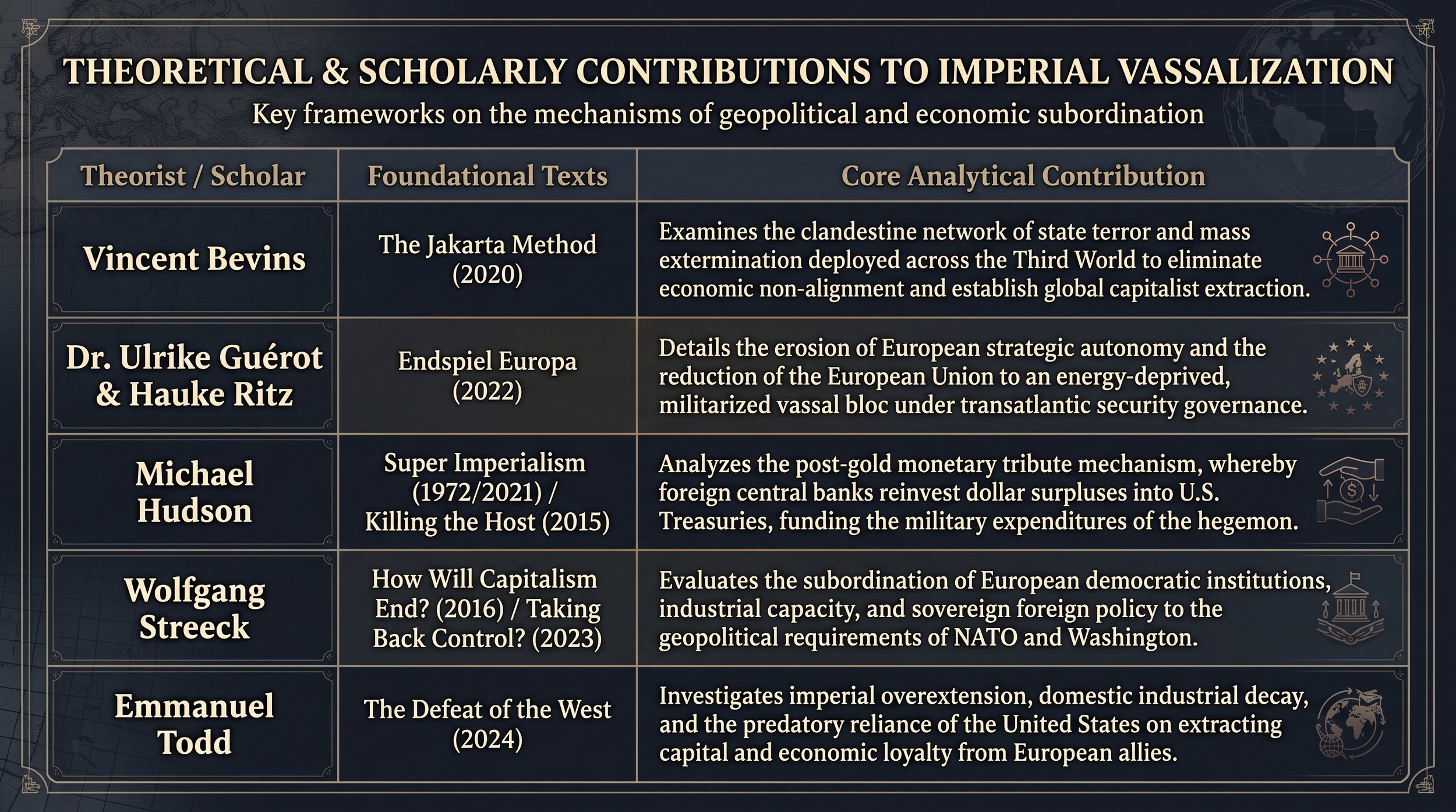
Historian Vincent Bevins lays out the physical mechanisms of this modern global division of labor in The Jakarta Method: Washington’s Anticommunist Crusade and the Mass Murder Program that Shaped Our World. He shows that incorporating the Global South into the post-war neoliberal market system was not the result of voluntary alignment or administrative efficiency. It was the product of state terror, mass murder, and clandestine regime change. Looking at the anticommunist purges in Indonesia in 1965 and the military coup in Brazil in 1964, Bevins shows how Washington engineered the murder of around one million Indonesian civilians to wipe out the PKI (Indonesian Communist Party), destroy the land reform movements, and give the West the right to extract the resources of Indonesia. He argues that what happened in Brazil and Indonesia was the template for a global network of extermination. This template was then weaponized in 20 countries (Chile, Guatemala, the Philippines, etc.) to systematically eradicate non-alignment and the economic sovereignty of the Third World. The IMF and World Bank’s Structural Adjustment Programs were the bureaucratic embodiment of this purge and the mechanism that bound the periphery to debt, which in turn required them to export their minerals, agriculture, and cheap labor to the metropoles.
In parallel, the European continent—the historical cradle of competitive imperial expansion—has been subjected to systemic political and strategic subordination. As Dr Ulrike Guérot and philosopher Hauke Ritz argue in their book Endspiel Europa: Warum das politische Projekt Europa gescheitert ist – und wie wir wieder davon träumen können (The Endgame of Europe: Why the political project of Europe has failed – and how we can dream of it again), the EU has not succeeded in establishing the sovereign state or strategic autonomy that it should have. In fact, it is a vassal bloc in the transatlantic security system. Guérot and Ritz point to the EU’s integration into NATO operational directives as the mechanism through which Europe has been politically and strategically disempowered. The continent’s historic links with the Eurasian landmass, in both politics and commerce, have been severed. By subordinating its economic interests to the geopolitical dictates of Washington (a process which has been dramatically accelerated by the war in Ukraine and the destruction of the Nord Stream pipelines), Europe has lost access to affordable pipeline gas, has sacrificed its industrial competitiveness and has accepted deindustrialization on a massive scale to be used as a disposable frontline against the competing powers. Guérot argues that European sovereignty is impossible as long as Washington’s containment of Russia and China remains the determining factor in Europe’s security and foreign policy.
Political economist Michael Hudson confirms this dynamic of structural subordination in Super Imperialism: The Origin and Fundamentals of U.S. World Dominance. He shows that separating the U.S. dollar from gold in 1971 created a monetary tribute system unlike anything seen before in history. The system’s structure has forced surplus foreign central banks (those with a surplus of dollars from the U.S. trade deficit) to reinvest those surplus dollars in U.S. Treasury securities. This monetary feedback loop has meant that surplus nations in Europe and Asia have directly financed the U.S. empire’s balance-of-payments deficit, domestic consumption, and overseas military bases. Global dollar hegemony forces allied protectorates to finance their own economic containment and geopolitical subordination.
Streeck goes into this in greater depth in How Will Capitalism End? He analyzes the demise of democratic capitalism in Europe and its transformation into a consolidated Atlanticist protectorate. The war in Ukraine was the institutional mechanism that effectively ended German and European diplomatic autonomy, subordinating both domestic social welfare and industrial policy to American energy exports and defense contracts. Todd in The Defeat of the West makes the same point about the erosion of Western imperial hegemony from within. The West is disintegrating because of deindustrialization at home, social fragmentation, and the collapse of the educational system. Todd shows that as the U.S. exhausts its productive capacity, it increasingly forces its European dependencies to consume, demand total economic conformity, submit to regulation, and flee capital from the periphery to the core to keep the metropolis afloat.
Biophysical Realities, Diminishing Returns, and Global Ecological Overshoot
The fundamental crisis undermining the modern world-system is biophysical rather than ideological or military. For eight millennia, civilization has grown by relocating its environmental impact and by continuously depleting ecological capital. In the 21st century, the imperial Great Game is playing out across the U.S., China, Russia, the EU, India, and Africa, and has reached the physical limits of a closed planetary system. No frontiers remain, and no populations remain to colonize to subsidize the metropoles’ growth.
(I won’t bring up migration, immigration, or refugees that are always created and required by the structural preconditions of “The Game.” In another essay.)
It’s the OVERSHOOT, stupid.
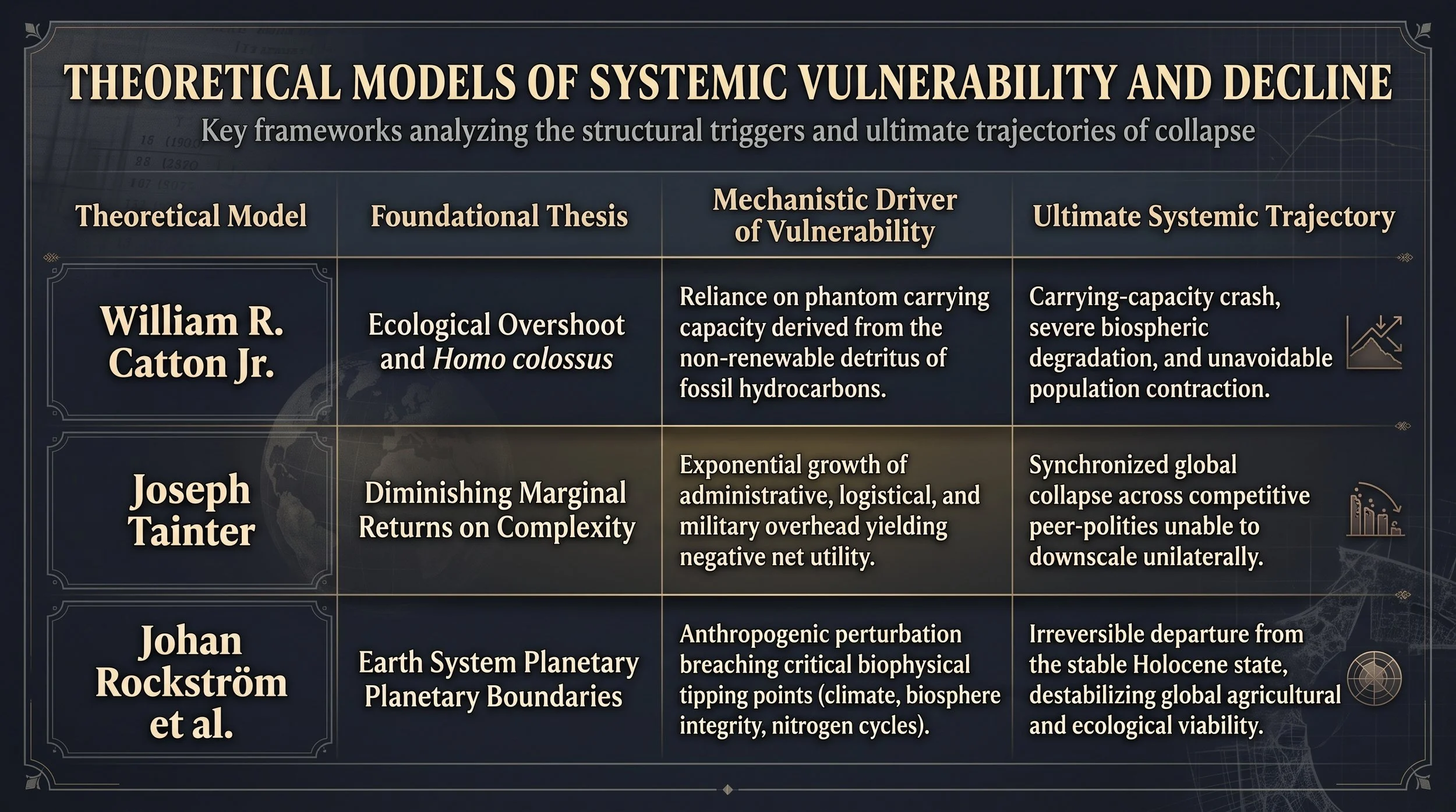
Sociologist William R. Catton Jr. lays out the mechanics of this boundary in Overshoot: The Ecological Basis of Revolutionary Change. He describes humanity’s transition from biological members of local ecosystems to Homo colossus, a species whose per capita resource consumption and thermodynamic footprint have been enormously amplified by industrial machinery. Catton points out that the explosive growth of both population and economic output in the 19th and 20th centuries was entirely due to the exploitation of the non-renewable energy locked up in fossil fuels, which in turn has created an unstable ‘phantom carrying capacity’:
“This algal Age of Exuberance lasts only a few weeks. Long before the seasonal cycle can bring in more detritus, there is a massive die-off of these innocently incautious and exuberant organisms. Their ‘age of overpopulation’ is very brief, and its sequel is swift and inescapable.”
Catton describes modern techno-industrial society as operating within a temporary ‘detritus ecosystem’ as it consumes finite mineral and hydrocarbon reserves that have accumulated over hundreds of millions of years. Industrial humanity treats the drawdown of these resources as simply continuing economic production. Catton notes that all the political and economic proposals we have for dealing with stagnation essentially accelerate the consumption of the planet’s remaining natural capital, systematically reducing the planet’s carrying capacity for future generations.
“Posterity doesn’t vote, and doesn’t exert much influence in the marketplace. So the living go on stealing from their descendants... By not recognizing the ecological pattern, we have misconstrued our own history. Our misunderstanding enabled us to overshoot carrying capacity. If misunderstanding persists, it can turn the ecological kind of antagonism into the emotional kind, making an unkind fate crueler than necessary. As other mammalian species have moved into a post-exuberant stage, increased antagonism and competition typically have led to increased violence and behavioral degeneracy.”
(I cite his work in many essays and places. Too few people understand the perspectives laid out in his book.)
When over-exploitation and pollution permanently reduce the ecosystem’s carrying capacity, the baseline support capacity collapses, inevitably contracting both population and structural complexity.
Anthropologist Joseph Tainter makes the institutional aspects of this thermodynamic exhaustion clear in The Collapse of Complex Societies (frequently cited). He sees human societies as problem-solving systems that keep adding sociopolitical complexity (more bureaucratic/administrative organs, more legal institutions, more military hierarchies, more specialized infrastructure, etc.) to deal with the stresses inherent in any complex system. The key point is that the investment in sociopolitical complexity is subject to a law of diminishing returns:
“Human societies are problem-solving organizations; sociopolitical systems require energy for their maintenance; increased complexity carries with it increased costs per capita; and investment in sociopolitical complexity often reaches a point of declining marginal returns.”
In the early stages of civilization, simple institutional additions yield huge returns in social stability, resource capture, and technological capability. As civilization progresses, however, the metabolic energy and material cost of the administrative apparatus begins to exceed the resources it generates. To maintain its existing scale, society must keep extracting ever more from the environment and the population, making it brittle, fragile, and prone to collapse.
Tainter makes a crucial distinction between historical collapses and the crisis we face today in the context of the techno-industrial complex. The ancient collapses (Roman West, Chaco, Lowland Maya, etc.) were all regional phenomena. When other polities of comparable complexity arise, you can’t simply unilaterally simplify:
“Collapse, when it comes, will be a group affair. No one can collapse unless they all collapse at once. (Which is what happened to the Maya.) That is the reason Europe did not collapse long ago, and that is the reason the next collapse will be a global one.”
In a competitive peer-polity system, any nation that reduces its complexity, cuts energy use, or gives up on resource extraction is absorbed or destroyed by its competitors. Given that modern techno-capitalism has brought all the great powers into a single global trade and financial system, regional isolation is no longer an option. The great powers are locked in a race to consume finite biophysical stocks, and when complexity reaches its limit, the collapse will be global and simultaneous.
Techno-Utopian Escapism, the TESCREAL Axis, and Algorithmic Warfare
Faced with biophysical ceilings and diminishing marginal returns, the technocratic and economic elites of the industrial core have embraced hyper-rationalist ideologies that rationalize the continued drive for expansion. Rather than face the planet’s material limits, they have come to view terrestrial boundaries as temporary engineering problems to be solved through computational optimization, AGI, space colonization, and the eventual building of Dyson spheres. These technological fantasies function as a secular eschatology, providing a narrative that justifies continued extraction of the biosphere.
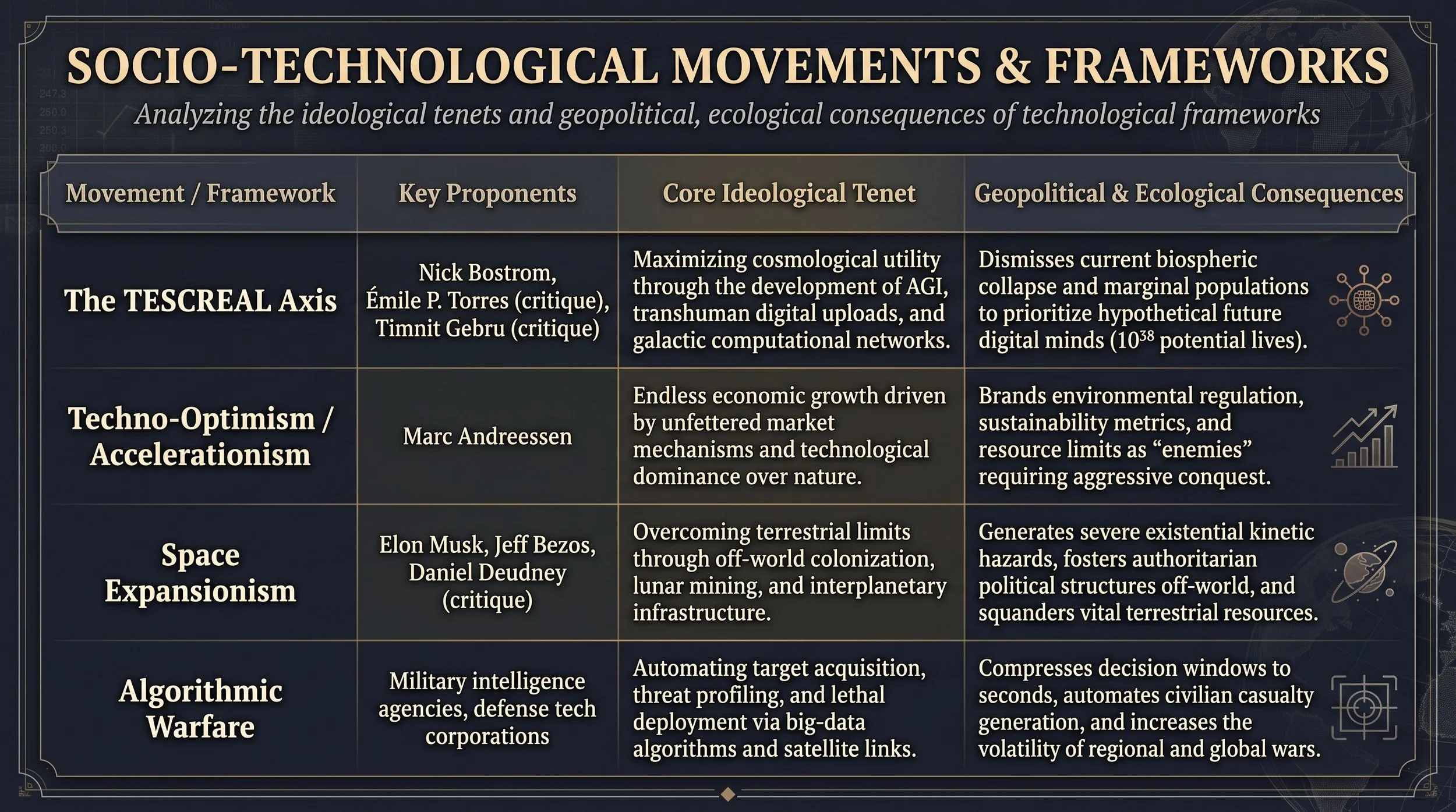
Computer scientist Dr. Timnit Gebru and philosopher Émile P. Torres examine this ideological nexus under the acronym TESCREAL (Transhumanism, Extropianism, Singularitarianism, Cosmism, Rationalism, Effective Altruism, and Longtermism). Within the TESCREAL package, we have Eugenics and the promise of Utopia via Artificial General Intelligence. Gebru and Torres show that these are distinct movements that form a coherent philosophical doctrine directly descended from the eugenics traditions of 20th-century Anglo-American thought.
“And we were specifically interested in the underlying ideological drivers behind the current race to build ASI or artificial superintelligence. TESCREAL is a clunky, kind of unsightly term. Still, it does a lot of important explanatory work... [the ideologies] share historical roots and an obsession with IQ that can be traced back to first-wave eugenicists.”
The TESCREAL view holds that biological humanity is only a passing phase in the evolution of intelligence and will be replaced by post-human digital intelligences that will colonize the galaxy and build enormous computer architectures throughout the cosmos. Nick Bostrom lays this out very clearly in his work Astronomical Waste: The Opportunity Cost of Delayed Technological Development. From a total utilitarian standpoint, he argues that every moment that humanity delays in colonizing space and creating digital simulations is a huge loss of potential value:
“The potential for approximately $10^{38}$ human lives is lost every century that colonization is delayed... it may take about $10^{31}$ to $10^{44}$ operations to simulate all neuronal operations that have occurred in the history of life on Earth.”
Under that totalizing utilitarian calculus, present-day environmental destruction, social inequalities, and real human suffering matter little compared with the trillions of post-human minds (10^58 potential digital minds in the reachable universe) waiting to be created in vast computational clusters. The living biosphere is therefore subordinated to creating post-biological computational systems.
Venture capital in the Valley strongly favors this view. In The Techno-Optimist Manifesto, Marc Andreessen sets out these assumptions as an emphatic defense of extractive market capitalism:
“We believe growth is progress — leading to vitality, expansion of life, increasing knowledge, higher well-being... everything good is downstream of growth... We are not victims; we are conquerors. We believe in nature, but we also believe in overcoming nature. We are not primitives, cowering in fear of the lightning bolt. We are the apex predator; the lightning works for us.”
Andreessen rejects ecological limits, sustainability targets, and regulatory precautions, identifying them as ideological adversaries:
“Our enemy is stagnation... Our enemies are: degrowth, the precautionary principle, sustainability, ESG, the Sustainable Development Goals”.
Notably, Andreessen includes Filippo Tommaso Marinetti (the Italian Futurist who celebrated industrial warfare and co-authored the 1919 Fascist Manifesto) as one of his ‘Patron Saints of Techno-Optimism,’ underscoring the inherently militaristic and expansionist character of current tech accelerationism.
In Dark Skies: Space Expansionism, Planetary Geopolitics and the Ends of Humanity, political theorist Daniel Deudney systematically dismantles the notion that off-world expansion offers a viable escape from Earth’s constraints. He shows that space colonization is not a hedge against extinction but rather a potentially catastrophic risk in itself.
Space expansionism does not transcend terrestrial geopolitical rivalry; it exports imperial dynamics into an environment characterized by extreme physical vulnerability and catastrophic weapons potential. Extraterrestrial human habitats, requiring total control over breathable-atmosphere supply, water recycling, and temperature regulation, would inevitably demand centralized, unyielding technological control, creating archetypal totalitarian regimes.
Deudney also shows that creating sovereign extraterrestrial settlements would lead to an interplanetary security dilemma. Orbital habitats and redirected asteroids could carry catastrophic kinetic energy within Earth’s deep gravity well. Space industrialization would therefore give sovereign actors the capability to launch planet-killing kinetic strikes, which in turn would massively increase the probability of a terminal conflict.
The ultimate expression of techno-utopian hubris is the swift incorporation of AI and algorithmic decision systems into the conduct of war. The dream of planetary governance via a computational architecture has given rise to automated military systems that take satellite telemetry, telecom data, and algorithmic profiling and turn them into assassination targets at operational speeds that make meaningful human intervention impossible.
The +972 Magazine/Local Call investigation into these systems’ use in the Gaza Strip revealed the full extent of the automation. They looked at the ‘Lavender’ and ‘The Gospel’ (Habsora) systems. Lavender is an AI decision-support system that ingests massive surveillance archives and assigns each individual a probabilistic score for their likelihood of being a militant. It then produces kill lists with tens of thousands of names. The operators reported that human review was a mere formality. A human would spend as little as 20 seconds on a target, typically just confirming it was a male, and then approve the kill. The Gospel is an automated structural-targeting system that identifies infrastructure and dwellings for aerial strikes at speeds far beyond any human’s capacity, turning targeting into an automated industrial slaughterhouse. These algorithmic decision systems show that accelerating computation does not free us from the biophysical reality of destruction. It simply lets declining imperial powers optimize their killing at an ever-increasing rate. The real threat is the automation of warfare as an industrial process, accelerating the region’s collapse and increasing the likelihood of terminal world conflict.
The Inadequacy of Reformist Governance within the Growth Paradigm
A fundamental mistake in modern political theory is assuming that simply reconfiguring the distribution of political power or reorganizing capital within the existing growth paradigm will address the deepening civilizational crisis. Mainstream reformist models (from the Nordic model of social democracy and state socialism to more progressive transnational movements such as DiEM25 (Democracy in Europe Movement 2025)) still operate within industrialist models dictated by the laws of thermodynamics. They will, of course, criticize the concentration of corporate power, the financialization of the economy, and the democratic erosion of the neoliberal model. Their policy prescriptions, however, are all premised on the need for continued macroeconomic growth to pay for welfare transfers, finance the construction of replacement energy grids, and maintain full employment.
By accepting continuous growth as a necessary condition of institutional legitimacy, political reformism is trapped in the multipolar trap (a classic game-theoretic dilemma that operates across the system). In the anarchic international system of peer polities (U.S., China, Russia, India and the EU), every state is under an imperative to maximize its energy, computing and industrial capacity. Any state that reduces its industrial metabolism, cuts resource extraction, or redirects capital away from military technologies will be swiftly marginalized in the geopolitical order or face direct military intervention by its peers.
This dynamic is that all the major political projects of modern civilization are based on the same extractive metabolism. European social democracy is routinely presented as the ‘fair’ alternative to unregulated capitalism, but it was historically underpinned by unequal ecological exchange with the Global South. The real energetic and ecological costs of production were absorbed through the cheap import of minerals, fuels and cash crops from the Global South. This allowed European populations to enjoy a very high standard of living, while these same resource transfers funded the welfare state. The high standard of living in social democratic countries was not a self-contained achievement; it resulted from resource extraction from the Global South.
A structural failure equally afflicts classical state socialism. In reality, it meant matching the capitalist world’s level of heavy industry, the scale of resource extraction, and the size of the military to achieve the same Promethean drive to master nature. Transferring ownership of productive assets from private corporations to central bureaucracies does nothing to change the thermodynamic facts of resource depletion, environmental damage, and ecological overshoot. State socialist institutions were still problem-solving hierarchies that required ever-greater energy inputs and were subject to the same law of diminishing returns to complexity that Tainter identified.
The alternative “Green New Deals” and decarbonization schemes reiterate these contradictions. You can’t replace a fossil-fuel-based energy metabolism with renewables and battery storage without an utterly massive expansion of the industrial mining frontier. The materials required to electrify everything (lithium, cobalt, nickel, copper, rare earths, etc.) all require huge-scale open-pit mining, chemical processing, and ecosystem destruction in South America, Central Africa, and on indigenous lands. Rather than decoupling economic activity from the planet’s biophysical limits, the industrial green transition merely relocates ecological destruction from the atmospheric carbon sink to the Global South’s terrestrial mining basins, maintaining the very imperial dynamic of resource extraction. Because reformist political programs still commit to continuing the modern civilization as we know it (with all its complexity and levels of consumption), they are metabolic accelerants, just as much as the status quo, and will continue to deplete the planet’s remaining living systems.
Hospicing Modernity and Constructing Post-Extractive Relationalities
As modern techno-industrial civilization is inescapably constrained by its biophysical limits, and technological fantasies can only promise ever more catastrophic escalation, human survival will depend on an ontological shift. This entails the dismantling of the anthropocentric worldview in which we are the apex species, entitled to rule over and exploit the rest of the living world. The alternative is to move toward a cultural paradigm of humility, mutual restraint, and reciprocal care for the planet’s living systems.
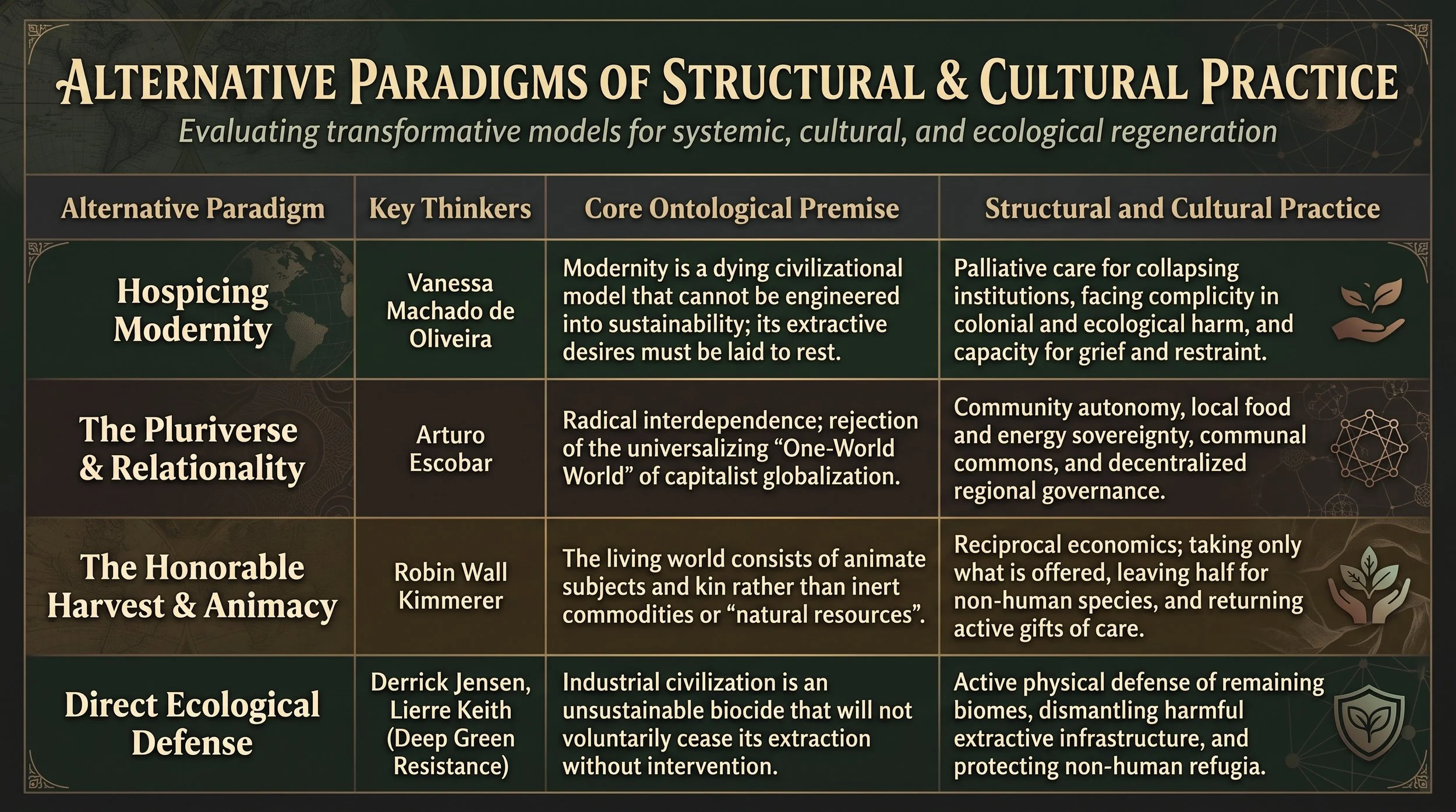
Decolonial scholar Vanessa Machado de Oliveira makes this cultural shift explicit in Hospicing Modernity: Facing Humanity’s Wrongs and the Implications for Social Activism. Another book I reference consistently, and I hope more people read and understand. She says the ‘failure’ lies in the ‘house that modernity built’ (a sociopolitical edifice based on universalizing rationalism, perpetual expansion, and the subjugation of the biosphere). It cannot be reformed or re-engineered to be sustainable, and any attempt to save it merely prolongs its destructive tendencies.
Rather than attempting to remodel a fundamentally flawed foundation, humanity must learn to “hospice” modernity. Hospicing means offering palliative care to a dying civilizational model: helping its extractive structures gradually decompose while mitigating the collateral damage inflicted on human and non-human communities during its decline. This approach requires sitting with grief, acknowledging complicity in structural violence, and unlearning the habits of entitlement, total control, and continuous growth that define the modern consumer identity.
Anthropologist Arturo Escobar approaches this in Designs for the Pluriverse: Radical Interdependence, Autonomy and the Making of Worlds. He fiercely criticizes the hegemony of the ‘One-World World’ (the idea that there is one world and that all other worlds must be subsumed into it through technological development and integration into the global market). Escobar favors ‘relational ontologies’ in which all things exist only through their deep interdependence with all other things and living networks. The pluriverse is a world of ‘many worlds’ (a world where many worlds fit). It is a world of community autonomy, local food sovereignty, communal tenure, and regional self-sufficiency, where the global market’s universalizing imperative is dismantled in favor of local, ecologically embedded forms of life.
Indigenous botanist Robin Wall Kimmerer makes this fundamental shift in worldview (from seeing the natural world as mere property to seeing it as a living community) very clear in Braiding Sweetgrass: Indigenous Wisdom, Scientific Knowledge and the Teachings of Plants. Kimmerer identifies the fundamental disease of industrial society as alienation from the non-human world and the way in which language reinforces that alienation:
“The animacy of the world is something we already know, but the language of animacy teeters on extinction—not just for Native peoples, but for everyone. Our toddlers speak of plants and animals as if they were people, extending to them self and intention and compassion—until we teach them not to... Saying ‘it’ makes a living land into ‘natural resources.’ If a maple is an ‘it,’ we can take up the chain saw. If a maple is a ‘her,’ we think twice”.
Kimmerer contrasts the extractive nature of global capitalism with the indigenous ethic of the ‘Honorable Harvest’ and asserts that any sustainable human culture must base its mode of consumption on biological reciprocity.
“The Honorable Harvest asks us to give back, in reciprocity, for what we have been given. Reciprocity helps resolve the moral tension of taking a life by giving in return something of value that sustains the ones who sustain us... Take only that which is given. Never take more than half. Leave some for others. Harvest in a way that minimizes harm... Sustain the ones who sustain you and the Earth will last forever”.
Through the Honorable Harvest, humanity sheds the arrogance of the apex predator. Instead, it becomes a relative within the web of life, taking only what is freely given and actively restoring the living systems that support it.
For more radical environmentalists such as Derrick Jensen and Lierre Keith in Deep Green Resistance, the advanced stage of biospheric collapse means you can’t rely on individual voluntary transformation. They see industrial civilization as an active biocide that will keep extracting energy and materials from the biosphere until the systems themselves break.
“The dominant culture—civilization—is killing the planet, and it is long past time for those of us who care about life on earth to begin taking the actions necessary to stop this culture from destroying every living being... We do not question the existence of an economic and social system that is working the world to death... We need all the courage of which the human heart is capable, forged into both weapon and shield to defend what is left of this planet”.
These frameworks indicate that human life following the collapse of industrial civilization cannot rely on simple technological maintenance or reformist state policies. It requires creating localized cultures that operate within genuine ecological limits, prioritize regional subsistence, and respect the living world.
Synthesis and Civilizational Horizon
The historical trajectory of global civilization has encountered absolute thermodynamic and biophysical limits. An eight-thousand-year developmental paradigm organized around continuous territorial, economic, and technological expansion has exhausted both its external margins and internal buffers. The imperial dynamic in which core powers stabilized their domestic economies by violently looting weaker peripheries has reached an inescapable boundary: the planet has run out of unexploited continents to colonize, resource basins to deplete, cultures to conquer, and ecological sinks to fill.
As imperial expansion falters against these physical limits, the global order turns cannibalistic. The primary hegemon increasingly extracts surplus capital and industrial assets from its own client states, transforming the European Union into an energy-starved, deindustrializing vassal bloc through enforced Atlanticist alignment and proxy conflict. To obscure this structural exhaustion, ruling technocrats and venture oligarchs promote hyper-technological fantasies of escape—from the utilitarian calculus of the TESCREAL axis, which justifies the destruction of the living Earth in pursuit of cosmic computation, to the hazardous delusions of space colonization and asteroid mining. These technological visions do not transcend biophysical reality; instead, they legitimize the unchecked consumption of the biosphere and fuel the development of automated algorithmic targeting systems that compress human deliberation into lethal milliseconds, moving humanity closer to terminal global warfare.
Mainstream political and economic alternatives—including social democracy, state-directed socialism, and reformist frameworks such as DiEM25—remain unable to resolve this crisis because they refuse to abandon the underlying imperative of industrial growth. In an anarchic interstate system defined by competitive peer-polity rivalry, nations remain trapped in a dynamic in which no single power can voluntarily downscale its throughput without risking geopolitical subjugation by rivals. Consequently, reformist measures merely manage resource distribution within an unsustainable industrial metabolism, hastening the systemic exhaustion they seek to avert.
The alternative to uncontrolled civilizational collapse is not the preservation of modern industrial institutions through green technologies or globalized planning. Rather, it demands the intentional hospicing of modernity, the deconstruction of the inflated identity of Homo colossus, and the grounding of human life within the pluriverse of radical interdependence. Human survival beyond the collapse of industrial civilization depends on abandoning the pursuit of endless growth and cultivating an identity based on ecological humility, linguistic animacy, and the reciprocal restraint of the Honorable Harvest. Only by releasing the myth of civilizational mastery can communities construct enduring, localized ways of life within a recovering biosphere.